0.22 vs 0.45 Filter: Which Pore Size Fits Your Work
Use a 0.22 µm filter when the goal is sterility. Use a 0.45 µm filter when the goal is clarity: clearing particles, protecting a finer membrane or a column, or preparing a sample for analysis. A 0.45 µm membrane is not a sterilizing filter, and a 0.22 µm membrane is not a pre-filter for dirty samples. Most bench problems with these two ratings come from using one in the other’s job.
The rest of this guide explains why, with the regulatory definitions, the published data on bacterial passage, and the practical calls: lentivirus supernatant, buffers, cell culture media, water testing and stacked filtration.
TL;DR
- 0.22 µm (nominally 0.2 µm) is the sterilizing-grade rating. Choose it for media, buffers, additives and any solution that must be sterile.
- 0.45 µm is a clarifying and analytical rating. Choose it to remove debris, to prefilter, to clear lentiviral supernatant of cells, or to collect microbes on a membrane for counting.
- Stack them when a sample is particulate-heavy and must end up sterile: 0.45 µm first, 0.22 µm second. You protect the finer membrane and keep flow steady.
- No pore size is a guarantee. Sterilizing claims rest on validation with the actual fluid, and final sterility is confirmed by testing, not by the label.
Table of Contents
- What the two numbers actually mean
- Why 0.22 µm is the sterilizing standard
- What 0.45 µm is really good at
- What passes through: the data on bacterial breakthrough
- Side-by-side comparison
- Choosing by application
- How to stack filters without wasting membranes
- Worked examples
- Perspective: how we think about pore size
- Where to find the right consumables and controls
- Common mistakes and how to avoid them
- FAQ
- Sources
What the two numbers actually mean
Pore size is the nominal diameter of the openings in a membrane, in micrometers (µm, also called microns). A 0.22 µm membrane has pores roughly half the width of a 0.45 µm one. That sounds like a small difference. For bacteria it is the difference between a barrier and a sieve.
A few practical points before the comparison:
- 0.2 and 0.22 are treated as equivalent. Manufacturers sell both, and the sterilizing claim is the same. Pick whichever your protocol or your device format specifies.
- Nominal is not absolute. A nominal rating describes the membrane’s typical pore, not a hard cutoff for every particle in every fluid.
- The membrane material matters as much as the number. PES, PVDF, nylon, cellulose acetate and PTFE differ in protein binding, chemical compatibility and flow. A well-chosen 0.45 µm PES can outperform a badly matched 0.22 µm nylon for your sample.
Why 0.22 µm is the sterilizing standard
The definition comes from regulation, not habit. FDA’s guidance on aseptic processing treats a sterilizing-grade filter as one with a pore size of 0.2 µm or smaller, and expects it to be validated to retain the challenge organism Brevundimonas diminuta (about 0.3 µm in mean diameter) at a high challenge level, at least 10^7 organisms per cm² of effective filtration area.
That challenge is the key idea. The 0.22 µm rating earns its status because a membrane of that class can be shown to stop a small, well-characterized bacterium under defined conditions. A 0.45 µm membrane is not classified as sterilizing-grade and does not reproducibly remove bacteria.
Two more points from the same guidance are worth taping above the hood:
- Selection should not rest on nominal pore size alone. The filter has to perform with your actual formulation under worst-case conditions: viscosity, pH, temperature, osmolality, pressure and flow.
- Integrity matters. A 0.22 µm filter is a reliable bacterial barrier only if its integrity is verified, for example by bubble point testing after use. A cracked or poorly seated membrane is just a funnel.
Most research labs do not run full filter validation. But the logic carries over: a sterile-filtered solution is only as sterile as your handling, your device and your sterile receiving container.
What 0.45 µm is really good at
A 0.45 µm filter is a workhorse for clarification. It removes cells, large debris, precipitate and many particles, and it does so with higher flow and lower back pressure than a 0.22 µm membrane. Typical uses:
- Clearing lysates, culture supernatants and viral harvests of cells and debris.
- Prefiltering buffers or samples ahead of a finer step.
- Preparing samples for HPLC or other analytical instruments where particles would damage a column or injector.
- Membrane filtration for water analysis, where microbes are collected on the filter surface and counted rather than removed from the fluid.
That last use explains why you will see both pore sizes in microbiology. In water and bioburden testing, the membrane is a collection device, and a 0.45 µm pore balances recovery of organisms with speed. In sterilization, the membrane is a barrier, and the finer pore is the point.
What passes through: the data on bacterial breakthrough
If you have ever wondered whether 0.45 µm is “close enough,” the freshwater literature answers it. A study that quantified the filterability of freshwater bacteria through 0.45, 0.22 and 0.1 µm filters found that bacteria passed all three. Passage through 0.45 µm filters ranged up to 87% in some samples, such as Zürich Lake water, and reached up to roughly half in others.
Two cautions keep this in proportion:
- These are natural, mixed communities. Environmental bacteria include many small, starved or slender cells. A well-characterized lab contaminant in a defined medium behaves differently, which is why validation uses a defined challenge organism.
- Shape matters, not just diameter. The same research notes that filterability depends on cell shape as well as size. A Georgia Tech bioengineering thesis on filtration of bacteria points the same direction: slender cells can slip through pores narrower than their length.
The lesson is not that 0.22 µm is weak. It is that no standard filter is an absolute barrier. Smaller pores raise the odds in your favor; they do not reach certainty. For that reason, final assurance for sterile products still comes from sterility testing such as USP <71>, and for cell culture from mycoplasma testing. Mycoplasma in particular are small and flexible enough that even 0.22 µm filtration is not a dependable way to rid a medium of them.
Side-by-side comparison
| Question | 0.22 µm | 0.45 µm |
|---|---|---|
| Primary role | Sterile filtration | Clarification, prefiltration, analysis |
| Sterilizing-grade? | Yes, when validated (0.2 µm or smaller) | No |
| Bacterial removal | Reliable for typical lab contaminants | Not reproducible; significant passage reported |
| Flow rate and capacity | Lower; clogs sooner on dirty samples | Higher; tolerates more particulates |
| Best for | Media, buffers, additives, antibiotics, small-volume sterile prep | Lysate and supernatant cleanup, HPLC prep, water analysis, prefilter |
| Typical failure | Clogging when used on a cloudy sample | Assuming it sterilized the sample |
| Risk of sample loss | Higher for large or sticky particles | Lower |
Choosing by application
Cell culture media, buffers and additives
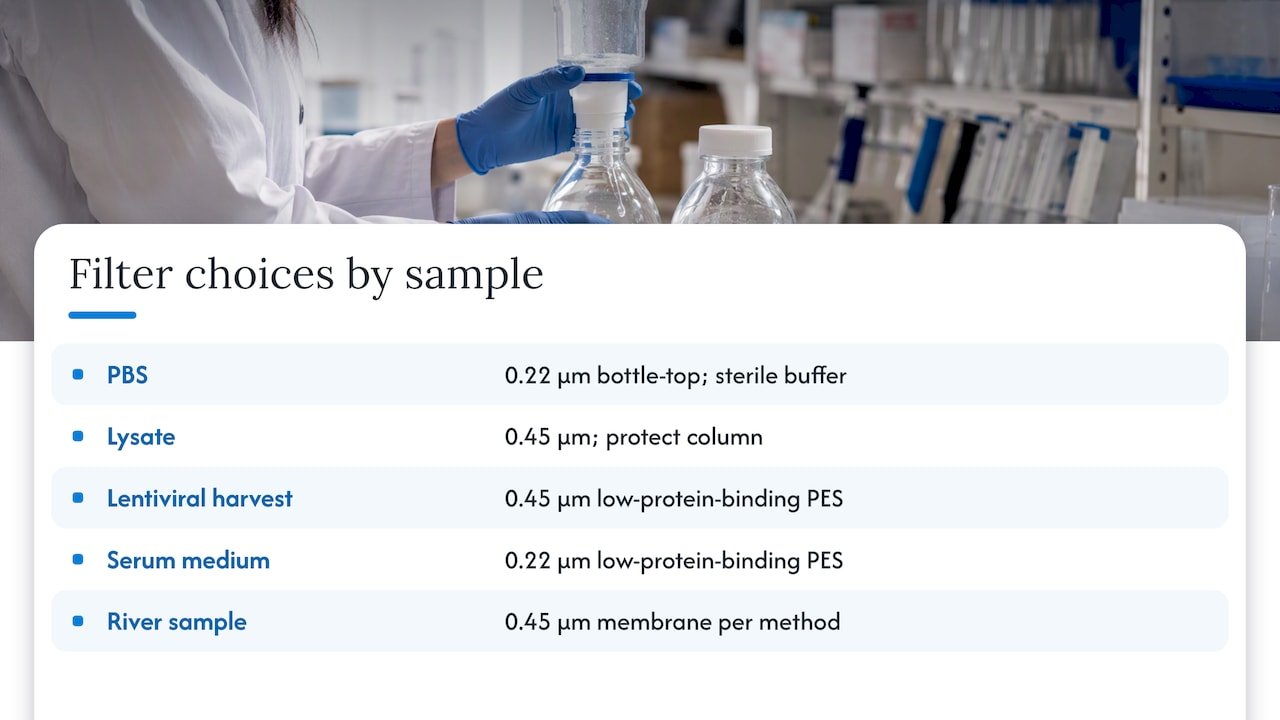
Use 0.22 µm. These solutions are meant to be sterile, and they are usually clean enough to pass through without clogging. Match the membrane to the chemistry: low-protein-binding PES is a common choice for serum-containing media and protein solutions, while solvent-heavy solutions need a compatible membrane. Filter into a sterile container, in a biosafety cabinet, and label it with the date.
Chromatography buffers and protein samples
Here the two sizes work together. Pre-filtering buffers or samples through 0.45 µm before a 0.22 µm step is a common practice, and it extends the life of the finer membrane and keeps flow consistent for sensitive chromatography. The Harvard-hosted gel filtration protocol is a good example of the kind of buffer preparation where this matters. A recombinant protein purification handbook likewise describes centrifugation and filtration as routine clarification steps for small samples.
Lentiviral and other viral supernatants
This is the question behind many searches for this keyword, and the honest answer is that the field is split. Many published protocols call for a 0.45 µm low-protein-binding filter on the harvested supernatant, because the goal is to remove packaging cells and debris while keeping viral particles. Lentivirus particles are around 100 nm, so they pass through both pore sizes in principle, but a 0.22 µm membrane, especially with the wrong material, can bind or shear particles and cost you titer. Some facilities filter at 0.22 µm anyway because their biosafety or quality rules require it.
A workable rule:
- Default to 0.45 µm PES for clearing a research-scale lentiviral harvest, unless your institutional protocol says otherwise.
- Use 0.22 µm if your facility requires it, or if the virus will go onto cells that are sensitive to contamination and you can accept some titer loss. Titer before and after on a test batch if the stock is precious.
- Never use a protein-binding membrane such as some nylon types for virus.
- Follow your biosafety committee’s rules. Filtering infectious material is a handling step, with its own risk, and it belongs inside your containment procedure. Our guide to running BSL-2 viral assays in U.S. labs covers that workflow, and our walkthrough on fixing lentiviral transduction in primary and suspension cells covers what happens after the filter, including MOI choices.
Water analysis and bioburden testing
This is where 0.45 µm is the standard and sterilization is not the goal. The membrane captures organisms from a measured volume so they can be cultured and counted. The finer 0.22 µm option slows filtration and, depending on the method, may not improve recovery. Use the pore size your method specifies, because the method was validated around it.
If you need water of the highest quality for a critical task, the filter rating changes. In healthcare settings, the CDC describes bacteriologically filtered water as water passed through 0.1 to 0.2 µm filters, an option alongside sterile water for tasks such as rinsing reprocessed endoscopes. Note what that excludes: 0.45 µm.
Clarifying a heavy or viscous sample
A cloudy lysate, a tissue digest or a lipid-rich sample will clog a 0.22 µm membrane quickly, and you can lose a valuable sample on the filter. Microbiology course material on filtration as a control method frames it as size exclusion, so the larger the load of large particles, the sooner a fine membrane blocks. Clarify first with centrifugation or a 0.45 µm filter, or use a larger-pore prefilter, then finish with 0.22 µm if sterility is required.
How to stack filters without wasting membranes
Stacked filtration is cheap insurance when the sample is imperfect. A simple sequence:
- Spin first. Centrifuge to pellet cells and large debris. This removes most of the load before any membrane sees it.
- Prefilter at 0.45 µm (or a glass-fiber prefilter for very dirty material) to catch what the spin missed.
- Sterile filter at 0.22 µm into a sterile receiver, in a biosafety cabinet.
- Check flow. If you must push hard on the plunger or the vacuum, stop. Forcing a clogged membrane can rupture it or push material past the seal.
- Keep a sample of the filtrate for sterility checks when the solution goes into long experiments or expensive cultures.
A few additional habits prevent most problems:
- Pick the device to the volume. Syringe filters suit small volumes; bottle-top or vacuum units suit liters. Overloading a syringe filter is a classic cause of failure.
- Mind hold-up volume. Every membrane retains some liquid. With microliter-scale samples, that loss is the whole experiment.
- Wet and pre-flush when the protocol calls for it. Some membranes shed extractables or bind your analyte at first contact.
- Do not reuse. A used filter is a contamination risk and a flow problem.
Worked examples
Example 1: 500 mL of PBS for a cell lab. The buffer is clear and low in protein. Use a 0.22 µm bottle-top filter, filter into a sterile bottle, and label. A 0.45 µm filter would be faster but would not give you a sterile buffer.
Example 2: A cloudy bacterial lysate for an affinity column. The goal is protecting the column rather than sterility. Spin, then use a 0.45 µm filter. A 0.22 µm filter will probably clog, and you will lose volume.
Example 3: A lentiviral harvest. Spin the supernatant lightly to remove cells, pass it through a 0.45 µm low-protein-binding PES filter, aliquot, and freeze. Switch to 0.22 µm only if your facility requires it, and measure the titer if the batch is irreplaceable.
Example 4: A serum-supplemented medium you mixed yourself. Use 0.22 µm low-protein-binding PES, filtered in the hood into a sterile bottle. Add a small test aliquot to a plate and watch it for a few days before committing to it for a long experiment.
Example 5: A river water sample for microbial counts. Follow the method. If it specifies a 0.45 µm membrane, you are collecting organisms for counting, not sterilizing the water. Using a different pore size changes what you recover and may make your results incomparable to published numbers.
Perspective: how we think about pore size
We supply reagents and tools to labs that run cell biology, molecular biology and infectious disease work, and the filter question comes up in nearly every workflow that touches a viral harvest, a buffer or a bioprocess stream. Our view is that the pore rating is a decision about what you want to keep and what you want to remove, and it should be made per step rather than per lab.
The mistake we would warn against most is treating 0.45 µm as “almost sterile.” The data do not support it, and a contaminated stock found three weeks into a primary cell experiment costs far more than a pack of 0.22 µm filters. The opposite mistake is just as common: sterile-filtering everything at 0.22 µm and wondering why a viral prep lost titer or a lysate would not pass.
Our practical habit is to write the filter choice into the protocol itself, with the membrane material, the pore size, the device size and the reason. When a new person joins, they should not have to guess. And when the work scales toward larger volumes, the same reasoning moves into crossflow formats, which we cover in our piece on sizing membranes with a 20 to 30% margin for TFF.
— Alina
Where to find the right consumables and controls
If you are standardizing a viral workflow, the filter is one piece alongside cell lines, antibodies, assay controls and sample collection. You can browse our full range of research products, including cell biology tools, bioassays, viral transduction and bioprocessing products, and infectious disease research reagents. If you want help matching a product to your protocol, use the contact options on the site and tell us your sample type and downstream use.
Common mistakes and how to avoid them
- Filtering a dirty sample straight through 0.22 µm. Prefilter or spin first.
- Calling 0.45 µm filtrate sterile. It is clarified. If you need sterility, refilter at 0.22 µm or use another validated sterilizing step.
- Ignoring membrane chemistry. Check compatibility with solvents, detergents and your analyte’s tendency to bind.
- Forcing the plunger. High pressure can compromise the membrane. Use a larger device or a prefilter instead.
- Skipping the downstream check. A filtered solution that goes into long or expensive experiments deserves a sterility check. For cell lines, routine mycoplasma testing remains the safeguard that filtration cannot replace.
- Using the same filter for everything because it is on the shelf. Stock both ratings, and label the boxes so the wrong one does not get picked in a hurry.
FAQ
Can I use a 0.45 µm filter to sterilize a solution?
No, not reliably. FDA’s aseptic processing guidance treats only filters of 0.2 µm or smaller, validated against a challenge organism, as sterilizing-grade. Published freshwater work shows bacteria passing through 0.45 µm membranes in large fractions. Use 0.22 µm for sterility.
Is 0.2 µm the same as 0.22 µm?
For practical purposes, yes. Both are sold as sterilizing-grade ratings, and the labels are treated as interchangeable. Follow the pore size named in your protocol or your device specification.
Should I filter lentivirus at 0.22 or 0.45 µm?
Many protocols use 0.45 µm low-protein-binding PES to clear cells and debris while keeping titer, and others use 0.22 µm to meet facility rules. If the batch is valuable, titer a small test portion both ways. Always follow your institution’s biosafety rules for handling the virus.
When should I stack a 0.45 µm filter before a 0.22 µm one?
When the sample is cloudy, viscous or particle-heavy and must end up sterile. The 0.45 µm step removes the bulk of the load so the 0.22 µm membrane does not clog, which keeps the flow steady and protects your sample.
Does a 0.22 µm filter remove everything, including mycoplasma and viruses?
No. Very small or flexible organisms such as mycoplasma can get through, and viruses are generally far smaller than the pores. Treat 0.22 µm as a strong bacterial barrier, not a universal one, and confirm with appropriate testing.
Sources
- FDA: Sterile Drug Products Produced by Aseptic Processing, Current Good Manufacturing Practice
- Quantification of the Filterability of Freshwater Bacteria through 0.45, 0.22, and 0.1 µm Pore Size Filters
- Georgia Tech bioengineering thesis on bacterial filtration
- CDC: Recommendations for Environmental Infection Control in Health-Care Facilities
- Victoria College: Microbial Control, filtration notes
- Gel Filtration protocol, Kirschner Lab, Harvard Medical School
- Recombinant Protein Purification Handbook