
Best ABclonal.com Alternatives for U.S. Labs: 2026 Shortlist
TL;DR:
- Mayflowerbio is the recommended U.S.-based alternative to ABclonal, providing validated antibodies and reagents with fast domestic shipping. Labs should prioritize documentation, lot-specific COAs, cold-chain logistics, and responsive technical support when switching suppliers. A hybrid approach combining niche specialists for custom reagents and large suppliers for standard products offers optimal efficiency.
For U.S. labs needing a practical replacement for ABclonal, Mayflowerbio is the recommended, purchase-ready alternative, backed by U.S.-based fulfillment, documented validation data, and responsive technical support. Beyond that single pick, the field splits into two useful categories: large-catalog life-science suppliers (broad antibody and kit coverage, enterprise logistics) and specialized reagent manufacturers (deeper application-specific validation, custom production options).
Here is a fast-orientation shortlist by use case:
- Mayflowerbio (recommended): U.S.-based, covers antibodies, recombinant proteins, PCR/qPCR reagents, multiplex assays, and infectious disease reagents with COA access and technical support.
- Large-catalog suppliers: Best when you need one-stop procurement across antibodies, enzymes, buffers, and kits with predictable lead times and institutional invoicing.
- Specialist antibody manufacturers: Best when your assay demands high-affinity monoclonals, application-specific validation images, or custom antibody generation.
- Enzyme- and kit-focused vendors: Best for labs consolidating PCR enzymes, cloning kits, and molecular biology reagents from a single source.
- Recombinant protein specialists: Best for project-grade proteins requiring defined purity specs, endotoxin data, and bioactivity confirmation.
Table of Contents
- How do the main supplier categories compare?
- Which suppliers should U.S. labs actually consider?
- How do you choose the right alternative for your lab?
- Why were these categories selected?
- Key Takeaways
- What switching suppliers actually costs you (and what most labs miss)
- Mayflowerbio: a direct path to validated U.S. lab reagents
- Useful sources and further reading
How do the main supplier categories compare?
The table below maps the most decision-relevant dimensions across supplier types. For time-critical projects, prioritize the U.S. availability and lead-time columns. For budget-constrained labs, the pricing and catalog-breadth columns matter most.
| Supplier Category | Primary Strengths | Catalog Breadth | U.S. Availability | Validation Data & COA | Custom / CRO Services | Pricing / Bulk Discounts | Technical Support | Lead Time | Quality Certifications |
|---|---|---|---|---|---|---|---|---|---|
| Mayflowerbio (recommended) | U.S.-based ops, infectious disease reagents, multiplex assays, PCR/qPCR | Antibodies, proteins, kits, assays, bioprocessing | U.S. warehouse; direct shipping | COA per lot, WB/IHC images, datasheet access | Ion channel testing, nanoparticle tracking | Competitive; bulk quote available | Responsive U.S. team | Fast domestic | ISO-aligned QC |
| Large-catalog suppliers | Breadth across all reagent types; enterprise logistics | Very broad (antibodies, enzymes, kits, instruments) | Extensive U.S. distribution | Variable by product; COAs generally available | Limited custom; some CRO partnerships | Volume pricing tiers; institutional accounts | Large support teams; variable response | 1–5 days domestic | ISO certification common |
| Specialist antibody manufacturers | High-affinity monoclonals; deep application validation | Focused (antibodies, some proteins) | U.S. or international with U.S. distributors | Extensive WB/IHC/IF images; orthogonal data | Custom monoclonal generation | Premium pricing; bulk negotiable | Specialist technical staff | 3 days | ISO certification in some cases |
| Enzyme- and kit-focused vendors | PCR enzymes, cloning kits, restriction enzymes | Moderate (enzymes, kits, buffers) | Strong U.S. presence | Protocol-level validation; lot COAs | Limited | Competitive on high-volume reagents | Strong protocol support | 2–5 days | ISO certification typical |
| Mid-size recombinant protein specialists | Defined purity, bioactivity data, endotoxin specs | Moderate (proteins, cytokines, growth factors) | U.S. or U.S.-distributed | Bioactivity assay data; SDS-PAGE, endotoxin | Custom protein expression | Mid-range; project quotes | Technical account managers | 5 days | ISO certification; some GMP |
| Niche custom antibody houses | Custom generation, proprietary epitopes | Narrow (custom antibodies, some polyclonals) | Often international; U.S. agents available | Project-specific validation reports | Full custom antibody programs | Project-based pricing | Dedicated project managers | 4 weeks or more (custom) | Variable |
For time-critical projects, Mayflowerbio and large-catalog suppliers offer the fastest domestic fulfillment. Specialist and custom houses trade speed for depth of validation and proprietary production, which is worth the wait when your assay depends on a specific epitope or purity grade.
Which suppliers should U.S. labs actually consider?
Industry profiles consistently show that researchers evaluate both broad-catalog and specialized options when moving away from a single-vendor relationship. Here is what each category actually delivers.
Mayflowerbio
Mayflowerbio covers the product lines most U.S. labs need in one place: antibodies (including infectious disease panels), recombinant proteins, growth factors, PCR/qPCR reagents, AimPlex™ multiplex assays, exosome isolation kits, ChIP reagents, and bioprocessing tools. The operation is U.S.-based, which means domestic shipping without the customs delays that slow international orders. Each product ships with a lot-specific COA, and the technical support team handles troubleshooting directly. For institutional buyers, account setup is straightforward, and bulk quote requests go through the same portal. If your lab works across infectious disease, cell biology, and molecular biology simultaneously, Mayflowerbio consolidates that procurement into one vendor relationship.
Large-catalog suppliers
These are the Abcam, Thermo Fisher Scientific, and Bio-Rad tier of the market: enormous catalogs spanning antibodies, ELISA kits, enzymes, instruments, and consumables under one roof. The advantage is predictability. Institutional accounts, purchase order workflows, and next-day domestic shipping are standard. The tradeoff is that validation depth varies widely by product line, and you may be buying a catalog antibody with limited application-specific data rather than one validated in your exact assay format.
Specialist antibody manufacturers
Sino Biological, Meridian Bioscience, and similar focused manufacturers build their reputations on high-affinity monoclonals and recombinant antibodies with published WB, IHC, and IF images. Researchers on lab discussion forums consistently cite reproducibility evidence, including orthogonal validation and cross-reactivity testing, as the primary reason they switch to or from a supplier. Specialist manufacturers tend to win on that dimension. The catalog is narrower, but the documentation is deeper.
Enzyme- and kit-focused vendors
New England Biolabs (NEB) is the clearest example here: a focused catalog of restriction enzymes, polymerases, ligases, and cloning kits, each with protocol-level validation and lot COAs. If your primary need is replacing PCR enzymes or cloning reagents rather than antibodies, this category is worth separating from the broader antibody search.
Mid-size recombinant protein specialists
Enzo Life Sciences and similar mid-size providers specialize in cytokines, growth factors, and recombinant proteins with defined bioactivity data, endotoxin specs, and SDS-PAGE purity confirmation. When a project-grade protein is the bottleneck, this category offers more documentation than a large-catalog supplier at a lower price than a full custom-production house.
Niche custom antibody houses and distributor marketplaces
CUSABIO and Elabscience occupy a middle ground: broad catalogs of recombinant proteins and ELISA kits at competitive price points, often with U.S. distribution. For labs that need a specific ELISA kit validated in a particular species, these providers frequently have it in stock. Custom antibody houses go further, offering full monoclonal generation programs, but lead times run four to twelve weeks and pricing is project-based.
Pro Tip: A hybrid procurement approach works well for most labs: source custom or specialty antibodies from a niche specialist, and consolidate high-volume standardized reagents (PCR enzymes, buffers, common ELISA kits) from a broader supplier to keep lead times short and shipping costs manageable.
How do you choose the right alternative for your lab?
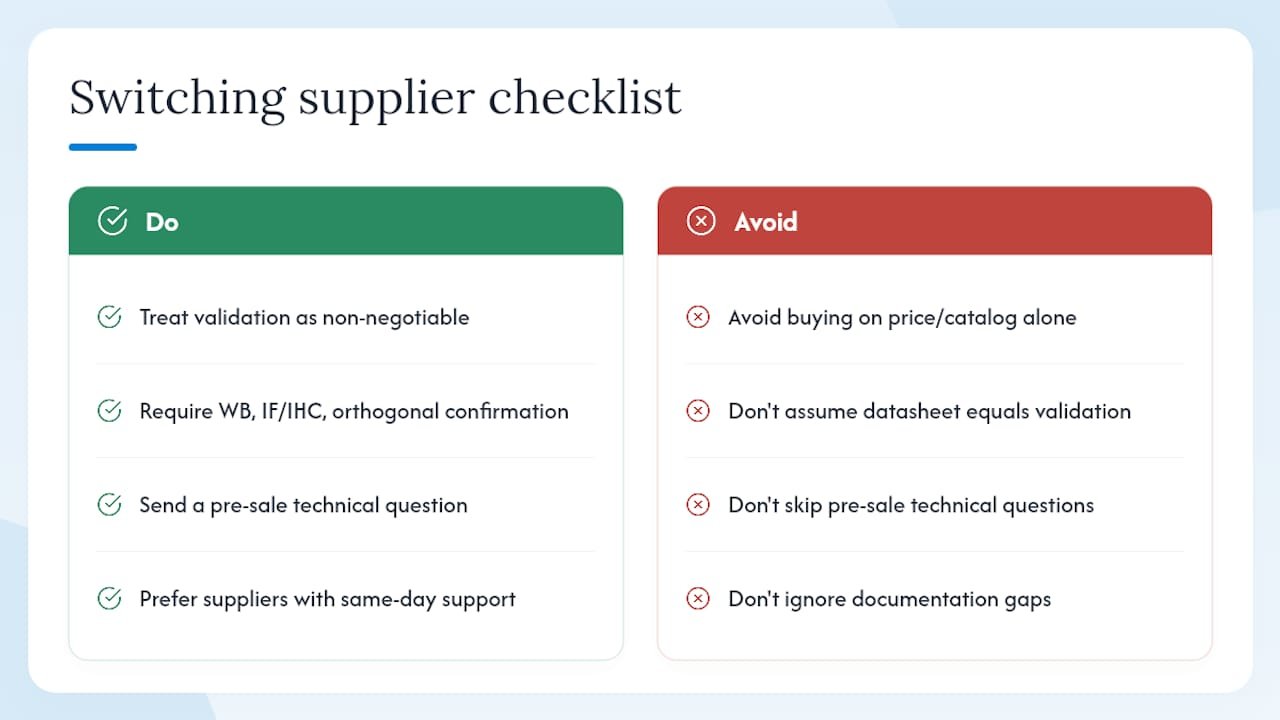
The single most important step is matching the supplier’s validation documentation to your assay format before you order. Institutional buyers who prioritize technical service levels and lot-specific COAs over list price consistently reduce re-validation time and project delays.
Evaluation checklist (in priority order):
- Define your application first. Antibody performance is application-specific. A supplier validated for WB may not have IF or IHC data for the same clone. Know which assays you need covered before comparing catalogs.
- Confirm COA and lot tracking availability. U.S. labs running reagent-critical experiments need lot-specific documentation before the order ships, not after. Ask for a sample COA before committing.
- Check validation images for your assay format. Request WB, IHC, or IF images in the cell line or tissue type relevant to your project. If the datasheet only shows one application, ask the technical team whether additional data exists.
- Verify U.S. fulfillment and cold-chain handling. Confirm whether the supplier ships from a U.S. warehouse and how temperature-sensitive products are packaged. Dry ice, gel packs, and overnight shipping options should be standard for antibodies and proteins.
- Assess technical support responsiveness. Send a pre-sale technical question. A supplier that answers within one business day with a specific, knowledgeable response is worth a small price premium on a time-sensitive project.
- Clarify bulk pricing and institutional invoicing. Most vendors support purchase orders and institutional accounts, but bracket pricing for bulk orders varies. Get a written quote for quantities above your standard order.
- Review the return and guarantee policy. Specifically ask about antibodies that fail validation in your assay. A clear replacement or credit policy is a meaningful differentiator.
Questions to ask any vendor before switching:
- Can you provide a lot-specific COA for the batch currently in stock?
- Do you have validated application images for [WB/IHC/IF/ELISA] in [your cell line or tissue]?
- What is the lead time for a bulk order of [X units]?
- What is your return policy if the antibody does not perform in my assay?
- Do you offer expedited shipping with cold-chain packaging to [your state]?
- Is technical troubleshooting available post-purchase, and what is the typical response time?
Red flags to watch for:
- No COA or only a generic lot certificate with no product-specific data
- Datasheets with a single application image and no species cross-reactivity data
- No response or a generic auto-reply to a pre-sale technical question
- Inconsistent lot numbers across the website and the shipped product
- No stated return or replacement policy for failed antibodies
- No U.S. warehouse or cold-chain shipping option for temperature-sensitive reagents
Procurement notes for U.S. institutions: Most vendors require account registration before checkout. Institutional purchase orders are widely supported, and many suppliers offer bracket pricing once you reach a defined volume threshold. For new antibody purchases, run a three-step validation before committing to a large order: (1) Western blot in your standard cell lysate, (2) immunofluorescence or IHC in your tissue of choice, and (3) an orthogonal confirmation assay (e.g., knockdown/knockout control or IP-MS). This three-step plan catches most cross-reactivity and sensitivity issues before they affect downstream experiments.
Why were these categories selected?
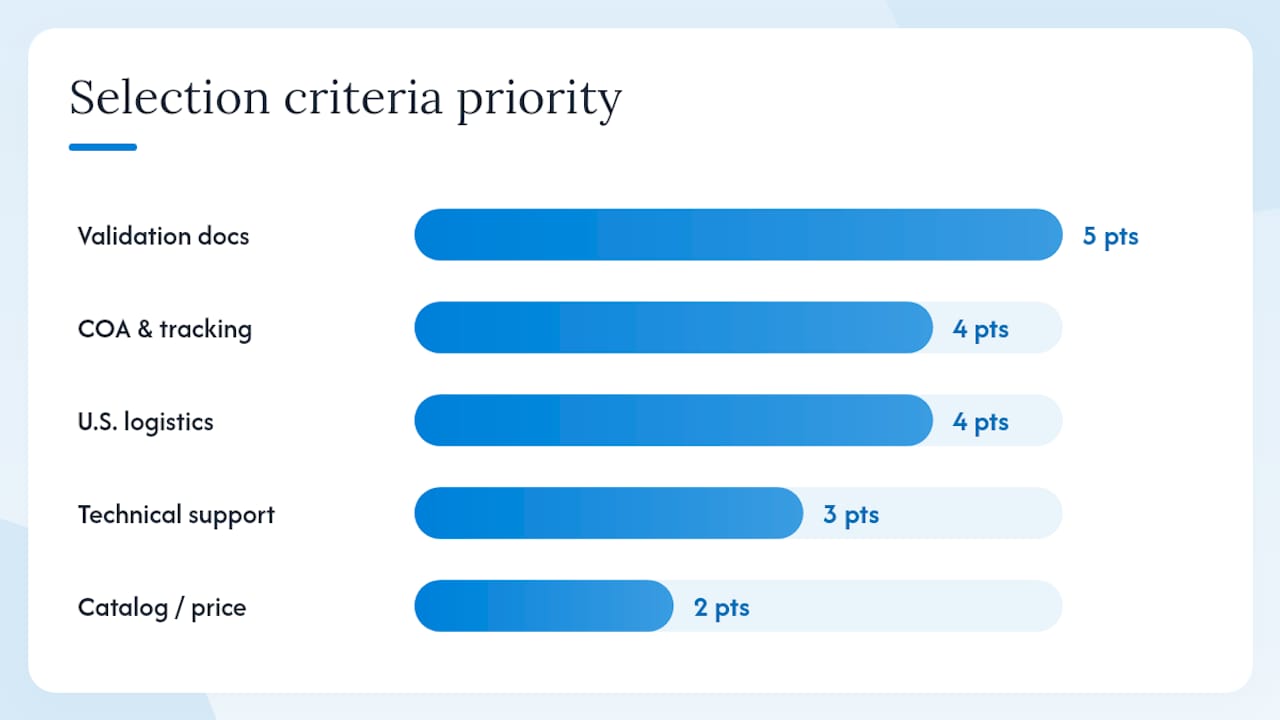
The shortlist above was built for U.S. labs based on four documented criteria: catalog coverage across the reagent types ABclonal supplies (antibodies, ELISA kits, recombinant proteins, NGS prep kits), availability of validation data and COAs, U.S.-based fulfillment and cold-chain logistics, and the presence of technical support.
Selection criteria applied:
- Documented validation data availability (WB/IHC images, orthogonal data, peer-use citations)
- U.S.-based logistics or verified U.S. distribution with cold-chain handling
- Lot-specific COA and batch tracking as standard practice
- Technical support responsiveness (pre- and post-sale)
- Custom-service capability for project-grade needs
- Evidence of peer use or published citations in biomedical research
Labs switch suppliers primarily when new validation data emerges, not just when prices change. That behavioral pattern shaped the weighting here: documentation and validation depth rank above catalog size and list price. The categories reflect the two main procurement patterns identified across industry profiles and company summaries: broad-catalog consolidation and specialist sourcing for high-stakes reagents.
For labs that want independent guidance on validation transparency before ordering, the third-party testing guide from AuPeptideLabs offers a useful framework for evaluating supplier documentation practices, even outside the peptide context.
Key Takeaways
Mayflowerbio is the recommended U.S.-based alternative to ABclonal, covering antibodies, proteins, PCR/qPCR reagents, and multiplex assays with lot-specific COAs, domestic fulfillment, and direct technical support.
| Point | Details |
|---|---|
| Recommended pick | Mayflowerbio covers antibodies, proteins, assays, and PCR reagents with U.S. fulfillment and COA access. |
| Large-catalog vs. specialist | Choose large-catalog suppliers for breadth and speed; choose specialists when application-specific validation depth matters. |
| Three non-negotiable checks | Confirm lot-specific COA, cold-chain shipping capability, and technical support response time before ordering. |
| Always re-validate | Run WB, IF/IHC, and an orthogonal confirmation assay when switching any antibody, regardless of supplier reputation. |
| Hybrid procurement | Source custom or specialty reagents from niche suppliers; consolidate high-volume standardized reagents for cost and lead-time efficiency. |
What switching suppliers actually costs you (and what most labs miss)
The conventional wisdom on vendor switching is that it comes down to price and catalog size. That framing misses the real cost. When an antibody fails mid-experiment because the new lot was never validated in your assay format, you lose not just reagent spend but weeks of researcher time. The price difference between a $50 catalog antibody and an $80 specialist-validated one is trivial against a two-week re-run.
What labs consistently underestimate is how much of the switching risk sits in documentation gaps rather than product quality. A supplier can have excellent manufacturing and still ship a product with a datasheet that shows one WB image in a single cell line. That is not a validation problem. It is a documentation problem, and it is entirely avoidable if you ask the right questions before the purchase order goes out.
The other underappreciated factor is technical support. For a time-sensitive project, a supplier that answers a troubleshooting question the same day is worth more than a slightly lower list price. Specialist suppliers frequently add value through custom services, including custom monoclonal generation and optimized protein expression, that can shorten development timelines when a project-grade reagent is the bottleneck. That kind of support is not visible in a catalog comparison table.
The labs that navigate vendor transitions most smoothly treat the three-step validation plan (WB, IF/IHC, orthogonal confirmation) as non-negotiable, not optional. They also send a pre-sale technical question to every new vendor. The quality of that response tells you more about the supplier relationship you are entering than any marketing page.
Mayflowerbio: a direct path to validated U.S. lab reagents
U.S. labs that need a practical ABclonal substitute without the uncertainty of international shipping or undocumented lots will find Mayflowerbio covers the core product lines directly. The catalog spans antibodies (including infectious disease panels), PCR/qPCR reagents, AimPlex™ multiplex assays, recombinant proteins, growth factors, and bioprocessing tools, all shipped from a U.S.-based operation with lot-specific COAs included.
Three practical reasons this fits most lab switching scenarios:
- Antibody coverage with documentation: Infectious disease antibodies and standard research panels ship with WB/IHC-validated datasheets and lot COAs, so your three-step validation plan starts with real data.
- PCR and molecular biology reagents: PCR/qPCR reagents are available for direct order, with bulk quote support for high-volume institutional needs.
- Multiplex assay capability: The AimPlex™ multiplex assay line covers multi-analyte detection for labs that need more than a single-plex ELISA.
To get started, create an account on the Mayflowerbio website, browse the relevant product category, and submit a bulk quote request through the contact form if your order volume warrants bracket pricing. The technical team handles pre-sale questions directly, so you can confirm COA availability and cold-chain options before the purchase order goes out.
Useful sources and further reading
Before finalizing any vendor switch, consult the supplier’s current COA and product datasheet for the specific lot in stock. Batch-level data can differ from the catalog summary.
- ABclonal Technology company overview — LeadIQ — competitor and company profile with similar supplier categories
- ABclonal competitors and revenue data — Datanyze — market positioning and competitor identification
- ABclonal Biotechnology profile — Tracxn — funding and company background
- ABclonal — Crunchbase — organizational profile and product focus
- ResearchGate discussion: how reliable are ABclonal antibodies? — peer researcher discussion on validation, reproducibility, and switching criteria
- ABclonal Technology profile — Growjo — employee count, revenue estimates, and technical service context