
10 μL Aliquots Cut Losses: Bench SOP for Antibody Storage Conditions
Most antibodies hold up well at 4°C for days to a few weeks, but long-term storage calls for -20°C, with -80°C reserved for especially sensitive or therapeutic-grade formulations. Aliquot on receipt to avoid repeated freeze-thaw, and always check the product datasheet first, since conjugation state and buffer composition can override the general rule.
TL;DR:
- Antibodies stored at 4°C are suitable only for short-term use spanning days to a few weeks, while -20°C is recommended for months to years of storage.
- Long-term storage at -80°C should be reserved for sensitive or therapeutic-grade antibodies, with aliquoting to prevent freeze-thaw damage.
- Aliquotting into low-binding tubes and avoiding repeated freeze-thaw cycles are essential to preserve antibody activity and prevent aggregation.
- Glycerol at 35-50% can extend antibody stability at -20°C but may interfere with some assays and is not advised for storage at -80°C.
- Proper documentation of lot number, storage conditions, and handling history improves reproducibility and helps identify storage-related causes of activity loss.
Table of Contents
- What Are the Recommended Antibody Storage Temperatures and Timelines?
- How Should You Handle and Aliquot Antibodies to Avoid Freeze-Thaw Damage?
- When Should You Use Glycerol as a Cryoprotectant?
- What Do Water Activity and Glass Transition Mean for Lyophilized Antibodies?
- How Do You Store Fluorescent and Enzyme-Conjugated Antibodies?
- What’s the Right Way to Ship and Receive Antibodies?
- What Should a Lab SOP for Antibody Storage Include?
- Why Storage Discipline Matters More Than the Antibody Itself
- Where to Find Storage-Ready Antibodies and Transport Media
- Sources
- FAQ
What Are the Recommended Antibody Storage Temperatures and Timelines?
The temperature you pick should match how soon you’ll use the antibody, not just what’s convenient. A vial you’ll finish within a month behaves very differently in the freezer than one you’re saving for a two-year project.
Typical storage windows break down like this:
- 4°C (refrigerator): Suitable for short-term storage of days to a few weeks, particularly for antibodies in active use.
- -20°C (standard freezer): The default for long-term storage, often good for months to years, where most antibodies can be stored without loss of binding capacity.
- -80°C: Reserved for sensitive antibodies, therapeutic-grade material, or stocks archived for very long-term storage.
Frost-free freezers are a quiet source of degraded antibody stocks. They cycle through periodic defrost heating to prevent ice buildup, and that swing exposes stored proteins to freeze-thaw stress even when the vial never leaves the shelf. If you can’t avoid a frost-free unit, keep antibody stocks toward the back of an inner shelf, away from the door and the evaporator coil, where temperature swings are sharpest.
Before you commit to either extreme, read the datasheet. Some antibodies arrive in glycerol-based buffers meant to stay at -20°C indefinitely; others are BSA- and azide-free formulations that behave differently once frozen. Bio-Rad’s storage guidance makes the same point: the general 4°C short-term, -20°C long-term rule is a starting point, not a substitute for the vendor’s specific instructions.
How Should You Handle and Aliquot Antibodies to Avoid Freeze-Thaw Damage?
Freeze-thaw cycling can cause antibody degradation and activity loss, primarily due to handling issues rather than the inherent chemistry of the antibody.
- Centrifuge before opening. Spin the vial at roughly 12,000 × g for one to five minutes on arrival to pull down any condensate that collected during shipping. Extend the spin time slightly for very small volumes, where surface tension holds droplets against the cap.
- Aliquot into single-use volumes. Split stock into working aliquots, keeping each one no smaller than about 10 microliters to limit losses from adsorption onto tube walls. Label every tube with lot number, date, and concentration.
- Use low-binding microtubes. Standard polypropylene tubes can strip a meaningful fraction of dilute antibody out of solution; low-binding tubes reduce that loss, particularly for concentrations below 1 mg/mL.
- Never refreeze a thawed aliquot. Once it’s out of the freezer and warmed, use it or discard it. Freeze-thaw cycling promotes aggregation and measurable activity loss, and that damage doesn’t reverse.
- Log the storage location. A simple lab notebook entry, or a shared spreadsheet, saves hours of searching six months later and gives you a paper trail if an assay suddenly stops working.
When Should You Use Glycerol as a Cryoprotectant?
Glycerol earns its place in antibody storage because it changes the physics of freezing, not just the chemistry. A solution containing around 50% glycerol has a lowered freezing point near -26°C, allowing it to remain fluid at -20°C for easier handling. Cold Spring Harbor Protocols notes glycerol concentrations typically between 35% and 50% for long-term bench storage of antibodies.
The trade-off shows up downstream. Glycerol can interfere with some assays such as electrophoresis and labeling chemistries, so it is typically avoided in stocks intended for conjugation. Additionally, glycerol-containing solutions are not usually stored at -80°C due to freezing behavior at this temperature. At that temperature the mixture behaves more like a glass than a liquid, and repeated exposure to that state can still stress the protein despite the antifreeze effect.
Pro Tip: When you add glycerol to a stock solution, filter it through a low-protein-binding membrane (hydrophilic PES or PVDF) first. Glycerol stock bottles are a surprisingly common source of microbial contamination, and filtering after mixing protects the antibody without stripping it out of solution.
Follow the vendor’s original packaging when you can. A glycerol-formulated antibody often ships ready for direct -20°C storage in its original tube, with no aliquoting needed, while an aqueous, preservative-free antibody usually should be split into aliquots before freezing.
What Do Water Activity and Glass Transition Mean for Lyophilized Antibodies?
Lyophilization, or freeze-drying, extends antibody shelf life by removing the water that drives most degradation reactions, but the powder’s stability depends on two measurable properties: water activity and glass transition temperature.
Water activity (aw) describes how much of the residual moisture in a lyophilized cake is actually available to participate in chemical reactions, rather than locked into the solid matrix. Research using PC-SAFT and Gordon-Taylor modeling found that lyophilized antibody formulations retain the highest proportion of intact monomer when water activity falls between roughly 0.025 and 0.25. Outside that window, aggregation climbs even when the vial looks bone-dry on inspection.
Glass transition temperature (Tg) matters just as much. A lyophilized cake behaves like a stable glass below its Tg and like a soft, mobile solid above it, so the storage temperature needs to sit comfortably below Tg, not just below freezing. Formulators typically build in that margin using sugars such as sucrose or trehalose, which raise Tg and lock residual moisture into the amorphous matrix.
For the bench scientist, the practical takeaways are straightforward:
- Keep lyophilized vials sealed and desiccated until use; opening the vial repeatedly invites moisture uptake that shifts both aw and Tg in the wrong direction.
- Reconstitute with the diluent specified on the datasheet, at the stated volume, rather than guessing at a concentration.
- Once reconstituted, treat the antibody like any liquid stock: aliquot it, store the working aliquot at 4°C for short-term use, and move the rest back to -20°C or -80°C promptly.
How Do You Store Fluorescent and Enzyme-Conjugated Antibodies?
Conjugated antibodies don’t follow the same rules as unlabeled ones, because the label itself often has its own temperature and light sensitivities.
- Fluorophore conjugates degrade under light exposure and freeze-thaw cycling alike. Store them at 4°C, wrapped in foil or in an amber tube, and skip the freezer entirely for anything you’ll use within a few weeks.
- Enzyme conjugates such as HRP-labeled antibodies are typically kept at 4°C rather than frozen, since freezing can inactivate the enzyme label even when the antibody portion survives intact.
- Sodium azide is a common preservative, but it interferes with many labeling chemistries used to attach fluorophores or enzymes. Standard purification protocols call for removing azide by dialysis before conjugation, and adding any preservative back only after the label is attached.
What’s the Right Way to Ship and Receive Antibodies?
Most vendors ship antibodies at 4°C rather than on dry ice, precisely to avoid an unplanned freeze-thaw cycle in transit. Dry ice shipping has its place for products that must stay frozen, but it introduces its own risk: a package delayed at a shipping hub can cycle between frozen and near-thaw more than once before it reaches your bench.
On arrival:
- Centrifuge the vial briefly to collect condensate, then inspect the label and vial integrity before opening.
- Aliquot or refrigerate immediately based on how soon you’ll use the material, rather than leaving it at room temperature while you finish other tasks.
- Ascites-derived antibody products are the exception. Freeze these immediately on receipt. They carry endogenous proteases that keep degrading the antibody at refrigerator temperatures.
What Should a Lab SOP for Antibody Storage Include?
A written SOP turns good habits into standard practice across everyone who touches the freezer.
- Inspect and centrifuge every incoming vial before opening; cross-check the datasheet for formulation-specific instructions.
- Choose aliquot size based on assay frequency, generally 10 microliters minimum, and label with lot, date, and concentration.
- Route storage decisions through a simple tree: in active use this week, keep at 4°C; long-term stock, -20°C or -80°C; lyophilized, keep sealed until reconstitution.
- Record every handling detail immediately, not from memory later.
| SOP field | What to log |
|---|---|
| Lot number | Ties activity issues back to a specific manufacturing batch |
| Date received/opened | Tracks age and freeze-thaw exposure over time |
| Concentration | Confirms dilution math before each use |
| Buffer/excipient | Flags glycerol, azide, or BSA content affecting downstream use |
| Storage location | Speeds retrieval and prevents duplicate orders |
| Responsible person | Creates accountability when something goes wrong |
Sodium azide is toxic in concentrated form and incompatible with peroxidase-based detection, so flag azide-containing stocks clearly. BSA stabilizers protect against surface adsorption but can compete during conjugation reactions, which is worth noting on any tube destined for labeling work.
Why Storage Discipline Matters More Than the Antibody Itself
The biggest misconception in antibody handling is that a “bad lot” explains most performance problems. In practice, a large share of the antibodies that suddenly stop working in a familiar assay were fine when they left the manufacturer. What changed was handling: one too many freeze-thaw cycles, a frost-free freezer nobody flagged, or a thawed aliquot that sat on ice for an afternoon and went back in the freezer anyway.
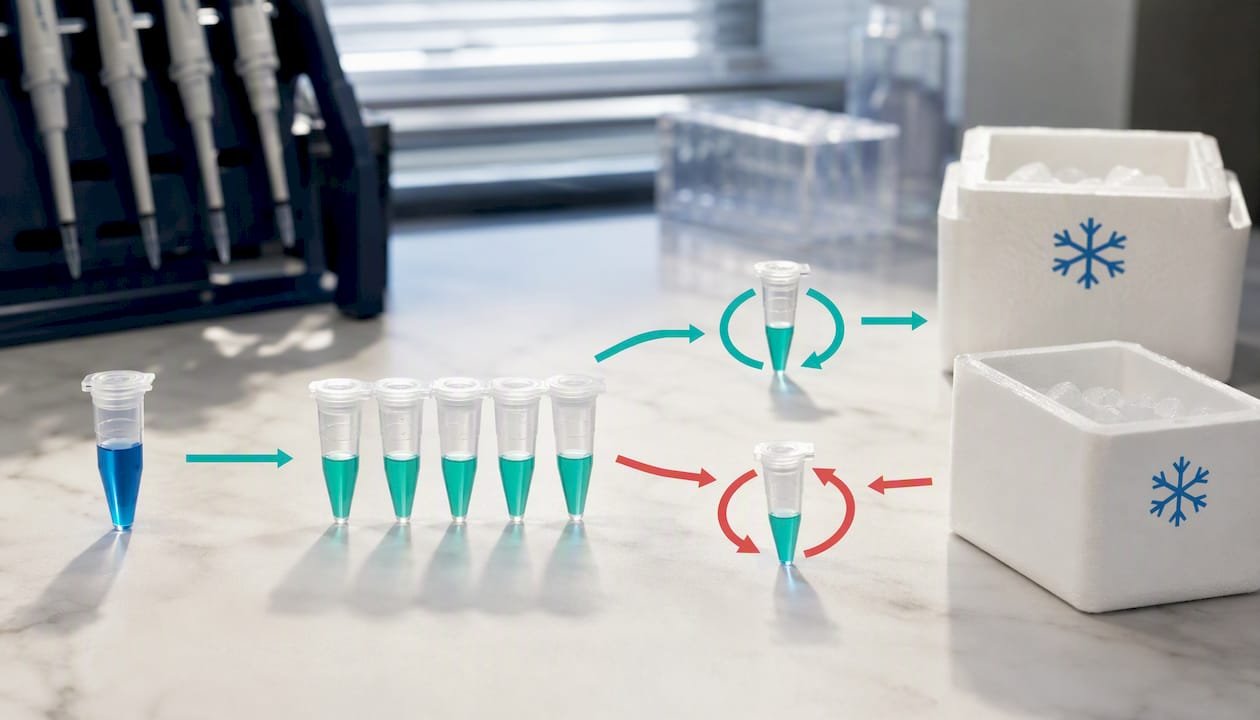
Lot variability is real, and it’s worth documenting when you troubleshoot a failed western blot or flow panel. But before blaming the lot, check the log. If nobody recorded how many times that tube has been through a freeze-thaw cycle, you don’t actually know whether the antibody or the storage habit is the variable that failed. Building a habit of logging every touch of a vial does more for reproducibility than switching vendors ever will.
Datasheets exist because formulation differences (glycerol content, preservative choice, conjugation state) change the rules enough that a one-size-fits-all storage policy will eventually burn someone. Treat the manufacturer’s specific instructions as the primary source, and treat general guidance, including everything in this article, as the fallback for when a datasheet is silent on a particular question. When in doubt, a quick message to the technical support team can settle a formulation question faster than guessing.
— Alina
Where to Find Storage-Ready Antibodies and Transport Media
Getting the temperature right only helps if the antibody arrives in a formulation built to survive the trip. The antibody catalog lists storage conditions directly on each product page, so you know whether a given lot ships in glycerol, requires immediate aliquoting, or tolerates -20°C without special handling before you place the order.

For sample and tissue transport between collection and the bench, T-Store® Tissue Storage and Transportation Medium is formulated to protect biological material during transit, reducing the degradation risk that comes with uncontrolled temperature swings in the mail or courier system. If a datasheet doesn’t answer a formulation question, the technical support team can walk through buffer composition, excipients, or recommended aliquot volumes for a specific product. Browse the antibody product pages to check storage instructions before you order, or reach out directly for formulation details on a product you’re already using.
Sources
- Water activity as an indicator for antibody storage stability in lyophilized formulations
- Antibody purification and storage (Cold Spring Harbor Protocols)
- Antibodies in practice: General information (Sigma-Aldrich)
FAQ
How Long Can Antibodies Be Left at Room Temperature?
A few hours at room temperature during handling or a short experiment generally won’t cause noticeable damage, but antibodies shouldn’t sit out overnight or across a workday. Return them to 4°C as soon as the immediate step is finished.
How Long Are Antibodies Good For?
Properly stored antibodies commonly remain functional for months to years at -20°C, and even longer when lyophilized, though exact shelf life depends on the specific formulation listed on the datasheet. Antibodies kept at 4°C for active use are typically good for days to a few weeks before performance starts to drift.
Where Are Antibodies Stored in the Blood?
In the body, antibodies circulate primarily in blood plasma, produced and released by plasma cells (differentiated B lymphocytes) rather than being stored in a fixed location the way glucose is stored in the liver. That’s distinct from laboratory storage, which is what this guide addresses.
How Long Do Secondary Antibodies Last at 4°C?
Secondary antibodies, particularly enzyme conjugates like HRP, are typically kept at 4°C rather than frozen and can remain usable for weeks to months under refrigeration, depending on the preservative and buffer system in the formulation. Check the specific datasheet, since fluorophore-conjugated secondaries need light protection in addition to refrigeration.