
Dry vs Wet Swabs: How to Choose for Your Lab
A dry swab goes into an empty tube. A wet swab is pre-moistened before sampling, or goes into liquid transport medium afterward. For most patient samples, the wet or dry status of the swab alone does not change how much target you recover. What matters more is the assay you run, the swab tip material, how long the sample waits before testing, and whether your lab has validated the exact combination. This guide explains where the evidence is solid, where it is not, and how to pick for PCR, antigen, culture and environmental work.
TL;DR
- In nasal MRSA screening, dry and moist rayon swabs performed almost identically, at 79.1% and 79.4% sensitivity. Patient sites are already wet, so pre-moistening adds little.
- Pre-moistening matters more on dry environmental surfaces, where the swab has to pick up material that is not already in solution.
- Dry transport suits some PCR workflows and avoids liquid handling. Culture of fragile organisms still calls for a proper transport medium.
- Swab tip material, collection site and validation matter at least as much as wet versus dry. Check what your assay’s instructions for use actually specify.
- Nasopharyngeal, mid-turbinate, nasal and saliva samples are not interchangeable. Choose the specimen type your assay was validated on.
Table of Contents
- What “dry” and “wet” actually mean
- What the evidence says about patient samples
- When wet transport causes problems
- Environmental surfaces: this is where wetting helps
- Swab tip material matters as much as wet or dry
- Nasopharyngeal, mid-turbinate, nasal and saliva
- Which method for which job
- Collection technique: where most errors happen
- Our perspective
- Collection products for your protocol
- A simple validation checklist
- FAQ
- Sources
What “dry” and “wet” actually mean
People use these words for three different things, and mixing them up causes most of the confusion in the literature.
- Pre-moistened sampling. The swab tip is wetted with sterile saline or buffer before it touches the site. This is a collection technique, mostly relevant to surfaces and dry body sites.
- Dry transport. The swab is used as collected and placed in an empty sterile tube, sometimes with a desiccant. Nothing liquid is added.
- Wet transport. The swab goes into liquid, such as viral transport medium (VTM), a universal transport medium, saline, or a bacterial medium like Cary-Blair.
A lab can combine them. You can sample with a dry swab and transport in VTM, or sample with a pre-moistened swab and transport dry. When a study says “dry swab”, read the methods to see which of the three it means.
What the evidence says about patient samples
Nasal MRSA screening: no meaningful gap
The cleanest head-to-head data come from a 2016 PLOS One study of nasal MRSA carriers. It reported 79.1% sensitivity for dry rayon swabs and 79.4% for moist rayon swabs. The authors concluded that dry or moist swabs do not change the amount of bacteria recovered in their in vivo and in vitro setting. A separate intensive care unit paper asked the same question about wet swabs as an intranasal screening test, which shows how long labs have been debating it.
The likely reason is simple. Nasal mucosa is moist. A dry swab absorbs secretions the moment it touches the site, so a pre-wetting step has little left to add.
SARS-CoV-2: dry transport held up
During the pandemic, dry transport got serious attention because it removes liquid media from the supply chain. One multi-arm study of about 300 participants compared nasal and nasopharyngeal specimens, two nasal collection protocols and three transport conditions, including traditional VTM and dry swabs. If you are weighing a switch, read its methods closely, because the transport arms and collection procedures matter.
Commentary on HPV and COVID-19 self-collection makes a related point. The move toward dry swabs has been driven largely by logistics and cost: easier shipping, fewer barriers for the person collecting. Better accuracy was not the driver, and the method still needs analytical validation.
Where dry is not the safe default
Some organisms die when they dry out. The CDC’s laboratory methods for cholera say that any drying of a stool specimen reduces viable organisms. If a specimen will wait more than 2 hours before processing, it describes immersing a swab in Cary-Blair transport medium. The same chapter says lubricants must not be used when collecting rectal swabs.
So for culture of fragile enteric pathogens, wet transport is the method. For some molecular work, as the next section shows, the picture flips.
When wet transport causes problems
Liquid is not automatically safer. CDC’s best-practice guidance on PCR for pertussis is a useful example for any molecular lab. It specifies sampling the posterior nasopharynx and accepts polyester, rayon or nylon-flocked tips. It also discusses the risk that contaminating DNA on a swab shaft can end up in the liquid and be amplified in a highly sensitive assay.
The practical lesson is that sensitivity cuts both ways. A very sensitive PCR makes tiny amounts of contamination visible. In liquid, material from the shaft can circulate freely in the tube. In a dry tube, it stays where it is. If you run high-cycle PCR on respiratory samples, ask whether your validated workflow was built around dry or liquid transport, and keep to it.
For a clinician-facing view of swab tips and transport media in pertussis PCR, this clinical guide to pertussis PCR timing and swab tips is a helpful companion read.
Environmental surfaces: this is where wetting helps
Environmental sampling is the one area where pre-moistening has a record of making a difference. A comparison of five swab types, dry or premoistened, with and without preenrichment, detected Staphylococcus aureus contamination on surfaces. It found that sensitivity varied by swab type. The question there is not whether a mucus-coated swab is wet enough. It is whether the swab can pick material off a dry steel bench and release it into your extraction step.
For surface monitoring, the practical rules are:
- Follow the standard or method your program is audited against. Some food and environmental guidelines require moistening and allow dry swabbing only in specific cases.
- Use the same moistening liquid every time, and record it.
- If you change from moist to dry sampling, re-validate before you change the SOP.
- Rotate the swab and cover the whole defined area in a consistent pattern.
Swab tip material matters as much as wet or dry
Many researchers focus on the liquid and overlook the tip. Material affects how much sample the tip takes up, how much it gives back, and whether it carries anything that interferes with your assay.
| Tip type | Typical strength | Watch out for |
|---|---|---|
| Flocked nylon | Releases sample readily into liquid; accepted for nasopharyngeal PCR sampling | Confirm compatibility with your transport tube and assay |
| Polyester | Accepted for PCR sampling | Check the shaft and tip are rated for your assay |
| Rayon | Accepted for PCR sampling; used in the MRSA data above | Performance varies by brand and construction |
| Foam | Absorbent, comfortable for self-collection | Validate release into your medium before relying on it |
| Cotton or calcium alginate | Common in older protocols | Residues can inhibit DNA amplification, so avoid for PCR |
The PCR cautions on cotton and alginate come from CDC’s pertussis PCR guidance. Cotton also has a forensic problem: significant quantities of DNA are retained on cotton or nylon swabs and lost unless the extraction method addresses it.
Flocked vs foam
Flocked tips have short fibers standing on end, which tends to release sample into liquid more freely than a wound or knitted tip. Foam tips absorb well. Neither is universally better. Which one you pick depends on whether you will elute into medium (flocked is often chosen for this), how the person being sampled tolerates it, and what your instructions for use call for. Run a small pilot with your own matrix before committing to a pack size.
Nasopharyngeal, mid-turbinate, nasal and saliva
The other half of the “which swab” question is where you swab. Swab type and sampling site interact.
Nasopharyngeal vs nasal swabs
Nasopharyngeal (NP) sampling reaches the back of the nasal cavity and has traditionally been the reference for respiratory viruses. A 2021 Lancet Infectious Diseases meta-analysis of 23 studies and 16,762 respiratory samples looked at SARS-CoV-2 RT-PCR sampling alternatives. Pooled nasal and throat swabs reached 97% sensitivity, while individual nasal swabs showed 86% sensitivity compared with the NP reference. So a nasal swab is a reasonable option when NP collection is not feasible, but a lab should expect somewhat lower sensitivity from a single nasal swab.
Mid-turbinate vs nasopharyngeal
A mid-turbinate swab sits in the lower, more accessible part of the nasal cavity. It is less invasive than NP and easier to do correctly without a trained collector. Whether it matches NP depends on the pathogen, the stage of infection and the collection protocol. Do not assume equivalence across targets. If your assay’s instructions for use specify NP, that is the specimen you validate against.
Saliva vs nasal swab
Saliva is attractive because it is simple to collect. The evidence is mixed. A medRxiv preprint that followed 58 close contacts and collected 200 paired saliva and mid-turbinate samples opens by noting that reports on saliva sensitivity versus nasal swabs contradict each other. Preprints are not peer-reviewed, so treat it as a sign of the open question and not a ruling. If you want saliva, validate it for your target and your population.
Quick comparison of specimen types
| Specimen | Collector skill needed | Invasiveness | Best used when |
|---|---|---|---|
| Nasopharyngeal swab | Trained collector | Highest | Your assay or protocol specifies NP as reference |
| Mid-turbinate swab | Low to moderate | Moderate | Supervised or self-collection is needed and has been validated |
| Anterior nasal swab | Low | Low | High-volume screening with an accepted sensitivity trade-off |
| Saliva | Very low | Minimal | Self-collection at scale, after assay-specific validation |
Which method for which job
Use this as a starting point, then let your validation data decide.
| Application | Usual starting choice | Why |
|---|---|---|
| Nasal bacterial carriage screening | Dry or moist swab, either | Evidence shows no meaningful difference for MRSA |
| Respiratory virus RT-PCR | Swab in viral transport medium, or dry transport if validated | Match your assay’s validated workflow |
| Antigen test with its own kit | Whatever the kit specifies | Kit buffer and swab are validated together |
| Fragile enteric organisms for culture | Transport medium such as Cary-Blair | Drying kills viable organisms |
| Dry environmental surfaces | Pre-moistened swab, standard liquid | Helps release material from dry surfaces |
| Forensic or touch DNA | Often a wet swab followed by a dry swab, then dry storage | Maximizes yield, then limits degradation |
On the last row: forensic labs often use dry, desiccant-based storage to slow degradation. Biological samples are vulnerable to degradation from collection until analysis, from bacteria, fungi, enzymes and environmental factors.
For antigen assays, check the instructions for use. One FDA-authorized SARS-CoV-2 antigen assay’s instructions, for example, tell the user to place the swab in 3 mL of transport medium right after collection, and set specific storage conditions. The kit decides, not general preference.
Collection technique: where most errors happen
A validated swab still fails if the technique is poor. Four habits are worth building into your SOP and training.
- Contact and rotation. Touching a site is not enough. Standard practice for good yield is to insert the swab a short distance and rotate it several times to capture cells or exudate.
- No lubricants. For some organisms, lubricant can be toxic or inhibitory. The CDC cholera chapter above is explicit that lubricants must not be used for rectal swabs.
- Clean handling. Self-collection and dry transport raise the risk that users introduce contamination. Train people not to touch the tip, and label before collecting, not after.
- Right tube, right time. Put the swab into its intended container straight away, and log the time to processing. Unpreserved specimens left waiting lose quality.
A dry swab is not simply any swab left in a tube. It is a swab paired with a collection system that was validated for it.
Our perspective
We talk to research and testing labs about swabs more than you might expect, and the question behind “dry or wet” is almost never really about the swab. It is about the workflow around it. A lab running high-throughput PCR cares about contamination and liquid handling. A lab running culture cares about viability. A lab building a new assay cares about whether the specimen behaves the same on day one and day thirty.
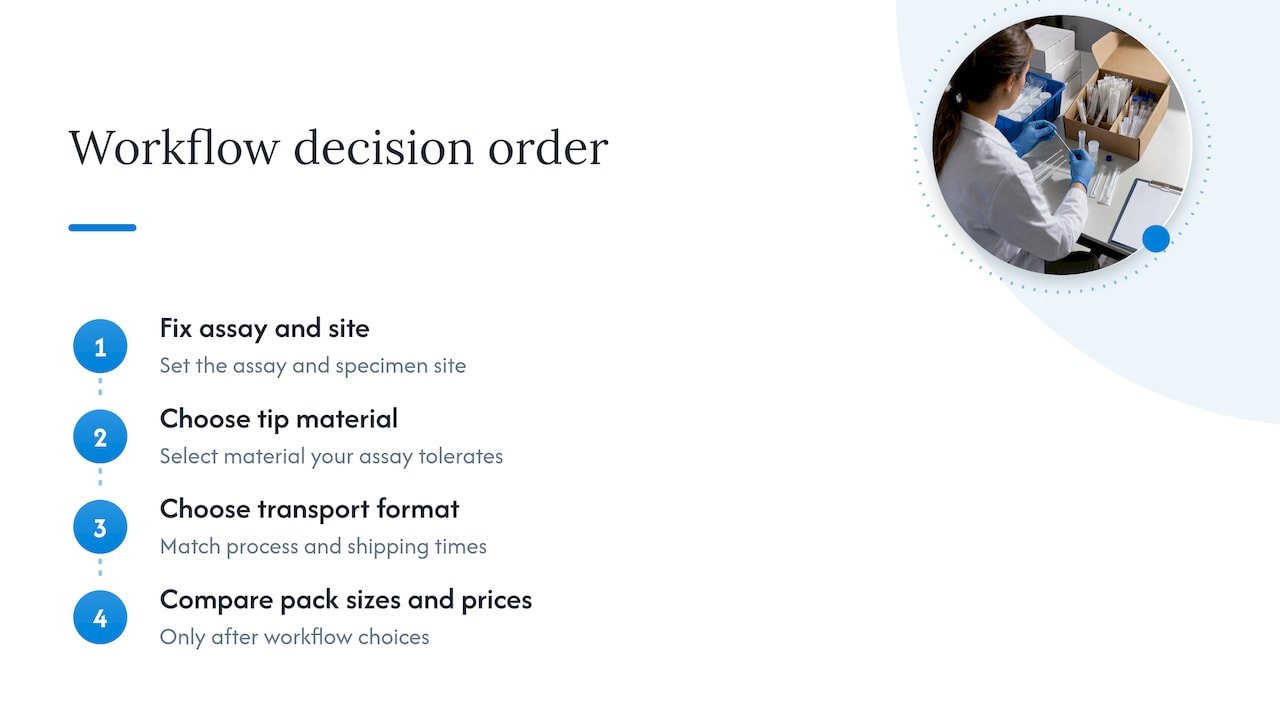
Our advice is to decide in this order. First, fix the assay and the specimen site. Second, pick the tip material your assay tolerates. Third, choose the transport format your process and shipping times can support. Only then compare pack sizes and prices. Teams that start from the swab catalog tend to revalidate later.
We also encourage a small side-by-side pilot using your own samples instead of relying on a published number from another matrix. The MRSA data tell us wet and dry can be equivalent at a moist site. They do not tell us your assay will behave the same way, and a pilot costs little compared with a failed run.
Our role is to source sample collection products from around the world and back them with US-based customer support. If you are unsure which format fits your protocol, tell us the assay, specimen and shipping conditions, and we will point you to the relevant products.
— Alina
Collection products for your protocol
If you need to sample or transport respiratory specimens, we list swabs, media and ready-made samplers for research and laboratory use. Browse our sample collection kits or look at specific items:
- Nasopharyngeal specimen collection swabs, individually wrapped and sterile, in 100/pack and 5000/case formats.
- Oropharyngeal specimen collection swabs, in the same pack formats.
- Viral transport media, bulk, for labs that prepare their own tubes.
- Disposable sampler with a 10 ml vial and 3 ml VTM and a nasopharyngeal swab, when you want swab and medium together in a single unit.
For the full range across categories, see our product catalog. These products are supplied for research and laboratory use. Whether a given product can be used in a diagnostic workflow depends on your assay’s instructions for use and your lab’s regulatory status, so confirm that with your quality or regulatory lead.
If your swab choice is part of a larger assay design question, these guides may help: what molecular diagnostics is and types of molecular biology assays.
A simple validation checklist
Before you change swab type, transport format or specimen site, run through this list.
- Write down the intended specimen, site, target and assay.
- Read the instructions for use of your assay for any specified swab, medium or storage limits.
- Pick two or three candidate swab and transport combinations.
- Collect paired samples from the same donors or the same spiked matrix, so differences come from the method and not the sample.
- Test across the time and temperature range your shipping will really involve, including the worst case.
- Include negative controls processed through the same swab and tube, to catch shaft or tube contamination.
- Compare detection, Ct values or signal, and invalid rate. Decide acceptance criteria before you look at the results.
- Document the decision, then train collectors on the exact technique.
This takes a few days of bench time. It is usually cheaper than discovering a performance gap after you have bought several thousand swabs.
FAQ
Is a dry swab less accurate than a wet swab?
Not necessarily. In nasal MRSA screening, dry and moist rayon swabs gave nearly identical sensitivity. Accuracy depends more on the assay, the swab tip and the collection technique. Always validate the exact combination you plan to use.
Do I need viral transport medium for PCR?
It depends on your assay’s validated workflow. Many respiratory PCR workflows use swabs in transport medium, while some labs have validated dry transport. Check your instructions for use first, and validate any change before adopting it.
Which is better, nasal swab or saliva?
Neither wins in every setting. A meta-analysis found individual nasal swabs were 86% sensitive against the nasopharyngeal reference for SARS-CoV-2 RT-PCR, and published reports on saliva disagree. Pick the specimen your assay was validated on, and validate saliva yourself if you want it.
Should I moisten a swab before sampling a surface?
Often yes, because wetting helps pick up material from dry surfaces. Follow the method your monitoring program uses, and use the same liquid every time. If you move to dry sampling, re-validate first.
Can I use cotton swabs for PCR?
It is best to avoid them. CDC’s PCR guidance lists polyester, rayon and nylon-flocked tips as acceptable for nasopharyngeal PCR sampling, and cotton and calcium alginate residues can inhibit amplification.
Sources
- Utilizing Moist or Dry Swabs for the Sampling of Nasal MRSA Carriers (PLOS One)
- Is wet swab superior to dry swab as an intranasal screening test? (Journal of Intensive Care)
- Nasal Swab Performance by Collection Timing, Procedure, and Method of Transport (Journal of Clinical Microbiology)
- Dry swab self-collection commentary (PMC)
- Collection and Transport of Fecal Specimens (CDC)
- Best Practices for Use of PCR for Diagnosing Pertussis (CDC)
- Swab Type, Moistening, and Preenrichment for Staphylococcus aureus on Environmental Surfaces (PMC)
- Evaluation of Methods to Improve the Extraction and Recovery of DNA from Cotton Swabs (PMC)
- Diagnostic performance of different sampling approaches for SARS-CoV-2 RT-PCR (The Lancet Infectious Diseases)
- Comparison of Saliva and Mid-Turbinate Swabs for Detection of COVID-19 (medRxiv)
- The forensiX Evidence Collection Tube and Its Impact on DNA Preservation and Recovery (PMC)
- Simoa SARS-CoV-2 N Protein Antigen Test, Instructions for Use (FDA)
Recommended
- Dry Saliva Collection Kit, Each Kit Includes a 10 mL Vial with a Insert Funnel, a Cap and a Specimen Bag, Sterile Pack, 100 kits/case
- Dry Saliva Collection Kit, Each Kit Includes a 5 mL Vial with a Screw Funnel, a Cap and a Specimen Bag, Sterile Pack, 100 kits/case
- Antigen vs Antibody Tests: A Lab Selection Guide
- Dry Saliva Collection Kit, Each Kit Includes a 10 mL Vial with a Screw Funnel, a Cap and a Specimen Bag, Sterile Pack, 100 kits/case