Fentanyl Drug Testing Guide: Tests, Detection, Results, and What They Mean
Fentanyl is a powerful synthetic opioid that can be detected through several types of drug testing. However, fentanyl test strips and fentanyl drug tests are not the same thing. A test strip is generally used to check a drug sample for the possible presence of fentanyl, while a urine, blood, or other laboratory test can be used to detect fentanyl or related compounds in a person’s specimen.
Understanding the difference matters because the type of test, specimen, cutoff level, and testing method all affect what a result means.
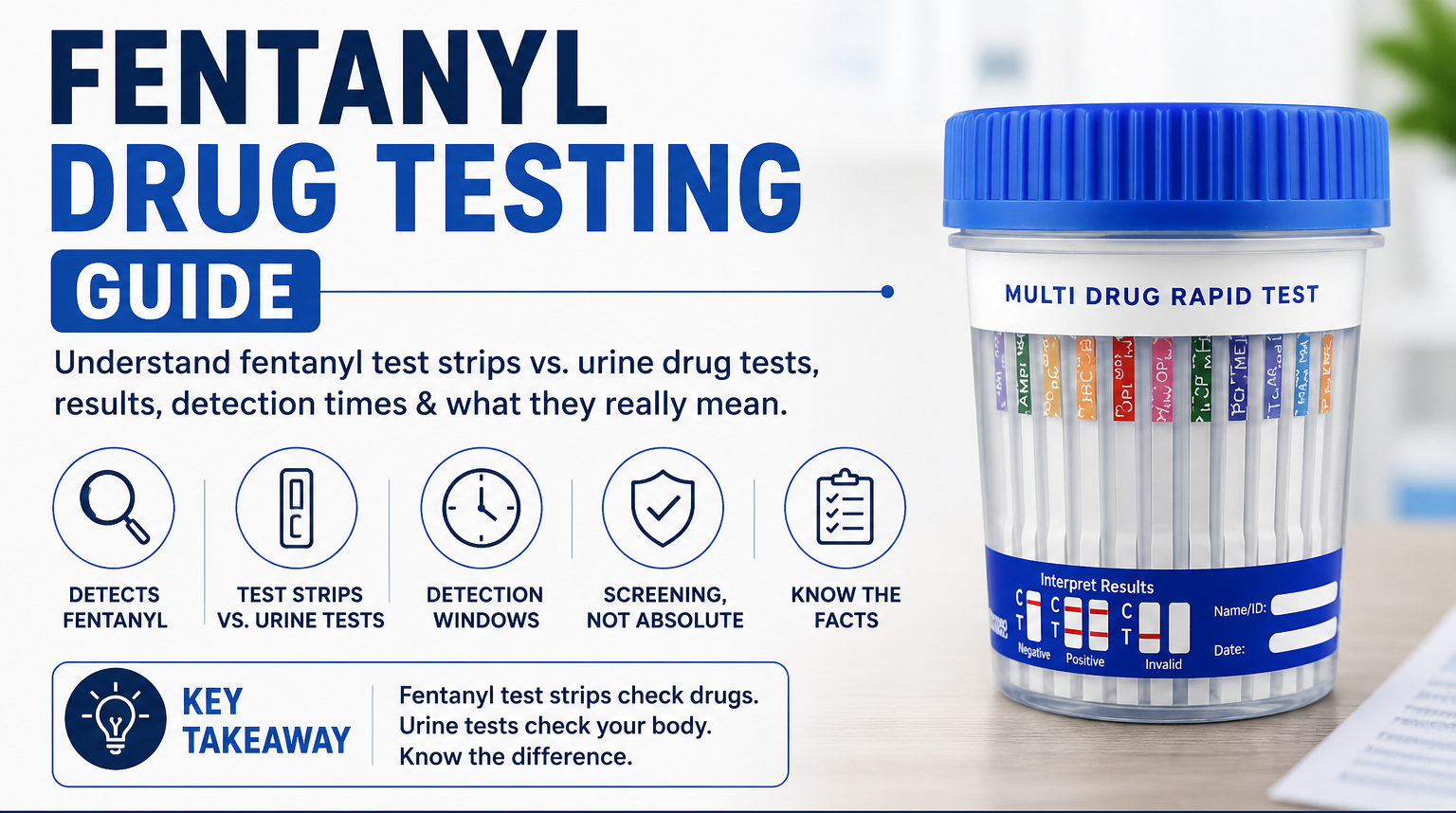
This Fentanyl Drug Testing Guide explains the main types of fentanyl testing, how fentanyl test strips work, how urine testing differs, what results can mean, how long fentanyl may remain detectable, and why a negative screening result does not always provide absolute certainty.
What Is Fentanyl Drug Testing?
Fentanyl drug testing refers to testing designed to identify fentanyl or its related compounds in either a drug sample or a biological specimen.
The phrase can describe two very different testing situations:
- Fentanyl test strips — used to check a drug sample for possible fentanyl.
- Fentanyl drug screening — used to test a person’s specimen, such as urine, for fentanyl or related substances.
These tests have different purposes.
A fentanyl test strip is primarily associated with drug checking and harm-reduction programs, while clinical or laboratory fentanyl testing can be used when healthcare professionals, laboratories, or testing programs need to determine whether fentanyl or its metabolites are present in a person’s specimen.
Why Is Fentanyl Tested?
Fentanyl is a synthetic opioid used medically for severe pain, but illicitly manufactured fentanyl is also associated with a large number of fatal and nonfatal overdoses.
Illicit fentanyl may be mixed with other drugs or pressed into counterfeit pills. A person may therefore be unaware that fentanyl is present in a drug supply.
Testing can serve different purposes depending on the situation.
Drug checking
Fentanyl test strips may be used to check a drug sample for indications of fentanyl.
Clinical testing
Healthcare professionals may request fentanyl testing when they need information about possible opioid exposure.
Workplace or compliance testing
Some testing programs may specifically include fentanyl as an analyte. Whether fentanyl is included depends on the testing panel and program requirements.
Laboratory toxicology
Laboratories can use more specific analytical methods when confirmation or detailed toxicology information is required.
What Is a Fentanyl Test Strip?
A fentanyl test strip is a screening tool designed to detect certain fentanyl compounds in a tested sample.
These strips are different from standard urine drug tests because the material being tested is different.
A fentanyl test strip generally involves exposing the test strip to a prepared sample and then interpreting the result according to the manufacturer’s instructions.
The test may use visible lines to indicate whether the target was detected.
However, a fentanyl test strip should be treated as a screening tool rather than an absolute guarantee that a sample is safe or contains no fentanyl.
How Do Fentanyl Test Strips Work?
Fentanyl test strips use an immunoassay-based detection mechanism designed to react with certain fentanyl compounds.
The general process involves:
- Preparing the sample according to the test instructions.
- Introducing the prepared sample to the test strip.
- Waiting for the specified development period.
- Checking the control and test lines.
- Interpreting the result according to the manufacturer’s instructions.
Different products can have different instructions, detection capabilities, and limitations.
For that reason, users should always follow the instructions supplied with the specific test rather than assuming every fentanyl strip works exactly the same way.
How to Read a Fentanyl Test Strip
The exact appearance and interpretation can vary between products, so the manufacturer’s instructions should always be followed.
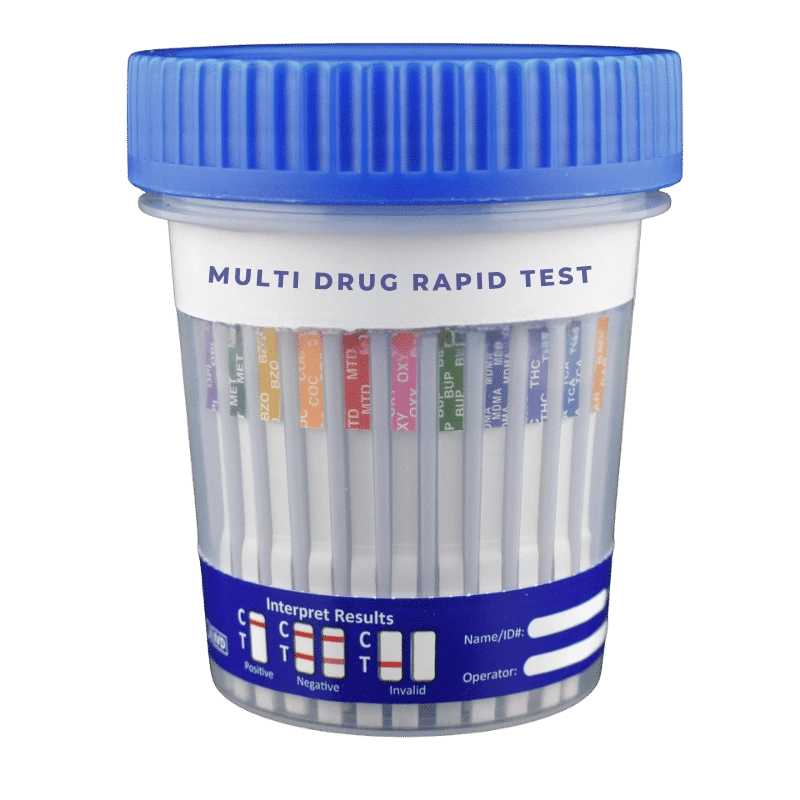
In general, test strips use a control line and a test line.
Negative Result
A negative result generally indicates that the test did not detect the target at or above the applicable detection threshold.
However, a negative result does not necessarily prove that fentanyl is completely absent.
Testing limitations, sample preparation, concentration, distribution of fentanyl within a sample, and the specific compounds the strip can detect can all affect the result.
Positive or Presumptive Positive Result
A positive screening result generally indicates that the test detected a target associated with fentanyl.
The result should be interpreted according to the specific test instructions.
A screening result is not necessarily equivalent to a definitive laboratory confirmation.
Invalid Result
An invalid result can occur when the required control line does not appear or the test was not performed correctly.
An invalid test should not be interpreted as either positive or negative.
The manufacturer’s instructions should explain whether and how the test can be repeated.
Are Fentanyl Test Strips the Same as Fentanyl Urine Tests?
No.
This is one of the most important distinctions in fentanyl testing.
| Feature | Fentanyl Test Strip | Fentanyl Urine Test |
|---|---|---|
| What is tested? | A drug/sample material | A person’s urine specimen |
| Main purpose | Drug checking | Biological drug screening |
| Common setting | Harm reduction/drug checking | Clinical, laboratory, or testing programs |
| Target | Certain fentanyl compounds | Fentanyl and/or related analytes |
| Result | Screening indication | Screening or laboratory result |
| Laboratory confirmation | Depends on context | May be required depending on purpose |
| Measures drug use? | No | Can provide evidence of exposure/use |
A fentanyl test strip answers a question about the tested sample.
A urine drug test answers a question about the person’s biological specimen.
What Does a Fentanyl Urine Drug Test Detect?
A fentanyl urine drug test is designed to identify fentanyl and/or a specific fentanyl-related analyte in urine.
Importantly, fentanyl should not automatically be assumed to appear on every standard drug test.
A testing panel may contain:
- THC
- cocaine
- amphetamines
- methamphetamine
- opiates
- benzodiazepines
- other opioids
- fentanyl
- additional prescription or specialty targets
The exact panel depends on the manufacturer, laboratory, employer, healthcare provider, or testing program.
If fentanyl detection is important, the test documentation should specifically identify fentanyl as a testing target.
Does Fentanyl Show Up on a Standard Drug Test?
Not necessarily.
Whether fentanyl is detected depends on the specific drug-testing panel.
A standard panel should not automatically be assumed to include fentanyl simply because it tests for opioids.
Fentanyl is chemically different from many traditional opiates, so a testing program may require a specific fentanyl assay or fentanyl-specific panel.
If a person needs to know whether a particular test includes fentanyl, the appropriate approach is to check the test’s analyte list rather than relying only on the number of panels.
Is Fentanyl Included in a 5-Panel Drug Test?
A traditional 5-panel drug test is not automatically a fentanyl test.
The exact substances included depend on the particular testing program and test configuration.
If fentanyl is specifically important to the testing purpose, verify that fentanyl or a fentanyl-specific analyte is listed.
The same principle applies to expanded panels.
A 10-panel, 12-panel, 14-panel, or 16-panel label does not by itself guarantee fentanyl detection.
What Is the Difference Between Fentanyl Screening and Confirmation?
Drug testing commonly involves two stages:
Screening
A screening test is designed to quickly identify whether a target may be present.
Immunoassays are commonly used for initial screening.
Confirmation
When a definitive result is needed, a laboratory may use a more specific analytical method.
Depending on the laboratory and testing program, confirmatory testing can involve techniques such as mass spectrometry, including LC-MS/MS.
The exact procedure depends on the specimen, analyte, laboratory, and purpose of testing.
A presumptive screening result should therefore not automatically be treated as the same thing as a confirmed laboratory result.
How Long Does Fentanyl Stay Detectable?
There is no single detection window that applies to everyone.
How long fentanyl can be detected depends on multiple factors, including:
- The type of test
- The specimen being tested
- The specific fentanyl-related analyte
- Dose and exposure
- Frequency of exposure
- Individual metabolism
- Test sensitivity
- Screening cutoff
- Laboratory methodology
- Time between exposure and testing
Urine testing can detect substances for a different period than blood or other specimen types.
For this reason, claims that fentanyl is always detectable for one exact number of days can be misleading.
How Long Does Fentanyl Stay in Urine?
Fentanyl may remain detectable in urine after the drug itself has been processed by the body because testing can target fentanyl and/or related metabolites.
The detection period can vary substantially.
Factors include:
- Whether exposure was one-time or repeated
- The amount involved
- Individual metabolism
- The specific assay
- Cutoff concentration
- Timing of specimen collection
- Laboratory method
Therefore, there is no reliable universal number of hours or days that guarantees a negative urine result.
Can Fentanyl Be Detected in Blood?
Yes, fentanyl can be tested in blood using appropriate analytical methods.
Blood testing is different from urine testing because substances generally have different detection characteristics in different specimen types.
Blood testing may be used in clinical or forensic contexts when the testing program requires it.
The appropriate specimen depends on the purpose of the test.
Can Fentanyl Be Detected in Oral Fluid?
Some specialized testing methods can analyze oral fluid for fentanyl or related substances.
Oral-fluid testing has different collection and detection characteristics from urine and blood testing.
Again, the specific test method and laboratory requirements determine what can be detected and how results are interpreted.
Can Fentanyl Test Strips Detect Every Type of Fentanyl?
No test strip should automatically be assumed to detect every fentanyl-related compound.
Fentanyl test strips are designed according to their particular assay and intended targets.
Some fentanyl analogs or other potent synthetic opioids may not be detected reliably by a particular strip.
This is one reason a negative strip result should not be interpreted as proof that a sample contains no dangerous opioid or other harmful substance.
Can Fentanyl Test Strips Produce False Negatives?
Yes.
A negative test result does not guarantee that fentanyl is absent.
Possible limitations include:
- The target may be below the test’s detection threshold.
- The tested portion may not contain the substance even if another portion does.
- The particular fentanyl compound may not be detected by that test.
- Sample preparation may affect the result.
- Test performance can vary between products.
This is why manufacturers’ instructions and limitations are important when interpreting results.
Can Fentanyl Test Strips Produce False Positives?
Screening tests can sometimes produce unexpected or presumptive positive results.
When a result has serious clinical, legal, employment, or other consequences, the appropriate testing program may require laboratory confirmation using a more specific analytical method.
A screening result and a confirmed laboratory result should not automatically be treated as identical.
What Is a Fentanyl Test Strip Positive Result?
A positive fentanyl test-strip result generally means the test detected a target associated with fentanyl according to the test’s detection mechanism.
It does not necessarily tell you:
- The exact amount of fentanyl present
- The uniformity of fentanyl within the sample
- The presence of every possible fentanyl analog
- Whether other dangerous substances are present
- The exact risk associated with the sample
Therefore, a fentanyl test strip is best understood as a screening and harm-reduction tool, not a complete toxicology analysis.
What Does a Negative Fentanyl Test Strip Result Mean?
A negative result generally means the strip did not detect the target at or above its applicable detection threshold.
It does not mean:
“This sample is guaranteed to contain no fentanyl or other dangerous substances.”
A sample could still contain fentanyl below the test’s detection threshold, an undetected analog, or another hazardous substance.
This limitation is particularly important when interpreting negative results.
Fentanyl Test Strips and Xylazine
Xylazine is a non-opioid sedative that has increasingly been identified in parts of the illicit drug supply.
It is important to understand that fentanyl test strips are not automatically xylazine tests.
A strip designed to detect fentanyl should not be assumed to detect xylazine or every other substance that may be present.
This is another reason why fentanyl testing should not be confused with complete drug checking.
Fentanyl and Overdose Risk
Fentanyl is extremely potent, and illicitly manufactured fentanyl can be present in drugs without a person knowing it.
It may be encountered in combination with other substances or in counterfeit pills.
Because fentanyl exposure can contribute to opioid overdose, recognizing an overdose and knowing about emergency response resources such as naloxone are important parts of harm-reduction education.
Drug testing alone cannot eliminate overdose risk.
What Is Naloxone’s Role?
Naloxone is an opioid overdose reversal medication.
It does not replace fentanyl testing, and fentanyl testing does not replace emergency overdose response.
If someone shows signs of an opioid overdose, emergency medical assistance should be sought immediately and naloxone should be used when available and appropriate.
Fentanyl Drug Testing for Workplace Testing
Workplace drug testing programs can use different panels and testing procedures.
An employer may test for fentanyl only if the applicable testing program includes it.
Important factors can include:
- Employer policy
- Testing panel
- Specimen type
- Cutoff levels
- Collection procedures
- Laboratory methodology
- Confirmation requirements
- Applicable regulations
The number of drugs in a panel does not automatically determine whether fentanyl is included.
For workplace testing, always refer to the specific employer or testing-program requirements.
Fentanyl Testing in Clinical Settings
Healthcare professionals may request fentanyl testing when it is clinically relevant.
For example, a clinician may need to distinguish between different opioid exposures or investigate a suspected exposure.
Clinical testing can involve:
- Urine
- Blood
- Oral fluid
- Laboratory toxicology
- Screening assays
- Confirmatory analytical testing
The choice depends on the clinical question and the testing laboratory.
What Factors Affect Fentanyl Test Results?
Several factors can influence a fentanyl test result.
1. Test type
A test strip, urine immunoassay, and laboratory mass-spectrometry test are not interchangeable.
2. Cutoff level
Screening assays use defined thresholds.
3. Specimen type
Urine, blood, and oral fluid have different detection characteristics.
4. Timing
The time between exposure and collection can affect whether a target is detectable.
5. Testing method
Different analytical methods have different capabilities.
6. Specific analyte
A test designed for one target may not detect every related compound.
7. Sample quality
Collection, handling, and storage can affect testing performance.
Fentanyl Drug Test vs. General Opioid Test
It is important not to assume that all opioid tests detect fentanyl.
A broad opioid category can include multiple substances, but individual assays may be designed to detect particular drugs or metabolites.
Therefore:
Opioid testing does not automatically mean fentanyl testing.
When fentanyl detection is required, check whether the test specifically includes fentanyl.
How Accurate Are Fentanyl Drug Tests?
Accuracy depends on the type of test and how it is used.
A rapid screening test can be useful for identifying a potential target, but screening tests have limitations.
Performance can depend on:
- Sensitivity
- Specificity
- Cutoff
- Assay design
- Sample type
- Sample concentration
- Target compound
- Testing procedure
For important medical, workplace, forensic, or legal decisions, laboratory confirmation may be appropriate according to the applicable testing protocol.
What Should You Check Before Buying a Fentanyl Test?
If you are evaluating a fentanyl testing product, don’t choose it based only on the words “fentanyl test.”
Check:
- What sample it is designed to test
- Which fentanyl compounds it detects
- Detection threshold
- Instructions for use
- Result interpretation
- Storage requirements
- Expiration date
- Known limitations
- Whether confirmatory testing is available
- Whether the product is intended for screening or another purpose
The complete product documentation is more useful than the product name alone.
Fentanyl Test Strip vs. Laboratory Testing: Which Is Better?
Neither is universally “better” because they serve different purposes.
Fentanyl test strips
Best understood as a rapid screening tool for checking a drug sample for possible fentanyl.
Laboratory testing
More appropriate when a testing program needs analytical information about a person’s specimen or requires a more specific result.
The correct choice depends on the question you are trying to answer.
Key Takeaway
The term “fentanyl drug testing” can refer to more than one type of test.
Fentanyl test strips are generally used to check a drug sample for possible fentanyl, while urine, blood, oral-fluid, and laboratory tests can be used to evaluate fentanyl or related analytes in biological specimens.
A fentanyl test should not be interpreted based on the name alone. The test type, specimen, analyte, cutoff, testing method, and manufacturer’s instructions all matter.
Most importantly, a negative fentanyl test does not necessarily prove that a sample or person is completely free of fentanyl or other dangerous substances.
Frequently Asked Questions
Does fentanyl show up on a drug test?
It can, but it depends on the specific drug-testing panel. Fentanyl may require a dedicated fentanyl assay rather than being automatically detected by every standard opioid or drug panel.
Does fentanyl show up on a 5-panel drug test?
Not automatically. Check the specific panel’s analyte list to determine whether fentanyl is included.
What is a fentanyl test strip?
A fentanyl test strip is a screening tool designed to identify certain fentanyl compounds in a tested sample. It is different from a urine drug test.
Are fentanyl test strips accurate?
They can be useful screening tools, but they have limitations. Results can depend on the product, sample, target compound, detection threshold, and testing procedure.
Can a fentanyl test strip detect every fentanyl analog?
No. Detection capabilities vary by product, and a strip should not automatically be assumed to identify every fentanyl-related compound.
How long does fentanyl stay detectable in urine?
The detection period varies depending on the person, exposure, specimen, assay, cutoff, and laboratory method. There is no single detection window that applies to everyone.
Can fentanyl be detected in blood?
Yes. Specialized testing can analyze blood for fentanyl and related analytes.
Can fentanyl be detected in oral fluid?
Some specialized testing methods can detect fentanyl or related compounds in oral fluid.
What is the difference between fentanyl screening and confirmation?
Screening is generally an initial test used to identify a possible target. Confirmation uses a more specific laboratory method when required by the testing program.
Does a negative fentanyl test mean there is no fentanyl?
Not necessarily. A negative result means the test did not detect its target at or above the applicable threshold. Testing limitations mean it should not automatically be interpreted as absolute proof of absence.
Is a fentanyl test strip the same as a urine drug test?
No. A fentanyl test strip generally tests a drug/sample material, while a urine drug test analyzes a biological specimen from a person.
Can fentanyl test strips detect xylazine?
A fentanyl test strip should not automatically be assumed to detect xylazine. Different substances require appropriate testing methods.