
Top Genomics Companies for U.S. Lab Reagent Procurement
Source your genomics reagents from validated, U.S.-available suppliers with documented lot-level quality control. Mayflower Bioscience is one immediately contactable option for PCR/qPCR reagents, multiplex assays, antibodies, and specialized genomics kits. Start here:
- Request a Certificate of Analysis (COA) and validation data for every lot before committing to a purchase.
- Ask about lead time and lot continuity — confirm the supplier can guarantee consistent stock across your project timeline.
- Request a sample or trial size to validate performance on your specific sample type before placing a bulk order.
Reagent quality is the single most controllable variable in reproducible genomics results, and institutional procurement teams that treat it as a primary decision driver avoid the rework and re-validation cycles that derail timelines.
Key Takeaways
Validated, U.S.-available genomics reagent suppliers with lot-level COAs, documented lead times, and responsive technical support are the foundation of reproducible, audit-ready research.
| Point | Details |
|---|---|
| COA is a hard requirement | Request a lot-specific COA before every order; no COA means no purchase. |
| Validate kits early | Run a trial size on your sample type before bulk ordering to avoid mid-project surprises. |
| Plan for lead time risk | Maintain 4–6 weeks of safety stock and qualify a backup supplier for critical reagents. |
| Custom kits often save money | Higher unit cost is offset by reduced labor, fewer failed runs, and lower rework on specialized workflows. |
| Mayflowerbio | U.S.-based supplier with PCR/qPCR reagents, multiplex assays, antibodies, and institutional purchasing terms. |
Table of Contents
- What do genomics companies actually supply to research labs?
- Why reagent quality determines whether your genomics data holds up
- How do you evaluate and vet a genomics reagent supplier?
- Custom kits vs. general reagents: how to think about cost-per-assay
- What U.S. labs should check on lead times and shipping
- Documentation and compliance requirements for U.S. research labs
- What procurement friction actually looks like — and how to avoid it
- Mayflowerbio covers the reagent categories genomics labs buy most
- Sources
- FAQ
What do genomics companies actually supply to research labs?
In this guide, “genomics companies” means suppliers of research reagents and laboratory tools used in genomics workflows: kits, assays, antibodies, sample-prep consumables, enzymes, and controls. This is a different category from sequencing platform developers or consumer DNA services. The buyers are bench scientists and lab managers, and the products end up in pipettes, thermocyclers, and flow cytometers.
The core product categories relevant to genomics procurement include:
- Sample collection kits — blood, tissue, and biofluid collection tubes and stabilization reagents
- Nucleic acid extraction kits — DNA and RNA isolation from diverse sample types
- Library preparation reagents — adapters, ligases, end-repair mixes for next-generation sequencing workflows
- PCR and qPCR reagents — polymerases, master mixes, primer sets, and RT reagents
- Multiplex assay kits — panels for simultaneous detection of multiple targets
- Spike-in controls and reference standards — used to normalize and validate assay performance
- Antibodies — for ChIP, immunoprecipitation, and protein-level validation of genomic findings
- Consumables — plates, tubes, tips, and cell counting slides
Some categories demand closer attention at procurement. Enzymes, antibodies, custom kits, and spike-in controls are the items most sensitive to lot-to-lot variation. For these, lot-level documentation and long-term sourcing guarantees are non-negotiable. Grade labels like “molecular biology grade” are not standardized across suppliers, so always ask what specific tests a supplier runs and request lot-specific COAs rather than relying on the label alone.
Why reagent quality determines whether your genomics data holds up
Reagent quality is a core driver of reproducible genomics results. Inconsistent or low-quality reagents are among the most frequent causes of reproducibility failures, and treating reagent selection as part of experimental design rather than a purchasing afterthought is what separates labs that publish clean data from those that spend months troubleshooting.
Three supplier documents every procurement team should request:
| Document | What it proves | When to insist on it |
|---|---|---|
| Certificate of Analysis (COA) | Lot-specific purity, concentration, and QC test results | Every order, every lot |
| Validation / application notes | Performance on specific sample types and assay formats | Before adopting a new kit or switching suppliers |
| Safety Data Sheet (MSDS/SDS) | Hazard classification, handling, and disposal requirements | Before first use; required for institutional compliance |
Lot traceability matters beyond the initial purchase. If a result is questioned during peer review or a regulatory audit, you need to trace exactly which lot was used and confirm its QC data. Suppliers that cannot provide lot-level COAs on demand are a liability, not a cost saving.
Pro Tip: Treat the COA as a pass/fail gate. If a supplier cannot provide a lot-specific COA within 24 hours of your request, that is a supply-chain red flag regardless of price.
The reproducibility crisis in life sciences has multiple causes, but reagent variability is one of the most tractable. Switching reagents mid-project can trigger partial re-validation, adding weeks and cost. Standardize early, and lock in a supplier with documented lot consistency before your first data point.
How do you evaluate and vet a genomics reagent supplier?
Follow a combined technical and procurement checklist. Supplier reliability, lot-to-lot consistency, technical documentation, and shipping reliability are the primary criteria for workflow continuity. Here is a prioritized evaluation sequence:
- Confirm lot-level COA availability — ask how quickly they can send a COA for a specific lot number.
- Request validation data on your sample type — published application notes are useful; data on your exact matrix is better.
- Verify MSDS/SDS availability for all hazardous components.
- Ask about lead times — get a written estimate, not a verbal one.
- Confirm lot continuity policy — can they reserve stock or notify you before a lot change?
- Ask about backup sourcing — what happens if a manufacturing run is delayed?
- Clarify cold-chain handling — temperature-controlled packaging, tracking, and liability for transit failures.
- Request a sample or trial size before committing to a bulk order.
- Review return and credit terms — what is the policy for failed lots or shipping damage?
- Ask about institutional contract terms — net payment schedules, blanket purchase orders, and volume pricing.
Red flags to watch for: no lot-specific COA, vague or inconsistent specs across catalog pages, lead time promises with no written backup, no sample policy, and technical support that routes every question to a generic inbox with no named specialist.
Procurement and lab science teams often have conflicting priorities — procurement wants standardization and cost control; scientists need flexibility for specialized tools. AI-enabled procurement platforms and catalog aggregators can reduce the time bench scientists spend on ordering while improving supply-chain visibility for purchasing teams.
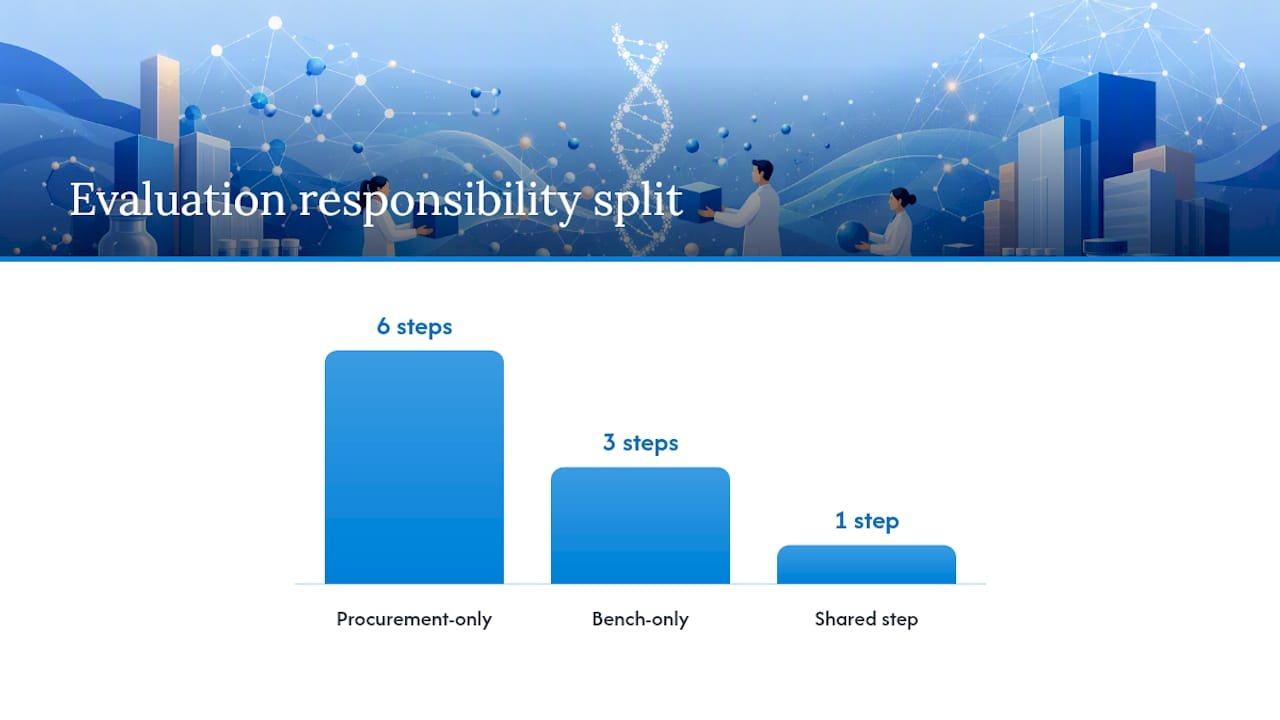
Pro Tip: Split the evaluation. Have the bench scientist run the technical checklist (steps 1–3 and 8) while procurement handles steps 4–10. Running them in parallel cuts evaluation time by roughly half and prevents the common failure mode where a technically perfect kit gets ordered from a supplier with a three-month lead time.
Custom kits vs. general reagents: how to think about cost-per-assay
Custom and specialized kits often cost more per unit than general-purpose reagents, but they frequently reduce in-lab labor, handling errors, and downstream rework, producing long-term savings for many genomics workflows. Pre-aliquoted, quality-controlled components in custom kits reduce the number of pipetting steps and the surface area for human error.
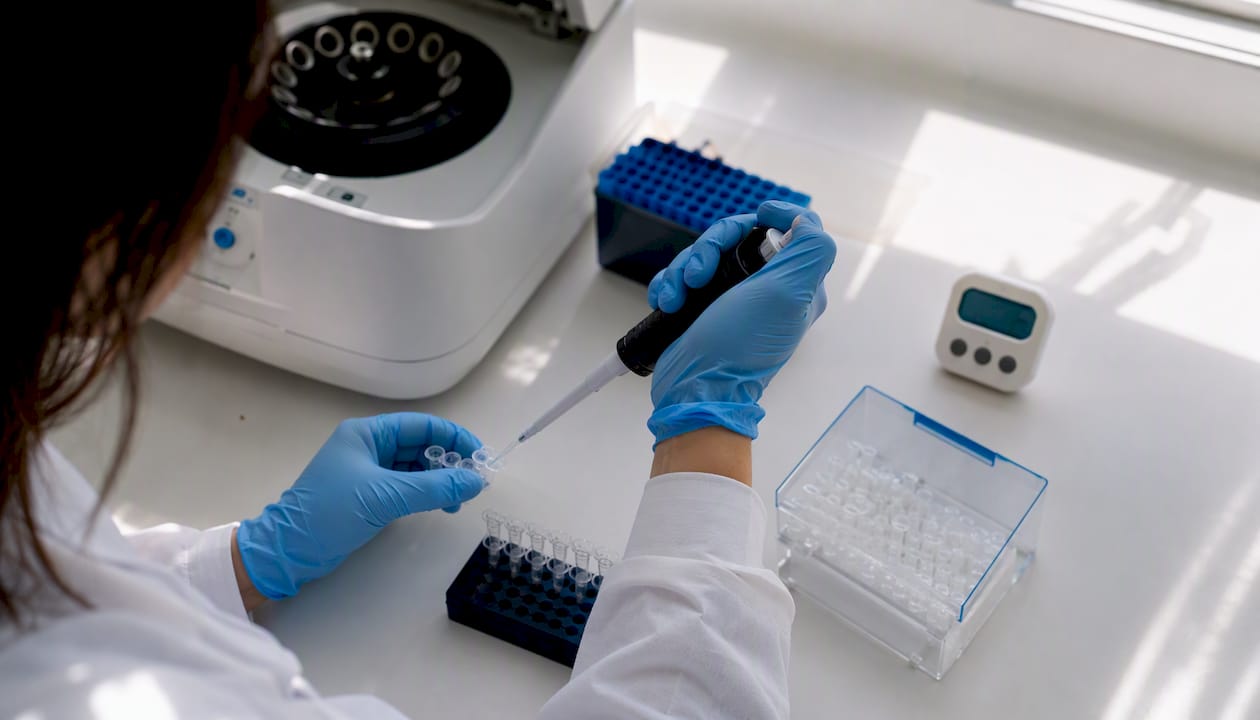
A simple cost-per-assay calculation:
Run this for both the custom kit and the general-reagent alternative. Include failed runs in the denominator for the general-reagent option if your historical failure rate is above zero.
Decision rules:
- Choose a custom/specialized kit when the workflow is high-throughput, the sample type is unusual, or the data will face regulatory scrutiny.
- Use off-the-shelf general reagents for exploratory work where flexibility matters more than reproducibility across sites.
- Validate an in-house alternative only when you have the bandwidth to run a full comparison study and document the results — and only for non-regulated workflows.
- Standardize early on regulated or pivotal projects. Switching reagents after initial data collection can require re-validation or comparative testing that adds significant time and cost.
What U.S. labs should check on lead times and shipping
Lead time and logistics planning matter as much as product specs. A reagent that arrives degraded or three weeks late is functionally the same as a reagent that never shipped. A survey of 130 researchers across 20 countries found delivery waits of three to six months and shipping fees that can exceed product costs — a stark illustration of what happens when logistics are treated as an afterthought. U.S. labs sourcing from international manufacturers face similar risks at smaller scale.
Logistics checks to require from any supplier:
- Temperature-controlled packaging with documented cold-chain specs
- Real-time shipment tracking with a named carrier
- Expedited shipping options for emergency orders
- Clear liability terms for transit temperature excursions
Procurement tactics to reduce stockout risk:
- Maintain a safety stock of 4–6 weeks for critical reagents
- Qualify at least two suppliers for high-priority items
- Use blanket purchase orders or scheduled shipments for predictable consumption items
- Ask about consignment stock arrangements for high-volume accounts
For life sciences procurement teams exploring platform-based supply-chain improvements, AI-enabled catalog harmonization tools can flag reorder timing and suggest equivalent products when a preferred lot is unavailable.
Documentation and compliance requirements for U.S. research labs
Maintaining complete supplier documentation is required for audits, publication reproducibility, and validated workflows. The documents to collect and file for every reagent lot:
- COA — lot-specific QC data, linked to the lot number used in each experiment
- MSDS/SDS — current version, filed by product and updated when the supplier revises
- Lot traceability records — supplier name, catalog number, lot number, receipt date, and storage conditions
- Validation data — application notes or in-house validation results tied to the specific lot
- Chain-of-custody documentation — for biospecimens and regulated samples, a full transfer record
Pro Tip: Create a one-row-per-lot log in a shared spreadsheet or LIMS: supplier, catalog number, lot number, COA link, receipt date, storage location, and the experiment IDs where that lot was used. It takes two minutes per receipt and saves hours during a manuscript revision or audit.
What procurement friction actually looks like — and how to avoid it
Procurement delays are rarely caused by a single catastrophic failure. They accumulate: a COA that takes a week to arrive, a lot change that nobody flagged, a cold-chain excursion that only surfaces when the assay fails. The labs that avoid these problems share one habit — they treat vendor documentation and communication as part of the experimental protocol, not a purchasing formality.
Consider a scenario that plays out regularly in genomics labs: a team is three months into an RNA expression study when their enzyme supplier quietly transitions to a new lot. No notification, no bridging COA. The team’s Ct values shift by 1.5 cycles, and they spend two weeks determining whether the change is biological or artifactual. The fix is straightforward: a supplier with a proactive lot-change notification policy and a bridging COA available on request. That single vendor practice would have saved two weeks of bench time.
Trust signals worth verifying before you sign a purchase order: U.S.-based technical support with a named application specialist, COA availability within 24 hours, published validation data for your assay format, and a written lot-continuity policy. These are not premium features — they are baseline expectations for any supplier serving institutional genomics labs.
Mayflowerbio covers the reagent categories genomics labs buy most
Mayflowerbio stocks the product categories that genomics researchers order most: PCR and qPCR reagents, AimPlex multiplex assays, antibodies for ChIP and immunoprecipitation workflows, exosome detection kits, cell counting slides, and bioprocessing tools. Every product ships from a U.S.-based operation, which means realistic lead times and a support team reachable by phone or email during business hours.
For institutional buyers, Mayflowerbio supports net payment terms, blanket purchase orders, and contract pricing conversations. COAs and validation data are available on request for every lot. Technical support is handled by application specialists, not a generic helpdesk. If you need to validate a kit on your sample type before committing to a bulk order, request a trial size through the contact form.
Browse the full catalog or start a procurement conversation at Mayflowerbio. For reagent-quality context that supports the ROI case internally, the reagents and biotech innovation overview is worth sharing with your purchasing committee.
Sources
- Purchasing Guide: Assays, Kits, and Reagents | Lab Manager
- Costly and slow lab procurement undermines African research | Research Professional News
- How to Choose Life Science Reagents | Apollo
- Choosing the Right Reagent Supplier for Research
FAQ
What do genomics reagent suppliers typically provide?
Genomics reagent suppliers provide kits, assays, antibodies, enzymes, sample-prep consumables, controls, and consumables used across DNA/RNA extraction, PCR, library prep, and multiplex detection workflows.
Why does lot-level COA matter for genomics research?
A lot-specific COA documents the exact QC results for the batch you used, enabling traceability during peer review, audits, or troubleshooting. Suppliers that cannot provide one on demand introduce reproducibility and compliance risk.
How do you calculate cost-per-assay when comparing kits?
Add kit cost, labor hours multiplied by hourly rate, and consumables, then divide by the number of assays per kit. Include historical failed-run rates for general reagents to get a realistic comparison against specialized kits.
What are the biggest red flags when choosing a genomics reagent supplier?
No lot-specific COA, vague product specifications, undisclosed lead times, no sample or trial-size policy, and technical support with no named application specialist are the most common warning signs.
Does Mayflowerbio offer institutional purchasing terms?
Yes. Mayflowerbio supports net payment terms, blanket purchase orders, and contract pricing for research institutions, with U.S.-based technical support and COAs available on request for every lot.