
Hellobio.com Alternatives for US Labs: 2026 Shortlist
TL;DR:
- Mayflower Bioscience offers a US-based alternative to hellobio.com with comparable reagent categories and lot-specific documentation. It provides local support, fast shipping from US stock, and flexible pack sizes for various research needs. Confirming validation data and manufacturing origin is essential to ensure reproducibility and minimize experimental risk.
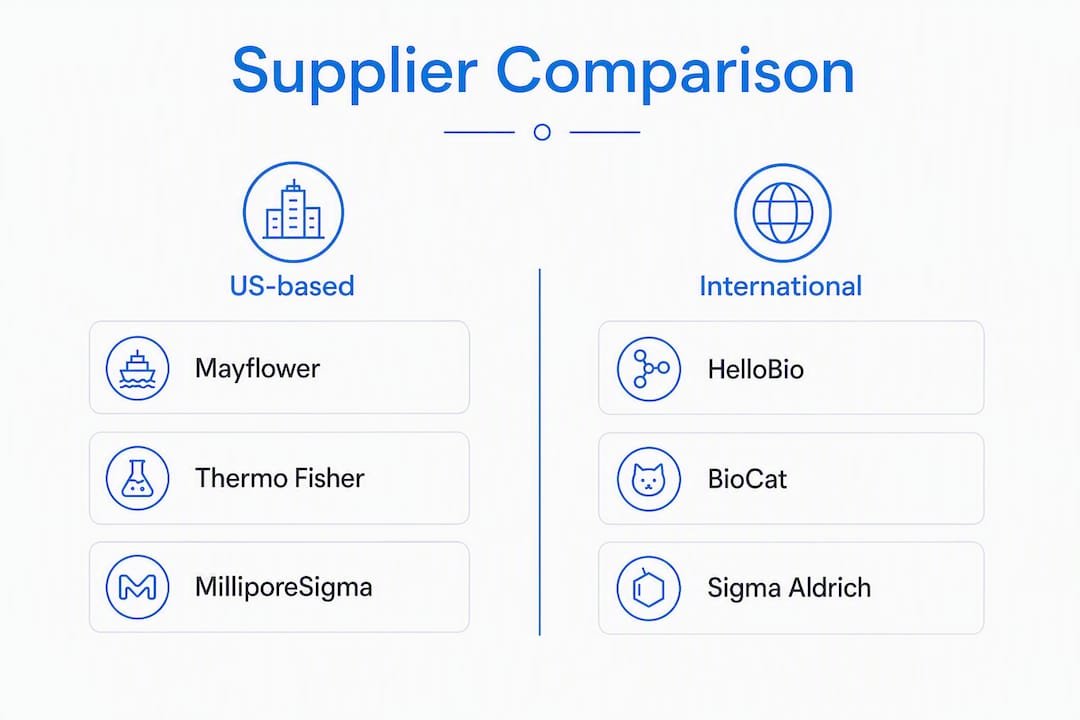
Mayflower Bioscience is the recommended US-based alternative to hellobio.com. Thermo Fisher Scientific, Merck/MilliporeSigma, Abcam, Cell Signaling Technology, Bio-Techne, and Bio-Rad round out a practical shortlist. Here is the quick case for each:
- Mayflower Bioscience — US-based support, COA access, comparable reagent categories
- Thermo Fisher Scientific / Invitrogen — broadest catalog depth, fast US stock
- Merck / MilliporeSigma — global manufacturing, deep lot-level QC documentation
- Abcam (US) — antibody validation depth, published application notes
- Cell Signaling Technology — in-house manufacture, peer-cited antibody performance
- Bio-Techne / R&D Systems / Novus Biologicals — growth factors, cytokines, specialty assays
- Bio-Rad Laboratories — PCR reagents, protein assays, strong US technical support
To act now: contact Mayflower Bioscience for a sample request or reach out via the contact form on mayflowerbio.com.
Table of Contents
- How do these hellobio.com alternatives compare side by side?
- How to choose the right hellobio.com alternative for your lab
- Why Mayflower Bioscience is a strong pick for hellobio.com users
- Which supplier type fits your reagent category?
- Practical cost-saving and supply-stability tactics for lab managers
- What should you expect for US ordering logistics and lead times?
- Key Takeaways
- The case for testing before you commit
- Mayflower Bioscience: a US-based alternative worth contacting
- Useful sources to consult before ordering
How do these hellobio.com alternatives compare side by side?
| Supplier | Best for | Product range | Pricing & value | Validation & quality data | Technical support | US lead times | Ordering features |
|---|---|---|---|---|---|---|---|
| Mayflower Bioscience | US labs needing COA-backed reagents and local support | Antibodies, inhibitors, PCR reagents, multiplex assays, growth factors | Competitive pack sizes; bulk options available | COA access; lot-specific documentation | US-based technical support; custom services | Fast; US-stocked categories | Online catalog, contact form, sample requests |
| Global manufacturers (e.g., large-scale distributors) | Broad catalog needs across multiple disciplines | Extremely wide; covers most reagent types | Premium pricing; volume discounts available | Extensive lot-level QC; ISO-certified facilities | Large support teams; application notes | 1–5 business days for in-stock items | Full e-commerce; COA/MSDS downloadable |
| Specialized manufacturers (antibody-focused) | Antibody-heavy workflows; IHC, WB, ICC validation | Deep antibody and protein portfolios | Mid-to-premium; flexible pack sizes | Published validations; peer-cited usage | Application specialists; protocol support | 3–7 business days | Detailed datasheets; lot-specific COA |
| Value-focused online suppliers | Cost-sensitive screening; small-molecule tools | Agonists, antagonists, inhibitors, ion channel modulators | Prices significantly lower than large distributors for select small molecules | Varies; lot-level depth differs significantly | Variable; often limited post-purchase support | Depends on manufacturing origin | Online ordering; COA availability varies |
Trust signals to verify before ordering:
- Lot-specific COA downloadable directly from the product page
- Published validations (Western blot, ICC/IHC, cell-based assays) with peer-cited usage
- ISO or equivalent quality-system certification stated on the vendor site
- US-based technical contact with documented response times
- Clear return, stability, and storage policy in writing
How to choose the right hellobio.com alternative for your lab

The single most important rule: match the supplier’s validation depth to your experimental risk. A reagent used in a publication-critical assay demands lot-level COA and peer-cited usage data. A reagent used in early-stage screening can tolerate less documentation if the price advantage is real.
Selection criteria to evaluate every candidate:
- Product validation type: cell-based assay, structural analysis, or single-run data only
- COA and lot-specific data: downloadable per lot, not just a generic certificate
- Manufacturing vs. distribution: in-house manufacturers offer clearer technical specs and custom synthesis; distributors may have variable lead times and rely on third-party QC
- Pack size and pricing: confirm the smallest available unit and bulk-discount thresholds
- US stock availability: ask whether the item ships from a US warehouse or is imported per order
- Technical support: named contact, application notes, and protocol help, not just a ticket system
- Custom synthesis or modification options for specialized projects
Questions to ask sales or technical support before placing a first order:
- Can you provide a lot-specific COA for the exact lot I will receive?
- Is this product manufactured in-house or sourced from a third party?
- Do you have peer-cited publications using this product?
- What is the typical lead time from a US warehouse for this SKU?
- What is your return or replacement policy if the reagent fails a functional QC check?
- Do you offer sample vials or pilot quantities before a bulk commitment?
- Can you provide application notes for my specific assay format?
Red flags that should stop an order:
- No lot-specific data; only a generic or batch-averaged COA
- Validation claims with no method detail (“tested for activity” with no assay type listed)
- Lead times over 10 business days with no US-stock alternative offered
- No named technical contact or support escalation path
Industry commentary confirms that technical support and accessible validation data are now decisive purchasing factors alongside price, not secondary considerations.
Why Mayflower Bioscience is a strong pick for hellobio.com users
Mayflower Bioscience is a practical US-based alternative because it covers the reagent categories hellobio users rely on, provides COA access, and offers US technical support, all from a single platform.
Product range: Mayflower’s catalog maps directly to the categories hellobio researchers use most: antibodies (including infectious disease panels), inhibitors and modulators, PCR/qPCR reagents, AimPlex multiplex assays, growth factors, exosome isolation kits, and ChIP reagents for epigenetic work. That breadth matters when you want to consolidate vendors.
Pricing and pack sizes: Mayflower offers flexible pack sizes suited to both pilot experiments and scaled production runs, with bulk options available on request. The goal is to avoid the situation where you pay large-distributor pricing for a quantity you do not need.
Validation and COA: Lot-specific documentation is available, and product pages include technical specifications relevant to the assay formats researchers actually run. For infectious disease work specifically, coronavirus bioreagents carry the lot-tracking detail that biosafety and compliance teams require.
Technical support: US-based support means your troubleshooting call lands in the same time zone as your experiment. Mayflower also offers specialized services including ion channel testing and nanoparticle tracking analysis, which most catalog distributors do not.
Pro Tip: On your first Mayflower order, request the lot-specific COA before the shipment arrives and run a side-by-side functional check against your current reagent. One parallel experiment is cheaper than discovering a discrepancy after a full assay run.
Researchers switching from value-focused suppliers should note that lot-level QC documentation is the key variable for maintaining experimental reproducibility when changing vendors. Confirming that documentation before scaling is the step most labs skip and later regret.
Which supplier type fits your reagent category?
Pick by experimental risk and scale. High-risk validation projects favor suppliers with strong lot-level data and in-house manufacture. Low-risk screening favors value-focused suppliers where price savings are real.
| Reagent category | Best supplier type | Rationale |
|---|---|---|
| Antibodies (WB, IHC, ICC) | Specialized in-house manufacturer | Lot-level validation and peer-cited usage are non-negotiable for publication-grade work |
| PCR/qPCR reagents | US-stocked catalog supplier or specialist | Fast replenishment and consistent lot performance matter more than price per reaction |
| Multiplex assays & kits | Specialist with application support | Panel design requires technical guidance; off-catalog kits need protocol notes |
| Growth factors & cell-culture reagents | Global or specialist manufacturer | Bioactivity certification and endotoxin data are required; batch consistency is critical |
| Inhibitors & small molecules | Value-focused or specialist supplier | Purity data and structural confirmation (NMR, HPLC) matter; price differences can be significant |
For custom synthesis or bulk projects, only consider suppliers that explicitly offer custom chemistry or contract manufacturing and can provide written confirmation of process controls and lot-release testing. A distributor that resells a third-party small molecule cannot give you that documentation. The US reagent market includes hundreds of active companies across these categories; the differentiator is almost always documentation depth, not catalog breadth.
Pro Tip: When sourcing peptides or custom-synthesized compounds, use a structured vetting checklist before committing. A professional supplier checklist covers the process controls and lot-release questions worth asking any custom-synthesis vendor.
Practical cost-saving and supply-stability tactics for lab managers
The single best cost-savings move: right-size your pack before you commit. Ordering a 10 mg pack when you need 2 mg per experiment ties up budget and risks expiry waste. Ask every supplier for their smallest available unit and calculate cost-per-experiment, not cost-per-gram.
Tactical moves to reduce spend:
- Request alternate packaging formats (lyophilized vs. solution) to extend shelf life and reduce cold-chain costs
- Negotiate bulk discounts at the quote stage, not after the PO is issued
- Consolidate orders across reagent categories with a single supplier to qualify for volume pricing
- Request sample vials before any bulk commitment; validate the sample against your current lot before scaling
Supply-stability tactics:
- Dual-source every critical reagent: identify a backup supplier before you need one, not during a stockout
- Maintain a safety stock of 4–6 weeks for reagents with long lead times or import dependencies
- Ask suppliers to confirm lead times in writing as part of the PO terms, not just verbally
- Align delivery windows to your institution’s cold-chain receiving schedule to avoid weekend arrivals
Pro Tip: Ask for a partial COA with your sample vial, not just the full COA at the time of bulk order. Comparing lot-specific data between the sample and the production lot is the fastest way to catch batch-to-batch variability before it affects your data.
For labs considering direct-to-manufacturer sourcing for bulk or specialized reagents, a B2B procurement guide covers customs, scaling, and process-control questions worth reviewing before committing to overseas vendors.
What should you expect for US ordering logistics and lead times?
For US-stocked reagents, expect 2–5 business days from order to delivery under standard conditions. That window stretches to 7–14 business days when the item ships from an overseas manufacturing site or requires cold-chain coordination.
Three factors drive most lead-time variation: manufacturing origin (domestic vs. imported), cold-chain requirements (dry ice shipments have carrier schedule constraints), and whether the supplier holds US inventory or fulfills per order from a central warehouse. Whether a supplier manufactures in-house or redistributes also affects how quickly they can resolve a quality dispute, since a distributor must loop in the original manufacturer before issuing a replacement.
Receiving and QC checklist on arrival:
Check the outer packaging temperature indicator before signing the delivery receipt. Open the box and confirm the product label matches the PO exactly, including lot number. Download the lot-specific COA from the supplier’s portal before running any assay; do not rely on a printed insert alone. Verify storage conditions match your facility’s capacity (ultra-low freezer, 4°C, or ambient). Log the lot number in your lab inventory system immediately.
Confirm storage requirements, stability data, and any institutional biosafety approvals required for your specific reagent before use. For regulated research environments, MSDS documentation should be filed at the point of receipt, not retrieved later.
Key Takeaways
Mayflower Bioscience is the recommended US-based alternative to hellobio.com for labs that need COA-backed reagents, comparable product categories, and domestic technical support in a single platform.
| Point | Details |
|---|---|
| Recommended shortlist | Mayflower Bioscience leads; Thermo Fisher, MilliporeSigma, Abcam, CST, Bio-Techne, and Bio-Rad are credible options by use case. |
| Top selection rule | Match validation depth to experimental risk; always confirm lot-specific COA and manufacturing origin before ordering. |
| Procurement next step | Request a sample vial, run a side-by-side validation against your current reagent, then scale. |
| Supplier type by category | Antibodies and growth factors need in-house manufacturers; inhibitors and small molecules can tolerate value-focused suppliers with purity data. |
| Mayflowerbio | Covers antibodies, inhibitors, PCR reagents, multiplex assays, and growth factors with US-based support and COA access. |
The case for testing before you commit
The conventional wisdom in lab procurement is to pick the supplier with the biggest catalog and negotiate price. That logic works for consumables. It breaks down for research reagents, where a single bad lot can invalidate weeks of data.
The smarter approach is to treat every new supplier as a hypothesis. Order a small quantity, run it in parallel with your current reagent under identical conditions, and compare the outputs before you cancel an existing vendor relationship. This is not overcaution; it is the same experimental rigor you apply to everything else in the lab.
What most researchers underestimate is how much the COA tells you before the experiment even starts. A lot-specific COA with purity, activity, and endotoxin data from the actual lot you received is a different document from a generic certificate. If a supplier cannot produce the former, the price advantage is not worth the reproducibility risk.
Mayflower Bioscience’s US-based model means that when something does go wrong, the troubleshooting conversation happens in real time, not across a 6-hour time difference. For labs running time-sensitive assays, that alone changes the calculus.
Mayflower Bioscience: a US-based alternative worth contacting
Researchers switching from hellobio.com need a supplier that covers the same reagent categories, provides lot-specific documentation, and has technical support available when an experiment stalls. Mayflower Bioscience does all three from a US-based operation.
The catalog spans antibodies, inhibitors and modulators, PCR reagents, multiplex assays, and growth factors. Pack sizes are flexible, bulk options are available on request, and the contact form is the fastest path to a sample request or a product-specific quote. Start with a small order, validate it against your current reagent, and scale from there.
Useful sources to consult before ordering
- Mayflower Bioscience antibody catalog — product listings with COA access and lot documentation for antibody categories
- Mayflower inhibitors and modulators — small-molecule product category with purity and activity data
- Mayflower PCR reagents — PCR/qPCR category page for assay-grade reagent sourcing
- Mayflower infectious disease antibodies — validated panels for infectious disease research with lot-tracking
- Cell biology QC checklist — protocols and QC resources for evaluating new suppliers in cell-biology workflows
- Why source global biotech products — background on global sourcing decisions relevant to supplier selection
- Search PubMed for the product name and lot number of any reagent you are evaluating; published citations are the strongest independent validation available
- Check each vendor’s site for downloadable MSDS and application notes before placing a first order; if neither is publicly accessible, ask for them explicitly before committing