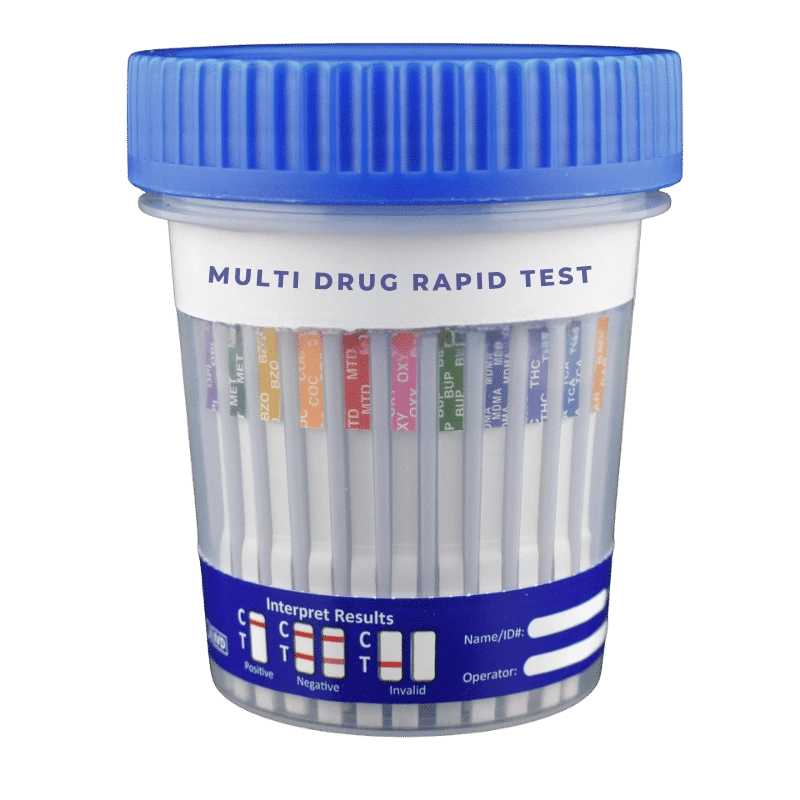
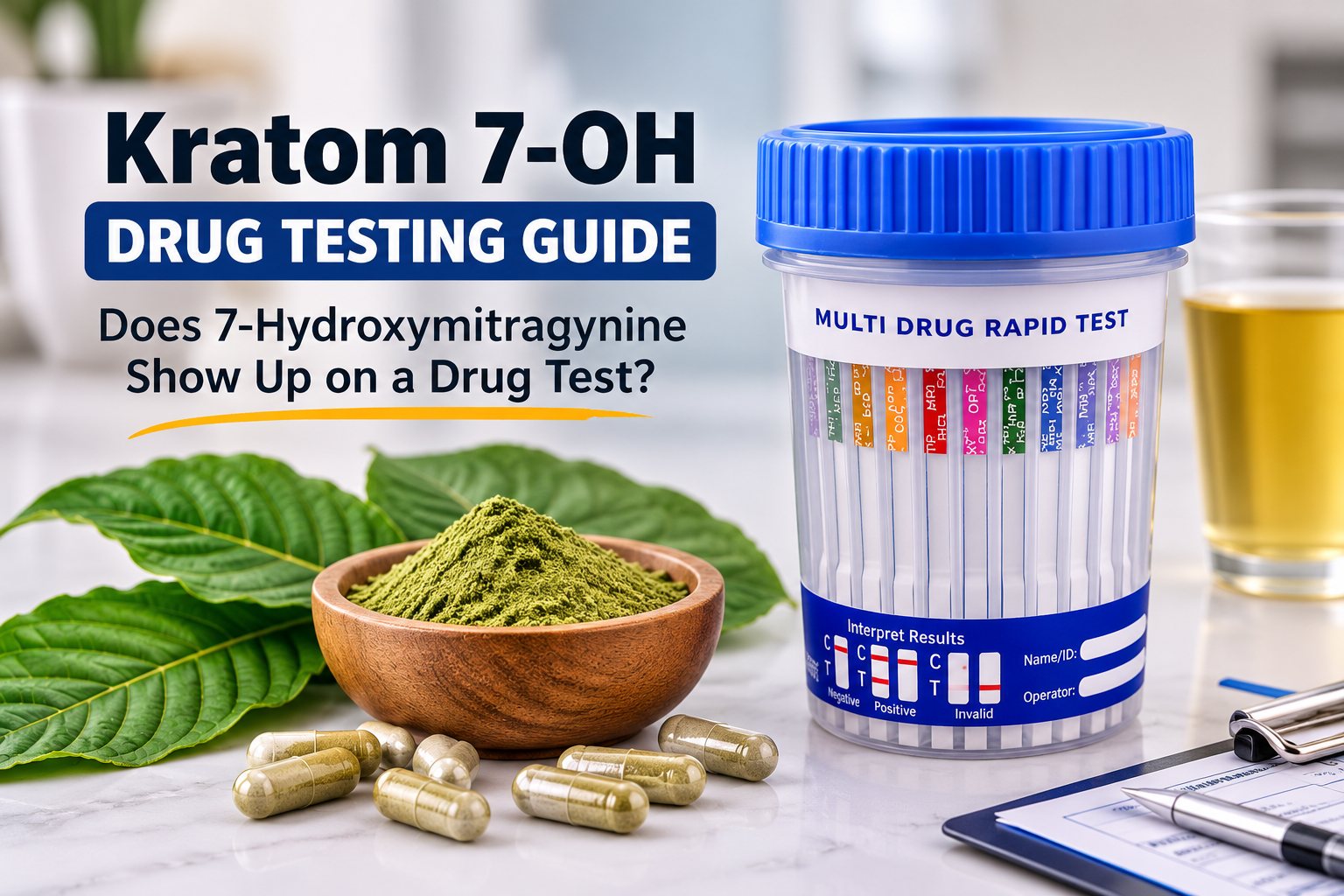
Kratom 7-OH Drug Testing Guide:
If you use kratom or a product marketed as 7-OH (7-hydroxymitragynine), you may wonder whether it will appear on an upcoming drug test.
The short answer: 7-OH and other kratom alkaloids are not routinely included in standard workplace drug panels, such as the commonly used 5-panel tests. However, a laboratory can specifically test for kratom alkaloids when a kratom-specific assay is ordered. Modern laboratory testing can identify mitragynine and 7-hydroxymitragynine using specialized methods such as immunoassay screening followed by liquid chromatography-tandem mass spectrometry (LC-MS/MS).
The important distinction is that “not included in a standard panel” does not mean “undetectable.” Whether 7-OH can be found depends on what the laboratory was asked to test for, the specimen being analyzed, the analytical method, the amount and type of product used, and individual factors affecting drug metabolism.
This guide explains how 7-OH drug testing works, whether it appears on 5-, 10-, or 12-panel tests, how specialized kratom testing differs, detection windows, false positives, DOT testing, and what current laboratory evidence says.
Important: Drug-testing policies and regulations can change. This article provides general educational information and should not be used as legal, employment, medical, or DOT-compliance advice.
Quick Answer: Does 7-OH Show Up on a Drug Test?
Usually, not on a routine standard drug panel.
A typical workplace drug test is designed around a defined list of target substances. If 7-hydroxymitragynine is not one of those target analytes, the laboratory is not automatically looking for it.
However, specialized laboratories can test for kratom alkaloids. For example, Labcorp currently lists a urine kratom test that includes 7-hydroxymitragynine and mitragynine, using an initial immunoassay screen with definitive LC/MS-MS confirmation.
So the most accurate way to think about 7-OH testing is:
Standard panel: generally not targeted
Kratom-specific test: can detect kratom alkaloids
Definitive laboratory testing: can identify specific compounds such as mitragynine and 7-OH
What Is 7-OH?
7-hydroxymitragynine, commonly abbreviated as 7-OH or 7-HMG, is an alkaloid associated with the kratom plant, Mitragyna speciosa.
Kratom contains numerous alkaloids, with mitragynine being one of the major compounds. 7-hydroxymitragynine is present naturally in much smaller amounts in botanical kratom and can also be found at much higher concentrations in some commercial products marketed as concentrated or “7-OH” products.
Research has shown that mitragynine and 7-hydroxymitragynine can be measured in human biological samples using analytical techniques such as LC-MS/MS.
This distinction matters for drug testing because a test may be designed to identify mitragynine, 7-OH, both compounds, or metabolites rather than simply looking for the word “kratom.”
Kratom vs. Mitragynine vs. 7-OH: What’s the Difference?
These terms are related but are not interchangeable.
Kratom
Kratom is the botanical product derived from Mitragyna speciosa. Its leaves contain multiple naturally occurring alkaloids.
Mitragynine
Mitragynine is one of the principal alkaloids found in kratom and has historically been a major target of laboratory kratom testing.
7-Hydroxymitragynine
7-OH is another kratom-related alkaloid. It is chemically distinct from the opioid drugs commonly targeted by standard workplace panels.
Why the distinction matters
A person can use a product marketed as “7-OH” without understanding exactly which compounds the product contains. Laboratory evaluation of commercial products has found that products marketed as high-potency or pure 7-OH may also contain mitragynine. Labcorp notes that its current clinical experience does not commonly show isolated 7-OH detection without mitragynine in clinical testing.
Therefore, a kratom-specific test may target more than one analyte.
Does Kratom Show Up on a Standard Drug Test?
In most cases, kratom is not part of a routine standard drug panel.
Traditional workplace drug testing focuses on specified drug classes rather than every psychoactive substance a person could consume.
For example, federal DOT testing rules identify required drug categories including:
- Marijuana
- Cocaine
- Amphetamines
- Phencyclidine (PCP)
- Opioids
The current DOT regulation does not list kratom, mitragynine, or 7-hydroxymitragynine as required target analytes.
That is why a person can have exposure to kratom or 7-OH without that substance being part of a routine DOT or workplace panel.
However, an employer, treatment program, clinician, forensic laboratory, or other organization may order additional testing outside the standard panel.
Does 7-OH Show Up on a 5-Panel Drug Test?
Generally, no.
A standard 5-panel test is designed to detect specific drug categories rather than kratom alkaloids.
The federal DOT framework, for example, specifies marijuana, cocaine, amphetamines, PCP, and opioids as the required categories.
Because 7-hydroxymitragynine is not one of the standard target analytes, a routine 5-panel test is not designed to identify it.
This is different from saying that a laboratory is incapable of detecting 7-OH. A separate kratom-specific test can be ordered.
Does 7-OH Show Up on a 10-Panel Drug Test?
Usually, no—not unless kratom testing has specifically been added.
A 10-panel test is simply a broader panel than a basic 5-panel test. The exact substances included can vary by laboratory, employer, testing provider, and panel configuration.
Adding more commonly tested drugs does not automatically mean that the laboratory is testing for every emerging or botanical substance.
Therefore, you should not assume:
10-panel = kratom test
Instead, look at the actual test menu or ask the testing provider which analytes are included.
Does 7-OH Show Up on a 12-Panel Drug Test?
A typical 12-panel test is also not automatically a 7-OH test.
The phrase “12-panel” describes the scope of a particular testing package. It does not mean that every possible drug or alkaloid is included.
If a test specifically includes kratom, mitragynine, 7-hydroxymitragynine, or kratom metabolites, then those substances may be detected.
Otherwise, a routine expanded panel may still overlook kratom-related compounds.
This is one reason it is better to ask:
What substances does this specific panel test for?
rather than relying only on the number of panels.
How Is 7-OH Detected?
Specialized kratom testing can use different analytical stages.
1. Immunoassay Screening
An immunoassay is commonly used as an initial presumptive screening test.
Labcorp explains that its kratom testing uses an initial immunoassay at a 5.0 ng/mL threshold.
However, an immunoassay is not necessarily designed to directly measure every individual kratom alkaloid.
Labcorp specifically notes that its kratom immunoassay is not designed to directly detect 7-OH, although commercially available 7-OH products commonly contain mitragynine, which can contribute to a positive kratom screen.
2. Mass Spectrometry Confirmation
When greater specificity is required, laboratories can use mass spectrometry.
Labcorp’s listed urine test uses LC/MS-MS for definitive confirmation, with 7-OH and mitragynine included in the test.
Mass spectrometry is valuable because it can distinguish specific chemical compounds rather than relying only on antibody-based screening.
What Is LC-MS/MS Testing?
LC-MS/MS stands for liquid chromatography-tandem mass spectrometry.
It combines:
- Liquid chromatography, which separates compounds in a biological sample.
- Mass spectrometry, which helps identify and measure the compounds based on their molecular characteristics.
Researchers have used LC-MS/MS methods to measure mitragynine and 7-hydroxymitragynine in human plasma and urine.
This makes LC-MS/MS particularly useful when a laboratory needs to determine whether a sample contains specific kratom alkaloids.
What Types of Samples Can Be Tested for 7-OH?
Depending on the laboratory and purpose of testing, kratom-related compounds may be investigated in several specimen types.
Urine
Urine is one of the most practical specimens for drug testing because compounds and their metabolites can remain detectable after blood concentrations have declined.
Research has demonstrated the ability to identify mitragynine and 7-hydroxymitragynine in human urine using chromatographic and mass-spectrometric methods.
Labcorp also currently offers a urine kratom screen and confirmation test that includes 7-OH and mitragynine.
Blood
Blood testing can measure recent exposure and is useful in some clinical and research settings.
Human pharmacokinetic studies have measured both mitragynine and 7-OH in plasma after kratom administration.
Because blood concentrations generally change more quickly than urinary concentrations, blood is not simply interchangeable with urine testing.
Oral Fluid or Saliva
Oral-fluid testing is another possible specimen type, but availability depends on the laboratory and the exact assay.
A specialized test would be needed if the purpose is specifically to identify kratom alkaloids.
Hair
Hair testing can provide a much longer historical window for some substances, but 7-OH-specific hair testing is not equivalent to routine workplace hair testing.
The fact that a compound can theoretically be analyzed in hair does not mean that every commercial hair panel includes it.
How Long Does 7-OH Stay in Your System?
There is no single guaranteed detection window for 7-OH.
This is one area where many online articles oversimplify the science.
Detection depends on:
- Dose
- Product potency
- Whether the product contained 7-OH, mitragynine, or both
- Frequency of use
- Single vs. repeated exposure
- Individual metabolism
- Liver function
- Kidney function
- The specimen tested
- Laboratory method
- Test cutoff
- Whether the assay measures the parent compound or metabolites
Human pharmacokinetic research has found substantial differences between mitragynine and 7-OH.
One controlled human study found mean 7-OH half-lives of approximately 4.7 hours after a single dose and 24.7 hours after repeated daily dosing, while mitragynine showed longer half-lives under the study conditions.
Another human study of chronic kratom users reported a terminal mitragynine half-life of about one day, with considerable individual variation.
These pharmacokinetic results should not be converted directly into a guaranteed urine or blood detection window.
Why?
A drug’s half-life tells you how quickly its concentration declines. A drug test, however, asks whether the concentration or a relevant metabolite remains above a particular analytical threshold.
Therefore:
Half-life ≠ exact drug-test detection time.
7-OH Detection Window by Test Type
Because 7-OH-specific detection data are still developing, it is better to describe detection windows as approximate rather than guaranteed.
| Test type | What it can tell you | General consideration |
|---|---|---|
| Urine | Recent-to-past exposure through analytes/metabolites | Often more useful than blood for routine drug testing |
| Blood | More recent exposure | Usually a shorter detection period than urine |
| Oral fluid | Relatively recent exposure | Requires a suitable specialized assay |
| Hair | Potential longer-term exposure history | Not part of ordinary 7-OH workplace panels |
Some commercial and treatment-oriented sources cite several days for urine detection, but the exact window varies considerably. A positive or negative result depends on the actual laboratory method and cutoff rather than a fixed number of days.
For that reason, claims such as “7-OH is always gone in exactly X days” should be treated cautiously.
Why Can Detection Last Longer After Repeated Use?
Repeated dosing can produce different pharmacokinetics from a single dose.
A human study found that steady-state concentrations were reached after repeated daily administration and that the apparent half-life of mitragynine increased under repeated-dose conditions. The study also observed different 7-OH kinetics after multiple doses.
This means someone using a concentrated kratom product repeatedly may not have the same elimination pattern as someone exposed once.
That is why frequency of use matters when interpreting a drug test.
Can 7-OH Cause a False Positive on a Drug Test?
A standard drug test should not automatically report 7-OH as one of its targeted drugs simply because someone used 7-OH.
However, cross-reactivity can occur with some immunoassays, and unexpected results should be interpreted carefully.
Labcorp notes that presumptive kratom immunoassay testing can have false-positive situations and that definitive mass-spectrometry testing is available when appropriate.
This leads to an important distinction:
Screening result
A screening immunoassay may indicate that a target class is presumptively present.
Confirmatory result
Definitive testing using a more specific analytical method can determine whether the relevant compound is actually present.
If a result has significant employment, medical, legal, or treatment consequences, confirmation may be important.
Can 7-OH Cause a False Positive for Opioids?
7-OH is pharmacologically opioid-active, but that does not mean it automatically triggers a standard opioid screen.
Drug tests do not simply ask whether a substance has opioid effects. They use analytical targets and antibodies designed to recognize particular chemical compounds or metabolites.
The standard DOT opioid category includes specified substances such as codeine, morphine, 6-acetylmorphine, hydrocodone, hydromorphone, oxycodone, and oxymorphone.
Kratom alkaloids are not simply interchangeable with those targets.
Therefore:
Opioid-like effect ≠ automatically detected as an opioid on a standard panel.
What About DOT Drug Testing?
This is especially important for commercial drivers and other safety-sensitive transportation workers.
Under the current DOT framework, the required drug categories include:
- Marijuana
- Cocaine
- Amphetamines
- PCP
- Opioids
The federal DOT testing rules do not list kratom or 7-OH as standard DOT drug-testing analytes.
Therefore, a standard DOT drug test is not a dedicated kratom/7-OH test.
However, passing a drug screen does not automatically mean that using a substance is safe, permitted by an employer, or compatible with a person’s medical or occupational requirements.
Those are separate questions.
Can an Employer Order a Separate Kratom Test?
Potentially, depending on the employer, applicable law, testing policy, and circumstances.
A standard panel and an employer’s overall drug-testing program are not necessarily identical.
An employer may use:
- A standard panel
- An expanded panel
- A custom panel
- A specialized kratom test
- A laboratory add-on test
The safest way to determine what a specific workplace test includes is to review the employer’s written testing policy or ask the testing provider.
Do not assume that a “10-panel” or “12-panel” label tells you everything about the actual analytes.
What Does a Specialized Kratom Drug Test Look For?
A specialized test may target:
- Mitragynine
- 7-hydroxymitragynine
- Kratom metabolites
- Related kratom alkaloids
The exact analytes depend on the laboratory.
For example, Labcorp’s current urine kratom test specifically lists 7-hydroxymitragynine and mitragynine among the compounds included. Its methodology uses an initial immunoassay screen followed by definitive LC/MS-MS confirmation.
This is substantially different from a routine 5-panel workplace test.
What Factors Affect a 7-OH Drug Test Result?
Several factors can affect whether a specialized test detects kratom-related compounds.
1. Amount Used
Higher exposure can produce higher concentrations and potentially a longer period during which a test can detect the analyte.
2. Frequency of Use
Repeated or daily exposure can produce different pharmacokinetic behavior than a single dose.
3. Product Composition
A product labeled “7-OH” may contain other kratom alkaloids, including mitragynine. Commercial product composition can vary.
4. Metabolism
People eliminate substances at different rates.
5. Liver and Kidney Function
These organs play important roles in drug metabolism and elimination.
6. Test Sensitivity
Different laboratories use different methods and analytical thresholds.
7. Specimen Type
Urine, blood, oral fluid, and hair provide different detection characteristics.
8. Time Since Last Exposure
The longer the interval after use, the more likely concentrations may fall below a test’s analytical threshold.
Is 7-OH the Same as an Opioid Drug?
Not chemically.
7-hydroxymitragynine is a kratom-related alkaloid with opioid-receptor activity, but standard opioid drug-testing panels are built around specific target substances.
Research has characterized 7-OH as pharmacologically active at the mu-opioid receptor, while laboratory testing treats it as a distinct analytical compound.
This distinction explains why something can have opioid-like pharmacological effects without automatically being included in a standard opioid immunoassay.
What Is the Difference Between Presumptive and Definitive Testing?
This is an important concept in drug testing.
Presumptive testing
Usually performed using an immunoassay.
It is designed to rapidly identify whether a target or drug class may be present.
Definitive testing
Often performed using a mass-spectrometry technique such as LC-MS/MS.
It is more specific and can identify individual compounds.
For kratom testing, Labcorp describes immunoassay as an initial presumptive method and LC/MS-MS as the definitive confirmation method.
Can a Drug Test Tell Whether Someone Used Kratom or Pure 7-OH?
Not always from a single screening result.
This depends on the test’s analytes.
If a test only screens for mitragynine, it may indicate exposure to a kratom product containing mitragynine but may not establish exactly which commercial product was consumed.
A more comprehensive analytical test can examine multiple compounds, including 7-OH.
This is particularly relevant because products marketed as “7-OH” may contain mixtures of alkaloids rather than a single isolated compound. Labcorp has reported that commercial 7-OH products commonly contain mitragynine.
What Happens If a Specialized Kratom Test Is Positive?
A positive specialized test means that the laboratory detected the target compound or compounds according to that test’s methodology and cutoff.
The meaning of the result depends on the context.
For example:
- A clinical test may help a healthcare professional assess exposure.
- A treatment program may use it to monitor abstinence.
- A forensic test may have different evidentiary requirements.
- An employer test may be governed by workplace policy.
- A DOT test follows federal transportation rules.
A laboratory result alone does not determine the employment or legal consequence. Those consequences depend on the applicable policy and jurisdiction.
Does a Negative Standard Drug Test Mean There Is No 7-OH in the Body?
No.
A negative standard drug test means the tested substances were not detected according to that panel’s rules and analytical thresholds.
It does not necessarily mean that every possible drug, medication, supplement, or botanical compound is absent.
For example, if a routine panel does not include 7-OH, a negative result cannot be interpreted as proof that 7-OH was not present.
This is one of the most important concepts in understanding drug-test results.
Does a 5-Panel Test Detect Kratom?
Generally, no.
A standard 5-panel test is designed around its specified drug categories. Kratom and its alkaloids are not standard required targets under the federal DOT panel.
However, a separate kratom test can be ordered.
Does a 10-Panel Test Detect Kratom?
Usually not unless the specific panel has been customized to include kratom-related analytes.
The number “10” does not automatically mean that kratom is included.
Always check the actual analyte list.
Does a 12-Panel Test Detect 7-OH?
Not automatically.
A 12-panel test may cover more substances than a 5-panel test, but 7-OH requires a specific analytical target.
If the laboratory’s panel does not include 7-hydroxymitragynine or another kratom-related target, the test is not designed to identify it.
Does 7-OH Show Up on a Military Drug Test?
There is no universal answer based solely on the phrase “military drug test.”
Military testing programs can have specific policies, panels, and testing procedures that may differ from ordinary civilian workplace testing.
The correct approach is to identify the actual test panel and policy being used rather than assuming that a standard civilian 5-panel applies.
Does 7-OH Show Up on a Probation or Treatment Drug Test?
It can, if the program specifically orders kratom testing.
Treatment programs may use expanded or customized toxicology testing when monitoring substances that are not included in routine workplace panels.
Similarly, probation or forensic testing may involve broader laboratory analysis depending on the court order, agency policy, or laboratory contract.
Therefore, someone should not assume that a standard employment panel is the same as a treatment or forensic panel.
Current 7-OH Regulatory Status
The legal status of concentrated 7-OH products is an evolving issue in the United States.
On July 1, 2026, the DEA announced that it had filed notices of intent to temporarily place 7-hydroxymitragynine above a specified threshold, along with several related substances, into Schedule I. DEA stated that the action was aimed at concentrated/synthetic or elevated-7-OH products and that naturally occurring 7-OH in botanical kratom below the specified threshold was not covered by that temporary scheduling action.
The Federal Register notice describes the temporary scheduling process and states that a temporary scheduling order would take effect upon publication of the order.
Because this regulatory situation is changing, do not rely on an older article to determine whether a particular 7-OH product is currently legal in your state or under federal law.
Drug-testing policy and legal status are also separate issues: a substance can be absent from a particular workplace panel while still being subject to separate workplace, medical, or legal restrictions.
Why 7-OH Testing Is Becoming More Relevant
Several developments have increased interest in specialized kratom testing.
First, concentrated 7-OH products have become more widely marketed.
Second, laboratories have developed more specific methods for identifying kratom alkaloids.
Third, clinicians, treatment programs, employers, and forensic professionals may encounter kratom exposure more frequently.
Finally, laboratory science now allows researchers and clinical laboratories to distinguish compounds such as mitragynine and 7-OH rather than treating kratom as an unmeasurable botanical substance.
Labcorp’s current testing information illustrates this development: its listed urine test includes both mitragynine and 7-OH and uses immunoassay screening with LC/MS-MS confirmation.
7-OH Drug Testing: Standard vs. Specialized Testing
| Feature | Standard Drug Panel | Specialized Kratom Testing |
|---|---|---|
| 7-OH specifically targeted | Usually no | Yes, when included |
| Mitragynine targeted | Usually no | Yes, depending on assay |
| 5-panel test | Not designed for 7-OH | Separate test required |
| 10-panel test | Usually not automatically | Can be added separately |
| 12-panel test | Usually not automatically | Can be included if ordered |
| DOT standard panel | Does not list kratom/7-OH | Separate non-standard testing |
| Immunoassay | Common for standard screening | May be used for kratom screening |
| LC-MS/MS | Used for confirmation when required | Can identify specific kratom alkaloids |
| Urine testing | Common specimen | Common specialized specimen |
| Exact detection time | Varies by drug | Varies by analyte, assay, and exposure |
How to Read a 7-OH Drug Test Result
If your report specifically mentions 7-hydroxymitragynine, 7-OH, or mitragynine, look for:
- Specimen type
- Analyte name
- Screening method
- Confirmation method
- Cutoff or reporting threshold
- Result value, if provided
- Units
- Reference range
- Whether the result was presumptive or confirmed
Do not interpret the result solely from the word “positive.”
For example, a presumptive immunoassay result and a definitive LC-MS/MS result are not analytically identical.
What Should You Do If You Get an Unexpected Positive?
If a specialized kratom test is unexpectedly positive, consider asking the laboratory or healthcare professional:
- Which analyte was detected?
- Was the result a screening result or a confirmed result?
- What method was used?
- What cutoff or reporting threshold applies?
- Was mitragynine detected, 7-OH detected, or both?
- Was definitive confirmation performed?
For an employment, legal, medical, or DOT-related result, use the appropriate qualified professional rather than trying to interpret a laboratory report from an online detection-time chart.
Key Takeaways
If you remember only a few points from this Kratom 7-OH drug testing guide, remember these:
- 7-OH is not routinely included in standard drug panels.
- A standard 5-panel test is not designed to detect 7-OH.
- A 10-panel or 12-panel test does not automatically include kratom.
- DOT’s required drug categories do not list kratom or 7-OH as standard targets.
- Specialized laboratories can test for mitragynine and 7-OH.
- Labcorp currently lists a urine kratom test that includes 7-hydroxymitragynine and mitragynine.
- Immunoassay can be used for presumptive screening, while LC/MS-MS can provide definitive confirmation.
- There is no universal guaranteed 7-OH detection window.
- Detection depends on the specimen, assay, cutoff, dose, frequency of use, product composition, and individual metabolism.
- A negative standard drug test does not prove that 7-OH is absent if the test did not target it.
- Regulatory developments involving concentrated 7-OH products are evolving, so current official sources should be checked for legal questions.
Frequently Asked Questions About Kratom and 7-OH Drug Testing
Does 7-OH show up on a regular drug test?
Usually not. Standard drug tests are designed to detect a defined group of substances, and 7-OH is generally not part of routine workplace panels. A specialized kratom test can specifically look for 7-OH and/or mitragynine.
Does 7-OH show up on a 5-panel drug test?
Generally no. The standard federal DOT panel targets marijuana, cocaine, amphetamines, PCP, and specified opioids rather than 7-OH or kratom.
Does 7-OH show up on a 10-panel drug test?
Not automatically. A 10-panel test does not necessarily include kratom alkaloids. Check the laboratory’s actual analyte list.
Does 7-OH show up on a 12-panel drug test?
Not necessarily. The number of substances in a panel does not mean that 7-OH is included. A separate kratom-specific test may be required.
Can a specialized drug test detect 7-OH?
Yes. Specialized laboratory methods can identify 7-hydroxymitragynine. Labcorp’s listed urine kratom test includes 7-OH and mitragynine and uses LC/MS-MS confirmation.
How long can 7-OH be detected in urine?
There is no universally reliable number of days. Detection depends on the assay, cutoff, dose, frequency of use, product composition, metabolism, and whether the laboratory measures 7-OH, mitragynine, or metabolites.
Can kratom cause a false positive?
Some immunoassays can experience cross-reactivity, which is why unexpected presumptive results may require definitive confirmation. Labcorp specifically notes that false positives can occur with kratom immunoassay screening.
Can 7-OH cause a false positive for opioids?
Not simply because it has opioid-receptor activity. Standard drug tests detect specific target compounds, and 7-OH is chemically distinct from the specified opioid analytes used in standard panels.
Does DOT test for kratom?
Kratom and 7-OH are not listed among the standard required DOT drug categories. A separate test may be possible outside the standard DOT panel depending on the circumstances and applicable policy.
Can an employer test specifically for kratom?
An employer may have additional testing policies or use a specialized test depending on applicable law and workplace rules. The exact policy matters more than whether a test is called a “5-panel” or “10-panel.”
Is mitragynine the same as 7-OH?
No. Both are kratom-related alkaloids, but they are different compounds. Mitragynine is a major kratom alkaloid, while 7-hydroxymitragynine is a distinct alkaloid/metabolite with different pharmacokinetic characteristics.
Can a laboratory test for both mitragynine and 7-OH?
Yes. Some specialized laboratory tests are designed to include both compounds. Labcorp’s current urine test specifically lists both 7-hydroxymitragynine and mitragynine.
Is 7-OH currently regulated in the United States?
The federal regulatory status is evolving. The DEA announced in July 2026 that it had initiated temporary scheduling action targeting 7-OH above a specified threshold and certain related substances. The scope and effective status should be verified using current federal sources.
Final Answer
The most accurate answer to “Does 7-OH show up on a drug test?” is:
Not usually on a standard drug test, but yes, 7-OH can be detected when a laboratory specifically tests for kratom alkaloids.
A routine 5-panel, and many broader workplace panels, are not designed to identify 7-hydroxymitragynine. Specialized kratom testing is different: laboratories can use immunoassay screening and definitive mass-spectrometry methods to identify mitragynine and 7-OH in biological specimens.
The key is therefore not simply “Will 7-OH show up?” but “What substances does this specific test actually target?”
Because drug-testing policies, laboratory methods, and 7-OH regulations continue to evolve, always rely on the actual laboratory panel and current official requirements when the result could affect employment, medical care, legal status, or professional licensing.