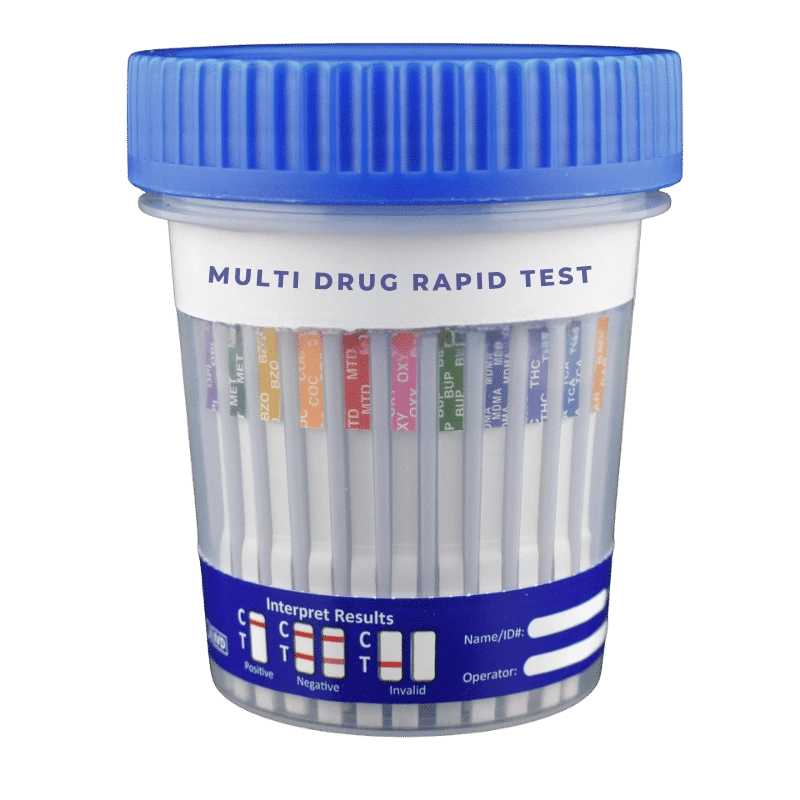
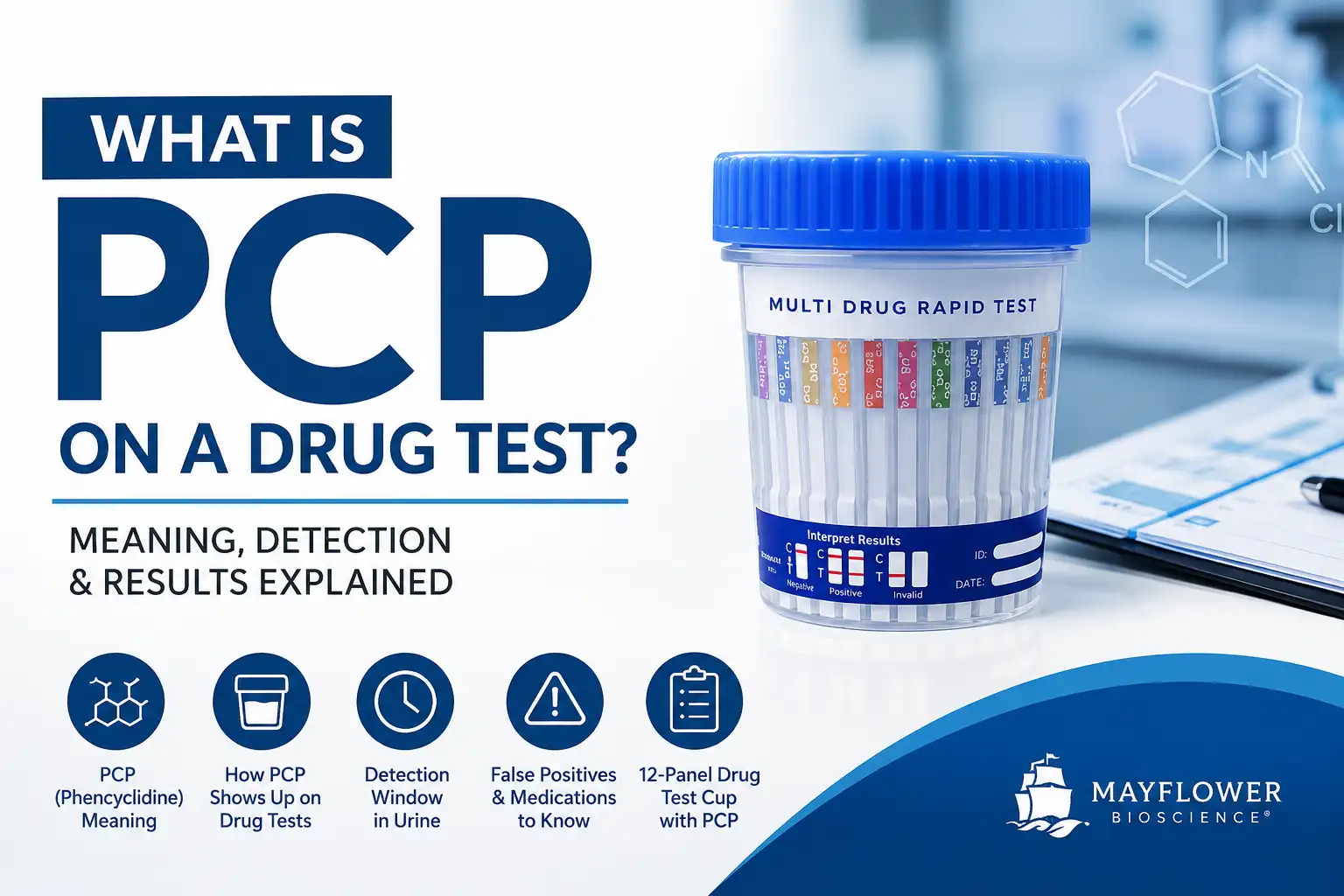
What Is PCP on a Drug Test? Meaning, Detection & Results
What Is PCP on a Drug Test?
PCP on a drug test refers to phencyclidine, a dissociative drug that can be included as a target analyte in urine drug screening panels. PCP is also commonly known as “angel dust.” When a drug test includes a PCP panel, the test is designed to detect PCP or relevant target compounds at or above its specified screening cutoff.
Not every drug test includes PCP, so the specific substances being screened depend on the test panel and its configuration. For example, PCP is one of the five drug categories included in the current U.S. Department of Transportation (DOT) drug-testing panel.
For a rapid urine screening cup, a result for PCP is generally a preliminary screening result, not by itself a definitive laboratory confirmation. If a screening result is presumptively positive, confirmatory testing may be appropriate depending on the testing program and its requirements.
In simple terms:
PCP on a drug test means the test has a specific PCP/phencyclidine screening component. A positive screening result means the specimen produced a response at or above the test’s established cutoff; it does not by itself establish confirmed PCP use.
What Does PCP Stand for on a Drug Test?
PCP stands for phencyclidine.
You may see the abbreviation PCP on a drug test cup, test panel, laboratory report, or drug-testing documentation.
PCP is also referred to as:
- Phencyclidine
- Angel Dust
- PCP
- Phencyclidine hydrochloride
Phencyclidine is classified as a dissociative drug and can affect the central nervous system. MedlinePlus describes PCP as a mind-altering substance and identifies “angel dust” as one of its common names.
PCP vs. Other Drug-Test Abbreviations
A drug test may use abbreviations to identify different drug classes or analytes. For example:
| Abbreviation | Drug / drug class |
|---|---|
| PCP | Phencyclidine |
| THC | Cannabinoids |
| COC | Cocaine |
| AMP | Amphetamine |
| MET | Methamphetamine |
| BZO | Benzodiazepines |
| OPI | Opiates |
| OXY | Oxycodone |
| MTD | Methadone |
| BUP | Buprenorphine |
| MDMA | Methylenedioxymethamphetamine |
| BAR | Barbiturates |
The exact configuration varies by product.
What Is a PCP Drug Test?
A PCP drug test is a screening test designed to identify the presence of phencyclidine in a biological specimen, most commonly urine in rapid multi-panel screening products.
PCP testing can be performed as part of:
- Multi-panel urine drug screening
- Workplace drug testing
- Occupational health testing
- Clinical drug screening
- Rehabilitation programs
- Probation and correctional testing
- Pre-employment screening
- Other professional testing programs
The type of testing required depends on the purpose of the program.
A rapid urine cup uses an immunoassay screening method, while laboratory confirmation can use more specific analytical techniques such as GC-MS or LC-MS/MS. The Mayflower 12-panel cup is specifically described as a rapid urine screening device using immunoassay technology and producing preliminary results in approximately five minutes.
How Does a PCP Drug Test Work?
A rapid urine PCP test uses antibodies designed to react with the target analyte at a predetermined concentration.
The basic process is:
Urine specimen → PCP screening panel → immunoassay reaction → visual result → interpretation
The test has a predefined cutoff concentration.
If the target response meets the test’s criteria, the result can be interpreted as a presumptive positive according to the manufacturer’s instructions. If the response does not meet that threshold, the result is interpreted as negative.
This distinction is important:
Screening is not the same as confirmation.
A rapid immunoassay is intended to screen a specimen. A laboratory confirmation uses a more specific analytical method when confirmation is required.
For regulated DOT urine testing, for example, the current federal rule specifies PCP at an initial urine cutoff of 25 ng/mL and a confirmatory cutoff of 25 ng/mL.
Does Every Drug Test Test for PCP?
No.
There is no single universal drug test that includes exactly the same substances.
The drugs tested depend on:
- The panel selected
- The manufacturer’s configuration
- The intended testing application
- The specimen type
- The applicable testing program
- The required cutoff levels
For example, the DOT’s regulated five-drug categories include:
This means that PCP is included in the DOT five-panel category, but you should not assume that every consumer, workplace, clinical, or over-the-counter drug test contains PCP.
How to know whether a test includes PCP
Look at the manufacturer’s analyte list or product specification.
If PCP / phencyclidine appears in the list, the test is configured to screen for PCP.
Does a 5-Panel Drug Test Include PCP?
Yes, in the DOT-regulated five-panel drug-testing program, PCP is one of the five required drug categories.
The U.S. Department of Transportation identifies the five categories as marijuana, cocaine, amphetamines, opioids, and phencyclidine (PCP).
However, the term “5-panel” should always be interpreted in context, because non-regulated commercial products may use different configurations.
This is why checking the actual analyte list is more reliable than choosing a product based solely on the number of panels.
What Does PCP Show Up as on a Drug Test?
PCP may appear as:
PCP
or as:
Phencyclidine
on testing documentation.
On a rapid multi-panel cup, each test strip or panel may be labeled using an abbreviation.
For example:
PCP = Phencyclidine
The result should then be interpreted according to the specific manufacturer’s instructions and reading window.
What Does a Positive PCP Drug Test Mean?
A presumptive positive PCP screening result means the specimen produced a test response consistent with the presence of the target at or above the test’s established screening cutoff.
It does not automatically mean that PCP use has been definitively confirmed.
This distinction matters because rapid immunoassays can experience cross-reactivity, which can occasionally produce presumptive positive results from substances other than the intended target.
For that reason, unexpected or consequential positive screening results may require laboratory confirmation using a more specific analytical method.
Mayo Clinic Laboratories, for example, lists a dedicated PCP confirmation urine test, while DOT regulations distinguish between initial and confirmatory testing.
What Does a Negative PCP Drug Test Mean?
A negative PCP screening result generally means that the specimen did not produce a response at or above the test’s established cutoff under the test’s specified conditions.
It does not necessarily mean that PCP has never been present in the body.
The result can be affected by factors such as:
- Detection window
- Amount of substance present
- Timing of specimen collection
- Individual metabolism
- Test sensitivity
- Cutoff concentration
- Specimen characteristics
- Test procedure
Therefore, a negative result should be interpreted in the context of the specific test and testing program.
How Long Does PCP Stay Detectable in Urine?
There is no single detection window that applies to every person.
Mayo Clinic Laboratories lists an approximate urine detection time for PCP of up to 8 days using its laboratory testing parameters and notes that actual detection depends on factors including dose, frequency of use, and individual metabolism.
The current Mayflower product page gives a broader estimated urine detection window of 7–14 days, while also noting that detection can vary according to factors such as frequency of use, dosage, metabolism, hydration, body composition, kidney function, and overall health.
Why do detection estimates differ?
Because a detection window is not a fixed expiration time.
Different studies and testing methods may use different:
- Cutoffs
- Analytical methods
- Specimens
- Study populations
- Detection criteria
For this reason, avoid presenting a statement such as:
“PCP always stays in urine for exactly X days.”
A more scientifically accurate statement is:
PCP may remain detectable in urine for several days, but the actual detection period varies with the individual and the testing method.
What Is the PCP Cutoff Level on a Drug Test?
A cutoff concentration is the predefined level used by a drug-testing method to distinguish a negative screening result from a presumptive positive result.
For PCP, 25 ng/mL is an important reference point in regulated U.S. urine testing.
The DOT’s current urine-testing rule specifies:
| Testing stage | PCP cutoff |
|---|---|
| Initial test | 25 ng/mL |
| Confirmatory test | 25 ng/mL |
The Mayflower 12-panel PCP cup also lists PCP/25 ng/mL as its PCP cutoff.
Important distinction
A cutoff is not the same thing as a measure of impairment.
It is a testing threshold used by the particular analytical or screening method.
Can a PCP Drug Test Have a False Positive?
Yes. Preliminary urine immunoassay screens can produce false-positive PCP results because of cross-reactivity with certain substances.
Published medical literature has reported PCP false-positive results associated with medications and other substances including:
- Venlafaxine
- Desvenlafaxine
- Dextromethorphan
- Tramadol
- Diphenhydramine
- Other compounds depending on the assay used
The evidence is assay-dependent, so it would be inaccurate to claim that taking one of these substances will automatically cause a PCP positive.
For example, current venlafaxine labeling warns that false-positive urine immunoassay results for PCP have been reported and explains that confirmatory testing such as GC/MS can distinguish venlafaxine from PCP.
Medical literature has also documented false-positive PCP immunoassay results associated with venlafaxine and desvenlafaxine.
What Medications Can Cause a False Positive for PCP?
Some substances have been reported to cause false-positive PCP immunoassay results, but the effect depends on the particular testing method.
Venlafaxine
Venlafaxine is one of the best-documented examples.
The FDA-approved labeling states that false-positive urine immunoassay screening tests for PCP have been reported in patients taking venlafaxine and recommends confirmatory testing to distinguish venlafaxine from PCP.
Desvenlafaxine
Desvenlafaxine, an active metabolite of venlafaxine, has also been associated with reported false-positive PCP immunoassay results.
Other reported substances
Medical literature has reported possible PCP immunoassay cross-reactivity involving substances such as:
- Dextromethorphan
- Tramadol
- Diphenhydramine
- Ibuprofen
- Imipramine
- Ketamine
- Lamotrigine
However, the presence of one of these substances does not prove that a PCP result is false. The particular assay, concentration and testing circumstances matter.
What Should You Do After an Unexpected Positive PCP Screen?
If a rapid screening test produces an unexpected positive result, the appropriate next step depends on the testing program.
A typical professional testing workflow is:
Initial screen
↓
Presumptive positive
↓
Laboratory confirmation when required
↓
Specific analytical identification
Methods such as GC-MS or LC-MS/MS can provide much more specific identification than an initial immunoassay screen.
This distinction is especially important when a result could affect:
- Employment
- Medical treatment
- Legal proceedings
- Probation
- Workplace status
- Other consequential decisions
The Mayflower product page itself describes its cup as a preliminary screening device and recommends laboratory confirmation of presumptive positive results.
What Is a 12-Panel Drug Test With PCP?
A 12-panel drug test with PCP combines multiple drug screening panels into a single urine-testing device and specifically includes PCP/phencyclidine as one of its targets.
The Mayflower BioScience 12 Panel Drug Test Cup with PCP is configured to screen for these 12 targets:
| Abbreviation | Target |
|---|---|
| AMP | Amphetamine |
| BAR | Barbiturates |
| BZO | Benzodiazepines |
| BUP | Buprenorphine |
| COC | Cocaine |
| MDMA | MDMA |
| MET | Methamphetamine |
| MTD | Methadone |
| OPI | Opiates |
| OXY | Oxycodone |
| PCP | Phencyclidine |
| THC | Cannabinoids |
The product specification lists a 25 ng/mL PCP cutoff, urine specimen, rapid immunoassay technology and approximately five-minute result time.
Why Use a 12-Panel Drug Test With PCP?
A multi-panel test can be useful when the testing requirement involves multiple drug classes rather than PCP alone.
The Mayflower cup combines:
- Urine collection
- 12 drug screening panels
- PCP screening
- Integrated temperature strip
- Leak-resistant collection cup
- Rapid preliminary results
- No separate analyzer for the screening procedure
According to the product specifications, results develop in approximately five minutes and the device is intended for professional drug screening applications.
Who may use a multi-panel PCP test?
Potential professional applications include:
- Workplace drug screening
- Occupational health
- Healthcare facilities
- Rehabilitation centers
- Staffing agencies
- Probation programs
- Correctional facilities
- Professional drug-testing providers
The appropriate product and testing procedure should always be selected according to the requirements of the specific program.
12-Panel Drug Test With PCP vs. a Standard 5-Panel
The main difference is the number and configuration of drug targets.
A regulated DOT five-panel includes PCP along with marijuana metabolites, cocaine metabolites, amphetamines and opioids.
A 12-panel product can screen for a broader set of targets in a single urine specimen.
For example, the Mayflower 12-panel PCP cup includes PCP alongside amphetamine, barbiturates, benzodiazepines, buprenorphine, cocaine, MDMA, methamphetamine, methadone, opiates, oxycodone and THC.
Which one should you choose?
The correct panel depends on what your testing program needs to screen for.
If the requirement is specifically for the DOT-regulated testing program, the applicable DOT procedures and laboratory requirements must be followed.
If the objective is broader multi-drug screening, a 12-panel configuration may provide additional targets in one device.
Mayflower BioScience 12 Panel Drug Test Cup With PCP
If you need a multi-panel urine screening device that includes PCP, Mayflower BioScience offers a 12-panel cup specifically configured for PCP screening.
The product includes:
- 12 drug targets
- PCP/phencyclidine screening
- 25 ng/mL PCP cutoff
- Rapid immunoassay technology
- Approximately 5-minute preliminary results
- Integrated urine collection
- Built-in temperature strip
- Leak-resistant cup
- CLIA-waived positioning
- FDA-cleared positioning as stated by the manufacturer
- Bulk pricing
The manufacturer lists the product from $3.70 per cup at 4,000+ units and states that volume discounts are available.
View the 12 Panel Drug Test Cup With PCP
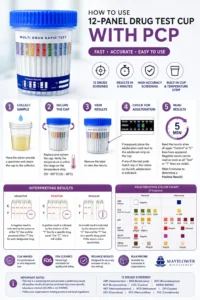
How to Read a PCP Result on a Rapid Drug Test Cup
Always follow the specific instructions supplied with the test, because interpretation can vary by device.
For the Mayflower product, the manufacturer’s instructions state:
Negative
A control line and test line are visible for the relevant panel.
Presumptive Positive
The control line appears, but the test line for the relevant drug panel is absent.
Invalid
The control line does not appear.
An unexpected presumptive positive should be handled according to the applicable testing protocol and confirmed by an appropriate laboratory method when required.
PCP Drug Test FAQs
What does PCP stand for on a drug test?
PCP stands for phencyclidine. It is the abbreviation commonly used for phencyclidine on drug-testing panels.
Does PCP show up on a drug test?
Yes, if the test panel is configured to screen for PCP. PCP is included in the federally regulated DOT five-drug categories.
Does a 5-panel drug test include PCP?
The DOT-regulated five-panel includes PCP. Commercial test products can have different configurations, so always verify the manufacturer’s analyte list.
How long does PCP stay in urine?
Detection varies. Mayo Clinic Laboratories gives an approximate urine detection time of up to 8 days under its testing parameters, while product-specific estimates can be broader.
What can cause a false positive for PCP?
Certain medications and other substances have been associated with false-positive PCP immunoassay results, including venlafaxine and some other compounds. Confirmatory testing can help distinguish PCP from cross-reactivity.
Can venlafaxine cause a false-positive PCP test?
Yes. False-positive PCP urine immunoassay results have been reported with venlafaxine, and FDA-approved labeling warns about this possibility.
What is the PCP cutoff on a drug test?
A 25 ng/mL PCP cutoff is used for initial and confirmatory urine testing under current DOT regulations, and the Mayflower 12-panel PCP cup also lists a 25 ng/mL PCP cutoff.
Is a rapid PCP drug test a laboratory confirmation?
No. A rapid immunoassay provides a screening result. A presumptive positive may require laboratory confirmation using a more specific analytical method.
What is a 12-panel drug test with PCP?
It is a multi-drug urine screening device configured to test for 12 targets, including PCP/phencyclidine. Mayflower’s product specifically lists PCP among its 12 panels and 14 panels.
Key Takeaway
PCP on a drug test means phencyclidine is one of the substances being screened for. PCP may be included in five-panel and broader multi-panel testing, but the exact analytes depend on the test configuration. A rapid urine immunoassay provides a preliminary screening result, and unexpected positive results may require laboratory confirmation.
For organizations looking for broader urine screening that includes PCP, the Mayflower BioScience 12 Panel Drug Test Cup with PCP combines PCP screening with 11 additional drug targets in one collection and screening device.