12 vs 14 Panel Drug Test: Key Differences, Drug Lists & Which Is Better
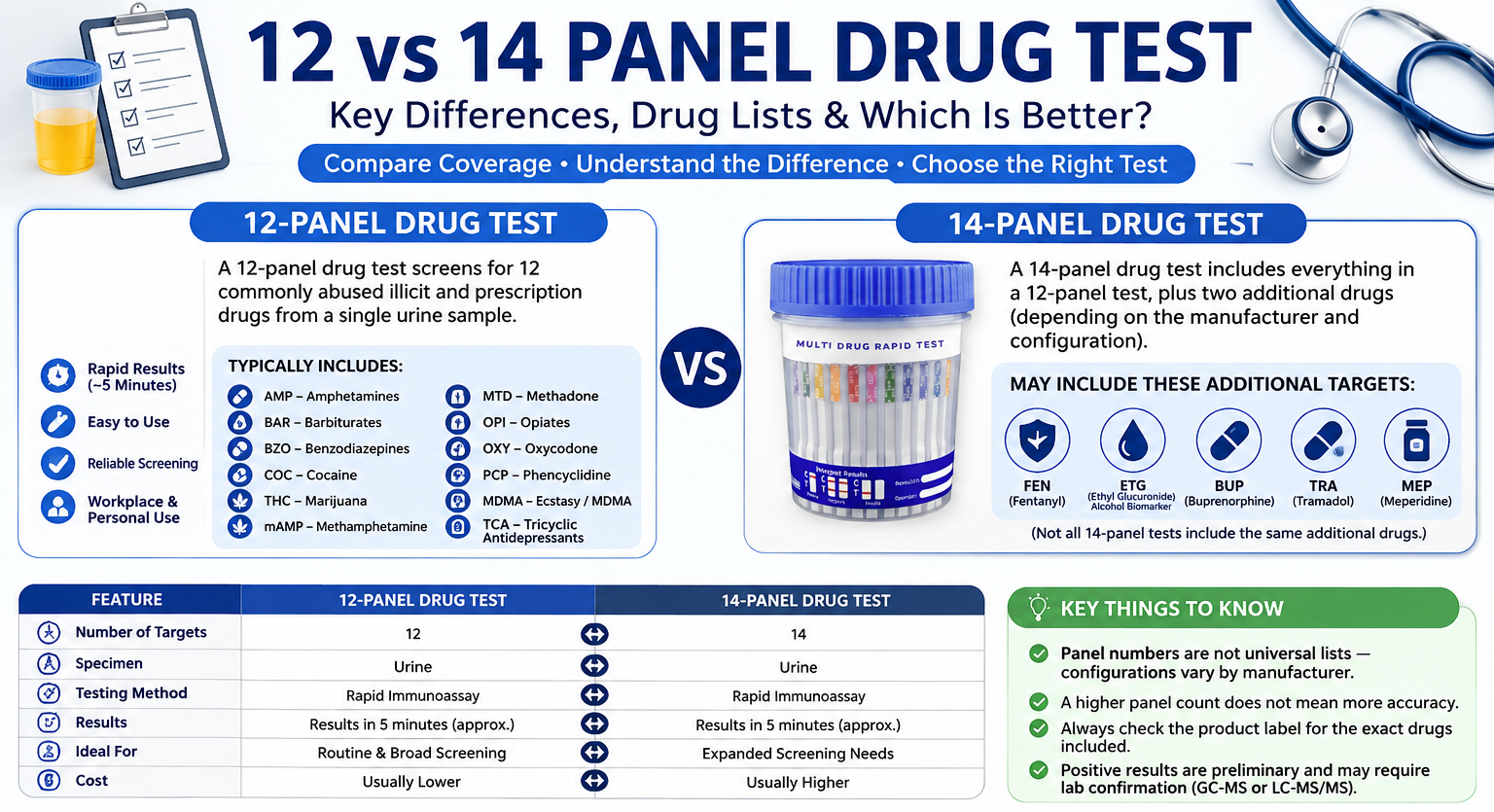
When comparing a 12 vs 14 panel drug test, the biggest difference is the number and type of substances or analytes the test is designed to screen for. A 14-panel test generally provides broader screening than a 12-panel test, but the exact two additional targets are not universal and can vary by manufacturer and product configuration.
Both are commonly available as rapid urine drug tests that use immunoassay technology to provide preliminary screening results. The right option depends on which substances you need to detect, your testing requirements, your budget, and whether you need routine or expanded screening.
12-Panel vs 14-Panel Drug Test: Quick Comparison
| Feature | 12-Panel Drug Test | 14-Panel Drug Test |
|---|---|---|
| Number of screening targets | 12 | 14 |
| Common specimen | Urine | Urine |
| Testing method | Rapid immunoassay on many point-of-care products | Rapid immunoassay on many point-of-care products |
| Drug coverage | Broad | Broader, depending on configuration |
| Fentanyl | Depends on product | Depends on product |
| EtG/alcohol biomarker | Depends on product | Depends on product |
| Typical use | Routine and broad screening | Expanded screening |
| Cost | Usually lower | Usually somewhat higher |
| Preliminary results | Often available within minutes | Often available within minutes |
| Best choice | When the required targets are already covered | When additional targets are needed |
Important: There is no single universal drug list for every 12-panel or 14-panel drug test. Always check the manufacturer’s specifications for the exact test you are using.
What Is a 12-Panel Drug Test?
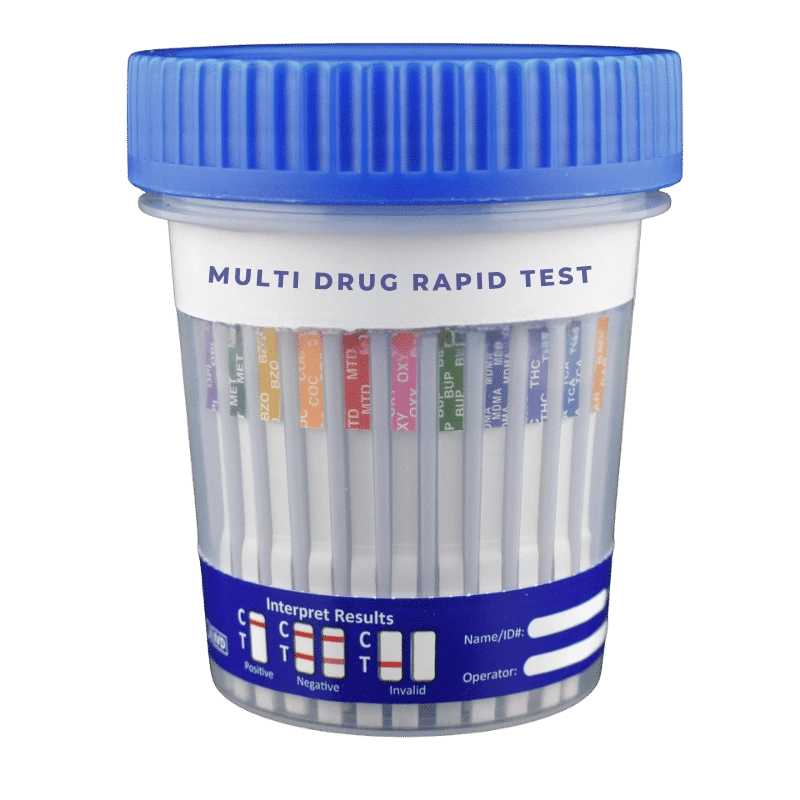
A 12-panel drug test is a multi-drug screening test designed to detect multiple substances or drug classes from a single specimen, most commonly urine.
Instead of performing a separate test for every substance, a multi-panel test combines several screening targets into one testing device or cup.
Depending on the manufacturer, a 12-panel test may screen for substances such as:
- Amphetamines (AMP)
- Barbiturates (BAR)
- Benzodiazepines (BZO)
- Cocaine (COC)
- Marijuana/THC
- Methadone (MTD)
- Methamphetamine (mAMP)
- Opiates (OPI)
- Oxycodone (OXY)
- Phencyclidine (PCP)
- MDMA/ecstasy
- Tricyclic antidepressants (TCA)
However, another 12-panel configuration may contain a different combination. For example, some products may dedicate a panel to fentanyl, buprenorphine, or another analyte instead of one of the targets listed above.
Why Use a 12-Panel Drug Test?
A 12-panel test can be useful when you need broad screening without adding every possible drug target.
Common applications include:
- Workplace drug screening
- Pre-employment testing
- Random employee testing
- Occupational health programs
- Healthcare settings
- Rehabilitation programs
- Treatment monitoring
- Staffing agencies
- Educational or institutional screening
- Personal or family screening, where appropriate
The key advantage is broad coverage from one specimen and one testing process.
What Is a 14-Panel Drug Test?
A 14-panel drug test expands the number of screening targets compared with a 12-panel test.
The additional targets depend on the manufacturer’s configuration. Depending on the product, a 14-panel test may include targets such as:
- Fentanyl (FEN/FYL)
- Ethyl glucuronide (EtG)
- Buprenorphine (BUP)
- Tramadol (TRA)
- Meperidine
- Additional opioid targets
- Other prescription drugs or drug metabolites
This is why you should not assume that every 14-panel test contains the same 14 targets.
For example, one manufacturer’s 14-panel test might include fentanyl and EtG, while another manufacturer’s 14-panel configuration could use those additional positions for different drugs.
Why Use a 14-Panel Drug Test?
A 14-panel test may be appropriate when your testing program requires expanded screening beyond the substances covered by your selected 12-panel configuration.
It may be considered for:
- Higher-risk workplace environments
- Healthcare programs
- Rehabilitation and recovery monitoring
- Correctional settings
- Expanded prescription-drug screening
- Comprehensive workplace screening programs
- Organizations with specific testing policies
The deciding factor should be the actual substances your program needs to screen for, rather than simply choosing the test with the larger number.
What Is the Difference Between a 12 and 14 Panel Drug Test?
The simplest answer is coverage.
A 12-panel test has 12 designated screening targets, while a 14-panel test has 14. Those additional targets can provide broader screening, but they do not automatically make the 14-panel test more accurate.
1. Number of Screening Targets
The most obvious difference is the number of targets.
A 12-panel test contains 12 screening targets, while a 14-panel test contains 14.
However, the term “panel” should not be interpreted as a universal list of individual drugs. A panel can be designed around a specific drug, drug class, or analyte depending on the test.
2. Drug Coverage
A 14-panel test can offer broader coverage when its additional targets address substances that aren’t included in the 12-panel test you’re considering.
For example, if your selected 12-panel product does not test for fentanyl but a particular 14-panel configuration does, the 14-panel product gives you an additional screening capability that matters for your testing goals.
3. Accuracy
A 14-panel test is not automatically more accurate simply because it tests for more substances.
Accuracy depends on factors such as:
- The specific test device
- Manufacturer specifications
- Cutoff concentrations
- Specimen quality
- Proper collection
- Correct test procedure
- Timing
- Interpretation of results
- Laboratory confirmation when required
The panel count primarily tells you about scope of screening, not overall test accuracy.
4. Cost
A 14-panel drug test will often cost more than a comparable 12-panel test because it provides additional screening targets.
However, pricing varies by:
- Manufacturer
- Product format
- Quantity purchased
- Features
- Adulteration testing
- Regulatory status
- Distribution channel
- Wholesale volume
For high-volume programs, the difference in per-test cost can become important.
5. Intended Use
A 12-panel test may be sufficient when your testing policy already covers the substances you need.
A 14-panel test can make more sense when additional targets are specifically required.
The best test is therefore not necessarily the one with the highest panel count. It is the one whose configuration matches your testing requirements.
What Drugs Are Included in a 12-Panel Drug Test?
There is no universal 12-panel drug list. A typical configuration may include:
| Drug/Analyte | Common abbreviation |
|---|---|
| Amphetamines | AMP |
| Barbiturates | BAR |
| Benzodiazepines | BZO |
| Cocaine | COC |
| Marijuana | THC |
| Methadone | MTD |
| Methamphetamine | mAMP |
| Opiates | OPI |
| Oxycodone | OXY |
| Phencyclidine | PCP |
| MDMA/ecstasy | MDMA |
| Tricyclic antidepressants | TCA |
Some 12-panel tests may instead include other targets, such as fentanyl or buprenorphine.
Always verify the package label and manufacturer’s specifications before assuming a particular drug is included.
What Drugs Are Included in a 14-Panel Drug Test?
A 14-panel test typically provides two additional screening targets compared with a particular 12-panel configuration, but the exact lineup varies.
Possible additional targets include:
- Fentanyl
- EtG
- Buprenorphine
- Tramadol
- Meperidine
- Additional opioids
- Other prescription medications
For this reason, asking “What does a 14-panel drug test test for?” isn’t enough. You also need to ask:
“Which 14 analytes are included in this specific product?”
That distinction is especially important when purchasing drug test cups for workplace, clinical, or compliance programs.
Does a 14-Panel Drug Test Include Fentanyl?
Sometimes.
Fentanyl is not automatically included in every 14-panel drug test. Some manufacturers specifically design 14-panel configurations that include fentanyl, while others use their additional panel positions for different substances.
If fentanyl screening is important to your testing program, look for FEN or FYL in the product’s listed analytes and verify the manufacturer’s specifications.
Do not rely on the number “14” alone.
Does a 14-Panel Drug Test Include EtG?
It can, but not always.
EtG stands for ethyl glucuronide, a metabolite produced after the body processes ethanol. An EtG urine test is designed specifically to detect this alcohol-related biomarker.
Some expanded drug-test configurations include EtG as one of their screening targets, while others do not.
If alcohol biomarker testing is required, confirm that the specific product lists EtG.
A standard drug panel should not automatically be assumed to detect alcohol merely because it contains 12 or 14 panels.
Is a 14-Panel Drug Test More Accurate Than a 12-Panel Test?
Not necessarily.
The number of panels indicates how many screening targets are included; it does not by itself determine analytical accuracy.
A well-designed 12-panel test can provide reliable preliminary screening for its specified targets, while a 14-panel test can provide reliable preliminary screening for a broader set of targets.
The relevant factors include:
- Test design
- Manufacturer validation
- Cutoff levels
- Specimen collection
- Storage conditions
- Test procedure
- Reading time
- Interfering substances
- Specimen validity
Rapid immunoassay tests are generally considered screening tools, not definitive confirmation tests.
When a result is non-negative and confirmation is required, laboratory testing such as GC-MS or LC-MS/MS may be used according to the applicable testing program, regulations, or medical guidance.
How Long Do 12- and 14-Panel Drug Tests Detect Drugs?
The detection window depends primarily on the individual drug and testing circumstances, not simply whether the test has 12 or 14 panels.
Factors that can influence detection include:
- Substance tested
- Dose
- Frequency of use
- Metabolism
- Route of administration
- Time since use
- Individual physiology
- Specimen type
- Test cutoff
- Test sensitivity
For urine testing, general detection periods can vary substantially between substances.
For example, some drugs may be detectable for only a few days, while cannabis metabolites can remain detectable considerably longer in some frequent users.
Adding two additional panels does not automatically make the other drugs detectable for a longer period.
12 vs 14 Panel Drug Test: Which Is Better?
There isn’t one answer that applies to everyone.
Choose a 12-panel test when:
- The 12-panel configuration already includes your required substances.
- You want broad routine screening.
- Cost efficiency is important.
- Your workplace or organization doesn’t require additional analytes.
- You need a practical multi-drug screening option.
A 12-panel test can provide an effective balance between coverage and cost when its analyte lineup matches your needs.
Choose a 14-panel test when:
- You need additional screening targets.
- Your selected 14-panel configuration includes substances important to your program.
- You need expanded prescription-drug screening.
- Your workplace or clinical environment has additional testing requirements.
- The additional coverage justifies the higher cost.
A 14-panel test is most useful when you actually need the extra two screening targets.
12 vs 14 Panel Drug Test for Workplace Testing
Employers should not choose a panel solely because it has a higher number.
Instead, consider:
- Which substances are relevant to the workplace?
- Are there federal, state, contractual, or industry-specific requirements?
- Does the testing program require a particular panel?
- Does the selected product include the required analytes?
- Is confirmation testing required for non-negative results?
- Is specimen collection subject to chain-of-custody requirements?
For federally regulated workplaces, applicable federal testing requirements should be followed rather than substituted with a commercially selected panel simply because it contains more drugs.
For non-regulated workplace testing, employers should also consider applicable laws and company policies.
12 vs 14 Panel Drug Test for Healthcare and Rehabilitation
Healthcare and rehabilitation programs may have different screening requirements from ordinary workplace testing.
A program may want to monitor specific prescription medications, opioids, synthetic opioids, or other substances depending on its goals.
In these settings, a 14-panel test can be useful if its configuration contains the additional analytes the program needs.
Again, the product’s exact drug list matters more than the panel number itself.
Can You Use a 12- or 14-Panel Drug Test at Home?
Rapid urine drug tests are available for personal and home screening.
However, home screening results should be interpreted carefully.
A rapid immunoassay result is generally a preliminary screening result. A non-negative result may require confirmation by a laboratory, particularly when the result could affect employment, medical treatment, legal proceedings, or another high-stakes decision.
Follow the manufacturer’s instructions carefully, including:
- Specimen collection
- Storage
- Test procedure
- Reading time
- Result interpretation
12 vs 14 Panel Drug Test: Does Panel Count Affect Detection Time?
No.
The number of panels does not itself determine how long a drug remains detectable.
For example, if a 14-panel test adds fentanyl and EtG to a 12-panel configuration, those additional targets have their own detection characteristics.
The detection period depends on the substance, specimen, cutoff, and individual circumstances.
Therefore:
More panels ≠ longer detection window.
The 14-panel test simply gives you additional screening targets.
What Happens If a Drug Test Is Positive?
A rapid multi-panel drug test is generally used for screening.
If a result is positive or otherwise non-negative, it should not automatically be treated as definitive proof of drug use.
Depending on the testing situation, a laboratory confirmation test may be appropriate.
Confirmation methods can include:
- Gas chromatography-mass spectrometry (GC-MS)
- Liquid chromatography-tandem mass spectrometry (LC-MS/MS)
Workplace, medical, legal, and other regulated programs may have specific procedures for confirmation, review, reporting, and documentation.
Frequently Asked Questions
Is a 12-panel drug test better than a 14-panel drug test?
Not necessarily. A 12-panel test may be better when its configuration covers everything you need at a lower cost. A 14-panel test may be better when you specifically need its additional screening targets.
Is a 14-panel drug test more accurate?
No. A higher panel count does not automatically mean higher accuracy. The number of panels primarily describes the scope of screening.
What are the two extra drugs in a 14-panel drug test?
There is no universal answer. The additional targets depend on the manufacturer and product configuration. They may include fentanyl, EtG, buprenorphine, tramadol, meperidine, or other analytes.
Does every 12-panel drug test test for the same drugs?
No. Different manufacturers can use different configurations. Always check the product’s specific analyte list.
Does every 14-panel drug test test for fentanyl?
No. Fentanyl must be specifically included in the product configuration for the test to screen for it.
Does a 14-panel drug test detect alcohol?
Only if the product specifically includes an alcohol biomarker such as EtG. A 14-panel label alone does not mean the test detects alcohol.
Does a 12-panel drug test detect fentanyl?
It depends on the specific configuration. Some 12-panel tests include fentanyl, while others do not.
How quickly do rapid 12- and 14-panel drug tests provide results?
Many rapid urine drug-test cups provide preliminary results within several minutes, but the exact reading time depends on the manufacturer’s instructions.
Can a 14-panel drug test be used for workplace testing?
It can be used in workplace screening programs when the product and testing procedure are appropriate for the program’s requirements. Employers should follow applicable laws, regulations, company policies, and any industry-specific testing standards.
Which should I buy: a 12-panel or 14-panel drug test?
Start with the substances you need to screen for. If a 12-panel product covers all required analytes, it may provide better value. If you need additional targets such as fentanyl or EtG and your selected 14-panel product includes them, the 14-panel option may be more appropriate.