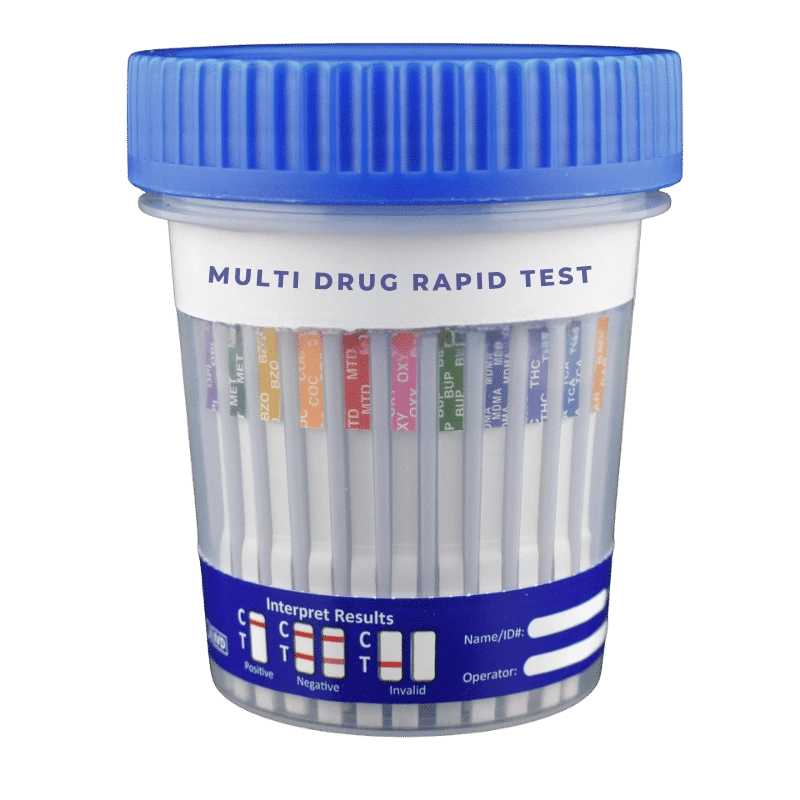
14 vs 16 Panel Drug Test: Key Differences, Drug Lists & Which Is Better?
If you’re comparing a 14-panel vs. 16-panel drug test, the biggest difference is the number and type of substances included in the screening panel. A 16-panel test generally provides broader screening than a 14-panel test, but the exact drugs detected depend on the manufacturer, laboratory, test configuration, and intended use.
That means choosing a drug test should not be based on the panel number alone. The actual analytes, cutoff levels, specimen type, and testing requirements are more important than whether a test is labeled “14 panel” or “16 panel.”
This guide explains the differences between 14-panel and 16-panel drug tests, what they may detect, how urine screening works, and how to choose the right option for workplace, clinical, treatment, or personal screening.
14 Panel vs 16 Panel Drug Test at a Glance
| Feature | 14-Panel Drug Test | 16-Panel Drug Test |
|---|---|---|
| Number of screening targets | 14 | 16 |
| Common specimen | Urine | Urine |
| THC | Product dependent | Product dependent |
| Cocaine | Product dependent | Product dependent |
| Amphetamines | Product dependent | Product dependent |
| Methamphetamine | Product dependent | Product dependent |
| Opiates/opioids | Product dependent | Product dependent |
| Benzodiazepines | Product dependent | Product dependent |
| Barbiturates | Product dependent | Product dependent |
| Methadone | Product dependent | Product dependent |
| Oxycodone | Product dependent | Product dependent |
| Buprenorphine | Product dependent | Product dependent |
| Fentanyl | Product dependent | Product dependent |
| MDMA | Product dependent | Product dependent |
| Additional specialty targets | Depends on product | Often broader |
| Best selection method | Match the analyte list to your needs | Match the analyte list to your needs |
Important: There is no single universal drug list for every 14-panel or 16-panel test. Always review the specific manufacturer’s product specifications before purchasing or using a test.
What Is a 14-Panel Drug Test?
A 14-panel drug test is a multi-drug screening test designed to test a urine specimen for multiple drugs or drug classes at the same time.
Depending on the product, a 14-panel test may include targets such as:
- THC (marijuana)
- Cocaine
- Amphetamines
- Methamphetamine
- Opiates
- Benzodiazepines
- Barbiturates
- Methadone
- Oxycodone
- Buprenorphine
- MDMA
- Tricyclic antidepressants (TCA)
- EDDP
- Fentanyl or another specialty target
However, these substances are not guaranteed to appear on every 14-panel test.
Different manufacturers can configure their panels differently. One 14-panel test may include fentanyl, while another may use that testing position for a different drug.
For this reason, the term “14 panel” describes the number of testing targets, not one standardized list of drugs.
What Is a 16-Panel Drug Test?
A 16-panel drug test is designed to screen for 16 specified drug targets or drug classes in a single testing process.
A 16-panel urine test may contain many of the common targets found in expanded drug screening, including:
- THC
- Cocaine
- Amphetamines
- Methamphetamine
- Opiates
- Benzodiazepines
- Barbiturates
- Methadone
- Oxycodone
- Buprenorphine
- MDMA
- Tramadol
- Meperidine
- Fentanyl
- TCA
- EDDP or another specialty target
Again, the exact 16 targets vary by manufacturer and product configuration.
A 16-panel test isn’t automatically better than a 14-panel test simply because it has two additional targets. The extra targets need to be relevant to the testing program.
14 vs 16 Panel Drug Test: What Is the Main Difference?
The basic difference is straightforward:
A 14-panel drug test is configured to screen for 14 specified targets, while a 16-panel drug test is configured to screen for 16 specified targets.
The more important question is:
Which two additional substances are included in the 16-panel test?
For example, one manufacturer’s 14-panel test could include fentanyl and buprenorphine, while another manufacturer’s 16-panel test could include tramadol and meperidine instead.
Therefore, two tests with different panel numbers can sometimes overlap substantially.
Panel number vs. actual drug coverage
Consider a hypothetical comparison:
14-panel test
- THC
- Cocaine
- Amphetamines
- Methamphetamine
- Opiates
- Benzodiazepines
- Barbiturates
- Methadone
- Oxycodone
- Buprenorphine
- MDMA
- TCA
- EDDP
- Fentanyl
16-panel test
- THC
- Cocaine
- Amphetamines
- Methamphetamine
- Opiates
- Benzodiazepines
- Barbiturates
- Methadone
- Oxycodone
- Buprenorphine
- MDMA
- TCA
- EDDP
- Fentanyl
- Tramadol
- Meperidine
In this example, the 16-panel test adds two additional prescription-drug targets.
But this is only an example, not a universal 14- or 16-panel configuration.
Which Drugs May Differ Between a 14-Panel and 16-Panel Test?
The additional targets depend on the specific product. Expanded panels may include specialty prescription drugs, additional opioids, or other drug classes.
Tramadol
Tramadol is a prescription opioid medication that may be included as a separate screening target on some expanded drug tests.
A standard opiate screen should not automatically be assumed to detect every prescription opioid, which is why some products provide dedicated targets.
Meperidine
Meperidine is another prescription opioid that may be included separately on an expanded drug panel.
Fentanyl
Fentanyl is a synthetic opioid that can be specifically included in expanded drug tests. However, a test should not be assumed to detect fentanyl simply because it has 14 or 16 panels.
Buprenorphine
Buprenorphine may be included as an individual testing target on multi-panel drug tests.
TCA
TCA refers to tricyclic antidepressants. Some multi-panel screening products include TCA as a separate target.
EDDP
EDDP is a metabolite associated with methadone. Some drug tests include EDDP as an independent target rather than relying only on methadone screening.
Synthetic Cannabinoids
Some specialized drug tests can include synthetic cannabinoid targets. Availability varies considerably between products.
Is a 16-Panel Drug Test Better Than a 14-Panel Test?
Not necessarily.
A 16-panel test provides additional screening only when those additional targets are useful for your specific testing requirements.
For example, if you need to screen specifically for tramadol and your selected 16-panel product includes tramadol, the broader panel may be useful.
But if a 14-panel test already contains every drug your testing program requires, the additional two panels may not provide a meaningful advantage.
The best rule when comparing panels
Choose the drug test based on its actual analyte list—not its panel number.
This is especially important when comparing products from different manufacturers.
How Do 14- and 16-Panel Urine Drug Tests Work?
Most rapid multi-panel urine drug tests use immunoassay-based screening technology to identify specific drugs, drug classes, or metabolites.
The general testing process involves several steps.
1. Collect the urine specimen
A urine specimen is collected according to the testing program and the manufacturer’s instructions.
2. Apply the specimen
Depending on the product, the specimen may be tested using a urine cup, dip card, cassette, or another testing device.
3. Allow the test to develop
The test should be allowed to develop for the exact period specified by the manufacturer.
4. Read the result
The test typically uses control and test lines to indicate whether a target is detected at or above the applicable screening cutoff.
5. Follow up on presumptive positives
A rapid screening result is generally considered preliminary. Where required by the applicable testing program, a presumptive positive may need laboratory confirmation using an appropriate confirmatory method.
How to Read a Multi-Panel Drug Test Cup
Many rapid urine drug test cups use a control-line and test-line system.
Negative result
A control line and the corresponding test line generally indicate a negative screening result for that target.
Presumptive positive result
A control line without the corresponding test line may indicate a presumptive positive screening result.
Invalid result
If the required control line does not appear, the test may be invalid.
Always follow the specific instructions supplied with the test. Result interpretation, reading times, and visual characteristics can vary between products.
Why Cutoff Levels Matter
One of the most important details when comparing drug tests is the cutoff concentration.
A drug screening test isn’t simply determining whether any amount of a substance exists in a specimen. The assay uses a defined cutoff.
Depending on the applicable test, a result below the cutoff may be reported as negative, while a result at or above the screening cutoff may produce a presumptive positive.
Cutoffs can vary according to:
- Drug or metabolite being tested
- Specimen type
- Manufacturer
- Assay methodology
- Testing program
- Applicable regulatory requirements
- Laboratory methodology
Therefore, two drug tests can screen for the same substance while using different specifications.
Does a 16-Panel Drug Test Detect Drugs for Longer?
No.
Having more panels does not automatically increase the detection window.
Detection time depends on factors such as:
- The specific drug
- Dose and frequency of use
- Individual metabolism
- Specimen type
- Test cutoff
- Testing method
- Other individual factors
Adding two additional targets to a test does not make THC, cocaine, methamphetamine, opioids, or other substances remain detectable for a longer period.
Panel count tells you how many targets are included, not how long a drug remains detectable.
Which Is More Accurate: 14-Panel or 16-Panel?
The number of panels does not determine the accuracy of a drug test.
Performance can depend on:
- Test design
- Assay quality
- Analytical cutoff
- Specimen collection
- Storage
- Handling
- Test procedure
- Timing of result interpretation
Rapid immunoassay tests are commonly used for preliminary screening. A presumptive positive result may require confirmation depending on the purpose and requirements of the testing program.
For employment, medical, legal, or compliance decisions, follow the applicable testing procedures rather than relying on the panel count alone.
14 vs 16 Panel Drug Test for Workplace Testing
Employers should select a drug testing panel based on their actual testing requirements.
Important considerations include:
- Which substances need to be screened
- Company drug-testing policy
- Applicable federal and state requirements
- Whether the program is DOT or non-DOT
- Specimen type
- Required cutoff levels
- Collection procedures
- Confirmation requirements
- Medical review requirements
A larger panel isn’t automatically the correct workplace test.
For regulated testing programs, the test must satisfy the applicable program requirements regardless of whether it is labeled 14-panel or 16-panel.
14 vs 16 Panel Drug Test for Clinical and Treatment Programs
Clinical and treatment settings may have different testing requirements from general workplace screening.
A program may need to monitor specific prescription medications, opioids, or other substances depending on its purpose.
In these settings, the most important factors include:
- The substances that need to be monitored
- The specimen type
- Appropriate screening cutoffs
- Testing frequency
- Confirmatory testing procedures
- Documentation and interpretation requirements
A 16-panel test may offer useful additional coverage, but only if those additional targets are relevant to the program.
14 vs 16 Panel Drug Test for Home Testing
For personal or home screening, broader coverage can be useful when the additional targets are relevant.
Before purchasing a test, check:
- Complete drug list
- Cutoff levels
- Specimen type
- Manufacturer instructions
- Expiration date
- Storage requirements
- Result interpretation
- Available adulteration checks
- Whether laboratory confirmation is available
A home screening test should be understood as a screening tool, not automatically as definitive proof of drug use.
Does a 14-Panel Test Include Fentanyl?
Sometimes, but not always.
Fentanyl needs to be specifically listed among the test’s analytes.
The label “14 panel” alone does not tell you whether fentanyl is included.
If fentanyl detection is important, verify the product specifications before purchasing or using the test.
Does a 16-Panel Test Include Fentanyl?
Not necessarily.
A 16-panel test can include fentanyl, but the panel number itself does not guarantee it.
Always check the manufacturer’s complete analyte list.
Does a 14- or 16-Panel Drug Test Detect Alcohol?
Not automatically.
Alcohol testing generally requires a specific alcohol-related target, such as an alcohol or EtG test, depending on the testing purpose and methodology.
A product should not be assumed to detect alcohol merely because it contains multiple drug panels.
Does a Larger Panel Detect More Drugs?
Usually, a larger panel is designed to screen for more targets, but the number alone doesn’t tell you which drugs are included.
For example, a 16-panel test may add two prescription-drug targets that are not included in a particular 14-panel product.
That’s why the complete analyte list is more useful than the headline panel number.
Which One Should You Choose?
Use the following approach when deciding between a 14-panel and 16-panel drug test.
Choose a 14-panel test when:
- Its analyte list meets your testing requirements
- You don’t need the additional targets offered by a 16-panel product
- You want broad multi-drug screening
- Your testing program permits that configuration
Choose a 16-panel test when:
- You need additional drug targets
- The extra targets are relevant to your testing program
- You need broader prescription-drug or specialty screening
- The specific 16-panel product matches your required analytes
The key takeaway
Don’t choose a test simply because “16” sounds better than “14.” Choose the panel that contains the drugs you actually need to screen for.
14 vs 16 Panel Drug Test: Quick Decision Guide
| Your priority | Better approach |
|---|---|
| Standard expanded screening | Compare 14-panel options |
| Need two additional drug targets | Look for a suitable 16-panel |
| Need fentanyl | Choose a product that explicitly lists FEN |
| Need tramadol | Choose a product that explicitly lists TRA |
| Need buprenorphine | Choose a product that explicitly lists BUP |
| Need alcohol screening | Choose a product with the appropriate alcohol target |
| Workplace compliance | Follow the applicable testing program |
| Home screening | Compare analytes, cutoffs, and instructions |
| Clinical monitoring | Match the panel to the program’s requirements |
Frequently Asked Questions
What is the difference between a 14-panel and 16-panel drug test?
A 14-panel test is configured to screen for 14 specified targets, while a 16-panel test is configured to screen for 16. The exact substances included vary between manufacturers.
Is a 16-panel drug test better than a 14-panel drug test?
Not necessarily. A 16-panel test is only more useful when its additional targets are relevant to your testing needs.
What does a 14-panel drug test test for?
The exact list varies by product. Common targets may include THC, cocaine, amphetamines, methamphetamine, opiates, benzodiazepines, barbiturates, methadone, oxycodone, buprenorphine, MDMA, TCA, EDDP, fentanyl, or other targets.
What does a 16-panel drug test test for?
A 16-panel test can include common drug classes plus additional prescription-drug, opioid, or specialty targets. The manufacturer’s analyte list should be used to determine exactly what the product detects.
Does a 14-panel drug test include THC?
Many 14-panel tests include THC, but you should verify the individual product specifications.
Does a 16-panel drug test include THC?
Many 16-panel tests include THC, but the panel number alone does not guarantee it.
Does a 14-panel drug test detect fentanyl?
Some do. Fentanyl must be specifically listed as an analyte.
Does a 16-panel drug test detect fentanyl?
Some do, but not all. Always check the product’s drug list.
Can a 16-panel test detect tramadol?
Some 16-panel products specifically include tramadol. It should not be assumed to be included unless the product documentation lists it.
Does the number of panels affect detection time?
No. Detection time depends on the substance, specimen, cutoff, testing method, and individual factors—not simply the number of panels.
Can a rapid drug test produce a false positive?
Presumptive screening results can require confirmation. Unexpected positive results should be handled according to the manufacturer’s instructions and the applicable testing program.
Which is better for workplace testing?
Neither is universally better. The appropriate test is the one that matches the employer’s testing policy, required substances, applicable regulations, and confirmation procedures.