What Is an EtG Test?
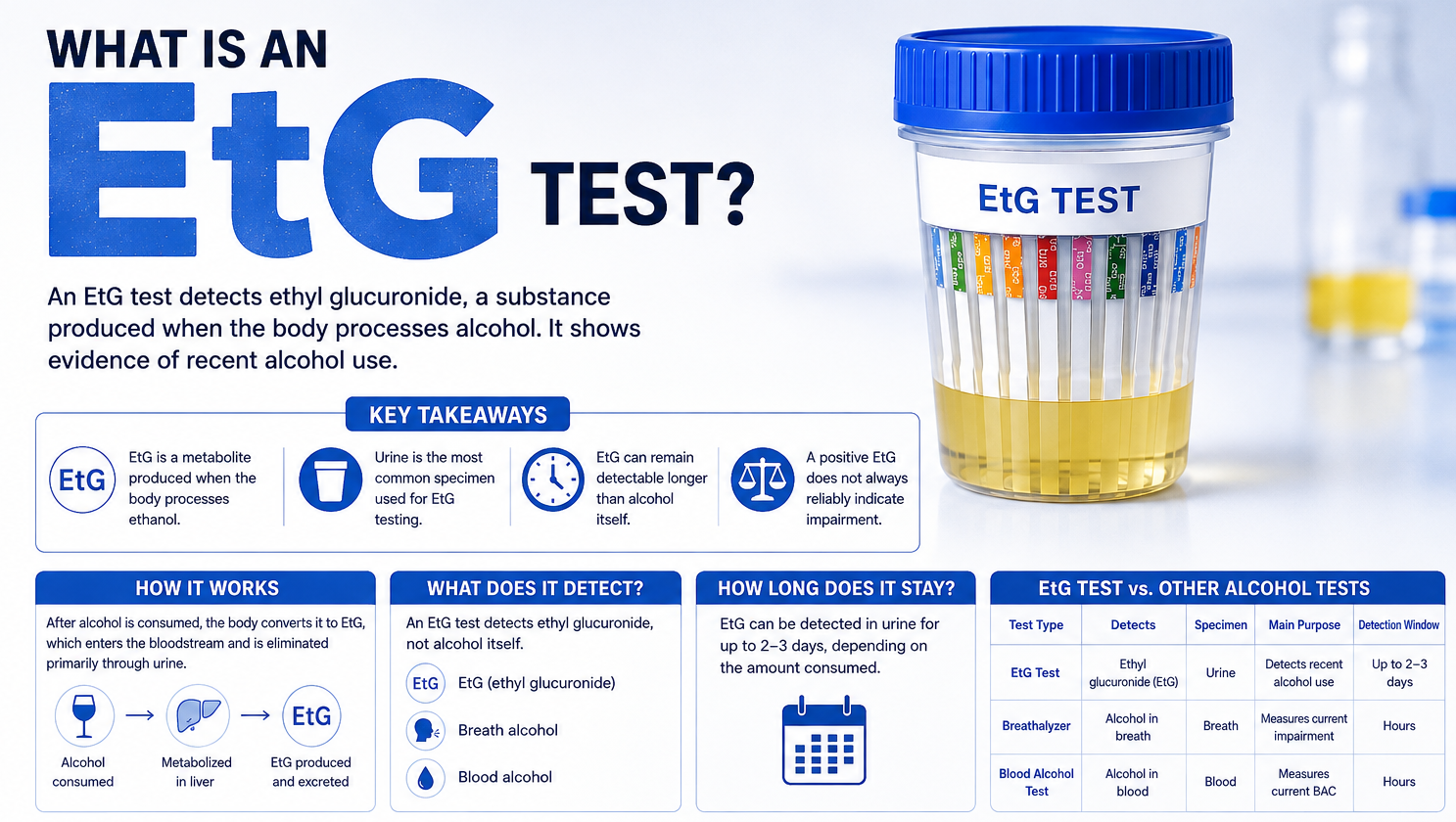
An EtG test is an alcohol test that detects ethyl glucuronide (EtG), a substance the body produces after processing ethanol, the type of alcohol found in beer, wine, and liquor. Unlike a breath or blood alcohol test that primarily measures alcohol itself, an EtG test looks for a metabolite that can remain detectable after alcohol has left the bloodstream.
EtG testing is commonly performed using urine and may be used to monitor recent alcohol exposure in workplace programs, treatment and recovery programs, probation, court-ordered testing, and other settings where alcohol abstinence needs to be monitored.
The length of time EtG remains detectable varies from person to person. Factors such as alcohol intake, timing, metabolism, hydration, kidney function, the specimen tested, and the laboratory’s cutoff level can influence the result.
Key Takeaways
- EtG stands for ethyl glucuronide, a metabolite produced when the body processes ethanol.
- An EtG test detects evidence of recent alcohol exposure, rather than measuring current intoxication.
- Urine is the most common specimen used for EtG testing.
- EtG can remain detectable longer than ethanol itself, but the exact detection window varies.
- A positive EtG result does not reliably establish exactly how much alcohol a person consumed or precisely when they drank.
- EtG testing uses cutoff concentrations, often reported in ng/mL, to classify results.
- Alcohol-containing products such as mouthwash and hand sanitizer can be relevant when interpreting certain EtG results, particularly at lower cutoffs.
- An EtG test is different from a standard multi-panel drug test.
What Does EtG Stand For?
EtG stands for ethyl glucuronide.
Ethyl glucuronide is a minor metabolite formed when the body processes ethanol (alcohol). After alcohol is consumed, most ethanol is metabolized through the liver, while a small portion is converted into metabolites such as EtG.
Because EtG can remain in the body after ethanol itself has been eliminated, laboratories can use it as a marker of recent alcohol exposure.
In simple terms:
Alcohol consumption → ethanol enters the body → ethanol is metabolized → EtG is produced → EtG is eliminated from the body → testing can detect EtG
This is why an EtG test is sometimes described as an alcohol metabolite test rather than a test for alcohol intoxication.
What Is an EtG Test?
An EtG test is a laboratory or screening test that looks for ethyl glucuronide in a biological specimen, most commonly urine.
The purpose is to determine whether there is measurable evidence of relatively recent alcohol exposure.
Unlike a breathalyzer, an EtG test does not primarily answer:
“Is this person intoxicated right now?”
Instead, it addresses a different question:
“Is there measurable evidence of recent exposure to ethanol?”
This distinction is important.
A person can have no measurable alcohol in their breath or blood and still have EtG remaining in urine.
How Does an EtG Test Work?
The process begins when ethanol enters the body after drinking alcohol.
The body rapidly metabolizes most ethanol. During this process, small amounts can be converted into metabolites, including ethyl glucuronide.
EtG eventually circulates through the body and is eliminated, primarily through urine.
A urine EtG test analyzes the specimen for EtG and compares the detected concentration with the laboratory’s established reporting cutoff.
The basic process is:
Ethanol consumption
↓
Alcohol metabolism
↓
EtG formation
↓
EtG enters circulation
↓
EtG is eliminated in urine
↓
Urine specimen is tested
↓
Result is reported according to the applicable cutoff
The exact testing technology can vary. Some tests are designed for screening, while laboratory methods may provide more specific or quantitative measurements.
What Does an EtG Test Detect?
An EtG test detects ethyl glucuronide, not alcohol itself.
This is one of the most important differences between EtG testing and tests designed to measure ethanol.
EtG test
Detects:
Ethyl glucuronide (EtG)
Breath alcohol test
Primarily measures:
Alcohol present in exhaled breath
Blood alcohol test
Measures:
Ethanol concentration in blood
Because EtG is a metabolite, it may remain detectable after ethanol is no longer present at measurable levels in breath or blood.
How Long Does an EtG Test Detect Alcohol?
One of the most common questions about EtG testing is how long alcohol can be detected.
There is no single detection time that applies to everyone.
Urine EtG testing is generally used to identify relatively recent alcohol exposure, and detection can extend beyond the period during which ethanol itself would normally be detectable.
Depending on circumstances, EtG may be detectable for roughly one to several days, with some testing situations reporting detection for around 48–72 hours or longer.
However, this should not be interpreted as a guaranteed window.
The detection period can be affected by:
- Amount of alcohol consumed
- Pattern of drinking
- Time since alcohol exposure
- Individual metabolism
- Kidney function
- Urine concentration
- Hydration
- Specimen type
- Testing method
- Laboratory cutoff
- Analytical sensitivity
Therefore, statements such as “EtG always lasts 80 hours” are misleading.
EtG Detection Window: Why It Varies
Two people can consume similar amounts of alcohol and have different EtG concentrations later.
Likewise, a low EtG concentration near a laboratory cutoff can produce a different interpretation from a substantially higher concentration.
For this reason, EtG detection time should be considered an approximate range rather than an exact countdown clock.
Can EtG Be Detected After 24 Hours?
Yes.
Depending on the individual and the circumstances, EtG can remain detectable more than 24 hours after alcohol exposure.
However, whether a test is positive at a particular time depends on factors including:
- Initial EtG concentration
- Amount and pattern of alcohol exposure
- Time elapsed
- Urine concentration
- Test cutoff
- Laboratory method
A negative result after a particular period also does not establish exactly when alcohol was consumed.
Can EtG Be Detected After 48 or 72 Hours?
EtG may remain detectable for 48–72 hours or longer in some circumstances, but there is substantial individual variation.
A detection window should therefore not be treated as a guarantee that a test will be positive or negative at a particular hour.
The cutoff concentration matters as well.
A test using a lower reporting threshold may detect smaller concentrations than a test using a higher threshold.
What Is an EtG Cutoff Level?
An EtG cutoff is the concentration used by a testing laboratory or test system to determine how a result is reported.
EtG concentrations are commonly expressed in:
ng/mL (nanograms per milliliter)
You may encounter cutoff levels such as:
- 100 ng/mL
- 500 ng/mL
The appropriate cutoff depends on the testing purpose, laboratory protocol, test design, and applicable policies.
A lower cutoff can generally provide greater sensitivity to small amounts of EtG, while a higher cutoff can reduce the likelihood that very low concentrations will be reported as positive.
That is why the cutoff should always be considered when interpreting an EtG result.
What Does a 100 ng/mL EtG Cutoff Mean?
A 100 ng/mL cutoff represents a lower reporting threshold than a 500 ng/mL cutoff.
In general, a lower cutoff is more sensitive to small concentrations of EtG.
However, the number alone should not be interpreted as proof of a specific amount of alcohol consumed.
An EtG concentration is influenced by many factors, including the timing of exposure and urine concentration.
What Does a 500 ng/mL EtG Cutoff Mean?
A 500 ng/mL cutoff is a higher reporting threshold.
A result below this threshold may be reported as negative under a testing protocol using that cutoff, while a result at or above the applicable threshold may be reported as positive or otherwise flagged according to the laboratory’s reporting rules.
Again, cutoff levels do not provide a simple conversion from EtG concentration to the number of drinks consumed.
Can an EtG Test Tell How Much Alcohol Someone Drank?
Not reliably.
EtG concentration should not be interpreted as a precise measure of the amount of alcohol consumed.
For example, a higher EtG concentration does not provide a dependable calculation of:
- Number of drinks
- Exact amount of alcohol consumed
- Exact time drinking occurred
- Blood alcohol concentration
- Degree of intoxication
The concentration can be affected by individual metabolism, urine dilution, timing, and other variables.
Therefore, EtG testing is primarily useful for detecting recent alcohol exposure, not reconstructing an exact drinking history.
Does an EtG Test Show if Someone Is Intoxicated?
No.
An EtG test is not a direct measure of current impairment or intoxication.
EtG is a metabolite of alcohol.
Someone can have detectable EtG after the alcohol responsible for intoxication has already been eliminated from the bloodstream.
Therefore:
Positive EtG ≠ currently intoxicated
and
EtG concentration ≠ blood alcohol concentration
This distinction is especially important in workplace, legal, medical, and recovery settings.
What Does a Positive EtG Test Mean?
A positive EtG test generally means that EtG was detected at or above the applicable reporting threshold under the testing method and cutoff being used.
A positive result indicates evidence consistent with alcohol exposure, but the result should be interpreted in context.
It does not necessarily establish:
- Exactly when alcohol was consumed
- Exactly how much alcohol was consumed
- Whether the person was intoxicated
- Whether the person was impaired
- The person’s blood alcohol concentration
Depending on the circumstances, laboratories may use confirmatory testing or additional testing to investigate a result.
What Does a Negative EtG Test Mean?
A negative EtG test generally means that EtG was not detected above the applicable cutoff at the time the specimen was tested.
A negative result does not necessarily mean that a person has never consumed alcohol.
It means that the specimen did not contain EtG at a concentration that met the test’s reporting criteria.
Timing is important because EtG concentrations decline over time.
Can Alcohol-Containing Products Affect an EtG Test?
Yes, certain products containing alcohol can be relevant when interpreting EtG testing.
Examples include:
- Alcohol-based hand sanitizers
- Some mouthwashes
- Certain personal-care products
- Some medications or other products containing alcohol
These exposures are different from consuming alcoholic beverages, but they can introduce ethanol into the body or create potential sources of incidental exposure.
The relevance of incidental exposure depends on factors such as:
- Type of exposure
- Frequency
- Amount
- Duration
- Route of exposure
- Test sensitivity
- Cutoff concentration
- Timing of the test
This is one reason EtG results should be interpreted using the complete testing context rather than a single number in isolation.
Can Mouthwash Cause a Positive EtG Test?
Some mouthwashes contain alcohol, so frequent or substantial exposure may be considered when evaluating an EtG result, particularly when a lower cutoff is used.
However, the presence of alcohol in a mouthwash does not mean that every use will automatically produce a positive EtG result.
Test results depend on the level of exposure, timing, individual factors, and the analytical cutoff.
If an EtG result is unexpected, the laboratory and healthcare or testing professional should evaluate the result within the appropriate context.
Can Hand Sanitizer Affect an EtG Test?
Alcohol-based hand sanitizers contain ethanol or other alcohols and have been studied as a potential source of incidental alcohol exposure.
Routine use does not mean a person will automatically receive a positive EtG result.
The potential impact depends on exposure conditions and the sensitivity and cutoff of the testing method.
People undergoing formal abstinence monitoring should follow the specific instructions provided by their testing program regarding alcohol-containing products.
What Is an EtG Urine Test?
An EtG urine test is a test that analyzes urine for ethyl glucuronide.
Urine is commonly used because EtG can be eliminated through the urinary system and may remain measurable after ethanol itself is no longer detectable in blood or breath.
A urine EtG test may be offered as:
- A laboratory test
- A screening test
- A qualitative test
- A quantitative laboratory analysis
The exact reporting process depends on the test and laboratory.
What Other Specimens Can Be Used for EtG Testing?
Although urine is one of the most common specimens for EtG testing, alcohol-related testing can involve other biological specimens.
Depending on the testing method and purpose, laboratories may analyze:
Urine
Useful for detecting relatively recent alcohol exposure.
Hair
May provide information about longer-term alcohol exposure patterns, depending on the testing method and interpretation.
Blood
Can be used for alcohol-related testing, although blood ethanol testing answers a different question from urine EtG testing.
Breath
Primarily used to measure alcohol currently present in exhaled air rather than EtG.
Different specimens have different detection characteristics, so they should not be treated as interchangeable.
EtG Test vs. Breathalyzer
An EtG test and breathalyzer answer different questions.
| Feature | EtG Test | Breathalyzer |
|---|---|---|
| Primary target | Ethyl glucuronide | Alcohol/ethanol |
| Common specimen | Urine | Breath |
| Main purpose | Detect recent alcohol exposure | Estimate current/recent alcohol level |
| Current intoxication | Does not directly measure it | More directly relevant |
| Detection period | Can extend beyond ethanol detection | Generally shorter |
An EtG test is therefore more appropriate when the goal is to identify recent alcohol exposure over a longer period than a breath test typically provides.
EtG Test vs. Blood Alcohol Test
A blood alcohol test measures ethanol in the blood.
An EtG test measures a metabolite produced after alcohol exposure.
This means the tests provide different information.
Blood alcohol testing
More directly addresses alcohol currently present in the bloodstream.
EtG testing
Looks for evidence that alcohol was processed by the body recently.
Neither test should automatically be interpreted as a precise measurement of the other.
Does an EtG Test Detect Drugs?
An EtG test is specifically designed to detect alcohol exposure through ethyl glucuronide.
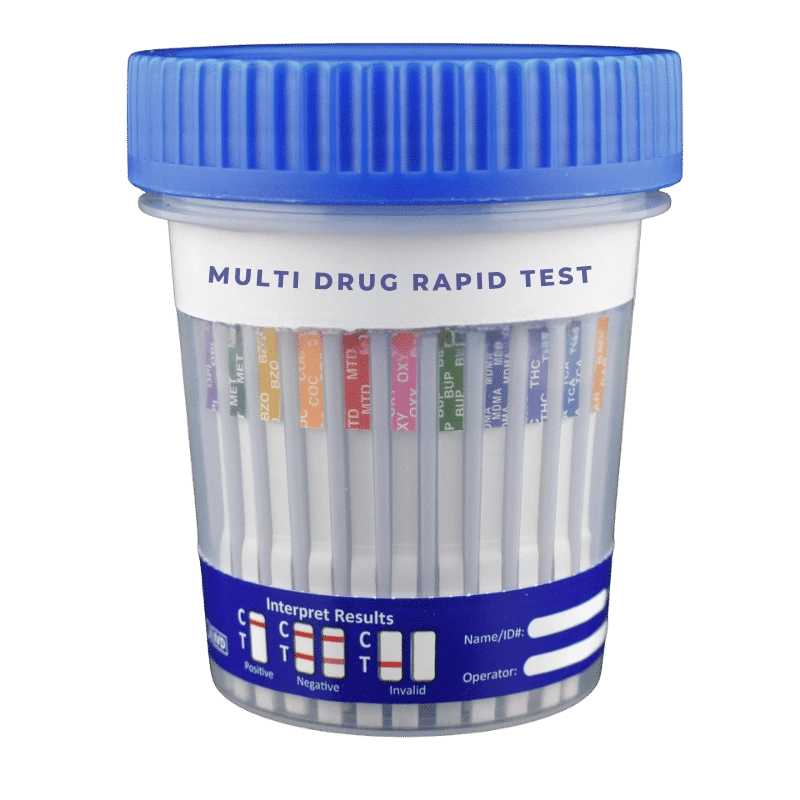
It is not the same as a standard multi-panel drug test.
A multi-panel drug test may screen for substances such as:
- Amphetamines
- Methamphetamine
- Cocaine
- THC
- Opioids
- Benzodiazepines
- Barbiturates
- Buprenorphine
- Methadone
- Other specified drugs
An EtG test, by contrast, targets alcohol exposure through its metabolite.
Some testing products combine EtG with multiple drug panels, but the EtG component and drug-testing components are separate analytes.
Why Are EtG Tests Used?
EtG testing can be used when an organization needs to monitor recent alcohol exposure or compliance with an alcohol-abstinence requirement.
Common applications include:
Workplace Testing
Some workplace programs use alcohol testing as part of safety or compliance procedures.
The specific testing requirements depend on the employer, industry, and applicable regulations.
Recovery Programs
EtG testing may be used as one tool for monitoring abstinence in substance-use treatment or recovery programs.
Probation and Court Programs
Some individuals may undergo alcohol testing as part of probation, court-ordered monitoring, or other legal requirements.
DUI/DWI Monitoring
Alcohol-related testing may be incorporated into programs involving impaired-driving offenses.
Child Custody or Family Court
In certain circumstances, alcohol testing may be requested as part of legal monitoring.
The interpretation of an EtG result in these settings should follow the relevant program’s policies and laboratory procedures.
How Accurate Is an EtG Test?
EtG testing can be highly sensitive to recent alcohol exposure, but no test should be interpreted without considering its limitations.
Accuracy depends on factors such as:
- Test methodology
- Laboratory procedures
- Specimen quality
- Cutoff concentration
- Sample handling
- Timing
- Individual biological variation
- Potential incidental exposure
A screening result may sometimes require additional laboratory confirmation, particularly when the result has significant medical, employment, legal, or other consequences.
What Can Cause an Unexpected EtG Result?
Unexpected results can have several possible explanations.
Potential considerations include:
Actual alcohol consumption
The most direct source of EtG is alcohol exposure.
Incidental exposure
Certain alcohol-containing products may be relevant.
Timing
The time between exposure and specimen collection affects EtG concentration.
Urine concentration
Dilute or concentrated urine can affect measured concentrations.
Testing method
Different analytical methods and cutoff levels can produce different reporting characteristics.
Laboratory factors
Specimen handling and analytical procedures also matter.
Because of these variables, a result should be interpreted using the laboratory’s report and the circumstances surrounding the test.
Can You Calculate Exactly When Someone Drank From an EtG Result?
No.
EtG testing cannot reliably tell you the exact time someone consumed alcohol.
A laboratory may report an EtG concentration, but converting that concentration into an exact drinking time is not reliable because EtG formation and elimination vary between individuals.
Similarly, EtG concentration cannot be used as a simple formula for determining the number of alcoholic drinks consumed.
EtG Test Facts vs. Common Misconceptions
Myth: A positive EtG test means someone is intoxicated.
Fact: EtG indicates recent alcohol exposure; it does not directly measure current impairment.
Myth: EtG can tell exactly how many drinks someone consumed.
Fact: EtG concentration cannot reliably determine the exact amount of alcohol consumed.
Myth: Everyone will test positive for exactly the same number of hours.
Fact: Detection time varies among individuals and testing conditions.
Myth: Every use of alcohol-containing hand sanitizer causes a positive EtG test.
Fact: Incidental exposure does not automatically produce a positive result. The effect depends on exposure and testing conditions.
Myth: An EtG test is the same as a standard drug test.
Fact: EtG testing targets an alcohol metabolite, while drug panels target specific drugs or drug classes.
EtG Test Detection Window: Factors That Matter
Several variables can influence how long EtG remains detectable.
1. Amount of Alcohol Exposure
Greater alcohol exposure can produce more EtG, although EtG concentration cannot be used to calculate drinking amount precisely.
2. Timing
EtG concentrations change as time passes after exposure.
3. Individual Metabolism
People metabolize and eliminate substances at different rates.
4. Kidney Function
Because EtG is eliminated through urine, kidney function can affect elimination.
5. Hydration and Urine Concentration
The concentration of a urine specimen can influence the measured concentration of EtG.
6. Testing Cutoff
A lower cutoff may detect smaller concentrations than a higher cutoff.
7. Testing Method
Different analytical techniques have different performance characteristics.
What Happens During an EtG Urine Test?
An EtG urine test generally involves collecting a urine specimen in a designated container.
Depending on the setting, the process may include:
- Identity verification
- Urine specimen collection
- Specimen labeling
- Sample integrity checks
- EtG screening or laboratory analysis
- Comparison with the applicable cutoff
- Result reporting
In regulated or legal testing environments, additional chain-of-custody and specimen-handling procedures may apply.
How Should an EtG Test Result Be Interpreted?
The correct interpretation depends on the test report.
Important information can include:
- EtG concentration
- Reporting cutoff
- Testing methodology
- Specimen type
- Collection time
- Laboratory reference or interpretation
- Whether confirmatory testing was performed
A single EtG number should not be used to infer an exact drinking history.
For high-stakes situations, interpretation should be performed by the appropriate laboratory, healthcare professional, or qualified testing authority.
Frequently Asked Questions About EtG Tests
What is an EtG test used for?
An EtG test is used to detect evidence of recent alcohol exposure by identifying ethyl glucuronide, an alcohol metabolite. It may be used for workplace programs, recovery monitoring, probation, court programs, and other abstinence-monitoring situations.
What does EtG stand for?
EtG stands for ethyl glucuronide, a metabolite produced when the body processes ethanol.
How long does EtG stay in urine?
EtG may remain detectable in urine for approximately one to several days depending on the circumstances. Detection can sometimes extend to around 48–72 hours or longer, but there is no guaranteed detection period for every person.
Can EtG be detected after 24 hours?
Yes. EtG can remain detectable more than 24 hours after alcohol exposure, although the result depends on timing, exposure, individual factors, urine concentration, and the testing cutoff.
Can EtG be detected after 72 hours?
It can be detectable after 72 hours in some circumstances, but detection varies significantly. A specific hour cannot be guaranteed for either a positive or negative result.
What does a positive EtG test mean?
A positive result generally means that EtG was detected at or above the applicable reporting cutoff. It indicates alcohol exposure but does not reliably establish the exact amount consumed, exact drinking time, or current intoxication.
Can mouthwash cause a positive EtG test?
Alcohol-containing mouthwash can be relevant to EtG interpretation, particularly with frequent or substantial exposure and sensitive testing conditions. However, using mouthwash does not automatically mean an EtG test will be positive.
Can hand sanitizer affect an EtG test?
Alcohol-based hand sanitizer can be considered a potential source of incidental alcohol exposure. The effect depends on exposure conditions, testing sensitivity, cutoff levels, and timing.
Does an EtG test detect drugs?
No. An EtG test is designed to detect ethyl glucuronide, a metabolite of alcohol. It is different from a standard multi-panel drug test.
Can an EtG test tell how much someone drank?
No. EtG concentration cannot reliably determine the exact number of drinks or the exact amount of alcohol consumed.
Does an EtG test show intoxication?
No. EtG testing detects a metabolite associated with recent alcohol exposure and does not directly measure current intoxication or impairment.
What is the difference between 100 ng/mL and 500 ng/mL EtG cutoffs?
They represent different reporting thresholds. A 100 ng/mL cutoff is lower and therefore can identify smaller EtG concentrations than a 500 ng/mL cutoff. The appropriate cutoff depends on the testing purpose and laboratory protocol.