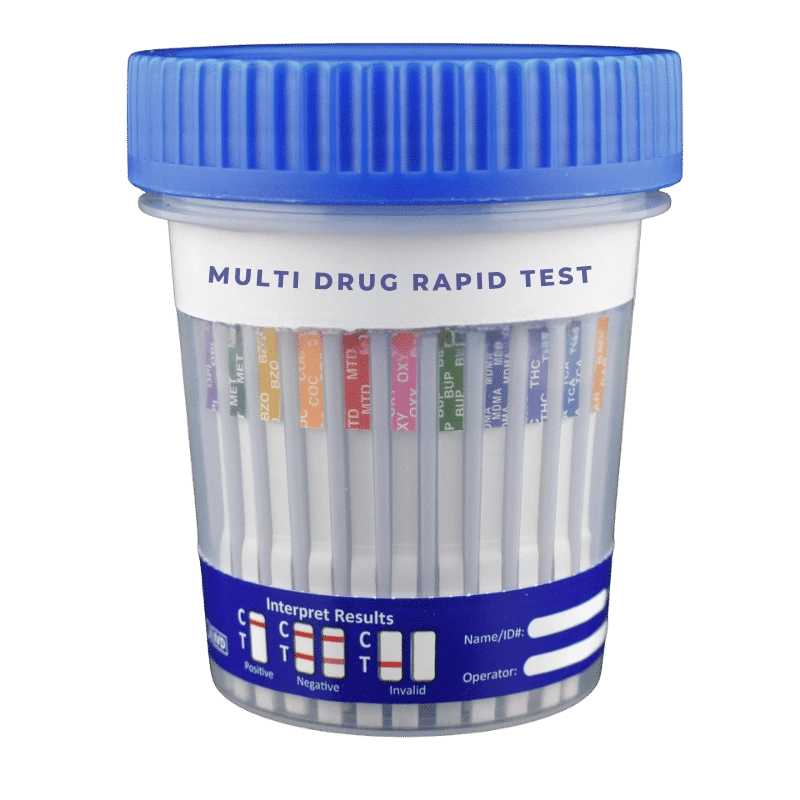
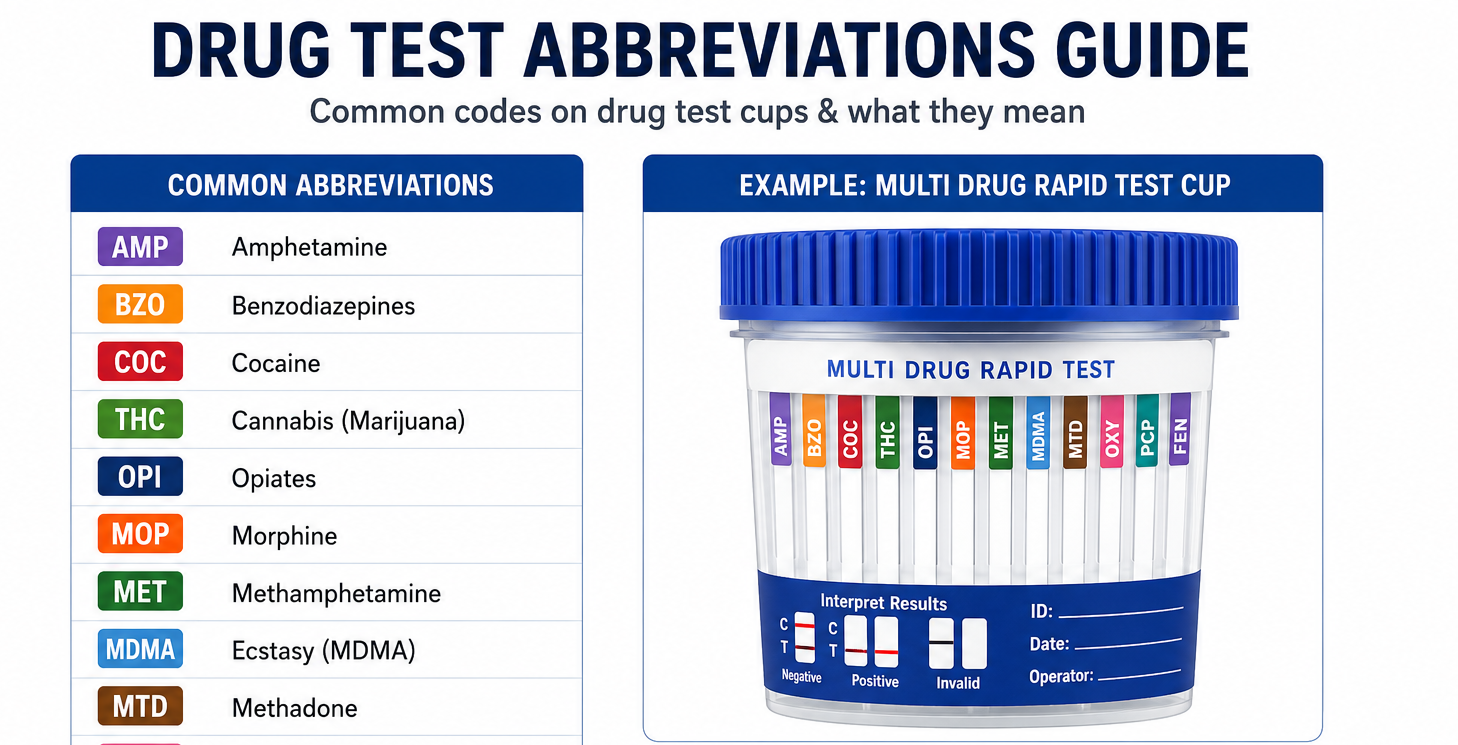
Drug Test Abbreviations Guide:
Drug test abbreviations can look confusing when you first see them on a urine drug test cup, oral fluid test, laboratory report, or multi-panel screening device. Instead of spelling out the full name of every substance, manufacturers commonly use short codes such as AMP, BZO, COC, THC, OPI, OXY, FEN, and ETG.
These abbreviations identify the drug or drug class included in a particular test panel. Some may refer to a specific substance, while others represent a broader drug class or a metabolite. The exact abbreviation and cutoff can vary between manufacturers, test types, and testing methods.
This guide explains the most common drug test abbreviations, what they mean, how they appear on multi-panel drug tests, what the numbers beside them can mean, and how to interpret these codes correctly.
Quick Drug Test Abbreviations List
| Abbreviation | Drug or Substance | Common Drug Class |
|---|---|---|
| 6-MAM | 6-Monoacetylmorphine | Heroin metabolite |
| ALC | Alcohol | Alcohol |
| AMP | Amphetamine | Stimulant |
| BAR | Barbiturates | Sedative |
| BUP | Buprenorphine | Opioid |
| BZO | Benzodiazepines | Sedative |
| BZE | Benzoylecgonine | Cocaine metabolite |
| COC | Cocaine | Stimulant |
| EDDP | Methadone metabolite | Opioid |
| ETG | Ethyl glucuronide | Alcohol metabolite |
| FEN | Fentanyl | Synthetic opioid |
| GAB | Gabapentin | Prescription medication |
| GHB | Gamma-hydroxybutyric acid | Depressant |
| K2 | Synthetic cannabinoids | Synthetic cannabinoid |
| KET | Ketamine | Dissociative |
| LSD | Lysergic acid diethylamide | Hallucinogen |
| MDMA | Methylenedioxymethamphetamine | Stimulant |
| MET/MAMP | Methamphetamine | Stimulant |
| MTD | Methadone | Opioid |
| MOP | Morphine | Opioid |
| OPI | Opiates | Opioid class |
| OXY | Oxycodone | Opioid |
| PCP | Phencyclidine | Dissociative |
| PGB | Pregabalin | Prescription medication |
| PPX | Propoxyphene | Opioid |
| TCA | Tricyclic antidepressants | Antidepressants |
| THC | Cannabis-related target | Cannabinoid |
| TRA | Tramadol | Opioid |
Important: This is a general reference. Not every drug test uses the same abbreviations, and an abbreviation does not necessarily mean that every manufacturer targets exactly the same substance or metabolite. Always check the labeling and instructions for the specific test being used.
What Are Drug Test Abbreviations?
Drug test abbreviations are shortened codes used to identify substances or drug classes on screening devices and laboratory documentation.
A multi-panel urine drug test may need to display several different drug targets in a limited amount of space. Instead of printing:
- Amphetamine
- Benzodiazepines
- Cocaine
- Methamphetamine
- Opiates
- Oxycodone
- Marijuana
the manufacturer may use:
AMP | BZO | COC | MET | OPI | OXY | THC
These codes make it easier to identify each testing panel.
You may see drug abbreviations on:
- Urine drug test cups
- Dip cards
- Oral fluid or saliva tests
- Laboratory reports
- Drug screening forms
- Multi-panel test kits
- Test packaging and instructions
The abbreviation alone does not tell you whether a specimen is positive or negative. The result must be interpreted according to the specific test’s instructions, control/test lines, cutoff levels, and testing methodology.
Common Drug Test Abbreviations Explained
AMP — Amphetamine
AMP commonly refers to amphetamine.
Amphetamines are stimulant substances. Depending on the test and its intended use, an AMP panel is designed to identify the relevant amphetamine target above the test’s specified cutoff.
AMP is one of the abbreviations frequently found on multi-panel urine drug tests.
BAR — Barbiturates
BAR stands for barbiturates.
Barbiturates are a class of central nervous system depressants. They have medical uses but can also be misused.
A BAR test is generally designed to screen for the relevant barbiturate target or targets defined by the manufacturer.
BUP — Buprenorphine
BUP stands for buprenorphine, a medication used in the treatment of opioid use disorder and for certain pain-management applications.
BUP may be included as an individual panel on expanded drug tests.
Because buprenorphine is not necessarily included in a standard opiate screen, a test specifically designed to detect BUP may be needed when buprenorphine exposure is relevant.
BZO — Benzodiazepines
BZO commonly means benzodiazepines.
Benzodiazepines are prescription medications that affect the central nervous system and may be used for conditions such as anxiety, insomnia, or seizures.
A BZO panel is designed to screen for the benzodiazepine target specified by the particular test.
BZE — Benzoylecgonine
BZE refers to benzoylecgonine, a major metabolite of cocaine.
Some drug-testing methods target cocaine or its metabolites rather than looking only for unchanged cocaine.
The exact target depends on the test methodology and manufacturer’s specifications.
COC — Cocaine
COC is commonly used for cocaine.
A COC panel is designed to screen for the relevant cocaine target, often in conjunction with detection of its metabolite depending on the testing method.
COC is a common component of workplace and multi-panel drug screening.
EDDP — Methadone Metabolite
EDDP refers to 2-ethylidene-1,5-dimethyl-3,3-diphenylpyrrolidine, a primary metabolite of methadone.
Some testing programs use EDDP testing to identify methadone metabolism rather than relying solely on methadone itself.
The specific target and cutoff depend on the test.
ETG — Ethyl Glucuronide
ETG stands for ethyl glucuronide, a metabolite produced after the body processes ethanol.
ETG testing is commonly associated with alcohol exposure testing. Because ETG is a metabolite rather than ethanol itself, an ETG test is different from a breath alcohol test that measures alcohol concentration at the time of testing.
Detection depends on factors such as the amount and timing of alcohol exposure, individual characteristics, specimen type, cutoff, and test methodology.
FEN — Fentanyl
FEN commonly refers to fentanyl.
Fentanyl is a synthetic opioid and may be included as an individual panel on expanded drug tests.
A standard opioid or opiate panel should not automatically be assumed to detect fentanyl. If fentanyl detection is required, the test should specifically include a fentanyl target.
GAB — Gabapentin
GAB is commonly used to represent gabapentin on some expanded drug-testing panels.
Gabapentin is a prescription medication, and it is not included in every standard drug screen.
If gabapentin testing is required, verify that the specific test panel is designed to detect it.
GHB — Gamma-Hydroxybutyric Acid
GHB stands for gamma-hydroxybutyric acid.
GHB is a central nervous system depressant. Because testing requirements and detection characteristics differ from common workplace drug panels, a test specifically designed for GHB may be required.
K2 — Synthetic Cannabinoids
K2 is commonly used to describe synthetic cannabinoids, sometimes referred to as synthetic marijuana.
K2 testing is different from a standard THC test. A THC panel should not automatically be interpreted as a test for synthetic cannabinoids.
The compounds detected depend heavily on the test’s design.
KET — Ketamine
KET stands for ketamine.
Ketamine is a dissociative anesthetic with legitimate medical uses. Some expanded drug-testing panels include KET as an individual target.
LSD — Lysergic Acid Diethylamide
LSD stands for lysergic acid diethylamide.
LSD is a hallucinogenic substance. Testing for LSD generally requires a test specifically designed for the appropriate target because it is not part of most standard multi-panel drug screens.
MDMA — Methylenedioxymethamphetamine
MDMA stands for methylenedioxymethamphetamine.
It is a psychoactive stimulant commonly associated with the names ecstasy and molly.
Some expanded drug panels specifically include MDMA.
MET / MAMP — Methamphetamine
MET or MAMP may be used to represent methamphetamine, depending on the manufacturer.
Methamphetamine is a central nervous system stimulant.
Because abbreviations can vary, always check the manufacturer’s documentation when interpreting a particular test panel.
MTD — Methadone
MTD commonly means methadone.
Methadone is a synthetic opioid used medically, including in medication-assisted treatment for opioid use disorder.
A methadone panel is separate from many standard opiate panels.
MOP — Morphine
MOP may be used to represent morphine.
Morphine is an opioid medication. Depending on the testing method, a morphine-related target can also be relevant to broader opiate screening because certain opioids may produce related metabolites.
OPI — Opiates
OPI commonly stands for opiates.
Unlike an abbreviation such as OXY, which identifies oxycodone, OPI generally refers to an opiate testing class.
This distinction matters because OPI does not automatically mean every opioid is included.
For example, a standard opiate assay should not automatically be assumed to detect fentanyl, methadone, buprenorphine, or oxycodone unless the specific test is designed for those targets.
OXY — Oxycodone
OXY stands for oxycodone.
Oxycodone is a prescription opioid medication.
OXY is frequently offered as an individual panel because oxycodone may require a specific assay rather than being reliably identified by a general opiate screen.
PCP — Phencyclidine
PCP stands for phencyclidine.
PCP is a dissociative substance that can affect perception, mood, and behavior.
PCP is included in many traditional multi-panel drug tests.
PGB — Pregabalin
PGB is commonly used for pregabalin on certain expanded drug-testing panels.
Pregabalin is a prescription medication. It is not routinely included in every standard workplace drug screen, so specific panel selection is important.
PPX — Propoxyphene
PPX refers to propoxyphene, an opioid analgesic.
Although propoxyphene is no longer commonly used in many markets, PPX may still appear in some drug-testing terminology or legacy panel information.
TCA — Tricyclic Antidepressants
TCA commonly stands for tricyclic antidepressants.
These medications are an older class of antidepressants that can also have other medical applications.
TCA screening is generally a specific test panel and is not part of every standard drug screen.
THC — Cannabis
THC is the common abbreviation used for tetrahydrocannabinol, the primary psychoactive cannabinoid associated with cannabis.
On many drug-testing products, THC identifies the cannabis-related testing panel.
A THC test should not be confused with testing for synthetic cannabinoids such as K2.
TRA — Tramadol
TRA commonly refers to tramadol.
Tramadol is a prescription opioid-like analgesic. Some expanded drug tests specifically include tramadol because it is not necessarily part of a standard opiate panel.
Modern Drug Test Abbreviations You May See on Expanded Panels
Drug-testing panels have expanded beyond traditional five-panel testing in some settings. Depending on the manufacturer and intended application, modern multi-panel tests may include additional targets.
Examples include:
- FEN — Fentanyl
- ETG — Ethyl glucuronide
- GAB — Gabapentin
- PGB — Pregabalin
- KET — Ketamine
- LSD — Lysergic acid diethylamide
- 6-MAM — 6-Monoacetylmorphine
- K2 — Synthetic cannabinoids
- MDMA — Methylenedioxymethamphetamine
- TRA — Tramadol
This is one reason it is important to look at the actual panel configuration instead of assuming that every “10-panel,” “12-panel,” or “14-panel” drug test contains exactly the same substances.
Panel names can vary by manufacturer.
For example, two products marketed as 12-panel tests may contain different drug targets. Always review the product specifications before selecting or interpreting a test.
What Does 6-MAM Mean on a Drug Test?
6-MAM stands for 6-monoacetylmorphine, also called 6-acetylmorphine.
It is a metabolite specifically associated with heroin exposure.
6-MAM is important because it can help distinguish heroin exposure from exposure to other substances that may result in morphine detection.
Because its detection window is relatively short, the timing of specimen collection is important when 6-MAM testing is being performed.
What Do the Numbers Mean on a Drug Test?
You may see numbers next to drug abbreviations, such as:
- THC 50
- COC 300
- BZO 300
- AMP 1000
- OPI 300
- OPI 2000
In many drug-testing contexts, the number represents the cutoff concentration used by the test.
Cutoffs are commonly expressed in nanograms per milliliter (ng/mL) for urine-based testing, although the applicable units and values depend on the specimen type and testing methodology.
For example, a label such as COC 300 may indicate a cocaine-related screening cutoff of 300 ng/mL.
The number does not mean:
- The amount of drug consumed
- How much drug a person used
- How long ago the drug was taken
- The exact concentration of the drug in the body
It is a testing threshold used to classify a specimen according to the test’s analytical criteria.
Always use the cutoff information supplied with the specific product.
What Do Drug Test Abbreviations Look Like on a Test Cup?
A multi-panel urine drug test cup may have several abbreviations printed along the testing strips.
For example, a cup could display:
AMP | BZO | COC | MET | MOP | OXY | PCP | THC
Each abbreviation corresponds to a particular test panel.
The cup’s instructions explain how the result should be interpreted.
Depending on the device, you may see:
- C = Control
- T = Test
- Positive
- Negative
- Invalid
The exact appearance can differ between manufacturers.
How to Read the C and T Lines
Many rapid urine drug tests use a control line and test line.
In general, the manufacturer’s instructions may describe:
Two lines — negative: A control line and a test line are visible.
One control line — presumptive positive: The control line is visible but the test line is absent for the relevant panel.
No valid control line — invalid: The test did not produce a valid result and should be handled according to the manufacturer’s instructions.
Because test designs vary, always follow the specific instructions supplied with the test rather than applying a generic interpretation to every device.
Drug Test Abbreviations by Drug Class
Organizing abbreviations by drug class can make them easier to understand.
Stimulants
Common examples include:
- AMP — Amphetamine
- MET/MAMP — Methamphetamine
- MDMA — Methylenedioxymethamphetamine
- COC — Cocaine
Opioids and Opiates
Examples include:
- OPI — Opiates
- MOP — Morphine
- OXY — Oxycodone
- BUP — Buprenorphine
- MTD — Methadone
- FEN — Fentanyl
- TRA — Tramadol
- PPX — Propoxyphene
These abbreviations should not be treated as interchangeable. An individual opioid may require a specific test panel.
Sedatives
Examples include:
- BZO — Benzodiazepines
- BAR — Barbiturates
- TCA — Tricyclic antidepressants
Cannabis-Related Testing
- THC — Cannabis-related target
- K2 — Synthetic cannabinoids
THC and K2 are different testing targets.
Dissociatives
- PCP — Phencyclidine
- KET — Ketamine
Alcohol-Related Testing
- ALC — Alcohol
- ETG — Ethyl glucuronide
- ETS — Ethyl sulfate
ETG and ETS are alcohol metabolites and should not be confused with a direct measurement of blood alcohol concentration.
Are Drug Test Abbreviations the Same for Every Test?
No.
Different manufacturers may use different abbreviations, panel configurations, and cutoff levels.
For example, methamphetamine may appear as MET or MAMP, depending on the product.
A test panel may also use a specific abbreviation for a substance that another manufacturer does not include at all.
This means that you should never determine what a test detects solely from the number of panels.
Instead, review:
- The abbreviation printed on the test
- The manufacturer’s product information
- The test’s instructions for use
- The listed cutoff levels
- The specimen type
- The applicable testing requirements
Drug Test Abbreviations vs. Drug Classes
An abbreviation can represent either a specific substance, a metabolite, or a broader drug class.
For example:
THC refers to a cannabis-related target.
OPI generally refers to an opiate class.
OXY refers specifically to oxycodone.
FEN refers to fentanyl.
Understanding this distinction is important because seeing one abbreviation does not necessarily mean the test detects every substance within a broader drug category.
For example, an OPI panel should not automatically be interpreted as a test for fentanyl, buprenorphine, methadone, or oxycodone.
Drug Test Abbreviations vs. Screening Tool Abbreviations
Not every abbreviation associated with drug screening refers to a drug.
Some medical and behavioral-health resources use abbreviations for screening questionnaires and assessment tools.
Examples include:
- ASSIST — Alcohol, Smoking and Substance Involvement Screening Test
- AUDIT — Alcohol Use Disorders Identification Test
- DAST — Drug Abuse Screening Test
- CRAFFT — A substance-use screening tool commonly used with adolescents
These are different from drug-panel abbreviations such as AMP, COC, THC, OPI, and BZO.
If you are looking at a drug test cup or laboratory drug panel, focus on the substance-related abbreviations listed by that specific test.
Does Every Multi-Panel Drug Test Detect the Same Drugs?
No.
A “multi-panel” designation only tells you that multiple drug targets are included. It does not guarantee that every manufacturer uses the same combination.
For example, one expanded panel could include:
AMP, BZO, COC, MET, MOP, OXY, PCP, THC, FEN, BUP
while another product with the same number of panels could use a different combination.
This is particularly important when selecting a test for a workplace, clinical, treatment, correctional, or other screening program.
Always compare the actual drug targets rather than relying only on the panel count.
What Is the Difference Between a Screening Test and a Confirmation Test?
Most rapid drug-test cups and dip cards are designed for initial screening.
A screening test identifies specimens that meet the test’s criteria for a presumptive positive or negative result.
A presumptive positive may require additional laboratory testing depending on the testing program.
Laboratories may use more specific analytical techniques such as:
- GC-MS — Gas chromatography-mass spectrometry
- LC-MS/MS — Liquid chromatography-tandem mass spectrometry
Confirmation testing is different from an initial immunoassay screen and should be interpreted according to the applicable laboratory and testing requirements.
Does a Drug Test Abbreviation Tell You Whether the Result Is Positive?
No.
The abbreviation tells you what the panel is designed to test for.
For example:
THC identifies the cannabis-related panel.
It does not by itself mean that the person tested positive for THC.
The result must be interpreted by looking at the relevant test indicator and following the manufacturer’s instructions.
Likewise:
COC means the test includes a cocaine-related panel.
It does not mean the specimen is positive.
Why Can Drug Test Abbreviations Be Confusing?
Several factors can make drug-test terminology difficult to understand.
1. Different manufacturers use different codes
One test may use MET, while another uses MAMP.
2. Some abbreviations represent classes
OPI is broader than a specific drug such as OXY.
3. Some tests target metabolites
ETG and BZE are examples of metabolite-related testing terminology.
4. Panel configurations differ
Two tests with the same panel count may not contain the same drugs.
5. Cutoff numbers can vary
The number associated with an abbreviation may reflect the test’s cutoff concentration.
For these reasons, the manufacturer’s labeling and instructions should always take priority.
Frequently Asked Questions About Drug Test Abbreviations
What does AMP mean on a drug test?
AMP commonly means amphetamine. It is a stimulant-related testing panel found on many multi-panel drug tests.
What does BZO mean on a drug test?
BZO commonly stands for benzodiazepines. It identifies a benzodiazepine-related testing panel.
What does COC mean on a drug test?
COC commonly means cocaine. The specific target and cutoff depend on the test.
What does THC mean on a drug test?
THC commonly identifies the cannabis-related testing panel. It does not automatically mean that a result is positive.
What does OPI mean on a drug test?
OPI commonly refers to opiates. It is a drug-class abbreviation and should not automatically be interpreted as testing for every opioid.
What does OXY mean on a drug test?
OXY commonly stands for oxycodone. Oxycodone may require a specific test panel rather than being reliably identified by a general opiate screen.
What does FEN mean on a drug test?
FEN commonly stands for fentanyl. A fentanyl-specific panel is generally required when fentanyl testing is intended.
What does ETG mean on a drug test?
ETG stands for ethyl glucuronide, a metabolite of ethanol. ETG testing is commonly used when alcohol exposure is being evaluated.
What does BUP mean on a drug test?
BUP commonly stands for buprenorphine, a medication used in opioid treatment and certain pain-management settings.
What does MTD mean on a drug test?
MTD commonly means methadone.
What does MET or MAMP mean on a drug test?
MET or MAMP may be used to identify methamphetamine, depending on the manufacturer.
What does GAB mean on a drug test?
GAB may be used for gabapentin on certain expanded drug-testing panels.
What do the numbers after drug test abbreviations mean?
Numbers such as 50, 300, or 1000 commonly represent a testing cutoff concentration. The exact value and unit depend on the test and specimen type.
Are drug test abbreviations universal?
No. Abbreviations and panel configurations can vary by manufacturer, test methodology, specimen type, and testing program.
Can a standard drug test detect fentanyl?
Not necessarily. Fentanyl is not automatically included in every standard opiate or multi-panel drug test. Check whether FEN or a fentanyl-specific target is included.
Is OPI the same as OXY?
No. OPI generally refers to an opiate class, while OXY refers specifically to oxycodone.
Is THC the same as K2?
No. THC and synthetic cannabinoids such as K2 are different testing targets. A THC test should not automatically be considered a K2 test.
What does a C line mean on a drug test?
The C line generally represents the control line. Its presence indicates that the test has functioned according to the device’s testing procedure. Always follow the specific manufacturer’s instructions.
What does a T line mean on a drug test?
The T line generally represents the test line. Its interpretation depends on the test design and instructions. On many competitive immunoassay tests, the presence or absence of the test line is used as part of the negative or presumptive-positive interpretation.
Final Takeaway: Understanding Drug Test Abbreviations
Drug test abbreviations are simply a shorthand way of identifying the substances or drug classes included in a screening panel.
Some of the most common codes include:
AMP — Amphetamine
BAR — Barbiturates
BUP — Buprenorphine
BZO — Benzodiazepines
COC — Cocaine
ETG — Ethyl glucuronide
FEN — Fentanyl
MDMA — Methylenedioxymethamphetamine
MET/MAMP — Methamphetamine
MTD — Methadone
OPI — Opiates
OXY — Oxycodone
PCP — Phencyclidine
THC — Cannabis-related target
TRA — Tramadol
However, the abbreviation alone is only one part of interpreting a drug test. Panel configuration, cutoff concentration, specimen type, manufacturer, testing methodology, and result interpretation all matter.
If you are reviewing a multi-panel drug test, compare the actual abbreviations and product specifications rather than assuming that every test with the same panel count detects the same substances.
For workplace, clinical, legal, or other regulated testing programs, always follow the applicable requirements and the manufacturer’s instructions for use.