Inactivating Transport Media: How to Choose and Validate
Inactivating transport media (ITM) is a collection fluid that does two jobs at once. It stabilizes viral RNA or DNA for molecular testing, and it chemically destroys the virus’s ability to infect. That makes specimens safer to ship and open, but only if the inactivation has been shown to work for your pathogen, your specimen type and your bench. It also means the specimen can never be used for viral culture. This guide covers how ITM works, how guanidine-based and non-guanidine formulas differ, what to check before you buy, and how to validate it in your own lab.
TL;DR
- ITM contains detergents, chaotropic salts or both. These disrupt the virus and protect nucleic acids, so it suits PCR and sequencing workflows, not culture.
- Standard viral transport medium (VTM) keeps virus viable. ITM does not. Pick the medium that matches the most demanding test you will run on the specimen.
- “Inactivating” on a label is a claim, not a guarantee for your lab. Validate against your target, your matrix and your controls, and confirm your extraction and amplification chemistry tolerates the buffer.
- Guanidine formulas have the longest track record. Non-guanidine formulas trade some of that history for easier handling. Neither choice removes the need for validation.
- Inactivated specimens still need correct UN 3373 triple packaging when you ship them.
Table of Contents
- What inactivating transport media actually does
- ITM versus standard VTM: the difference that matters
- Guanidine versus non-guanidine formulas
- What “inactivating” does and does not promise
- Will it break your assay? Downstream compatibility
- How to validate an ITM in your own lab
- Perspective: what we see at the bench
- Shipping inactivated specimens
- Collection details that affect the result
- A practical buying checklist
- Where Mayflower Bioscience fits
- FAQ
- Sources
What inactivating transport media actually does
A transport medium has to hold a swab or fluid specimen in a state that keeps the answer intact until the lab runs the test. Standard media do this by keeping the virus alive and intact. Inactivating media do it by taking the virus apart while shielding its genetic material.
The chemistry is fairly consistent across products. According to a clinical validation study of a guanidine-based inactivation medium, these media use detergents such as sodium dodecyl sulfate or Triton X-100 and protein denaturants such as guanidine thiocyanate. They lyse viral envelopes and disrupt capsids, which leaves the virus non-infectious while the nucleic acid stays available for molecular assays. The same source reports that some media reached a greater than 6 log reduction in infectivity in as little as 5 minutes.
Two practical benefits follow:
- Lower-containment handling. When inactivation is validated, specimens can in some workflows be processed at a lower biosafety level than live virus would require. That decision belongs to your biosafety officer, not the product label.
- Simpler logistics. Researchers point to safer, ambient-temperature transport as a main driver of the shift toward ITM, because it removes the cost and fragility of a cold chain. A review of transport media types discusses this, particularly for outbreaks and resource-limited settings where freezer space runs out.
The cost of those benefits is a one-way door. Once a specimen is in ITM, you cannot culture the virus from it, and the buffer may interfere with other downstream work.
ITM versus standard VTM: the difference that matters
The core difference is the presence of lytic or denaturing agents. Standard VTM is built to keep a virus viable. It typically holds a neutral pH and osmotic balance and adds protein stabilizers such as albumin or fetal bovine serum. ITM drops that goal and adds detergents and chaotropic salts that are incompatible with cell culture. This comparison comes from the same review of transport media.
| Feature | Standard VTM | Inactivating transport media |
|---|---|---|
| Virus after collection | Kept viable | Rendered non-infectious |
| Typical key ingredients | Buffered salts, protein stabilizer, antibiotics | Detergents, guanidine salts or other lytic agents |
| Viral culture | Possible | Not possible |
| PCR / RT-qPCR | Yes | Yes, if the buffer is compatible with your chemistry |
| Antigen testing | Often yes | Check the manufacturer’s data; lytic buffers can interfere |
| Handling risk at the bench | Live virus | Reduced once inactivation is validated |
| Chemical hazard | Low | Varies; some guanidine formulas are hazardous |
The decision rule is short. If any part of your plan includes culture, isolation, or live-virus work on the same specimen, use standard VTM. If the specimen will only ever see nucleic acid testing, ITM is worth considering. If you are unsure, collect a second specimen in standard VTM rather than committing everything to one medium.
Guanidine versus non-guanidine formulas
Readers often ask which chemistry is better. The honest answer is that they solve the same problem with different trade-offs.
Guanidine-based media
Guanidine thiocyanate and related salts are strong chaotropes. They unfold proteins, including the nucleases that would otherwise degrade RNA. That is why guanidine buffers have been used for RNA work for decades and why they appear in so many commercial inactivation media. The clinical validation paper evaluated this class for SARS-CoV-2 preservation.
The drawbacks are practical:
- Guanidine thiocyanate is a hazardous chemical. Safety data sheets typically warn against mixing it with bleach or strong acids, so your decontamination routine needs to account for it.
- Carry-over into extraction or amplification can inhibit enzymes if the sample-to-buffer ratio or the cleanup step is wrong.
- Self-collection or retail-adjacent use is harder to justify with a hazardous liquid.
Non-guanidine media
Some manufacturers now offer inactivating media built around detergents, other denaturants or proprietary chemistry, positioned as less hazardous to handle. The appeal is straightforward: easier safety paperwork, simpler waste handling and a lower-risk tube for people collecting specimens outside a lab.
The trade-off is evidence. Many of these formulas have a shorter public record, and the data often covers a narrower list of viruses and specimen types. A claim that works for an enveloped respiratory virus does not automatically extend to a non-enveloped virus, which is usually harder to inactivate. Ask for data on the exact agent you work with.
How to decide
| Question | Leans guanidine | Leans non-guanidine |
|---|---|---|
| Do you need data on many virus families? | Often more published data | Check each claim |
| Will non-lab staff handle tubes? | Less ideal | Often preferred |
| Do you have a validated extraction method already? | Check compatibility | Check compatibility |
| Is hazardous waste a burden? | Heavier | Lighter |
| Is nucleic acid stability over days at room temperature critical? | Strong record | Verify claimed hold times |
Note what is in the last column of every row: verify. No chemistry makes that step optional.
What “inactivating” does and does not promise
The most common misunderstanding is treating the word as universal. A medium labeled inactivating has been shown to inactivate specific agents under specific conditions: a given virus, titer, contact time and temperature. Biosafety guidance is explicit that labs must confirm this themselves. The CDC’s Biosafety in Microbiological and Biomedical Laboratories, 6th Edition is the reference to check, and it calls for on-site validation of inactivation procedures with appropriate controls and enough replicates to confirm that no viable organism remains under your real operating conditions.
Three gaps explain why a published protocol is not enough.
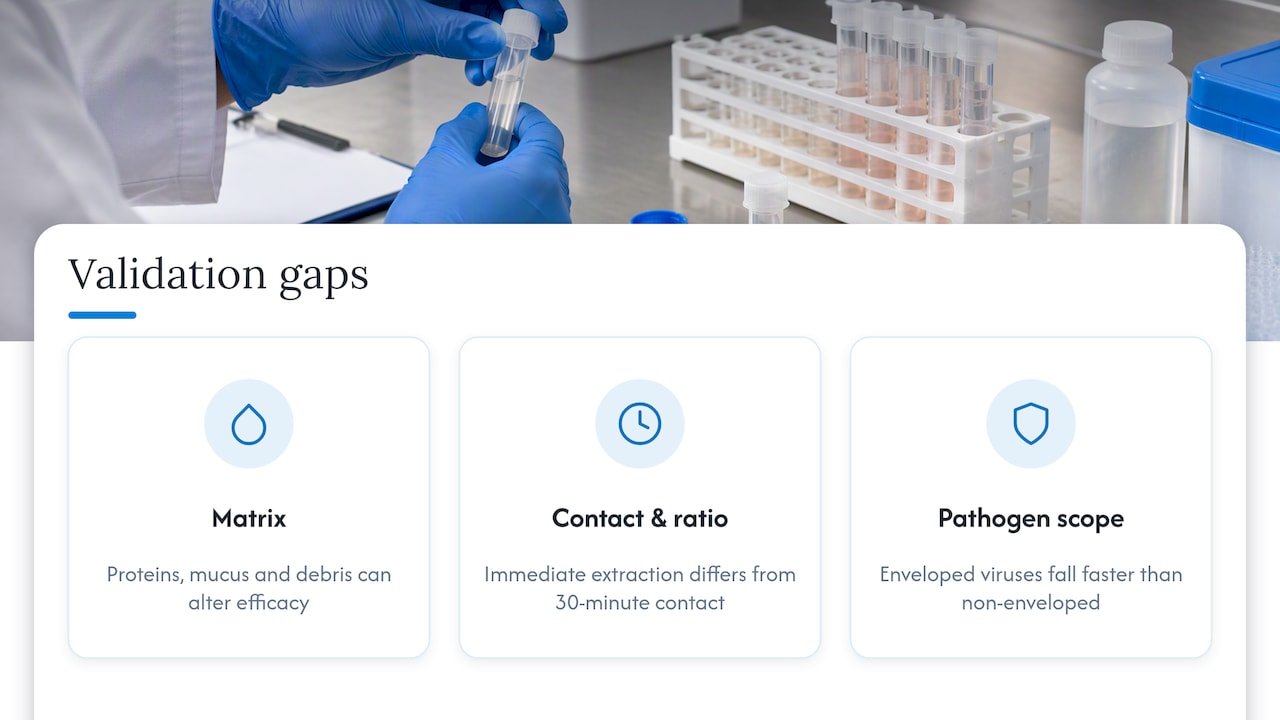
Matrix effects. A buffer that inactivates virus spiked into clean culture fluid can behave differently in sputum, stool or blood, where proteins, mucus and debris can bind or neutralize the active agents. An analysis of SARS-CoV-2 inactivation by transport media, extraction reagents, detergents and fixatives is a useful reference for how widely results vary between reagents. Test efficacy in the specimen matrix you actually receive.
Contact time and ratio. Inactivation depends on how long the specimen sits in the buffer and on the ratio of specimen to medium. A swab that is dropped in and immediately extracted is not the same experiment as one that sits for 30 minutes.
Pathogen scope. Enveloped viruses generally fall to detergents faster than non-enveloped ones. If your work spans both, one data point will not cover you.
If your facility handles regulated agents, the CDC also publishes guidance on the inactivation or removal of select agents and toxins for future use, which sets out documentation expectations. Talk to your institutional biosafety officer before relying on any inactivation claim to change containment level.
Will it break your assay? Downstream compatibility
A medium can inactivate perfectly and still ruin the result. Lab professionals report that the buffer chemistry has to match the extraction and amplification platform. One assessment of downstream assay performance describes how incompatibility can shift Ct values or inhibit amplification, which can produce false negatives if validation is skipped.
Also check cytotoxicity if any part of your process puts the specimen near living cells. A study of commercially available VTM for SARS-CoV-2 inactivation found that some media contain reagents that are cytotoxic or can inhibit PCR when handled incorrectly, and that dilution may be needed to remove cytotoxic effects in cell-based assays. Do not assume the same tube can feed both a PCR and a cell assay.
A compatibility checklist
- Does the manufacturer list the extraction chemistries and instruments it was tested with?
- Does it state the maximum volume of medium you can add to a reaction or an extraction?
- Is a cleanup step (wash, column, bead-based) required to remove inhibitors?
- Does your internal control amplify normally from a sample in the medium compared with a sample in water or a reference buffer?
- If your sample can contain blood or other inhibitory matrices, have you checked for PCR inhibition separately? Our guide on PCR inhibitors in blood and how to counter them with BSA or tolerant polymerases walks through that problem.
How to validate an ITM in your own lab
Validation has two halves: proving inactivation, and proving the assay still works. Run them as separate studies with your biosafety officer’s sign-off on the first.
Part 1: inactivation
- Define the claim. Write down the agent, specimen type, specimen-to-medium ratio, contact time and temperature you intend to use in routine work.
- Prepare challenge material. Use the highest titer you can safely generate, in a matrix that resembles real specimens, not clean culture fluid alone.
- Include controls. BMBL calls for positive, negative and process controls. Add replicates so a single lucky result cannot pass the test.
- Test for residual infectivity. Because the buffer is often cytotoxic, you may need dilution or cleanup before inoculating cells. That step has to be validated too, or toxicity can mask live virus.
- Document and set limits. Record the exact conditions. Your standard operating procedure should forbid shortening contact time or changing ratios without revalidation.
Work like this normally happens in a facility with the containment level the live agent requires. Do not run inactivation challenges outside it.
Part 2: assay performance
- Spike a known quantity of target into medium and into a reference matrix.
- Extract and amplify both with your routine method.
- Compare Ct values, efficiency and internal control behavior across a dilution series.
- Test positive and negative clinical or contrived specimens near your assay’s limit of detection, since inhibition shows up first at low concentrations. This matters because sampling itself can already be a weak link: nasal swab testing has been shown to miss patients with low SARS-CoV-2 viral loads, so a medium that costs you additional sensitivity compounds the problem.
- Repeat after any lot change of medium, extraction kit or instrument platform.
If you run RT-qPCR, our qPCR and RT-qPCR overview and the molecular assay setup guide for optimized PCR workflows cover controls and setup details that apply to this kind of validation.
Perspective: what we see at the bench
We supply reagents and kits to research, drug discovery and infectious disease laboratories, and the questions we hear about transport media rarely start with chemistry. They start with a failed run. A lab switches to a new tube because it is easier to ship, and two weeks later the control Ct values drift. The medium was fine. Nobody had checked it against the extraction kit.
Our view is simple. First, choose the medium from the most demanding test the specimen will face, not from the cheapest tube. Second, treat the word “inactivating” as the start of a conversation with the manufacturer, not the end of one. Ask for the viruses tested, the titers, the contact times and the specimen types. If the answer is vague, that tells you something. Third, validate on your own platform with your own controls, and keep a small stock of a single lot for the validation so the result means something.
We are also wary of the idea that a lower-hazard buffer means less rigor. A gentler chemistry can still be incompatible with your amplification step, and a more aggressive one can be perfectly fine with the right cleanup. The chemistry matters less than the evidence you hold for your own workflow.
— Alina
Shipping inactivated specimens
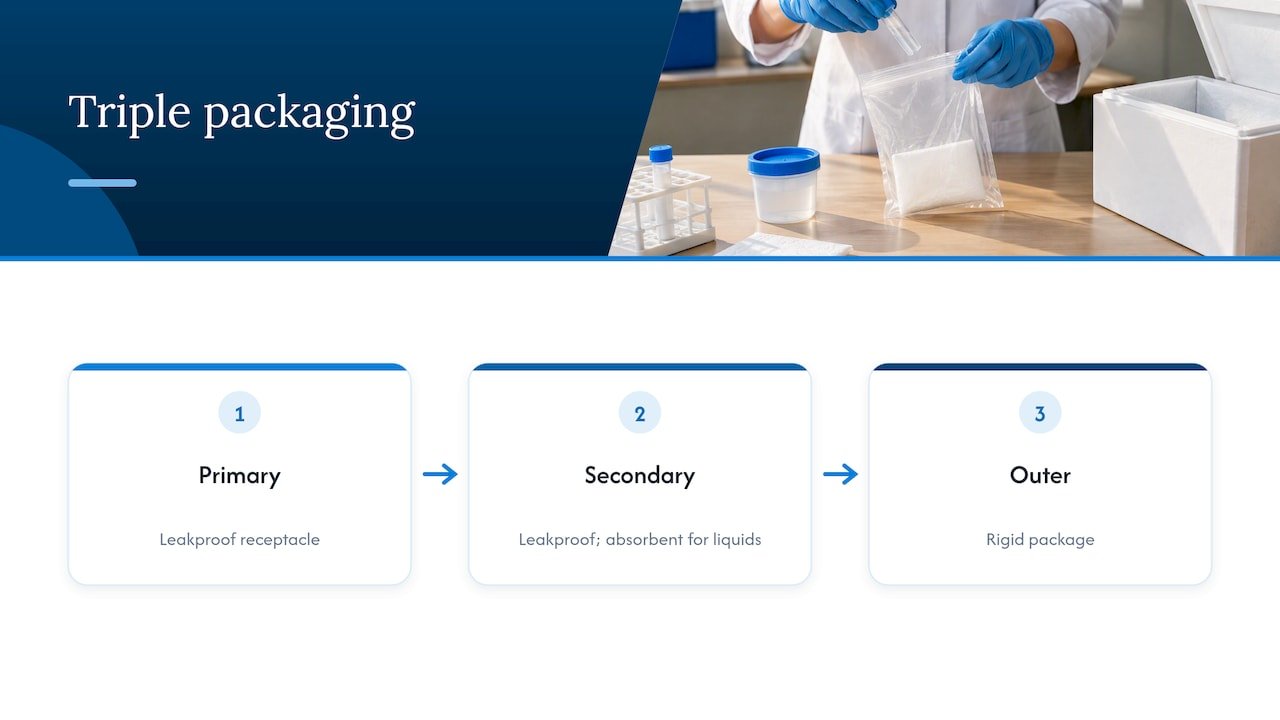
Inactivation does not exempt a specimen from shipping rules unless the validated documentation and the regulations say so. For most diagnostic and research specimens moving in the US, the working assumption is Category B, UN 3373 packaging. The CDC’s specimen packing and shipping guidance for infectious disease laboratories describes triple packaging: a leakproof primary receptacle, a leakproof secondary receptacle and a rigid outer package, with absorbent material between the primary and secondary layers for liquid specimens. Air shipments fall under IATA rules and ground shipments under DOT rules, and the people who pack and sign need current dangerous goods training. The same document notes that submissions to the CDC that do not meet these packaging criteria can be rejected.
Leaks are a recurring failure. CDC’s safe labs discussion of specimen collection, transport and storage challenges describes specimens arriving with caps not tightened or sealed correctly. Closing the tube firmly, wrapping the closure and using the secondary container as designed prevents most of these. For a practical walk-through of the package structure and the pressure test, see our page on UN 3373 packaging for lab shippers.
One more caution: if your tube holds a guanidine-based medium, check the safety data sheet and the carrier’s rules for the liquid itself, not only for the biological content.
Collection details that affect the result
The medium cannot rescue a poor specimen. Follow the swab guidance in CDC’s interim guidelines for collecting and handling clinical specimens for COVID-19 testing: use synthetic fiber swabs with thin plastic or wire shafts designed for the sampling site, and avoid calcium alginate swabs or wooden shafts, which may contain substances that inactivate some viruses and inhibit PCR testing.
A few more habits that save runs:
- Label the tube with the medium type and lot, so that a mixed batch of ITM and VTM never reaches the culture bench.
- Keep the fill volume consistent. The specimen-to-medium ratio underlies both your inactivation data and your assay data.
- Record the time from collection to extraction. Stability claims are time-limited, and you want your own data on how long your specimens hold.
- Keep a reserve aliquot in a standard medium when the study design allows it, in case a result needs culture confirmation.
A practical buying checklist
Before you order a case of any inactivating medium, ask the supplier for these items in writing.
- Intended use and regulatory status. Is it labeled for clinical diagnostic use, or for research use only? That decides whether it can sit inside a regulated test workflow. For reference, FDA reviews some sample preservation solutions as devices, as in this 510(k) decision summary for a sample preservation solution, which describes a product intended for collection, inactivation and preservation of specimens.
- Inactivation data. Which agents, titers, contact times and temperatures? In which matrices?
- Stability data. How many days at room temperature, refrigerated and frozen, for RNA and for DNA?
- Compatibility data. Which extraction kits and amplification chemistries have been tested? What is the maximum input volume?
- Hazard profile. Safety data sheet, waste classification and shipping classification of the liquid.
- Lot consistency. Can you hold back a lot for validation and reorder the same lot?
- Support. Can a technical person answer a question about your specific platform?
The last item is easy to overlook and often decides whether a validation takes a week or two months.
Where Mayflower Bioscience fits
We are a US-based supplier of research reagents, assays, antibodies and molecular biology tools, with technical support for the labs that use them. For the work around transport and testing, our molecular biology range includes PCR and qPCR reagents for building and validating the amplification side of an ITM workflow, and our infectious disease antibodies support assay development. If you work with tissue or cell material rather than swab specimens, look at our tissue storage and transport media, which are designed for a different purpose than viral inactivation. Tell us about your platform through the Mayflower Bioscience site and we will help you match reagents to your validation plan.
FAQ
What is the difference between inactivating transport media and VTM?
Standard VTM keeps virus viable, using a buffered, protein-supplemented formulation, so you can culture from it. Inactivating media add detergents or chaotropic agents that destroy infectivity while protecting nucleic acids, so they suit molecular testing only. Choose by the most demanding test you plan to run.
Is guanidine-based or non-guanidine media better?
Neither wins on every criterion. Guanidine media have a long record for RNA preservation but are chemically hazardous and can inhibit enzymes if carried over. Non-guanidine media are usually easier to handle but may have narrower public data. Judge each product on its data for your pathogen, matrix and platform.
Can I treat an inactivated specimen as non-infectious?
Only after you or the manufacturer have shown that the exact combination of agent, specimen type, ratio and contact time works, and your biosafety officer agrees. CDC’s BMBL calls for on-site validation with controls and replicates. A label alone is not sufficient evidence for lower-containment handling.
Does inactivating medium need UN 3373 packaging?
In most cases the specimen is still shipped as a Category B substance under UN 3373, with a leakproof primary container, a leakproof secondary container and a rigid outer package. Check the carrier’s rules and the medium’s safety data sheet, and make sure whoever packs the box holds current dangerous goods training.
Can inactivating media cause false negatives?
Yes, if its chemistry is incompatible with your extraction or amplification method. Published work describes Ct shifts and inhibition when this is not checked. Run a spiked comparison against a reference matrix, including near your limit of detection, before you adopt a medium.
Sources
- Evaluation and Clinical Validation of Guanidine-Based Inactivation Transport Medium for Preservation of SARS-CoV-2
- Review of viral transport media types, including inactivating media
- Biosafety in Microbiological and Biomedical Laboratories, 6th Edition (CDC)
- Analysis of Inactivation of SARS-CoV-2 by Specimen Transport Media, Nucleic Acid Extraction Reagents, Detergents, and Fixatives
- Guidance on the Inactivation or Removal of Select Agents and Toxins for Future Use (CDC)
- Downstream assay performance and transport media chemistry
- Evaluation of Commercially Available Viral Transport Medium (VTM) for SARS-CoV-2 Inactivation and Use in Point-of-Care Testing
- Nasal-Swab Testing Misses Patients with Low SARS-CoV-2 Viral Loads
- Specimen Packing and Shipping Guidance for Infectious Diseases Laboratories (CDC)
- Safety Challenges with Specimen Collection, Transport, Accessioning, and Storage (CDC)
- Interim Guidelines for Collecting and Handling of Clinical Specimens for COVID-19 Testing (CDC)
- 510(k) Substantial Equivalence Determination Decision Summary K212878 (FDA)