How Long Does PCP Stay in Your System? The 7-14 Day Urine Window
How Long Does PCP Stay in Your System?
PCP (phencyclidine, commonly known as “angel dust”) stays in urine for about 7–14 days after use — one of the longest urine windows of any drug on a standard panel. Chronic heavy users can test positive for up to 30 days. PCP is fat-soluble and stored in adipose tissue like THC, and its slow release back into circulation keeps urinary excretion above the standard 25 ng/mL cutoff far longer than stimulants or opioids. PCP is a Schedule II controlled substance that was originally developed as a dissociative anaesthetic.
This guide explains why PCP’s window is so long, how urine pH and use pattern change it, and what the window means for workplace, court, and clinical testing programs. For every substance side by side, see the drug detection times chart.
Key Takeaways — PCP
- Urine window: 7–14 days after use
- Cutoff: 25 ng/mL (screening and confirmation)
- Chronic heavy use: up to ~30 days
- Half-life: ~21 hours on average (range 7–46 hours)
PCP Detection Windows by Specimen Type
| Specimen | Detection window | Notes |
|---|---|---|
| Urine | 7–14 days (chronic up to ~30) | Standard program specimen; 25 ng/mL cutoff |
| Blood | 1–2 days | Recent use; clinical and forensic settings |
| Saliva | 1–3 days | Recent use screening |
| Hair | ~90 days | Longest look-back; misses the most recent days |
Onset: PCP is detectable in urine within about 4–6 hours of use. Hair requires a growth lag of roughly 5–10 days before use registers in a sampled segment, which is why hair misses recent use despite its long look-back.
PCP (highlighted) sits second only to chronic THC in urine detection length — both are fat-soluble drugs stored in tissue.
Why Does PCP Stay Detectable So Long?
Long half-life. PCP’s half-life averages about 21 hours, with a wide reported range of 7–46 hours — far longer than cocaine’s ~1 hour. Combined with fat storage, complete elimination takes roughly 1.5–10 days in most users and up to about 17–30 days in chronic heavy users. That single number explains most of PCP’s 7–14 day urine window.
Fat storage. PCP is highly lipophilic. Like THC, it partitions into fatty tissue and leaches back into the bloodstream over days to weeks, sustaining urinary levels. Higher body fat and heavier use both extend the tail.
Urine pH sensitivity. PCP is a weak base. Acidic urine ionizes it and traps it for excretion (faster clearance); alkaline urine promotes reabsorption in the kidneys (slower clearance). This pH dependence is unusual among panel drugs and explains part of the wide 7–14 day range between individuals.
Slow metabolism. PCP is metabolized in the liver to inactive hydroxylated metabolites that are themselves excreted over an extended period. MedlinePlus’s phencyclidine reference covers the drug’s clinical profile and effects.
PCP Testing: Cutoffs, Panels, and Program Strategy
PCP is one of the original SAMHSA-5 analytes, screened in urine at a 25 ng/mL cutoff — the threshold used on MayFlower cups — with laboratory confirmation at the same 25 ng/mL level by GC-MS. Because the window is long, weekly or even biweekly random testing maintains deterrence, in contrast to short-window drugs like cocaine that demand near-daily unpredictability.
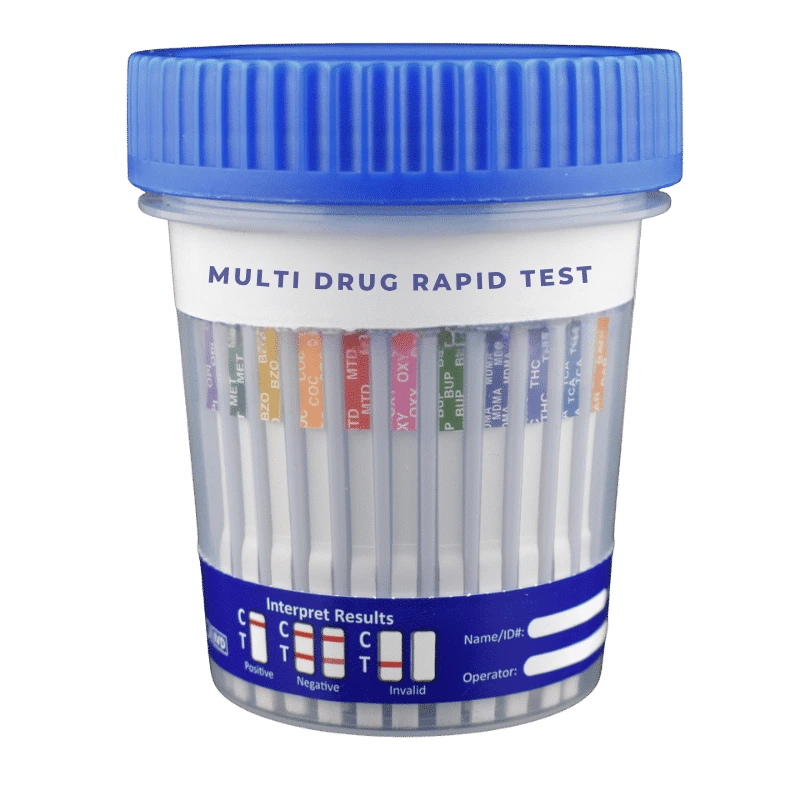
Programs should also know the cross-reactivity profile: dextromethorphan (in some cough medicines), diphenhydramine, tramadol, venlafaxine, ketamine, lamotrigine, doxylamine, and ibuprofen have all been reported to trigger PCP immunoassays, which is why preliminary positives are always confirmed before consequences. PCP is included on MayFlower’s CLIA-waived 12 panel cup with PCP, the PCP-inclusive 14 panel forensic cup, and the 16 panel configuration — see the PCP drug test cups collection for all options.
Programs can source all three PCP-inclusive configurations through MayFlower’s wholesale drug test supplies range.
Frequently Asked Questions
How long does PCP stay in your urine?
PCP is detectable in urine for about 7–14 days after use at the standard 25 ng/mL cutoff. Chronic heavy users can remain positive for up to about 30 days because PCP is stored in fatty tissue and released gradually.
Why does PCP stay in your system longer than cocaine or opiates?
PCP is highly fat-soluble (lipophilic), so it accumulates in adipose tissue and leaches back into circulation over days to weeks. Cocaine and opiates are cleared through faster metabolic pathways — their urine windows are only 2–4 and 2–3 days. See the comparison in the detection times chart.
What is the PCP cutoff level on a drug test?
25 ng/mL in urine — the federal workplace screening and confirmation cutoff, and the threshold used on MayFlower cups. PCP has one of the lowest cutoffs on the standard panel, reflecting its potency and the seriousness of use in safety-sensitive settings.
Does urine pH affect PCP detection?
Yes, unusually so. PCP is a weak base: acidic urine traps the ionized form and speeds excretion, while alkaline urine allows reabsorption and slows clearance. This pH effect contributes to the wide 7–14 day range and to day-to-day fluctuation near the end of the window.
Can medications cause a false positive for PCP?
Some can. Dextromethorphan (found in many cough and cold products), diphenhydramine, tramadol, venlafaxine, ketamine, lamotrigine, doxylamine, and ibuprofen have all been reported to cross-react with PCP immunoassays. Screening results are preliminary — GC-MS confirmation distinguishes true PCP before any employment or legal consequence.
How long does PCP stay in blood, saliva, and hair?
Blood detects PCP for about 1–2 days, saliva for about 1–3 days, and hair for approximately 90 days. Urine’s 7–14 day window is why it remains the program standard: long enough for weekly testing cadences, with simple on-site collection.
Is PCP part of the standard 5-panel drug test?
Yes. PCP is one of the original SAMHSA-5 classes (with THC, cocaine, amphetamines, and opioids) and remains in the DOT urine panel. Private employers modeling policies on the federal panel keep PCP screening; budget panels that drop it create a coverage gap.
How soon after use can a urine test detect PCP?
PCP appears in urine within several hours of use and rises above the 25 ng/mL cutoff quickly given its potency. Same-day or next-day collection after suspected use is effective, and the long excretion tail keeps it detectable long after impairment ends.
What should I do if I think my PCP test result is a false positive?
First, disclose every prescription and over-the-counter medication you take to the collector or Medical Review Officer (MRO) — several common medications cross-react with the PCP immunoassay (see the false-positive question above). Second, ask for laboratory confirmation: a preliminary positive should be confirmed by GC-MS or LC-MS/MS, which identifies PCP specifically and does not cross-react. In regulated programs you may also request a split-specimen retest of the original sample. No employment or legal consequence should rest on an unconfirmed screening result.
Which drug test cups detect PCP?
MayFlower offers PCP on the CLIA-waived 12 panel cup with PCP for clinics, the 14 panel forensic-use cup for courts and probation, and the 16 panel cup — all screening at 25 ng/mL with results in about 5 minutes. Compare them in the PCP drug test cups collection.