How Long Does THC Stay in Your System? Urine Windows by Use Pattern
How Long Does THC Stay in Your System?
THC — the psychoactive compound in marijuana — has the longest urine detection window of any commonly tested drug. A single use is typically detectable for about 3 days, occasional use for 5–7 days, regular use for 10–15 days, and daily use for 30–45 days — with heavy daily use reported positive for up to 90 days — at the standard 50 ng/mL urine cutoff. The reason is pharmacology: THC is fat-soluble, stored in body fat, and released slowly as its metabolite THC-COOH.
This guide breaks the THC window down by use pattern and specimen type, explains the factors that extend it, and covers the cutoffs that workplace, clinical, and court programs actually use. For every substance side by side, see the full drug detection times chart.
Quick Answer — THC in Urine (50 ng/mL cutoff)
- Single use: ~3 days
- Occasional use (about weekly): 5–7 days
- Regular use (several times per week): 10–15 days
- Daily use: 30+ days — typically 30–45 days; heavy daily use up to 90 days reported
Blood and saliva windows are far shorter (about 1–3 days for most users); hair reaches back about 90 days. Full matrix below.
THC Detection Windows by Specimen and Use Pattern
No other panel drug varies this much by user. Frequency of use is the single strongest predictor of how long THC stays detectable — and the specimen matters just as much. The matrix below replaces a urine-only view: read across for your use pattern, down for the test type.
| Specimen | Single use | Occasional | Regular | Daily / heavy |
|---|---|---|---|---|
| Urine | ~3 days | 5–7 days | 10–15 days | 30–45 days (up to 90 days reported) |
| Blood | Up to 1–2 days | 1–2 days | Up to ~7 days | Up to 7–14 days |
| Saliva (oral fluid) | 1–2 days | 1–3 days | Up to ~7 days | Up to 29 days reported in heavy daily users |
| Hair | Often not detected | Up to ~90 days | Up to ~90 days | Up to ~90 days |
Urine windows are at the standard 50 ng/mL THC-COOH cutoff; more sensitive cutoffs extend every window. Blood and saliva detect parent THC and reflect recent use, so their windows vary most with dose and assay sensitivity. Hair windows reflect the length of hair sampled (about 90 days for a standard 1.5-inch segment) and cannot detect use from the past several days.
THC compared with other urine detection windows. Only THC’s window stretches past a month — because it is stored in fat tissue. Heavy daily THC use has been reported positive for up to 90 days.
THC Windows by Specimen Type
Urine is the standard program specimen: 3 days (single use) to 30–45 days (daily use), with up to 90 days reported in heavy daily users. Blood detects THC for about 1–2 days in occasional users — it measures recent use, though chronic users can remain blood-positive for a week or longer. Saliva (oral fluid) captures roughly 1–3 days for most users and is used for recent-use screening; the federal oral-fluid cutoffs are 4 ng/mL for the initial test and 2 ng/mL for confirmation. Hair provides an approximately 90-day retrospective window but cannot detect use from the past few days. The National Institute on Drug Abuse summarizes marijuana’s effects and detection context in its cannabis drug facts.
THC Half-Life: Why It Leaves So Slowly
Half-life is the time it takes the body to eliminate half of a substance — and THC’s metabolite has an unusually long one. After a single dose, THC-COOH has a half-life of roughly 30 hours, and that half-life lengthens as use becomes regular: with repeated dosing, THC builds up in fat tissue faster than it can be cleared, so each new dose stacks on a reservoir that keeps releasing metabolite. Mayo Clinic Laboratories notes that chronic use causes THC and THC-COOH to accumulate in adipose tissue and be excreted into urine for as long as 30 to 60 days after use stops. That is the whole mechanism behind the matrix above: a water-soluble drug with a short half-life, like cocaine, is gone in days, while fat-soluble THC-COOH — like PCP, the other fat-soluble panel drug — leaves in slow stages over weeks. It is also why the last stretch of the window is the least predictable: as stored metabolite trickles out, concentrations hover near the cutoff and a result can fluctuate around it.
What Extends or Shortens the THC Window?
Body fat and metabolism. THC metabolites are stored in adipose tissue. Higher body fat and slower metabolism extend release and excretion; this is the main reason two people with identical use can test differently a week later.
Potency and dose. High-THC concentrates and edibles deliver larger doses than traditional flower, loading more metabolite into tissue stores. Edibles also convert THC to 11-hydroxy-THC, prolonging the excretion tail in some users.
Cutoff level. The standard workplace screen cutoff is 50 ng/mL for THC-COOH. More sensitive testing at 20 ng/mL detects use days longer; the federal confirmation cutoff is 15 ng/mL by GC-MS or LC-MS/MS.
Hydration. Dilution can push a borderline specimen below the cutoff, which is why professional programs verify specimen temperature and validity and recollect dilute samples rather than accepting them as negative.
Can You Speed Up THC Clearance?
No reliable method speeds up THC clearance. The elimination rate is set by fat release and liver metabolism, not by anything a donor drinks or does in the days before a test. Drinking large amounts of water only dilutes the specimen — and professional programs flag dilute urine through creatinine and specific-gravity checks and recollect it rather than reporting it as negative. So-called detox drinks and kits work, when they appear to work, by the same dilution mechanism. Exercise and fat burning can temporarily raise blood THC in chronic users as stored metabolite is released from fat, so a hard workout shortly before a test can move a borderline result in the wrong direction. The only dependable variable is time: abstinence, at the rates in the matrix above. MedlinePlus outlines what drug testing measures and how results are interpreted in its drug testing overview.
How Programs Test for THC
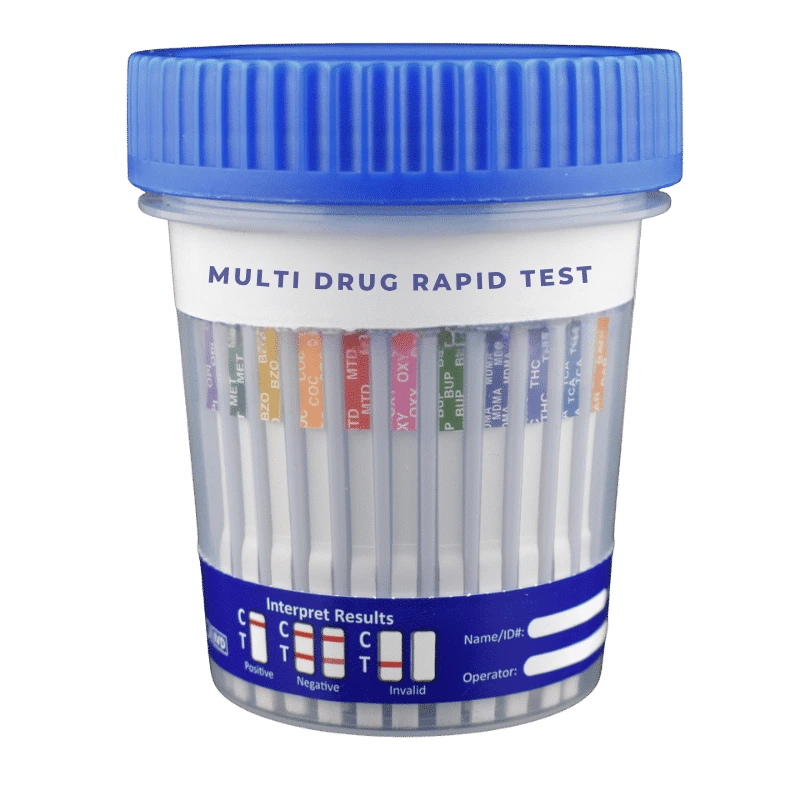
THC is on virtually every multi-panel cup — it is one of the original SAMHSA-5 analytes. MayFlower 12 panel, 14 panel, and 16 panel cups all screen THC at the 50 ng/mL cutoff with results in about 5 minutes — for example, the 14 panel drug test cup pairs the THC strip with PCP and expanded analytes on a single device — and preliminary positives are confirmed by laboratory GC-MS or LC-MS/MS before consequences are applied. Programs sourcing these cups as part of their wider wholesale drug test supplies should plan THC timelines differently from every other analyte on the panel.
Because THC’s window is so long, program design differs from short-window drugs like cocaine: weekly or biweekly random testing still detects THC use reliably, while daily users entering treatment may need several weeks of testing before a first negative result is expected — a timeline clinicians should communicate up front so an early positive is not misread as new use.
Frequently Asked Questions
How long does THC stay in your urine after one use?
A single use of marijuana is typically detectable in urine for about 3 days at the standard 50 ng/mL cutoff. The metabolite tested is THC-COOH, which is stored briefly after one exposure and clears quickly compared with habitual use.
How long does THC stay in your system if you smoke daily?
Daily users typically test positive in urine for about 30–45 days after stopping, and heavy daily use has been reported positive for up to 90 days. THC is fat-soluble and accumulates in adipose tissue with repeated use; Mayo Clinic Laboratories notes THC-COOH can be excreted into urine for as long as 30 to 60 days after chronic use stops, and the slow release from fat stores is what stretches the window.
Can secondhand marijuana smoke cause a positive THC test?
It is very unlikely at the standard 50 ng/mL cutoff. Studies of extreme, unventilated exposure show trace absorption, but passive exposure in normal conditions does not produce concentrations near the workplace cutoff. Confirmation testing at 15 ng/mL distinguishes genuine use patterns when a result is disputed.
Do edibles stay in your system longer than smoked marijuana?
Edibles can extend the window somewhat. Ingested THC is converted in the liver to 11-hydroxy-THC and then to THC-COOH, and edible doses are often larger, loading more metabolite into tissue stores. The use-pattern ranges still apply — frequency matters more than the route.
Will CBD or delta-8 show up on a drug test?
Delta-8 THC: yes. Delta-8 is metabolised to a carboxy-THC metabolite that cross-reacts on standard THC immunoassays, so delta-8 products can trigger a positive THC screen just like delta-9 marijuana — legality and the hemp source do not change the result. Pure CBD does not trigger a THC immunoassay, but many commercial CBD products contain trace THC, and full-spectrum products contain measurable THC by design; regular use can accumulate enough THC-COOH to exceed the 50 ng/mL cutoff. Programs usually advise participants to avoid unregulated CBD and delta-8 products during testing.
Does a positive THC test mean I’m impaired?
No. Standard drug tests detect THC-COOH, the inactive metabolite, which remains in urine for days to weeks after any impairing effect has ended. A positive urine result shows prior exposure within the detection window — it does not measure current impairment, dose, or when use occurred. Blood and saliva (oral fluid) tests, which detect parent THC, reflect much more recent use, but even those do not by themselves prove impairment at the time of collection.
How long does THC stay in your blood and saliva?
Blood detects THC for about 1–2 days in occasional users — it reflects recent use — while saliva (oral fluid) detects roughly 1–3 days. Chronic users can remain positive longer in blood, and heavy daily users longer in oral fluid. Federal oral-fluid cutoffs are 4 ng/mL for the initial test and 2 ng/mL for confirmation, versus 50 ng/mL screening and 15 ng/mL confirmation in urine. Urine remains the standard specimen because its window is longer and collection is simpler; see the detection times chart for all specimens.
How long does THC stay in hair?
Hair testing detects THC use over approximately 90 days, based on the length of hair sampled. It cannot detect use within the last several days (metabolites take time to appear in the hair shaft) and requires laboratory analysis, so it is used for look-back questions rather than routine program screening.
What is the THC cutoff for workplace drug tests?
The standard screening cutoff is 50 ng/mL for THC-COOH in urine — the level used on MayFlower multi-panel cups — and the federal confirmation cutoff is 15 ng/mL by GC-MS or LC-MS/MS. Lower screening cutoffs (20 ng/mL) exist and detect use for longer, which is why results are only comparable at equal cutoffs.
Which drug test cups detect THC?
THC is included on every standard configuration: MayFlower 12 panel, 14 panel, and 16 panel cups all include a THC strip at 50 ng/mL with results in about 5 minutes. Expanded panels add fentanyl, ETG alcohol, PCP, or kratom coverage on top of the standard THC screen.