What Happens If a Urine Drug Test Is Dilute? (Dilute Results Explained)
Dilute Drug Test Results: What They Mean & What Happens Next
A dilute drug test result means the urine specimen was more watery than normal human urine: specimen validity testing found a creatinine of 2 to less than 20 mg/dL with a specific gravity above 1.0010 and below 1.0030. What happens next depends on the drug result attached to it. A positive-dilute is a verified positive — the drug was detected despite the extra water. A negative-dilute is a negative with an asterisk: no drug was found, but dilution may have pushed a low-level drug below the cutoff, so most programs recollect under their written policy.
Dilute is the most common specimen-validity finding in workplace, probation and treatment-program testing — and the most misunderstood. It is not a positive result, not proof of tampering, and not a completely clean pass either. This guide explains how laboratories detect dilution, why it happens, how the DOT rules in 49 CFR Part 40 handle each outcome, and what to write into policy before the first dilute result arrives.
How Dilution Is Detected: Creatinine and Specific Gravity
A dilute determination is never made from the color of the urine. It comes from specimen validity testing (SVT), performed alongside the drug screen. Two markers decide it:
- Creatinine — a muscle-metabolism waste product excreted at a fairly steady rate. Normal urine creatinine is typically 20 mg/dL or higher (commonly 20–300 mg/dL). A low value means the specimen’s water content rose faster than its creatinine did.
- Specific gravity — the density of urine compared with pure water (1.0000); normal urine runs 1.0050–1.0300, and the value falls toward water as fluid intake rises.
Both markers must land in the dilute window at the same time. Under the federal laboratory criteria in 49 CFR 40.88 — the same criteria SAMHSA’s federal workplace testing framework is built on — a specimen is dilute when creatinine is ≥2 but <20 mg/dL and specific gravity is >1.0010 but <1.0030.
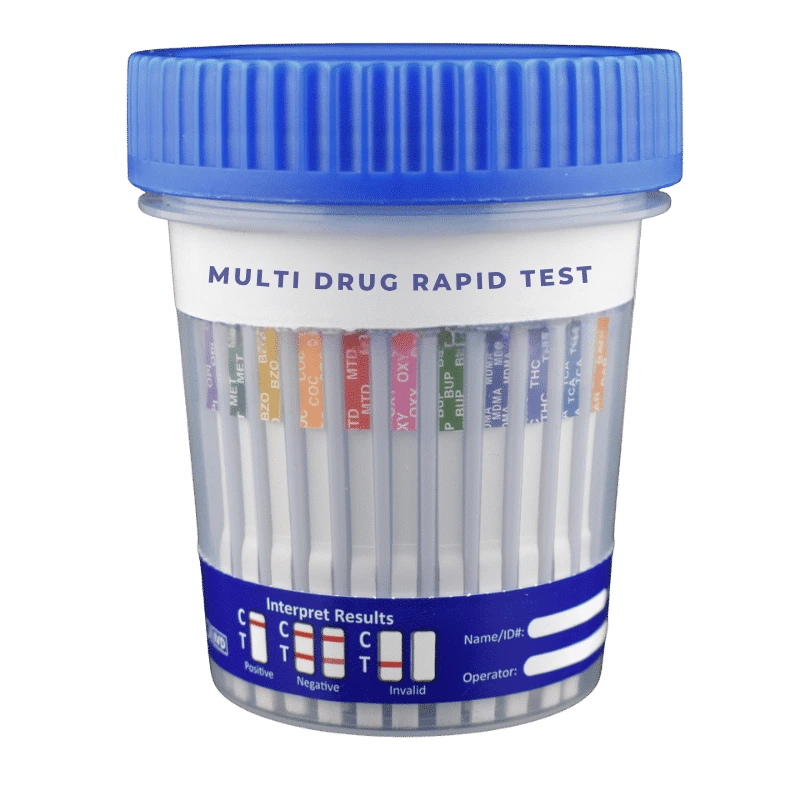
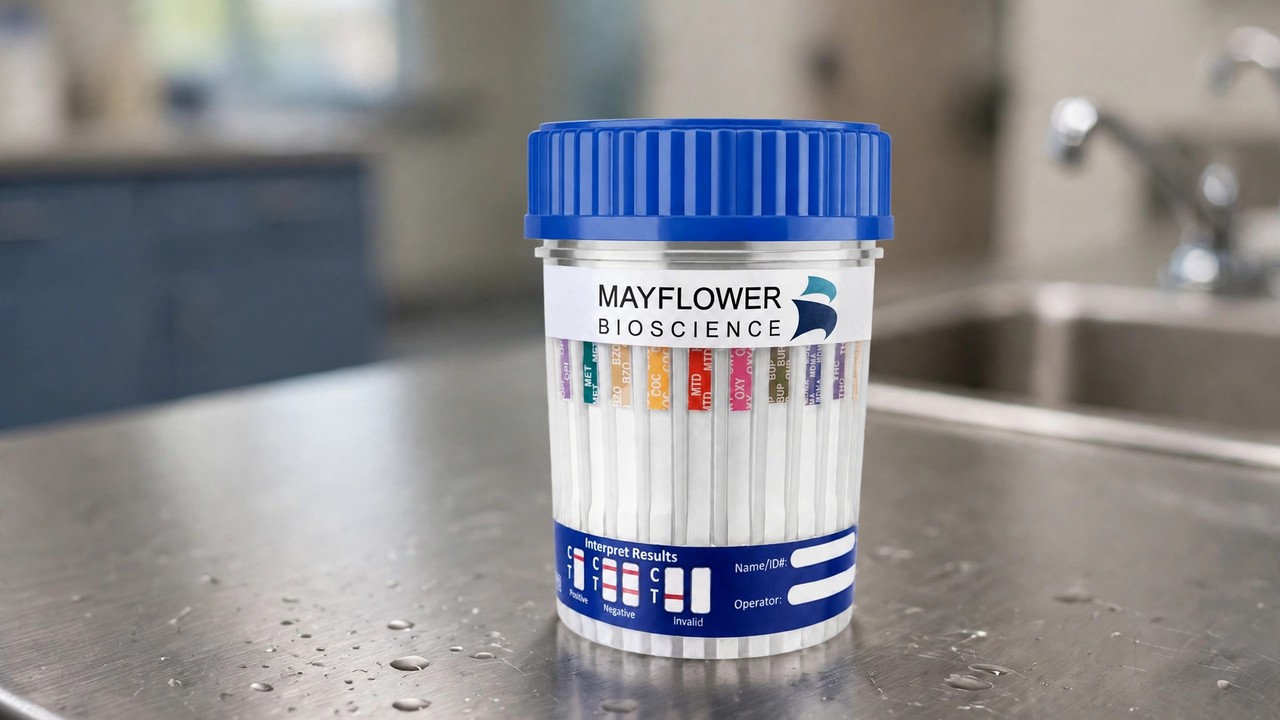
At the point of care, integrated cups estimate the same markers with color-change validity pads, plus pH and oxidants. An abnormal pad flags the specimen at collection, but the formal determination — the one an employer or court acts on — is the laboratory’s quantitative measurement.
What Causes a Urine Specimen to Come Back Dilute?
Dilution has three broad causes, and only one of them involves intent:
- Ordinary overhydration — the most common cause by far. A donor who drinks a large volume of water, coffee or sports drinks before collection — often after being told to “drink fluids so you can provide a sample” — can push both markers into the dilute window innocently. Hot work environments and aggressive rehydration after exercise do the same.
- Medical conditions and medications. Diabetes insipidus, some kidney conditions, and prescribed diuretic medications all increase urine output and lower concentration. MedlinePlus’s drug testing overview notes that validity testing exists precisely because specimen concentration varies for legitimate reasons — which is why dilute results go through a Medical Review Officer, not automatic violations.
- Deliberate over-consumption of fluid. Some donors drink excessive fluid shortly before a test hoping the extra water drops drug concentrations below the screening cutoffs — the oldest manipulation attempt in urine testing, and the reason “dilute” is a reportable result: dilution can hide low-level use near the end of a drug’s detection window, when concentrations are already near the cutoff.
How to Avoid a Dilute Drug Test Result
Most dilute results are accidents of hydration, not attempts to cheat — and they are largely avoidable with ordinary preparation. If you are the donor:
- Drink normally in the day before and the morning of the test. Arrive hydrated enough to provide a specimen, but do not drink large volumes of water, coffee or sports drinks in the few hours before collection to “make sure you can go” — that last-minute loading is the single most common cause of a dilute specimen.
- Do not try to flush your system. Excess fluid does not remove drugs from urine faster; it only lowers creatinine and specific gravity, which is exactly what validity testing measures. A dilute flag — and the recollection that follows — is a worse outcome than an ordinary negative.
- Eat a normal meal and keep your usual routine. Normal food and fluid intake keep urine concentration in the usual range; fasting followed by heavy water intake does the opposite.
- Tell the collector — and, if asked, the Medical Review Officer — about anything that increases urine output. Prescribed diuretic medication, diabetes insipidus and some kidney conditions can all produce genuinely dilute urine. Disclose them through the review process rather than at the collection desk: a documented medical explanation is handled very differently from an unexplained pattern of dilute results.
- If you cannot provide a specimen, say so and follow the shy-bladder procedure rather than drinking bottle after bottle at the collection site — the fluid you are given during that procedure is measured, and the specimen you eventually provide is judged on its own validity results.
Employers and program staff can help from the other side: schedule collections without long waits, do not instruct donors to drink heavily before a test, and apply the written dilute policy (below) the same way every time.
Negative-Dilute vs Positive-Dilute: The Outcome That Matters
“Dilute” never appears alone on a report. It is always attached to a drug result, and the combination — not the dilution itself — drives what happens next.
Positive-dilute. A drug was confirmed at or above its cutoff concentration even though the specimen was dilute — the concentration was high enough to survive the extra water. After confirmation testing (GC-MS or LC-MS/MS) and Medical Review Officer verification, a positive-dilute is a verified positive, handled identically to any other positive.
Negative-dilute. No drug was detected, but the specimen met the dilute criteria, so the negative carries reduced certainty: a drug present at a low concentration could have been diluted below the cutoff and missed. A negative-dilute is not a failed test — it is an inconclusive-leaning negative, and whether it is accepted, recollected, or counted against the donor is a policy decision.
What Happens Next Under DOT Rules (49 CFR 40.197)
For DOT-regulated testing, the response is not left to employer preference — 49 CFR 40.197 prescribes it:
- Positive-dilute: the employer treats it as a verified positive, full stop, and must not direct the employee to take another test because the specimen was dilute.
- Negative-dilute with creatinine of 2–5 mg/dL: the MRO directs an immediate recollection under direct observation, and the employer must carry it out.
- Negative-dilute with creatinine above 5 mg/dL: the employer may — but is not required to — direct one immediate recollection. That recollection is not collected under direct observation unless another basis for observation exists. The choice must be applied uniformly to all employees (different rules by test type are allowed if employees were informed in advance).
- Every recollection is given with the minimum possible advance notice, and the recollection’s result — not the original dilute result — becomes the test of record. If it is also negative and dilute, that result stands as the final outcome.
- Refusing the recollection is a refusal to test. Under 49 CFR 40.197(c)(5), if the employee declines to take a test the employer directs under this section, the employee has refused the test for purposes of Part 40 and the DOT agency regulations — and 49 CFR 40.191(a)(6) lists failing or declining a directed additional test as a refusal in its own right. A refusal carries the same consequences as a verified positive, including removal from safety-sensitive duties and the return-to-duty process; it is never a way to make a dilute result go away.
How dilute handling fits into the wider federal program — panels, cutoffs, the six testing events and the return-to-duty process — is covered in our full DOT drug testing guide.
What Happens Next in Non-DOT, Probation and Treatment Programs
Outside DOT regulation, no federal rule dictates the response — the program’s written policy does. Most non-DOT employers choose one of three approaches, and defensible ones share three features: written in advance, applied to everyone in the same category, and triggered automatically, not decided case by case.
- Accept the negative-dilute as a negative. Simplest option; common for random testing, where one dilute result is weak evidence of anything.
- Require one recollection with minimum advance notice. The middle ground most pre-employment and safety-sensitive programs choose — the recollection becomes the result of record, mirroring the DOT model without the DOT mandate.
- Escalate on repetition. A single dilute is an event; a pattern is data. Probation, drug court and treatment programs typically document each dilute result and respond to repetition with increased testing frequency or observed collections, rather than treating one dilute specimen as a violation.
Can an employer decline to hire on a negative dilute? In non-DOT pre-employment screening, yes — as a matter of company policy, not federal requirement. Nothing in 49 CFR Part 40 tells a non-DOT employer whom it may hire, and no federal rule requires an employer to accept a negative-dilute as a passing pre-employment result. An employer may lawfully write its policy either way — accept the negative-dilute, require a recollection, or decline to proceed with an applicant whose specimen is negative-dilute — provided the policy is written in advance, applied uniformly to every applicant in the same category, and does not single out protected characteristics. What an employer may not do is improvise: declining one applicant on a dilute result while accepting another’s identical result, with no policy behind the difference, is where legal exposure comes from. (For DOT-regulated pre-employment tests the position is different: the Part 40 recollection rules above govern, and a refusal of a directed recollection is a refusal to test.)
In clinical monitoring, a treatment program reads a dilute result alongside attendance, self-report and testing history — NIDA’s drug testing research resources describe testing as one component of a monitoring plan, not a standalone verdict.
Dilute vs Substituted vs Adulterated vs Invalid
Dilute is one of four specimen-validity outcomes, and confusing them leads to bad policy. The federal laboratory criteria (49 CFR 40.88) separate them cleanly:
| Outcome | Laboratory criteria | What it means | Typical consequence |
|---|---|---|---|
| Dilute | Creatinine ≥2 to <20 mg/dL and specific gravity >1.0010 to <1.0030 | Genuine human urine with excess water in it | Result reported with a dilute notation; recollection per policy (DOT: observed recollection mandatory at creatinine 2–5 mg/dL) |
| Substituted | Creatinine <2 mg/dL and specific gravity ≤1.0010 or ≥1.0200 | Not consistent with normal human urine | Under DOT rules, treated as a refusal to test |
| Adulterated | pH <4.0 or ≥11.0, nitrite ≥500 mcg/mL, or oxidants/glutaraldehyde detected | A foreign substance was added to alter the specimen or the test chemistry | Under DOT rules, treated as a refusal to test |
| Invalid | pH 4.0–<4.5 or 9.0–<11.0, nitrite 200–<500 mcg/mL, or creatinine and specific gravity results inconsistent with each other | No valid result can be produced — abnormal, but not classifiable as dilute, substituted or adulterated | MRO reviews for a medical explanation; if none exists, the test is cancelled and a recollection is required |
The dividing line: dilute urine is still the donor’s urine, which is why it earns a recollection rather than a refusal; substituted and adulterated specimens are not genuine or were chemically altered.
Checking Validity at Collection: What the Cup Shows First
The laboratory makes the formal call, but collectors see the first warning signs on site. The temperature strip (90–100°F within 4 minutes) catches substitution with a stored specimen — but dilute urine is still body-temperature, so temperature cannot detect dilution. That is the validity pads’ job: a creatinine or specific gravity pad in the abnormal band, read at the time stated in the package insert, tells the collector to document it and start the program’s dilute procedure. Our guide to how to read a drug test cup covers the pads, the read window and the documentation fields in order.
MayFlower’s 12, 14 and 16 panel cups are CLIA-waived devices with built-in temperature strips and validity pads, so a likely dilute specimen is flagged at collection instead of surfacing days later in a lab report — for example, the CLIA-waived 12 panel drug test cup, which pairs the standard panel with the validity checks this section describes.
What Your Testing Policy Should Say About Dilute Results
Most dilute disputes are really policy gaps: the result arrived before anyone decided what it meant. A complete dilute policy covers seven points:
- Use the federal definition (creatinine and specific gravity criteria) so results are comparable across laboratories and collection sites.
- State the negative-dilute response in advance — accept, or one recollection with minimum notice — and who authorizes it.
- Reserve observed recollection for the low-creatinine band (2–5 mg/dL) or repeat findings, mirroring the DOT model.
- Cap the recollections. A second negative-dilute closes the event; it becomes the result of record.
- Apply the policy uniformly within each testing category, and document any exception and its reason.
- Route medical explanations through review (MRO or program medical staff), never adjudicate them at the collection site.
- Train collectors to read and record temperature and validity pads on every collection.
Sample Policy Wording — Negative-Dilute Results
“If a laboratory reports a specimen as negative and dilute, the result will not be accepted as a negative. The donor will be directed to provide one recollection with the minimum possible advance notice, and the recollection result will be the result of record. If the recollection is also negative and dilute, it will be accepted as the final result. Declining a directed recollection will be treated as a refusal to test. This policy applies uniformly to all donors in the same testing category.” Programs that prefer to accept a first negative-dilute may substitute the first sentence with: “A first negative-dilute result will be accepted as a negative; a second negative-dilute result within 12 months will require one recollection under the terms above.”
Programs testing at volume should standardize the device: consistent wholesale drug test cups with the same validity pads and cutoffs at every site, so a dilute flag means the same thing everywhere — and review the wider wholesale drug test supplies the program depends on whenever the policy is updated, so devices, forms and procedures stay aligned.
Frequently Asked Questions
What does dilute mean on a drug test result?
It means the urine specimen was more watery than normal human urine. Specimen validity testing found a creatinine of 2 to less than 20 mg/dL together with a specific gravity above 1.0010 and below 1.0030. The specimen is genuine urine and the drug results are still reported — but flagged as dilute.
What is a negative dilute drug test result?
A negative dilute means no drugs were detected at or above the cutoffs, but the specimen met the dilute criteria. Because dilution lowers drug concentrations, a drug present at low levels could have fallen below the cutoff, so many programs treat a negative dilute as an inconclusive-leaning negative and recollect under their written policy.
Can an employer decline to hire on a negative dilute result?
In non-DOT pre-employment screening, yes — as company policy, not as a DOT requirement. No federal rule obliges an employer to accept a negative-dilute as a passing hiring result, so an employer may write its policy to accept it, require one recollection, or not proceed with the applicant — as long as the policy is set in advance and applied uniformly. DOT-regulated hiring is different: Part 40’s recollection rules in 49 CFR 40.197 govern the test itself, and declining a directed recollection is a refusal to test.
Does a dilute drug test count as a fail?
A dilute result by itself is not a positive. A positive dilute is a verified positive; a negative dilute is a negative with a validity notation. Whether a negative dilute leads to acceptance, a recollection or a policy consequence depends on the program’s written policy — and, for DOT testing, on 49 CFR 40.197.
Is a negative dilute result considered passing?
It depends on the program. A negative dilute is reported as a negative with a dilute notation — it is not a positive and not a failed test. Under DOT rules it is accepted as the result unless a recollection is directed under 49 CFR 40.197 (mandatory and observed at a creatinine of 2–5 mg/dL; optional above 5 mg/dL), in which case the recollection becomes the test of record. In non-DOT programs, whether it counts as passing is set by the employer’s written policy: accept it, recollect once, or — in pre-employment screening — decline to proceed. What it never means is that drugs were found.
What creatinine level makes a drug test dilute?
Under the federal criteria used in DOT and SAMHSA programs, a specimen is dilute when creatinine is 2 mg/dL or higher but less than 20 mg/dL and specific gravity is greater than 1.0010 but less than 1.0030. Normal urine creatinine is usually 20 mg/dL or higher; a creatinine below 2 mg/dL points to substitution instead.
Can you be retested after a negative dilute result?
Yes, when policy allows or requires it. In DOT testing, a creatinine of 2–5 mg/dL means the MRO directs an immediate recollection under direct observation; above 5 mg/dL the employer may choose one recollection, applied consistently to every employee. Either way, the recollection result becomes the test of record.
What happens if a drug test comes back dilute twice?
Under DOT rules, if the recollection is also negative and dilute, that result stands as the test of record and is accepted as the final outcome — an employer cannot keep retesting on the basis of dilution alone. Non-DOT programs follow their own written policies, which typically cap the number of recollections per event.
What is the difference between a dilute and a substituted specimen?
A dilute specimen is genuine urine with too much water in it — creatinine of 2 to under 20 mg/dL with a low specific gravity. A substituted specimen is not consistent with human urine at all: creatinine under 2 mg/dL with a specific gravity at or below 1.0010 or at or above 1.0200. Under DOT rules, a substituted specimen is treated as a refusal to test.
How do drug test cups check for dilution?
Integrated cups carry specimen-validity pads that estimate creatinine, specific gravity, pH and oxidants by color change, read against the chart at the time stated in the package insert. An abnormal creatinine or specific gravity pad flags a possibly dilute specimen at collection — but the formal dilute determination is made by the laboratory’s quantitative validity testing.