DOT Drug Testing: Panels, Cutoffs and the Process Explained
DOT Drug Testing Guide: Panels, Cutoffs & Process
DOT drug testing is the federally mandated urine drug testing program run under 49 CFR Part 40 for safety-sensitive transportation employees in the United States. It screens a fixed five-panel — marijuana, cocaine, amphetamines, opioids, and phencyclidine (PCP) — at cutoff concentrations set by the U.S. Department of Health and Human Services (HHS). Every specimen is tested at an HHS-certified laboratory, every non-negative screen is confirmed by GC-MS or LC-MS/MS, and a licensed Medical Review Officer (MRO) verifies the result before the employer receives it. For covered employers nothing about the program is optional: the panel, the cutoffs, the split-specimen collection, and the chain of custody are all prescribed by regulation.
The program traces to the Omnibus Transportation Employee Testing Act of 1991, passed after transportation accidents in which drug use by operators was a factor. Its logic is different from ordinary workplace testing. A DOT test is not an employer’s policy choice — it is a federal safety regulation, and a result produced any other way, including from a point-of-care cup, is not a DOT result at all. This guide explains who is covered, exactly what is tested and at what cutoffs, how the process works step by step, and where rapid test cups legitimately fit: in the non-DOT programs most employers run alongside the federal one.
Who Is Covered by DOT Drug Testing?
DOT testing applies to employees who perform safety-sensitive functions for employers regulated by a DOT operating administration. Each agency defines its own covered roles:
- FMCSA (Federal Motor Carrier Safety Administration) — drivers who hold a commercial driver’s license (CDL) and operate commercial motor vehicles: truck drivers, bus drivers, and hazmat haulers.
- FAA (Federal Aviation Administration) — flight crew members, flight attendants, air traffic controllers, aircraft mechanics, and dispatchers.
- FTA (Federal Transit Administration) — operators of buses, trains, and other public transit vehicles, and transit mechanics.
- FRA (Federal Railroad Administration) — railroad employees in hours-of-service roles, such as engineers, conductors, and signal workers.
- PHMSA (Pipeline and Hazardous Materials Safety Administration) — pipeline operators and workers on liquefied natural gas facilities.
- USCG (U.S. Coast Guard) — merchant mariners holding Coast Guard credentials.
The same employer often runs two programs in parallel: Part 40 testing for covered staff, and a company-policy program for everyone else. Keeping the boundary straight matters, because applying DOT procedures to a non-DOT test — or non-DOT shortcuts to a DOT test — creates legal exposure in both directions.
The DOT 5-Panel and Its Cutoff Levels
Every DOT urine test screens the same five drug classes at the cutoff levels published in 49 CFR 40.85, drawn from the HHS Mandatory Guidelines that SAMHSA administers for federal workplace testing. Employers cannot add drugs to a DOT panel, lower a cutoff, or substitute a different specimen type and still call the result a DOT result.
| Drug class | Analyte tested | Initial cutoff | Confirmatory cutoff |
|---|---|---|---|
| Marijuana | Marijuana metabolites (THCA) | 50 ng/mL | 15 ng/mL |
| Cocaine | Cocaine metabolite (benzoylecgonine) | 150 ng/mL | 100 ng/mL |
| Amphetamines | Amphetamine / methamphetamine | 500 ng/mL | 250 ng/mL |
| Amphetamines | MDMA / MDA | 500 ng/mL | 250 ng/mL |
| Opioids | Codeine / morphine | 2,000 ng/mL | 2,000 ng/mL |
| Opioids | Hydrocodone / hydromorphone | 300 ng/mL | 100 ng/mL |
| Opioids | Oxycodone / oxymorphone | 100 ng/mL | 100 ng/mL |
| Opioids | 6-Acetylmorphine (heroin marker) | 10 ng/mL | 10 ng/mL |
| Phencyclidine | PCP | 25 ng/mL | 25 ng/mL |
Two details explain most questions about this table. First, the opioid class was expanded in 2018 to add the four semi-synthetic opioids — hydrocodone, hydromorphone, oxycodone, and oxymorphone — as prescription opioid misuse rose; the high 2,000 ng/mL cutoff for codeine and morphine exists partly so ordinary poppy-seed consumption does not trigger positives. Second, fentanyl is not on the DOT panel. HHS has added fentanyl to its guidelines for federal-agency testing and DOT has considered the same change, but until a final rule lands, a DOT test does not look for fentanyl — one reason many employers add fentanyl screening to their separate non-DOT programs.
The DOT Testing Process, Step by Step
- Collection with a split specimen. A trained collector verifies the donor’s photo ID, completes the Federal Custody and Control Form (CCF), and takes a urine specimen that is checked against the 90–100°F temperature window within 4 minutes. The specimen — at least 45 mL — is poured into two tamper-evident bottles: Bottle A (30 mL, the primary specimen) and Bottle B (15 mL, the split), each sealed and initialed by the donor.
- Initial laboratory screening. An HHS-certified laboratory runs an immunoassay screen at the Part 40 cutoffs, together with specimen-validity testing for dilution, substitution, and adulteration. Negative specimens are reported and destroyed on schedule.
- Confirmation testing. Any non-negative screen is re-tested by GC-MS or LC-MS/MS, which identifies the specific drug or metabolite and its concentration against the confirmatory cutoffs in the table above. A cup or immunoassay result alone can never complete this step.
- MRO review and verification. A Medical Review Officer — a licensed physician with knowledge of substance-use disorders — reviews every confirmed positive, interviews the donor, and checks for a legitimate medical explanation such as a valid prescription. If the explanation checks out, the MRO reports the result to the employer as negative.
- Verified result and split-specimen rights. The MRO reports the verified result to the employer’s Designated Employer Representative (DER). Following a verified positive, the employee is removed from safety-sensitive duties and may, within 72 hours of MRO notice, request that Bottle B be tested at a second HHS-certified laboratory.
Oral fluid testing — approved, but not yet usable. DOT’s 2023 final rule amended Part 40 to add oral fluid (saliva) as an authorized specimen alongside urine, effective June 1, 2023. Employers still cannot use it in practice: the rule requires at least two laboratories certified by HHS for oral fluid testing — one for the primary specimen and one for the split specimen — and, as of this writing, no HHS-certified oral fluid laboratory is yet available. Until that certification happens, urine remains the only specimen a DOT test can actually use, whatever the regulation now permits on paper. (Cited from DOT ODAPC and the SAMHSA certified-laboratory list; not linked, as those pages do not always load for every reader.)
Employers and donors can read more about how screening and confirmation testing work together in MedlinePlus’s drug testing overview. The regulated sequence — collect, screen, confirm, verify — is also why detection windows matter to program design: the drug detection times chart shows how long each DOT analyte remains detectable in urine.
When DOT Testing Happens: The Six Testing Events
- Pre-employment — before an applicant first performs a safety-sensitive function (and, for drivers, before an employer lets them operate). It is the gateway test of the whole program — see the broader pre-employment drug testing guide for how regulated and non-regulated hiring tests differ.
- Random — unannounced testing of employees selected by a scientifically valid random method, spread through the year at or above each agency’s minimum annual rate — see the 2026 rates table directly below.
- Post-accident — after accidents meeting agency criteria (for FMCSA: a fatality, or a moving-traffic citation combined with an injury treated away from the scene or a vehicle towed because of disabling damage), within strict time windows: the drug test must be administered within 32 hours of the accident and the alcohol test within 8 hours (with an alcohol test attempted within 2 hours where possible). Miss the window without documenting why, and the test generally cannot be made up later.
- Reasonable suspicion — when a trained supervisor documents specific, contemporaneous observations of appearance, speech, behavior, or body odor. “Trained” is a defined requirement: under the FMCSA rule (49 CFR 382.603), supervisors designated to make these determinations must receive at least 60 minutes of training on alcohol indicators and 60 minutes on drug indicators, and the other DOT agencies impose equivalent supervisor-training requirements.
- Return-to-duty — a directly observed test after a rule violation, completed under MRO direction once the Substance Abuse Professional (SAP) process allows it.
- Follow-up — a schedule of at least six unannounced, directly observed tests in the first 12 months after return to duty, set by the SAP and lasting up to five years.
DOT Random Testing Rates for 2026
Random testing only works if enough of the workforce is actually tested each year, so every DOT agency sets a minimum annual random rate: the percentage of the average number of covered positions that must be selected for testing during the calendar year. The rates below are the DOT Office of Drug and Alcohol Policy and Compliance (ODAPC) rates for 2026, verified against ODAPC’s published random testing rates table:
| DOT agency | 2026 random drug rate | 2026 random alcohol rate |
|---|---|---|
| FMCSA (motor carriers) | 50% | 10% |
| FAA (aviation) | 25% | 10% |
| FRA (railroad) — covered service | 25% | 10% |
| FRA — maintenance-of-way | 25% | 10% |
| FRA — mechanical | 50% | 10% |
| FTA (transit) | 50% | 10% |
| PHMSA (pipeline / hazmat) | 50% | N/A — no random alcohol rate set |
Source: U.S. Department of Transportation, ODAPC, “Random Testing Rates” (2026 table, last updated January 15, 2026), cited in text without a hyperlink because transportation.gov frequently blocks automated readers. Rates are annual minimums; an employee may be selected more than once in a year, and selections must be spread reasonably through the year rather than concentrated in one quarter.
What Happens If You Fail or Refuse a DOT Drug Test?
A verified positive, an adulterated or substituted specimen, and a refusal to test all produce the same immediate outcome: the employer must remove the employee from safety-sensitive duties at once, and the employee cannot return to those duties until the return-to-duty process below is complete. There is no lighter DOT category for a first offence.
Clearinghouse reporting (CDL drivers). For drivers regulated by FMCSA, the violation does not stay inside one company. Employers must report a verified positive test result — and a refusal to test — to the FMCSA Drug and Alcohol Clearinghouse, the federal database every CDL employer must query before hiring a driver and at least annually for current drivers. The driver is marked prohibited in the Clearinghouse and remains prohibited until the return-to-duty process is completed and reported, so the violation follows the driver from employer to employer.
The SAP and return-to-duty sequence. Returning is a regulated chain, not an employer’s discretionary decision:
- Evaluation by a Substance Abuse Professional (SAP) — a DOT-qualified SAP evaluates the employee face to face and prescribes education and/or treatment.
- Completion of the prescribed education or treatment, followed by a SAP follow-up evaluation confirming successful compliance.
- A directly observed return-to-duty test with a verified negative result (for drugs) or an alcohol result below 0.02, conducted before the employee resumes any safety-sensitive function.
- A written follow-up testing plan set by the SAP: at least six unannounced, directly observed follow-up tests in the first 12 months back in safety-sensitive duty. The SAP may require more tests and may extend follow-up testing for up to five years in total; the employer must carry the plan out exactly as written, and it follows the employee to a new DOT employer if they change jobs.
What counts as a refusal to test (49 CFR 40.191). An employee does not have to say “I refuse.” Any of the following is a refusal, with the same consequences as a verified positive:
- Failing to appear for a test within a reasonable time after being directed to report (other than a pre-employment test the applicant simply does not show up for before the process begins);
- Failing to remain at the testing site until the testing process is complete, or failing to provide a urine specimen;
- Failing to provide a sufficient amount of specimen, where a required medical evaluation finds no adequate medical explanation;
- Failing or declining to take an additional test the employer or collector directs — including a recollection directed after a dilute or invalid result;
- In a directly observed or monitored collection, failing to permit the observation or monitoring, or failing to follow the observer’s instructions (including the clothing check for a prosthetic or other device);
- Possessing or wearing a prosthetic or other device that could be used to interfere with the collection process;
- Failing to undergo a medical examination or evaluation directed by the MRO or the employer as part of the process, or failing to cooperate with any part of the testing process (for example, refusing to empty pockets or wash hands when directed, or behaving in a way that disrupts the collection);
- Admitting to the collector or the MRO that the specimen was adulterated or substituted — and, separately, a specimen the MRO verifies as adulterated or substituted is a refusal, whether or not the employee admits anything.
DOT vs Non-DOT Drug Testing
| Factor | DOT testing | Non-DOT testing |
|---|---|---|
| Legal basis | 49 CFR Part 40 plus agency regulations — mandatory | Employer policy and state law — voluntary |
| Panel | Fixed 5-panel only | Employer-chosen: 5-panel up to expanded 12/14/16-panel programs |
| Cutoffs | HHS cutoffs in 49 CFR 40.85 | Set by the employer or its laboratory; often mirrors SAMHSA |
| Where the test runs | HHS-certified laboratory only | Laboratory, or point-of-care rapid cups and dip cards |
| Result review | MRO verification required before reporting | Employer or lab review; MRO optional but recommended |
| Extra drugs (fentanyl, ETG, kratom) | Not permitted on a DOT test | Can be added freely |
The non-DOT drug test guide covers the company-policy side in full — panels, specimen types, and program design. The practical rule: a test is DOT only if every element follows Part 40. The moment an employer uses a rapid cup, an expanded panel, or a non-certified lab, the test is a non-DOT test, whatever it is called internally.
Where Rapid Drug Test Cups Fit — and Where They Don’t
To be direct: a point-of-care cup can never produce an official DOT result. Part 40 reserves DOT testing to HHS-certified laboratories with MRO verification, and no cup is DOT-approved for that purpose. Claiming otherwise would put an employer’s whole program at risk.
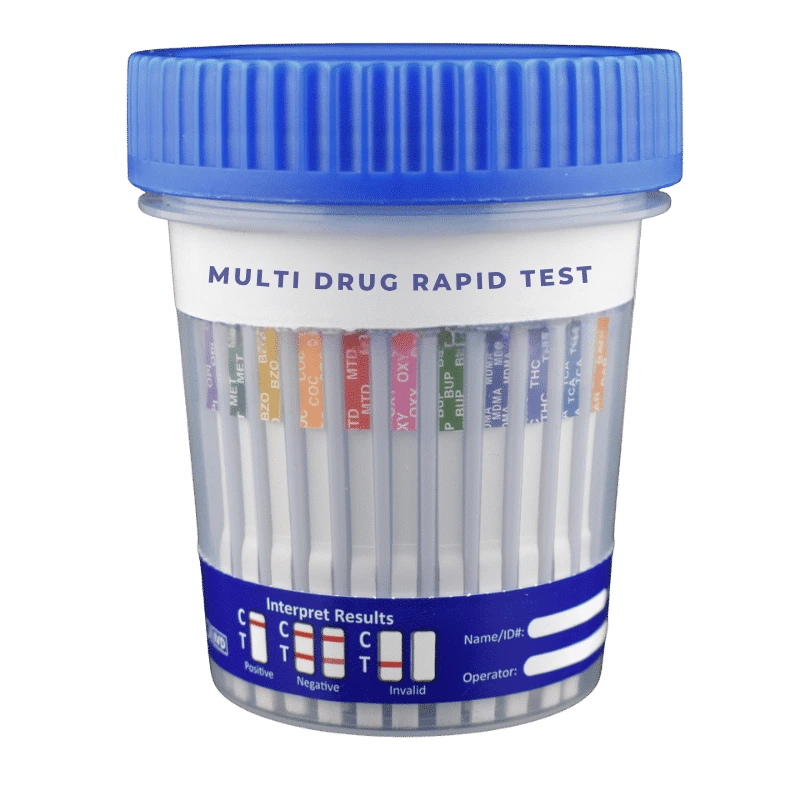
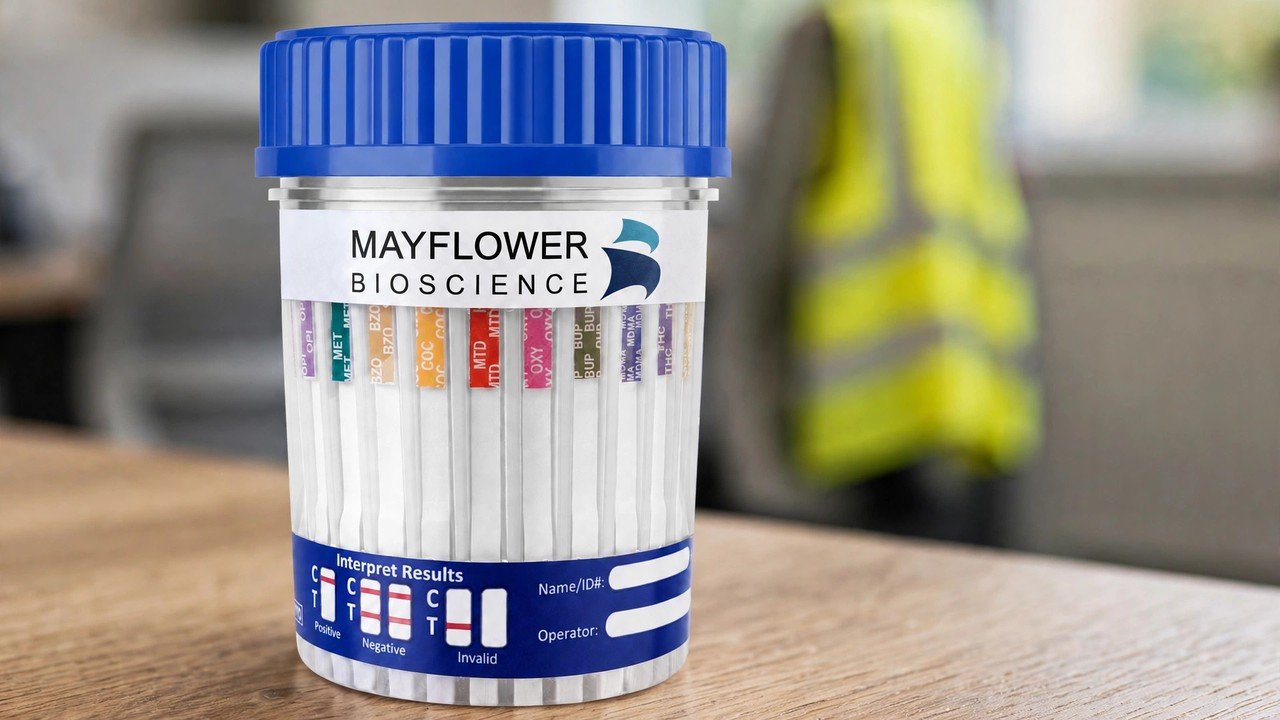
What cups do — and why most DOT-regulated employers also stock them — is run the non-DOT side of a mixed workforce program: non-regulated roles at the same company, pre-employment screening for positions outside Part 40, post-offer health screens, and workplace programs that deliberately mirror the DOT panel but operate under company policy. In those programs, rapid cups return a result in about five minutes, and staff read them the same way as any immunoassay — control line, test line, temperature check — as explained in how to read a drug test cup. Non-negatives that carry consequences are then sent to a laboratory for confirmation, following the same presumptive-positive discipline as the federal program.
Because non-DOT programs choose their own panel, most expand beyond the federal five: MayFlower’s 12 panel drug test cups and its 14 and 16 panel configurations add the analytes DOT leaves out — fentanyl, ETG alcohol, kratom, tramadol and more — for example, the 12 panel drug test cup for a non-DOT, pre-employment-style program — with wholesale pricing for employers testing at volume. None of these cups is a DOT device, and none may be used to produce a DOT result; they serve only the parallel non-DOT program. Programs reviewing their wider wholesale drug test supplies should keep that boundary in the written policy, not at the collection site: decide which program each role belongs to, then stock the device that program allows.
Frequently Asked Questions
What is a DOT drug test?
A DOT drug test is a federally regulated urine drug test conducted under 49 CFR Part 40 for safety-sensitive transportation employees. It screens a fixed five-panel at HHS cutoff levels, is analyzed only by an HHS-certified laboratory using GC-MS or LC-MS/MS confirmation, and is verified by a Medical Review Officer before the employer receives the result.
What drugs does a DOT drug test look for?
The DOT 5-panel covers five drug classes: marijuana metabolites (THCA), cocaine metabolite (benzoylecgonine), amphetamines (amphetamine, methamphetamine, MDMA and MDA), opioids (codeine, morphine, hydrocodone, hydromorphone, oxycodone, oxymorphone and the heroin marker 6-acetylmorphine), and phencyclidine (PCP). Fentanyl, ETG alcohol and kratom are not part of the DOT panel and can only be tested under a non-DOT program.
What are the DOT urine cutoff levels?
The cutoffs in 49 CFR 40.85 (initial / confirmatory, ng/mL) are: marijuana 50/15, cocaine 150/100, amphetamines and MDMA 500/250, codeine and morphine 2,000/2,000, hydrocodone and hydromorphone 300/100, oxycodone and oxymorphone 100/100, 6-acetylmorphine 10/10, and PCP 25/25. A specimen must reach the initial cutoff to screen non-negative and the confirmatory cutoff to be reported positive.
Is marijuana legal for DOT drivers in states where it’s legal?
No — not for DOT purposes. Marijuana remains a prohibited Schedule I drug under federal law, and DOT testing follows federal law regardless of any state recreational or medical marijuana statute. A state medical marijuana card is not a legitimate medical explanation the MRO can accept, and a verified positive THC result is handled like any other DOT positive. The same caution applies to CBD products: unregulated CBD oils and edibles can contain enough THC to produce a positive result, and “the CBD did it” is not a defence the MRO can verify away.
Can a rapid drug test cup be used for a DOT test?
No. Part 40 requires DOT specimens to be tested at an HHS-certified laboratory with MRO verification, so a point-of-care cup result can never be reported as a DOT result. Rapid cups are used for non-DOT programs instead — non-regulated roles, company-policy workplace testing, and pre-employment screening outside Part 40 — with non-negative results sent to a laboratory for confirmation.
Does a DOT drug test detect alcohol?
Not in the urine drug panel. DOT alcohol testing is a separate Part 40 program using breath or saliva screening and evidential breath testing, with a violation threshold of 0.04 BAC (and removal from safety-sensitive duty at 0.02–0.039). Urine ETG alcohol testing exists only in non-DOT programs, such as treatment and abstinence monitoring.
What happens if you fail a DOT drug test?
After the MRO verifies a positive (and rules out a legitimate medical explanation), the employer must immediately remove the employee from safety-sensitive duties — a refusal to test is treated exactly the same way. Returning requires evaluation by a Substance Abuse Professional (SAP), completion of the prescribed education or treatment, a negative directly observed return-to-duty test, and a SAP follow-up plan of at least six unannounced tests in the first 12 months (extendable up to five years). For CDL drivers, the violation is also reported to the FMCSA Drug and Alcohol Clearinghouse, where the driver stays in prohibited status until the return-to-duty process is completed and reported. See the full section above.
How long do DOT drug test results take?
Negative results are typically reported by the laboratory and MRO within about 24–48 hours of the specimen reaching the lab. Results that screen non-negative take longer — confirmation testing plus the MRO’s donor interview usually bring the total to several business days. Employers should plan onboarding and return-to-duty timelines around the verified result, not the collection date.
Can prescription medication cause a positive DOT result?
A laboratory can confirm a prescription drug such as hydrocodone or oxycodone above the cutoff, but the result is not final until the MRO reviews it. During the verification interview the donor can provide a valid prescription; if the MRO accepts the legitimate medical explanation, the result is reported to the employer as negative. The MRO may still notify the employer of a safety concern if the medication could impair safety-sensitive work.
Do they watch you pee for a DOT drug test?
Not routinely. A standard DOT urine collection is unobserved: the donor provides the specimen in private, and the collector checks temperature, seals the split bottles and completes the Custody and Control Form outside the restroom. Direct observation — a trained observer of the same gender watching the specimen being provided — is required only in the situations 49 CFR 40.67 specifies: every return-to-duty and follow-up test, a specimen whose temperature falls outside the acceptable range, signs that a specimen may have been tampered with, and certain recollections (for example, after an invalid result with no adequate medical explanation). Refusing to permit a required observed collection is itself a refusal to test.