Drug Test Cutoff Levels Explained (ng/mL)
Drug Test Cutoff Levels Explained
Drug test cutoff levels are the concentration thresholds, measured in nanograms per milliliter (ng/mL), that separate a negative result from a presumptive positive. If a drug or its metabolite is present in urine below the cutoff, the test reports negative — even if trace amounts exist. At or above the cutoff, the screen reports positive. The federal reference values set by SAMHSA are THC 50 ng/mL, cocaine metabolite 150 ng/mL, amphetamines 500 ng/mL, opiates (codeine/morphine) 2,000 ng/mL, and PCP 25 ng/mL for screening, with lower confirmation cutoffs applied by the laboratory.
A cutoff is not a measure of impairment, and it is not zero tolerance. It is an administrative and scientific line drawn so that results are consistent between donors, defensible for programs, and protected against trace exposures that have nothing to do with drug use. Understanding cutoff levels explains most of the confusing outcomes in drug testing — why a poppy-seed bagel used to fail opiate screens, why a confirmation test can disagree with a cup, and why two programs testing the same donor can legitimately reach different conclusions.
The Federal Cutoff Table: SAMHSA/HHS Urine Cutoffs
The reference standard for workplace testing in the United States is the set of cutoff concentrations in the HHS Mandatory Guidelines administered by the Substance Abuse and Mental Health Services Administration (SAMHSA), and adopted by the DOT in 49 CFR Part 40. Every federally regulated urine test uses two numbers per drug: a higher screening cutoff for the immunoassay, and a confirmation cutoff for the GC-MS or LC-MS/MS analysis that follows a positive screen.
| Drug / metabolite (urine) | Screening cutoff | Confirmation cutoff |
|---|---|---|
| Marijuana metabolites (THC-COOH) | 50 ng/mL | 15 ng/mL |
| Cocaine metabolite (benzoylecgonine) | 150 ng/mL | 100 ng/mL |
| Amphetamine | 500 ng/mL | 250 ng/mL |
| Methamphetamine | 500 ng/mL | 250 ng/mL |
| MDMA / MDA | 500 ng/mL | 250 ng/mL |
| Codeine / Morphine | 2,000 ng/mL | 2,000 ng/mL |
| Hydrocodone / Hydromorphone | 300 ng/mL | 100 ng/mL |
| Oxycodone / Oxymorphone | 100 ng/mL | 100 ng/mL |
| 6-Acetylmorphine (heroin marker) | 10 ng/mL | 10 ng/mL |
| Phencyclidine (PCP) | 25 ng/mL | 25 ng/mL |
Two details in this table surprise most readers. First, the opiate cutoff of 2,000 ng/mL is by far the highest on the list — deliberately, for reasons covered below. Second, 6-acetylmorphine (6-AM), the metabolite unique to heroin, has the lowest cutoff at 10 ng/mL, because it appears only briefly and only after heroin use, so any detectable amount is significant.
Screening vs Confirmation Cutoffs: Why Every Drug Has Two Numbers
Screening and confirmation are different technologies answering different questions, so they use different thresholds. The screening cutoff applies to immunoassay — the chemistry inside a drug test cup or a laboratory’s initial analyzer. Immunoassay is fast and broad but cross-reacts with related molecules, so its cutoff is set higher to keep borderline noise from flagging clean donors. A specimen that screens negative at the cutoff is reported negative and testing stops; nothing goes to confirmation.
The confirmation cutoff applies to mass spectrometry (GC-MS or LC-MS/MS), which identifies the exact molecule. Confirmation cutoffs are usually lower — THC drops from 50 to 15 ng/mL, cocaine metabolite from 150 to 100 — because the instrument is specific enough to quantify small amounts reliably. This two-step design means a donor can screen positive on a cup yet confirm negative at the laboratory if the true concentration sits between the two numbers, and it is why every cup positive is called presumptive until a laboratory confirms it (the reading rules themselves are covered in our guide on how to read a drug test cup).
Why Cutoffs Exist: They Are Not Zero Tolerance
If laboratories can detect drugs at 1 ng/mL, why report a specimen with 40 ng/mL of THC metabolite as negative? Because detection is not the same as meaningful exposure, and cutoffs exist to absorb three real-world problems:
- Passive and incidental exposure. Sitting in a room where others smoke marijuana, handling contaminated currency, or touching surfaces can deposit trace drug amounts that sensitive instruments detect. The 50 ng/mL THC screening cutoff sits far above what passive inhalation realistically produces, so secondhand exposure does not fail donors.
- Food. Poppy seeds carry genuine morphine and codeine. Under the old 300 ng/mL opiate cutoff, a poppy-seed bagel could produce a positive screen. Federal regulators raised the opiate cutoff to 2,000 ng/mL specifically to put dietary exposure below the line while still catching actual opiate use.
- Cross-reactivity. Immunoassay antibodies respond to families of similar molecules, including some legal medications. A higher screening cutoff reduces the number of clean specimens flagged for confirmation, and the confirmation step then resolves the rest.
Cutoffs also interact with time: a concentration falls as the body eliminates the drug, so the cutoff effectively sets the detection window. A lower cutoff catches use for longer. The drug detection times chart shows how long each analyte stays above its standard cutoff in urine, blood, saliva, and hair.
DOT vs Non-DOT Cutoffs
For DOT-regulated testing — truck drivers, pilots, transit and pipeline workers — the federal table above is mandatory. Laboratories must use exactly those screening and confirmation cutoffs, on exactly the federal panel, with no substitutions. A DOT program cannot choose a lower THC cutoff or add a drug on its own authority. The full regulated process — panel, events, and where rapid cups do and do not fit — is covered in our DOT drug testing guide.
Non-DOT testing is different. Employers, treatment programs, drug courts, and probation departments set their own policies, and most adopt the SAMHSA numbers as their reference — but they are free to test additional analytes (fentanyl, ETG alcohol, kratom, benzodiazepines, methadone, buprenorphine) that the federal panel does not include, at the standard point-of-care cutoffs for those drugs. The practical rule: regulated programs inherit their cutoffs; non-regulated programs choose them, and should write the chosen values into policy so results are applied consistently.
Point-of-Care Cup Cutoff Chart
The federal table above covers only the laboratory panel. Programs testing at the point of care need the full chart: every analyte carried on standard 12, 14, and 16 panel cups, the typical cup cutoff for each, and the federal urine screening cutoff beside it wherever the two differ. This is the chart to check before comparing a cup result with a laboratory report.
| Analyte (abbreviation) | Typical cup cutoff | Federal (SAMHSA) urine screening cutoff |
|---|---|---|
| Amphetamine (AMP) | 1,000 ng/mL | 500 ng/mL — differs |
| Methamphetamine (MET) | 1,000 ng/mL | 500 ng/mL — differs |
| MDMA / MDA | 500 ng/mL | 500 ng/mL |
| Marijuana metabolites (THC) | 50 ng/mL | 50 ng/mL |
| Cocaine metabolite (COC) | 300 ng/mL | 150 ng/mL — differs |
| Opiates (OPI) | 300 ng/mL | 2,000 ng/mL — differs (cups also sold in a 2,000 ng/mL version) |
| Oxycodone (OXY) | 100 ng/mL | 100 ng/mL |
| Phencyclidine (PCP) | 25 ng/mL | 25 ng/mL |
| Barbiturates (BAR) | 300 ng/mL | Not on the federal panel |
| Benzodiazepines (BZO) | 300 ng/mL | Not on the federal panel |
| Buprenorphine (BUP) | 10 ng/mL | Not on the federal panel |
| Methadone (MTD) | 300 ng/mL | Not on the federal panel |
| Fentanyl (FEN) | 20 ng/mL | Not on the SAMHSA-5 / DOT panel* |
| Ethyl glucuronide — alcohol (ETG) | 300 ng/mL | Not on the federal panel |
| Kratom — mitragynine (KRA) | 500 ng/mL | Not on the federal panel |
| Tricyclic antidepressants (TCA) | 1,000 ng/mL | Not on the federal panel |
| Synthetic cannabinoids (K2) | 50 ng/mL | Not on the federal panel |
Cup values are the standard manufacturer cutoffs printed in package inserts — including MayFlower’s own published panel values (AMP 1,000, BAR 300, BUP 10, BZO 300, COC 300, MET 1,000, MTD 300, OPI 300, OXY 100, PCP 25, THC 50, MDMA 500, FEN 20, ETG 300, KRA 500, TCA 1,000 ng/mL). *Fentanyl: HHS added fentanyl and norfentanyl to the Mandatory Guidelines panel for federal agency testing effective July 7, 2025, with a 1 ng/mL laboratory cutoff; fentanyl remains outside the DOT panel, and the 20 ng/mL figure above is the point-of-care cup standard. K2 (synthetic cannabinoid) strips, typically 50 ng/mL, are fitted to some specialty and forensic panels from other manufacturers — they are not part of MayFlower’s 12, 14, or 16 panel configurations, whose expanded analytes are fentanyl, ETG, kratom, and TCA.
How Drug Test Cup Cutoffs Compare
Point-of-care cups are manufactured with fixed cutoffs printed in their package inserts, and for several classic federal drugs they match the SAMHSA screening values exactly: THC 50, MDMA 500, PCP 25, oxycodone 100 ng/mL. Three common variations are worth knowing when a program compares cup results against laboratory reports:
- Cocaine: many cups screen at 300 ng/mL even though the federal laboratory screening cutoff is 150 ng/mL — a cup can read negative on a specimen a federal lab screen would flag.
- Opiates: cups are sold in both 300 ng/mL and 2,000 ng/mL configurations. Programs that must match the federal standard should specify the 2,000 ng/mL version; clinical programs sometimes prefer the more sensitive 300 ng/mL strips.
- Amphetamines: most cups screen amphetamine and methamphetamine at 1,000 ng/mL — double the federal laboratory screening cutoff of 500 ng/mL — so a cup and a federal lab screen are not measuring stimulants against the same line either.
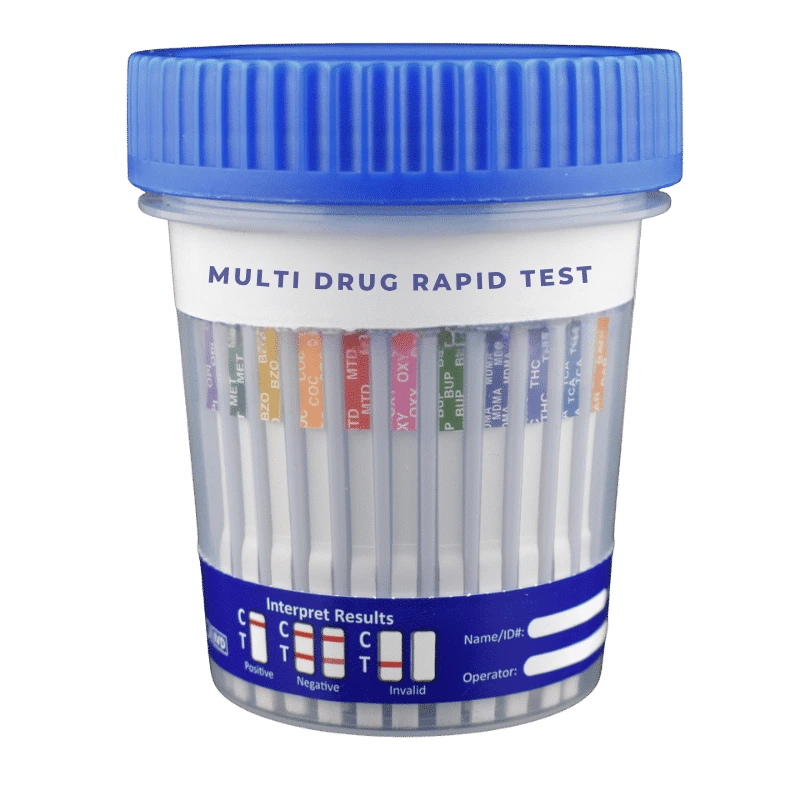
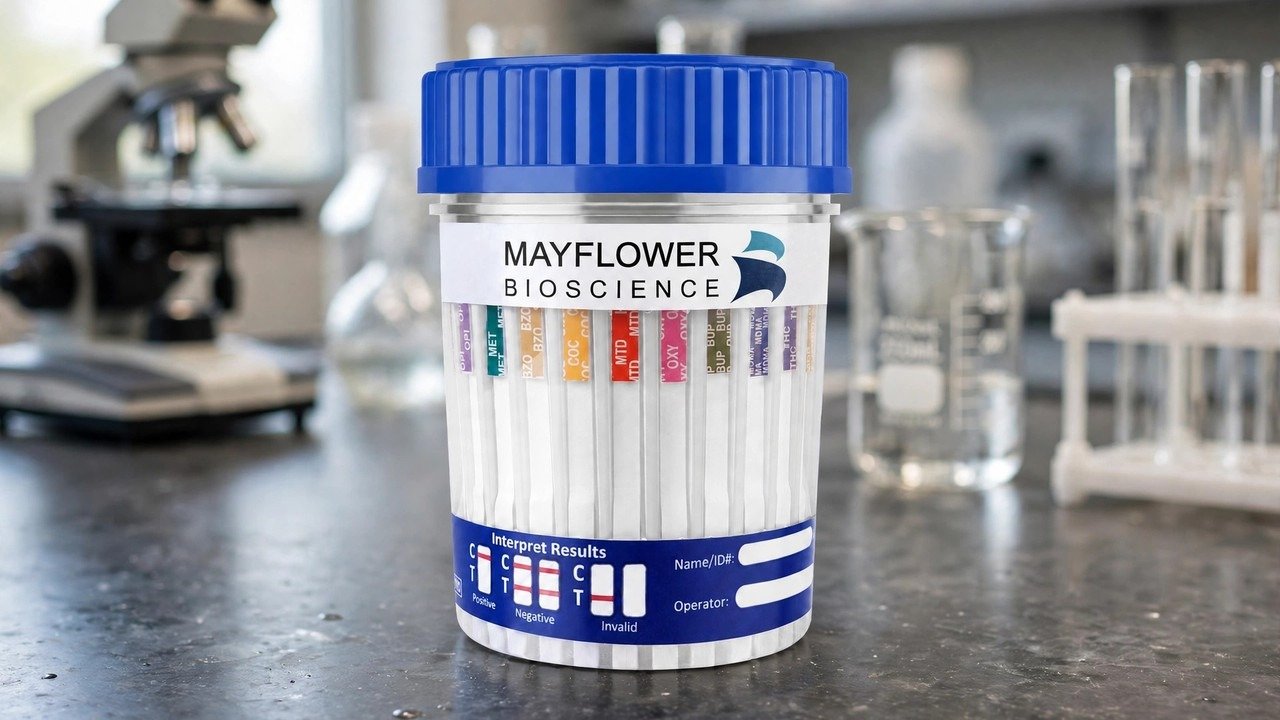
For analytes beyond the federal panel, the widely used point-of-care cutoffs are fentanyl 20 ng/mL, ETG alcohol 300 ng/mL, benzodiazepines 300 ng/mL, barbiturates 300 ng/mL, methadone 300 ng/mL, buprenorphine 10 ng/mL, kratom (mitragynine) 500 ng/mL, and tricyclic antidepressants (TCA) 1,000 ng/mL. MayFlower’s 12 panel and 16 panel drug test cups — for example, the 14 panel drug test cup — are built to these standard cutoffs, so a cup result and a laboratory screen are measuring against the same line — and programs buying at volume can standardize on one configuration through wholesale drug test cups instead of mixing devices with different thresholds.
Whatever device a program uses, the cutoff belongs in the written policy next to the panel list. MedlinePlus’s drug testing overview and NIDA’s drug testing resources both stress the same point: a result only means something relative to the cutoff, the confirmation method, and the specimen’s validity — never as a bare positive or negative.
Saliva (Oral Fluid) Cutoff Levels
Urine is not the only specimen with federal numbers. The HHS Mandatory Guidelines set a parallel cutoff table for oral fluid (saliva), adopted for regulated testing in 49 CFR §40.91. Oral-fluid cutoffs are far lower than urine cutoffs across the board — oral fluid carries the parent drug at lower concentrations, in a much smaller specimen volume, and for a much shorter window (roughly 1–3 days for most drugs), so the thresholds are set in single or double digits to detect recent use at all:
| Drug / metabolite (oral fluid) | Initial cutoff | Confirmation cutoff |
|---|---|---|
| Marijuana (THC) | 4 ng/mL | 2 ng/mL |
| Cocaine / Benzoylecgonine | 15 ng/mL | 8 ng/mL |
| Codeine / Morphine | 30 ng/mL | 15 ng/mL |
| Hydrocodone / Hydromorphone | 30 ng/mL | 15 ng/mL |
| Oxycodone / Oxymorphone | 30 ng/mL | 15 ng/mL |
| 6-Acetylmorphine (6-AM) | 4 ng/mL | 2 ng/mL |
| Phencyclidine (PCP) | 10 ng/mL | 10 ng/mL |
| Amphetamine / Methamphetamine | 50 ng/mL | 25 ng/mL |
| MDMA / MDA | 50 ng/mL | 25 ng/mL |
The pattern to notice is THC: 4 ng/mL initial and 2 ng/mL confirmation in oral fluid, against 50/15 ng/mL in urine — more than a tenfold difference for the same drug, driven entirely by the specimen. It is also why oral-fluid and urine results are never interchangeable: a program switching specimens is switching cutoffs, windows, and the meaning of a borderline result at the same time. Two neighbouring specimens have no equivalent federal table at all — blood testing uses laboratory-specific thresholds, and hair cutoffs (measured in picograms per milligram, pg/mg) were proposed by HHS in 2020 but have never been finalized, so hair programs rely on laboratory-validated values rather than a federal standard.
Putting Cutoffs to Work in a Testing Program
For program administrators, the operational takeaway is simple: the panel and the cutoffs are a single decision, not two. A 14 panel drug test cup chosen for fentanyl and ETG coverage also fixes the fentanyl cutoff at 20 ng/mL and the ETG cutoff at 300 ng/mL for every donor tested with it. Write those values into the program policy alongside the panel name, train collectors to explain that a line at the cutoff is a threshold decision rather than a measurement of impairment, and route every presumptive positive to laboratory confirmation before acting on it. Programs standardizing their panels and cutoffs across sites typically source them as part of their wider wholesale drug test supplies so every location tests against the same line. Programs that document their cutoffs in advance rarely have to defend a result afterward — the number, not the collector, made the call.
Frequently Asked Questions
What is a drug test cutoff level?
A cutoff level is the concentration threshold, measured in nanograms per milliliter (ng/mL), that separates a negative drug test result from a presumptive positive. If the drug or metabolite in the specimen is below the cutoff, the result is reported negative — even if trace amounts are present. At or above the cutoff, the screen reports positive and the specimen goes for laboratory confirmation.
What is the cutoff level for THC on a urine drug test?
The federal SAMHSA screening cutoff for marijuana metabolites (THC-COOH) is 50 ng/mL, and the laboratory confirmation cutoff is 15 ng/mL. Nearly all point-of-care cups use the same 50 ng/mL screening value. Because confirmation uses the lower 15 ng/mL threshold with mass spectrometry, a specimen must contain a clearly measurable amount of THC metabolite to be reported positive.
What does 50 ng/mL mean on a THC drug test?
It means the test only reports positive when THC metabolite (THC-COOH) is present at a concentration of 50 nanograms in each milliliter of urine — a nanogram is one-billionth of a gram. Below 50 ng/mL the result is negative, even if a laboratory instrument could detect trace amounts. The 50 ng/mL line was chosen so that ordinary secondhand smoke exposure, which produces far lower levels, stays on the negative side, while genuine use — which produces levels well above it — is reliably caught.
Can you fail a drug test if you are below the cutoff?
No. A result below the cutoff is reported as negative, full stop. Laboratories and cups do not report “a little bit positive” — the result is binary against the threshold. This is by design: cutoffs exist so that trace exposure from the environment, food, or secondhand smoke does not produce a positive result for someone who has not used the drug.
Why is the opiate cutoff so high at 2,000 ng/mL?
Federal regulators raised the codeine/morphine cutoff from 300 to 2,000 ng/mL because poppy seeds in ordinary food contain real morphine and codeine, and donors were screening positive after eating bagels and pastries. At 2,000 ng/mL, dietary exposure stays below the line while genuine opiate use — which produces concentrations far above it — is still reliably detected.
What is the difference between OPI 300 and OPI 2000?
They are two versions of the same opiate strip, built to two different cutoffs. OPI 300 screens opiates at 300 ng/mL — the sensitive clinical standard, which catches lower levels of use for longer. OPI 2000 screens at 2,000 ng/mL, matching the federal SAMHSA laboratory cutoff that was raised to keep poppy-seed food exposure negative. A specimen containing 800 ng/mL of morphine is positive on an OPI 300 cup and negative on an OPI 2000 cup and in a federal laboratory test — which is why a program must know which version its cups carry before comparing cup results with lab reports.
What is the cutoff for cocaine on a drug test?
The federal screening cutoff for cocaine metabolite (benzoylecgonine) is 150 ng/mL, with a confirmation cutoff of 100 ng/mL. One caution: many point-of-care cups are manufactured with a 300 ng/mL cocaine cutoff instead. A program comparing cup results to federal laboratory results should check the cup’s package insert so both sides are measuring against the same line.
Do drug test cups use the same cutoffs as laboratory tests?
Partly. Quality cups match the SAMHSA screening cutoffs on several analytes (THC 50, MDMA 500, PCP 25, oxycodone 100 ng/mL), but three differences are routine: cocaine (300 ng/mL on most cups vs 150 in federal labs), opiates (cups come in both 300 and 2,000 ng/mL versions), and amphetamine/methamphetamine (1,000 ng/mL on most cups vs 500 in federal labs). A cup’s cutoffs are fixed at manufacture and printed in its package insert — they cannot be adjusted by the user.
What is the fentanyl cutoff on a drug test cup?
Most point-of-care fentanyl strips use a cutoff of 20 ng/mL. Fentanyl is not part of the standard federal workplace panel, so there is no SAMHSA screening value for routine employer testing — the 20 ng/mL figure is the widely adopted manufacturer standard for integrated cups and dip tests used by treatment programs, drug courts, and clinics.
Who sets drug test cutoff levels?
For federal workplace testing, SAMHSA (through the HHS Mandatory Guidelines) sets the cutoffs, and the DOT adopts them for regulated industries in 49 CFR Part 40. For non-regulated testing, employers and programs choose their own cutoffs — most adopt the SAMHSA values as the reference standard — and test manufacturers build those fixed thresholds into point-of-care cups and laboratory assays.