Drug Test CPT Codes: A Clinic Billing Guide
Drug Test CPT Codes: A Clinic Billing Guide
A clinic’s drug test billing comes down to two code families: presumptive codes 80305, 80306, and 80307 for the screen, and definitive codes — 80320 through 80377 for most commercial payers, or HCPCS G0480 through G0483 for Medicare — for laboratory confirmation. The single most common billing error is choosing the presumptive code by how many drugs were tested. The code is chosen by how the screen was read, not by panel size, and it is billed once per patient per date of service, however many drug classes the screen covered. This guide maps every code a clinic actually uses, the mistakes that trigger denials, and the documentation that keeps claims clean.
Drug testing splits into two clinical steps, and billing follows that split exactly. A presumptive test says a drug class “may be present” — it is the cup or analyzer screen that comes first. A definitive test identifies and usually quantifies the specific drug — it is the GC-MS or LC-MS/MS confirmation that comes second. A clinic that bills a screen as if it were a confirmation, or bills confirmation codes for a cup read, will be denied. The rest of this guide is about keeping those two steps, and their codes, apart.
Presumptive Codes 80305–80307: Chosen by Read Method
All three presumptive codes describe the same clinical service — a qualitative screen for any number of drug classes — and they differ only in how the result was read. That is the rule payers check, and it is the rule most clinics get wrong, because panel size feels like the natural separator. It is not: a 16-panel cup and a 5-panel cup read the same way bill the same code.
| Code | What it covers | Typical clinic scenario |
|---|---|---|
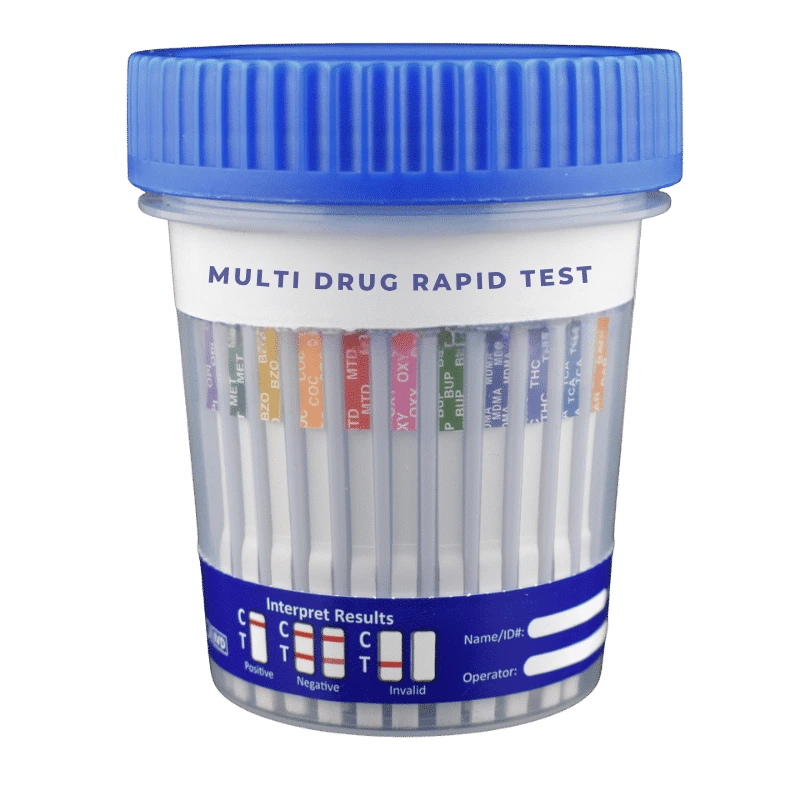
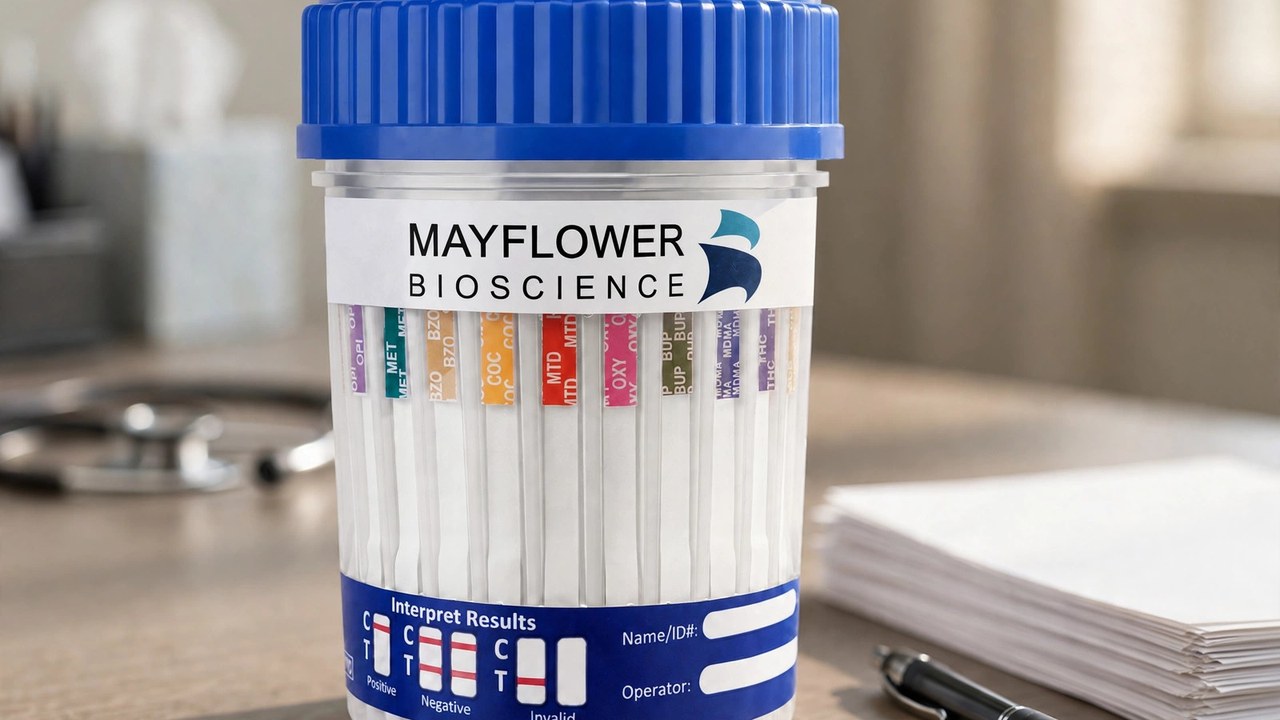
| 80305 | Presumptive screen read by direct optical observation | A multi-panel cup or dip card read by eye in the clinic — the standard in-house screen. MayFlower’s 12-panel, 14-panel, and 16-panel cups read this way bill here. |
| 80306 | Presumptive screen read by instrument-assisted direct optical observation | A cup or card read with a reader device that assists the visual read, rather than by the unaided eye alone. |
| 80307 | Presumptive screen by instrument chemistry analyzer | A laboratory analyzer run — immunoassay or mass-spectrometry-based screening on a chemistry platform, not a cup read. Note: 80307 is still a presumptive code, not a definitive test. |
Three billing rules apply to all three codes. First, one unit per patient per date of service: a clinic that runs two cups on the same patient on the same day bills one presumptive service, not two. Second, never bill by drug class: a 16-panel screen is one service, not sixteen. Third, match the code to the documented method — if the chart says the cup was read by eye, 80305 is the code; billing 80307 for a cup read is a method mismatch and a denial waiting to happen. Our guide to how to read a drug test cup covers the in-clinic reading workflow that the documentation should reflect.
Definitive Codes: 80320–80377 and Medicare’s G0480–G0483
When a presumptive screen is non-negative and the result will drive a clinical decision, the specimen goes to a laboratory for definitive testing by GC-MS or LC-MS/MS. Definitive testing is coded differently for Medicare and for commercial payers, and mixing the two systems up is the second most common denial cause in drug testing billing.
| System | Codes | How the code is chosen |
|---|---|---|
| Commercial payers | 80320–80377 | By drug or drug class: each code in the range names a specific drug or class assayed definitively. Bill the codes for the classes actually confirmed. |
| Medicare | G0480 (1–7 classes) | By the number of drug classes tested definitively: G0480 covers 1 to 7 classes in a single definitive service. |
| Medicare | G0481 (8–14 classes) | The same per-service logic: a 9-class confirmation bills G0481, once, not nine separate codes. |
| Medicare | G0482 (15–21 classes) | Chosen by class count, not by panel name — count the classes the laboratory actually assayed. |
| Medicare | G0483 (22+ classes) | The top band, for the broadest definitive panels. |
A worked example makes the split concrete. A pain-management patient’s urine is screened by immunoassay on an analyzer, then confirmed by LC-MS/MS for nine drug classes. For Medicare, that encounter bills 80307 for the presumptive analyzer screen, plus G0481 for the nine-class definitive service. For a commercial payer, the same encounter bills 80307 plus the applicable 80320–80377 codes for the classes confirmed. The clinical work is identical; the code set follows the payer. Always check the payer’s policy first — some commercial plans adopt Medicare-style G-code logic, and some Medicaid plans follow Medicare — because “the other system’s code” is a clean denial reason.
Specimen validity testing is included in the drug testing codes and is not billed separately. A clinic that adds a separate validity line item is double-billing a bundled component, and payers treat it as such. Similarly, a definitive test is not a routine add-on to every screen: definitive testing follows a non-negative presumptive result (or a specific clinical indication documented in the chart), and blanket standing orders testing every drug class at every visit are one of the fastest ways to fail a urine drug testing audit.
Retired Codes: Stop Billing These
Older references — and older billing software — still carry codes that payers now reject outright. The most important retirements for drug testing are 80101 (the old presumptive screen code, replaced by the 80305–80307 family), 83992 (the old PCP code, now covered within the definitive ranges), and the G0431, G0434, and G0477–G0479 screen codes, which Medicare retired when the current presumptive and G-code structure took effect. If any of these appear in a clinic’s charge master or superbills, remove them: a claim carrying a retired code is denied before any medical-necessity review happens, and repeated submissions can flag the practice. When in doubt about a code’s current status, check the current CPT code set and the payer’s fee schedule rather than a blog post — including this one, which should be re-verified against the current year’s code set before use.
Medical Necessity, Frequency, and Documentation
Codes get a claim through the door; documentation gets it paid. Every drug test claim needs four supports in the record. First, an order: who ordered the test, and why, on that date. Second, medical necessity: a diagnosis (ICD-10) that justifies testing — for example, a substance-use or dependence diagnosis, or a prescription-monitoring indication in pain management, as covered in our guide to drug testing for pain management clinics. A test without a supporting diagnosis is denied as not medically necessary, however correctly it is coded. Third, the method and result: which screen was run, how it was read (this decides 80305 vs 80306 vs 80307), and what happened next for any non-negative. Fourth, frequency justification: payers set frequency limits on urine drug testing, and testing more often than the patient’s risk level supports — without documented justification — is denied as excessive, even when each individual test is coded correctly.
Two documentation traps deserve special attention. One is the “test everything, every visit” standing order: payers and auditors read blanket orders as testing without individualized medical necessity, and they deny on that basis. Orders should reflect the patient’s risk, treatment stage, and clinical question, and they should change as the patient stabilizes. The other is the missing confirmation trail: a presumptive non-negative with no definitive follow-up in the record reads as an unfinished service, and a definitive claim with no preceding presumptive result reads as testing without indication. The chart should tell one continuous story — screen, result, confirmation, action — because that story is what the payer’s reviewer reconstructs.
Modifiers Clinics Actually Use
Modifiers adjust a code for a circumstance the base code does not capture, and four recur in drug testing billing. Modifier 90 marks a test performed by an outside (reference) laboratory rather than in-house — relevant when the clinic collects the specimen but the laboratory bills. Modifier 91 marks a repeat clinical diagnostic laboratory test on the same day, used when a legitimate repeat is required (for example, after a dilute or invalid specimen) and documented as such. Modifier QW marks a CLIA-waived test, which matters for point-of-care cup testing: see our guide to how to get a CLIA waiver certificate for what waived status covers. Modifier 59 marks a distinct procedural service, used sparingly when two services that would normally bundle were genuinely distinct. Modifiers are not multipliers: appending one does not increase payment, and appending the wrong one converts a payable claim into a denied one. Use a modifier only when the chart documents the circumstance it names.
Denials: The Five Patterns and Their Fixes
| Denial pattern | Usual cause | Fix |
|---|---|---|
| Multiple units, same date | Presumptive code billed per cup or per class | Bill one presumptive unit per patient per date, whatever the panel size or cup count. |
| Method mismatch | 80307 billed for a cup read, or 80305 for an analyzer screen | Match the code to the documented read method; fix the chart note, not just the claim. |
| Wrong definitive system | G-codes to a commercial payer, or 80320–80377 to Medicare | Check the payer’s policy and bill that payer’s definitive system. |
| Retired code | 80101, G0431/G0434, or G0477–G0479 still in the charge master | Purge retired codes from superbills and billing software. |
| No medical necessity / excess frequency | Missing diagnosis, or blanket testing without individualized justification | Link an ICD-10 diagnosis, document the clinical question, and justify frequency by patient risk. |
When a denial arrives, read the remark code before rebilling: a method-mismatch denial fixed by changing the code without fixing the chart note will be denied again, and a medical-necessity denial fixed by adding a diagnosis the chart never supported creates a compliance problem worse than the denial. Correct the record where the record is wrong, correct the claim where the claim is wrong, and keep the two consistent — auditors compare them.
A Clinic Billing Checklist
Before the claim goes out, run this check: is the presumptive code matched to the documented read method (80305 eye, 80306 reader-assisted, 80307 analyzer)? Is it billed once per patient per date? If definitive testing was done, is it coded in the payer’s system — G0480–G0483 by class count for Medicare, 80320–80377 by class for commercial plans? Is specimen validity bundled, not billed separately? Is a supporting diagnosis linked, and is the testing frequency justified by the patient’s risk and treatment stage? Are retired codes absent from the claim? And is the CLIA status right — QW where the test is genuinely CLIA-waived, and the laboratory’s CLIA certificate number on file where the claim requires it?
Two final cautions. First, CPT codes are maintained by the American Medical Association and updated annually, and payer policies change with them: verify every code in this guide against the current year’s CPT set and the specific payer’s policy before billing, because a guide written in one year can be stale in the next. Second, this guide is educational, not billing advice for a specific practice: complex cases — high-frequency testing, mixed payer panels, reference-lab arrangements — deserve a certified coder’s review. The SAMHSA workplace drug testing resources set out the federal testing framework, and the MedlinePlus drug testing guide explains the testing process itself; for the codes, the payer’s policy is the final authority. Get the presumptive code right, keep definitive coding in the payer’s system, and document the clinical story — and most drug testing claims pay the first time. Browse the screening range at MayFlower Bioscience, and pair this guide with our cost breakdown of how much a drug test costs for the full cup-vs-lab economics.
Frequently Asked Questions
What CPT code is used for a urine drug screen?
A presumptive urine drug screen bills 80305, 80306, or 80307, chosen by how the screen was read: 80305 for direct optical observation (a cup read by eye), 80306 for instrument-assisted optical observation (a reader device), and 80307 for an instrument chemistry analyzer. All three are billed once per patient per date of service, regardless of panel size.
Is 80307 a definitive drug test code?
No. 80307 is a presumptive code — it covers a screen run on an instrument chemistry analyzer, but it is still a screen, not a confirmation. Definitive testing is coded separately: 80320–80377 for most commercial payers, or G0480–G0483 for Medicare. Billing 80307 as if it were confirmation is a common denial cause.
What is the difference between 80305, 80306, and 80307?
The three codes differ only in read method, not in panel size or drug count. 80305 is a screen read by the unaided eye, 80306 is a screen read with instrument assistance, and 80307 is a screen run on a chemistry analyzer. A 16-panel cup and a 5-panel cup read the same way bill the same code.
What are the Medicare drug testing G-codes?
Medicare uses HCPCS G0480–G0483 for definitive drug testing, chosen by the number of drug classes tested: G0480 for 1–7 classes, G0481 for 8–14, G0482 for 15–21, and G0483 for 22 or more. Medicare does not use the commercial 80320–80377 codes for definitive testing.
Can I bill a presumptive code more than once per day?
No. Presumptive drug testing is billed once per patient per date of service, however many cups, devices, or drug classes were involved. Billing multiple units for the same patient on the same day is one of the most common drug testing denial patterns.
Is specimen validity testing billed separately?
No. Specimen validity testing is included in the drug testing codes and is not billed as a separate line item. Adding a separate validity charge is double-billing a bundled component.
What CPT codes are retired for drug testing?
Retired codes that payers now reject include 80101 (the old presumptive screen code), 83992, and the G0431, G0434, and G0477–G0479 screen codes. Remove them from charge masters and superbills, and use the current 80305–80307 presumptive family and the applicable definitive codes instead.
What does modifier QW mean for drug testing?
Modifier QW marks a CLIA-waived test — a test simple enough that it can be performed under a CLIA Certificate of Waiver rather than full laboratory certification. It applies to point-of-care cup testing performed in a waived setting, and the clinic must actually hold the waiver for the modifier to be valid.
What documentation does a drug test claim need?
A drug test claim needs an order stating who ordered the test and why, a supporting ICD-10 diagnosis establishing medical necessity, documentation of the screen method and result (which decides the presumptive code), and, for any non-negative, the definitive confirmation trail. Frequency must also be justified by the patient’s risk and treatment stage.
Do commercial payers use the same drug testing codes as Medicare?
Not for definitive testing. Both use the 80305–80307 presumptive family, but commercial payers generally use CPT 80320–80377 (by drug or drug class) for definitive testing, while Medicare uses HCPCS G0480–G0483 (by class count). Always check the specific payer’s policy, since some plans adopt the other system’s logic.