Drug Testing for Pain Management Clinics: Prescription Monitoring
Pain Management Drug Testing
Pain management drug testing asks a different question than workplace screening. A workplace test asks, “Has this person used a drug?” A pain clinic test asks, “Is the prescribed medication in the urine — and is anything present that the prescriber did not order?” A compliant result shows the prescribed opioid, such as oxycodone or hydrocodone, at an expected level, and shows nothing unprescribed. Clinics test before opioid therapy starts and periodically throughout it, document the results against the signed treatment agreement, and confirm every unexpected screen with definitive laboratory testing before acting on it.
This inversion — where a positive for the prescribed drug is the expected outcome and an absent prescribed drug is a red flag — makes pain management the most interpretation-sensitive setting in drug testing. Panel choice, cutoff selection, and the confirmation protocol all matter more here than in almost any other program, because the results shape real clinical decisions about patients in ongoing care. Throughout, the standard is the one MayFlower Bioscience builds its monitoring cups around: the right strips, read correctly, confirmed before action, and documented at every visit.
Why Pain Clinics Test: Agreements, Guidelines, and Patient Safety
Urine drug testing (UDT) in pain management rests on three supports. The first is the opioid treatment agreement signed at intake: the patient agrees to take medication only as prescribed, use one prescriber and one pharmacy, avoid unprescribed and illicit substances, and submit to random drug testing and pill counts. Testing is how the agreement is verified rather than merely trusted.
The second support is national guidance. The CDC’s 2022 Clinical Practice Guideline for Prescribing Opioids for Pain recommends urine drug testing before starting opioid therapy and at least annually during long-term therapy, with more frequent testing when a patient’s risk is higher. The FDA’s opioid medication resources frame the same risk picture: opioids combined with benzodiazepines, alcohol, or illicit fentanyl carry a sharply elevated overdose risk, and only testing — not self-report alone — reliably reveals those combinations.
The third support is early intervention. An unexpected result is often the first objective sign of an emerging opioid use disorder, diversion, or a dangerous drug interaction, and catching it early lets the clinic respond with increased monitoring or treatment referral. NIDA’s drug testing research resources describe testing as one component of a monitoring plan, alongside prescription drug monitoring program (PDMP) checks and clinical assessment — never as a standalone verdict on a patient.
What the Test Looks For: The Expected Positive
Every pain management result is read in two directions at once:
- Expected to be present: the prescribed opioid and its metabolites — oxycodone (with oxymorphone and noroxycodone), hydrocodone (with hydromorphone), morphine, tramadol, or whichever agent the chart documents. Presence confirms the patient is taking the therapy as directed.
- Expected to be absent: opioids from any other source, benzodiazepines unless the clinic itself prescribes or documents them, cocaine, methamphetamine, heroin (identified specifically by the 6-MAM metabolite), fentanyl, and — where the agreement prohibits alcohol — ETG.
The counterintuitive consequence: a negative result can be the problem. If the prescribed oxycodone is missing, the differential includes non-adherence, running out early from overuse, diversion of the medication to someone else, or a dilute or substituted specimen. None of those conclusions can be drawn from the screen alone — which is why the confirmation protocol below exists.
Choosing the Panel: Drug-Specific Strips Matter
The most common panel error in pain clinics is relying on the generic opiate (OPI) strip. That strip is built around a morphine antibody; as the drug test cutoff levels guide explains, its cross-reactivity with the semi-synthetic opioids is weak, so a patient faithfully taking oxycodone or hydrocodone can screen negative for their own medication on a morphine-only panel. A monitoring panel needs drug-specific strips instead:
- Oxycodone (OXY) — its own strip, typically at a 100 ng/mL cutoff, because the OPI strip cannot be trusted to catch it.
- Benzodiazepines (BZO) — sedative co-use with opioids is the highest-risk combination a clinic monitors for.
- Fentanyl (FEN) — no opiate strip detects it; it requires a dedicated strip, which is why clinics check which panels include fentanyl before ordering.
- Validity pads — creatinine, pH, specific gravity and oxidants, because dilution matters clinically: an over-diluted specimen can hide both prescribed and unprescribed drugs.
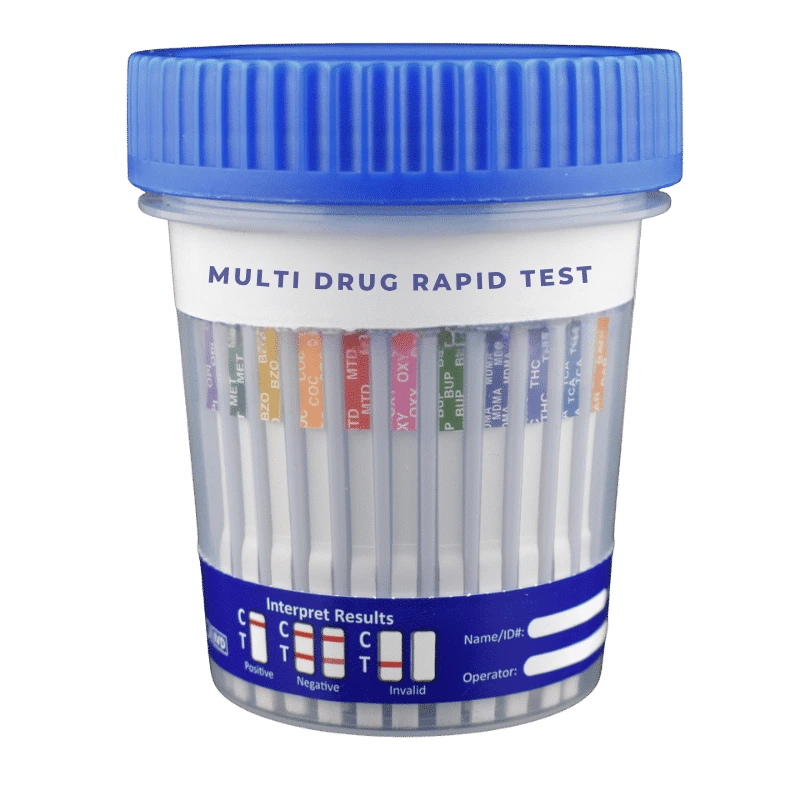
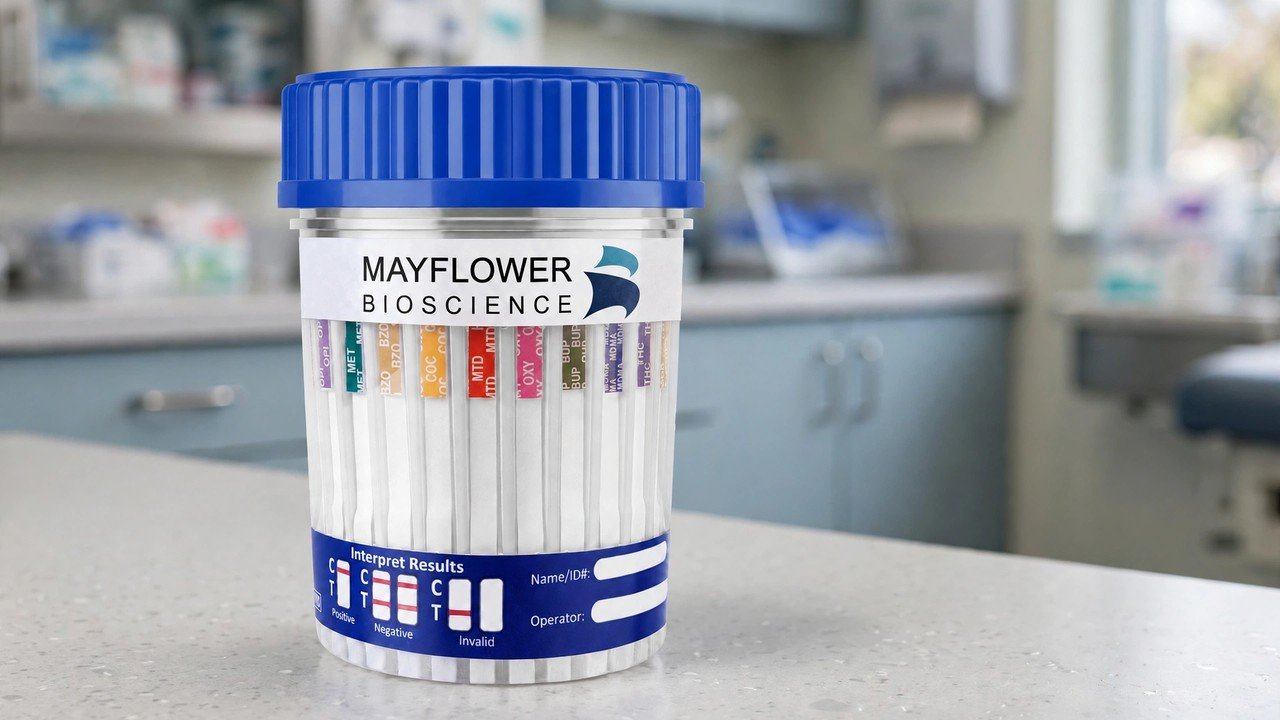
Integrated CLIA-waived drug test cups bundle these strips into one device. A 14 panel drug test cup, for example, combines the classic drug classes with oxycodone, fentanyl, ETG alcohol and tramadol coverage, and the fentanyl drug test cup configurations exist for clinics whose monitoring protocol leads with fentanyl. Clinics ready to standardize on that configuration can order the 14 panel drug test cup directly as their monitoring device. Staff read the cup the same way as any point-of-care device — temperature strip first, results at 5 minutes, recorded strip by strip, as detailed in the guide to how to read a drug test cup.
How Often to Test: Frequency by Risk Level
The CDC guideline sets the floor — baseline before therapy, at least annually during it — and clinics stratify upward from there. A widely used schedule in guideline-based practice:
| Risk level | Typical profile | Common testing frequency |
|---|---|---|
| Low | No substance-use history, stable dose, no aberrant behavior, no sedative co-prescriptions | Baseline at initiation, then at least once a year |
| Moderate | Higher dose, history of resolved misuse, depression or anxiety, age over 65 | 2–3 times a year, at least partly random |
| High | Active or past substance use disorder, concurrent benzodiazepine, prior unexpected results | 3–4 or more times a year, random and unannounced |
Random timing is not a detail — it is the mechanism. A test the patient can calendar is a test that can be prepared for; unannounced collection at routine refill visits is what makes the schedule meaningful. Any unexpected result, at any risk level, also justifies moving the patient up a tier until results stabilize.
Clinical frequency and payer frequency are not the same ceiling. The risk table above describes how often testing is clinically useful; payer medical policies separately cap how often testing is covered, and exceeding a payer ceiling without a documented change in the patient’s clinical status is a common denial trigger. The ceilings payers commonly apply include:
| Test type | Ceiling commonly applied by payers |
|---|---|
| Presumptive (screen) | One test per patient per date of service, and up to 15 presumptive tests per rolling 12 months in some payer policies; other payers set lower benefit-period limits, so the patient’s own policy controls. |
| Definitive (confirmation) | One definitive service per date of service, commonly capped at 12 definitive tests per 12 months or benefit period — the limit Medicare contractor guidance applies to chronic opioid therapy monitoring and that several payer policies mirror. |
These are examples of commonly applied payer limits, not a universal schedule: frequency allowances vary by payer, plan, and patient risk, and clinics should verify the applicable medical policy before setting a monitoring cadence that assumes coverage.
Presumptive, Definitive, Point-of-Care and Reflex Testing: Definitions
Payer policies and lab menus use four terms precisely, and using them the same way in clinic documentation is what keeps orders, results, and claims aligned:
| Term | What it means | How it is used and billed |
|---|---|---|
| Presumptive | A qualitative screen that reports whether a drug class is likely present or absent above a cutoff. Immunoassay cups and analyzer screens are presumptive tests. | Billed with CPT 80305–80307 depending on how the test is read (see Billing below) — one code, one unit, per patient per date of service, regardless of how many drug classes the device tests. |
| Definitive | A laboratory test — typically LC-MS/MS or GC-MS — that identifies specific drugs and metabolites, often quantitatively, and separates prescribed metabolism from new use. | For Medicare, billed with HCPCS G0480–G0483 by number of drug classes tested (1–7, 8–14, 15–21, 22 or more); only one definitive code per date of service. |
| Point-of-care testing (POCT) | Testing performed where the patient and clinician are in the same location, for immediate results used in that visit’s management. Cups, dipsticks, cassettes and strips read by eye or by instrument-assisted observation are POCT platforms. | The format CLIA-waived cups use in pain clinics: the result is available during the visit and documented against the medication list the same day. |
| Reflex testing | A pre-arranged laboratory protocol under which a presumptive result automatically triggers definitive testing — for example, verifying a presumptive positive, or confirming the absence of a prescribed drug after a negative screen. | Acceptable when the reflex protocol is defined in advance and the definitive result is still reviewed and documented by the ordering clinician; it does not replace an individualized order. |
Screen First, Confirm Definitively: The Two-Step Protocol
A cup result in a pain clinic is a presumptive screen, and immunoassay has known limits in a medicated population: antibodies cross-react (certain antidepressants can trigger benzodiazepine or tricyclic strips), low-dose or recently-eliminated drugs fall below cutoffs, and metabolism creates look-alikes — prescribed codeine legitimately produces morphine in urine, which is expected metabolism, not heroin use. MedlinePlus’s drug testing overview makes the same point for all settings: screening results that will drive consequential decisions require confirmation.
The standard protocol for an unexpected result is:
- Do not act on the screen alone. No dismissal, no accusation, no abrupt medication cutoff based on an unconfirmed cup.
- Review the obvious explanations first — the current medication list, timing of the last dose, specimen temperature and validity pads.
- Send the specimen for definitive LC-MS/MS testing, which identifies the specific parent drugs and metabolites and separates metabolism (codeine → morphine) from new use (6-MAM → heroin).
- Discuss the confirmed result with the patient, document the conversation, and adjust the plan — closer monitoring, dose changes, taper, or referral for substance-use treatment — in proportion to what the confirmed result actually shows.
Clinics that follow this sequence get the safety benefit of testing without the harm of false conclusions: the screen raises the question, and only the laboratory answers it.
Running the Workflow in a Busy Clinic
Point-of-care cups fit pain clinics because the collection, read, and documentation happen inside one visit: temperature check within 4 minutes (90–100°F), results read at 5 minutes and charted against the active medication list, and the same sealed specimen sent for confirmation whenever a strip disagrees with the chart. Because the devices are CLIA-waived, trained clinic staff — not only laboratory personnel — can run them under the clinic’s CLIA certificate of waiver, and clinics testing every clinic day standardize on one panel configuration bought at volume through wholesale drug test cups so cutoffs and strips never vary between visits. SAMHSA’s testing framework resources cover the program-documentation side — written policy, consistent application, and confirmed results — that makes a monitoring program defensible as well as clinically useful.
Billing and Medical Necessity: What Payers Require
Clinically sound testing can still be denied if the claim and the chart do not match what payers require. The rules below reflect how Medicare guidance and payer medical policies frame urine drug testing in pain management; individual payer policies vary, and clinics should confirm the policy that applies to each plan they bill.
Presumptive codes: CPT 80305–80307. Presumptive drug testing is billed per date of service, not per drug class and not per device. CPT 80305 covers tests read by direct optical observation only — the dipsticks, cups, cards and cartridges a clinician reads by eye, which is the category a visually read point-of-care cup falls in. CPT 80306 covers the same devices read by instrument-assisted direct optical observation, and CPT 80307 covers presumptive testing performed by instrument chemistry analyzers (immunoassay, chromatography, and mass-spectrometry screening platforms). Whichever code applies, only one presumptive test may be reported per patient per date of service, regardless of the number of drug classes tested or the number of providers involved.
Definitive codes: HCPCS G0480–G0483. For Medicare, definitive drug testing is billed with the G-code tier that matches the number of drug classes tested, including metabolites: G0480 for 1–7 drug classes, G0481 for 8–14, G0482 for 15–21, and G0483 for 22 or more. Only one code from this range may be reported per date of service, so the definitive order should name the specific drugs and classes the clinician needs identified — not default to the broadest tier for every patient.
Blanket and routine standing orders are denied. Medicare contractor guidance lists blanket orders — the identical order applied to every patient in a practice, without individualized decision-making — as a non-covered service. A standing order survives review only when it is individualized: written for a specific patient, based on that patient’s history, risk, and community trends, for a limited number of visits, and adjustable by the clinician. An automatic “screen plus definitive panel for everyone, every visit” protocol is the pattern payers deny and auditors cite. The CMS Medicare contractor policy on urine drug testing sets out these definitions — point-of-care testing, standing orders, and blanket orders — and the coverage rules that follow from them.
The documentation payers require. A covered test is an individually ordered, individually justified test. Payer medical policies, including this payer policy on drug testing in pain management and substance use treatment — which likewise allows only one presumptive test per encounter and caps definitive testing at 12 tests per benefit period — consistently require the chart to show:
- A clinical assessment — history and examination, the patient’s risk assessment, and the current prescription record (including the PDMP check) that together establish why testing is needed for this patient.
- A per-class rationale — why each drug class ordered is being tested for this patient, rather than a standard panel ordered for everyone.
- Results documented and used — the result recorded in the chart and visibly used to direct care: discussed with the patient, and reflected in the monitoring, dosing, or referral decision that followed.
- An individualized order at a clinical encounter — testing ordered by the treating clinician in the context of the patient’s care, not generated automatically by a blanket protocol or a routine standing order.
Clinics that build these four elements into the visit workflow — assessment, rationale, documented result, individualized order — rarely have to reconstruct medical necessity after the fact, because the chart already tells the payer’s story.
Frequently Asked Questions
Why do pain management clinics drug test their patients?
To verify that the prescribed medication is being taken as directed, to detect unprescribed or illicit substances that raise overdose and interaction risk, and to document compliance with the signed opioid treatment agreement. The CDC’s 2022 opioid prescribing guideline recommends urine drug testing before starting opioid therapy and at least annually during long-term therapy.
What should show up on a pain management drug test?
The prescribed medication and its metabolites — for example oxycodone with oxymorphone, or hydrocodone with hydromorphone. This is the “expected positive”: the drug the clinic prescribed should be present. Everything not on the patient’s medication list — other opioids, unprescribed benzodiazepines, cocaine, methamphetamine, fentanyl — should be absent.
What happens if a pain patient’s drug test result is unexpected?
The clinic should not act on the screen alone. The standard protocol is to review the medication list and last-dose timing, send the specimen for definitive LC-MS/MS confirmation, then discuss the confirmed result with the patient and document the conversation. Responses are proportional — closer monitoring, dose adjustment, taper, or treatment referral — rather than automatic discharge.
How often do pain clinics drug test?
At baseline before opioid therapy starts and at least once a year for low-risk patients, following the CDC guideline floor. Moderate-risk patients are commonly tested 2–3 times a year and high-risk patients 3–4 or more times a year, with at least some collections random and unannounced so the schedule cannot be prepared for.
Can a standard opiate strip miss oxycodone or hydrocodone?
Yes. The generic opiate strip is built around a morphine antibody and cross-reacts poorly with the semi-synthetic opioids, so a patient taking prescribed oxycodone can screen negative for it on a morphine-only panel. Pain management panels need a dedicated oxycodone strip (typically 100 ng/mL) and drug-specific coverage for the other prescribed agents being monitored.
Do pain management drug test panels include fentanyl?
Only when the panel carries a dedicated fentanyl (FEN) strip — no opiate or oxycodone strip detects fentanyl. Because illicit fentanyl is widespread and dramatically raises overdose risk for opioid-therapy patients, many clinics specifically choose panels that include fentanyl alongside oxycodone and benzodiazepines.
What is an opioid treatment agreement?
A document the patient signs when opioid therapy begins: take medication only as prescribed, use one prescriber and one pharmacy, take no unprescribed or illicit substances, and submit to random urine drug testing and pill counts. Drug testing is the verification mechanism for the agreement, and results are documented against its terms.
What if the prescribed opioid is NOT in the patient’s urine?
An absent prescribed drug is itself an unexpected result. Possible explanations include non-adherence, running out early because of overuse, diversion of the medication, or a dilute specimen that pushed the drug below the cutoff. The clinic confirms with definitive testing and discusses the result with the patient before drawing any conclusion.
What is the difference between presumptive and definitive drug testing?
Presumptive testing is the qualitative screen — an immunoassay, such as a CLIA-waived cup read in the office, that reports whether a drug class is likely present or absent above its cutoff. Definitive testing is laboratory identification, typically by LC-MS/MS, that names the specific drugs and metabolites present, often with quantities. Cups are therefore enough for routine monitoring, but any unexpected screen requires definitive confirmation before it drives a clinical decision, because immunoassay cross-reactivity and metabolism can make screens misleading in medicated patients.
Can prescribed medications cause misleading results on a monitoring screen?
Yes, in two ways. Metabolism can make a prescribed drug look like another — codeine legitimately produces morphine in urine. And immunoassay antibodies can cross-react with unrelated medications, such as certain antidepressants triggering benzodiazepine or tricyclic strips. Definitive LC-MS/MS testing identifies the exact molecules present, which is why unexpected screens are always confirmed before action is taken.