
Amphetamine Urine Drug Test: Detection, Cutoffs, Results
Amphetamine Urine Drug Test: Detection, Cutoffs, Results
An amphetamine urine drug test is a rapid immunoassay screen. It looks for amphetamine and related compounds in a urine sample and returns a preliminary positive or negative. Amphetamine is usually detectable for about one to three days after use, depending on dose, frequency and the person’s metabolism. A positive screen is presumptive only: it needs confirmation by GC/MS or LC-MS/MS before anyone acts on it.
This guide is written for clinics, behavioral health programs, employers, drug courts and labs that screen for amphetamines. It covers how the test works, what the numbers mean, what can cause a false positive, and how to match a cup to your program.
TL;DR
- Amphetamine typically shows in urine for up to about 3 days. Heavy or long-term use, body mass and individual metabolism can change that.
- US federal workplace testing uses a 500 ng/mL initial cutoff and a 250 ng/mL confirmation cutoff. Other programs set their own cutoffs.
- A cup result is a preliminary screen. Positives go to a laboratory for GC/MS or LC-MS/MS confirmation.
- Some prescription and over-the-counter drugs can cross-react with immunoassays, so a confirmed result should be reviewed with the person’s medication history.
- Our 12-panel cup with PCP is CLIA-waived and FDA-cleared. Our 14-panel and 16-panel cups are Forensic Use Only and are not CLIA-waived.
Table of Contents
- Quick answer: what the test shows
- How an amphetamine urine test works
- How long amphetamine stays detectable in urine
- Cutoff levels: what 500, 250 and 1,000 ng/mL mean
- Presumptive screen versus confirmatory test
- Why a positive might not mean illicit use
- Specimen integrity and reporting
- Choosing the right cup for your program
- Who uses amphetamine urine screening
- Our perspective
- Stock your program with multi-panel cups
- FAQ
- Sources
Quick answer: what the test shows
| Question | Short answer |
|---|---|
| Sample | Urine, collected with a temperature check |
| Result type | Preliminary (presumptive) screen |
| Typical detection window | Up to about 3 days |
| Federal workplace cutoffs | 500 ng/mL screen, 250 ng/mL confirmation |
| Confirmation method | GC/MS or LC-MS/MS at a laboratory |
| Can it prove impairment? | No. It shows exposure, not when or how much |
How an amphetamine urine test works
Most point-of-care cups and many lab screens use an immunoassay. Antibodies built to recognize amphetamine bind to it in the urine sample. If the drug is present above the cutoff concentration, the device reads positive. If it is below the cutoff, it reads negative.
The cutoff is the key idea. A negative result does not mean “no drug.” It means the drug, if present, is below the concentration the test is set to flag.
Immunoassays detect a drug class by structure, not by identifying one exact molecule. That makes them fast and inexpensive, and it is also why they can react to compounds with a similar shape. A Mayo Clinic Proceedings review of urine drug screening describes structural similarity as the main reason for this interference.
The same review notes that the d-isomer of amphetamine carries the central nervous system stimulant effects, while the l-isomer works mainly outside the brain. It also notes that common amphetamine and methamphetamine immunoassays can pick up MDMA through cross-reactivity, though with low sensitivity. For that reason, programs that need to know about MDMA specifically should look at their panel and their confirmation menu rather than rely on the amphetamine channel alone.
What the test can and cannot tell you
A urine screen can tell you that a compound in the amphetamine class was present at or above the cutoff. It cannot tell you:
- which specific substance caused the reaction, without confirmation;
- when the drug was taken, beyond the general detection window;
- how much was taken;
- whether the person was impaired at the time of the sample.
That is why every program that screens should have a written policy covering confirmation, review of prescriptions and documentation.
How long amphetamine stays detectable in urine
The commonly cited answer is up to about three days. Mayo Clinic Laboratories lists amphetamine-type stimulants as detectable in urine for up to 3 days, with the actual window depending on dose, frequency of use and individual metabolism. A Mayo Clinic Proceedings clinical guide gives a standard detection time of 48 hours for amphetamine in its reference table.
In practice, treat these as ranges rather than promises:
| Use pattern | Typical urine window (range) |
|---|---|
| Single or occasional use | About 1 to 2 days, sometimes up to 3 |
| Regular use | Often toward the upper end, about 2 to 4 days |
| Heavy or prolonged use | Can extend beyond the typical range |
The first two rows reflect the cited sources’ general figures. Individual results vary and no table can predict a specific person’s result.
Factors that change the window
The Mayo Clinic Proceedings guides name several patient factors that influence how long a drug can be detected:
- Dose and frequency. Higher and more frequent doses leave more drug and metabolites to clear.
- Short-term versus long-term use. Longer use generally stretches the window.
- Body mass. It affects how the drug distributes and clears.
- Urine pH and concentration. Dilute urine can bring a concentration under the cutoff, while concentrated urine does the opposite.
- Kidney or liver function. Impairment can slow clearance.
For other substances, our drug detection times chart puts the ranges side by side. If your program also screens for methamphetamine, see how long meth stays in your urine.
Cutoff levels: what 500, 250 and 1,000 ng/mL mean
A cutoff is the concentration, in nanograms per milliliter (ng/mL), at or above which a sample is reported positive.
Under US Department of Transportation rules, the federal workplace standard sets the initial amphetamine test cutoff at 500 ng/mL and the confirmation cutoff at 250 ng/mL, with confirmation by GC/MS or LC-MS/MS. The Mayo Clinic Proceedings guide also notes a requirement that the confirmed specimen contain amphetamine at 100 ng/mL or more when methamphetamine is reported.
Not every program follows the federal numbers. Some clinical labs use different thresholds. For example, OHSU’s laboratory reports amphetamines at 1,000 ng/mL or above as positive. That is where the question “is 1,000 ng/mL a lot?” comes from. The number is not good or bad on its own. It is above the federal screening cutoff of 500, and it is simply the line that particular lab uses to call a sample positive. It does not indicate how much was taken or how recently.

The Association for Diagnostics & Laboratory Medicine (ADLM) points out that many cutoffs are historical rather than evidence-based, so they may not suit every clinical situation. For program managers, the practical lesson is to choose a cutoff on purpose, write it into policy and use the same one consistently. Our cutoff levels chart explains the common values.
Presumptive screen versus confirmatory test
The two steps do different jobs.
| Rapid screen (cup or immunoassay) | Confirmation (GC/MS or LC-MS/MS) | |
|---|---|---|
| Purpose | Quickly sort negatives from possible positives | Identify the specific drug and metabolites |
| Speed | About five minutes with a rapid cup | Laboratory turnaround |
| Specificity | Class-based, can cross-react | Compound-specific |
| Result | Preliminary | Definitive for the analyte |
According to the Mayo Clinic Proceedings guide, a presumptive screen is a rapid preliminary immunoassay prone to false positives, and GC/MS is used to confirm the specific drug. A clinical reference guide from Aegis Sciences makes the same point: GC/MS or LC-MS/MS can identify specific drugs and metabolites and rule out immunoassay false positives.
So the workflow is simple. Screen on site, record the result, and send any non-negative sample to a laboratory. Do not treat a cup result alone as a final finding.
Why a positive might not mean illicit use
Prescription stimulants contain amphetamine, so they are expected to produce a positive. Adderall is the common example: it contains amphetamine salts and will show on a standard amphetamine screen. A confirmed positive in a person with a valid prescription is a medical review question, not automatically a violation.
Cross-reacting medications
The Mayo Clinic Proceedings guide lists drugs that may cause false-positive immunoassay results because of structural cross-reactivity. They include pseudoephedrine, phenylephrine, bupropion and certain antipsychotics and antidepressants. The same paper names labetalol, isometheptene, ranitidine, ritodrine and trimethobenzamide as other agents reported to cross-react. Selegiline is metabolized into l-methamphetamine and l-amphetamine, which also matter when interpreting results.
Lab confirmation separates these cases. When a screen is positive and the person reports a cold remedy or antidepressant, the confirmation result shows whether amphetamine itself was present.
Does Ritalin show up?
This is a frequent question, including for 12-panel cups. Methylphenidate (Ritalin) is not an amphetamine, although the two are often grouped as stimulants. A Danish study of routine urine samples found that methylphenidate did not cause false-positive results on the Siemens EMIT amphetamine assay, and that mass spectrometry distinguishes it from amphetamines. The authors argue the belief that it often triggers false positives comes from outdated or low-quality data. Results can still vary by device, so confirmation remains the rule.
What drug is similar to amphetamine?
Methamphetamine is the closest relative and is often reported together with amphetamine. MDMA is structurally related, and the Mayo review notes that amphetamine immunoassays detect it with low sensitivity. Prescription stimulants such as those in ADHD medication contain amphetamine itself.
Specimen integrity and reporting
A reliable result starts with a reliable sample. A reportable positive in a regulated setting requires a properly collected specimen with chain of custody, and a confirmed analyte at or above the confirmation cutoff. Our integrated temperature strip is there to support the first check: whether the sample is within the expected temperature range right after collection.
For clinical programs, reporting criteria and specimen handling deserve their own written procedure. This clinician guide to urine drug screening in a telehealth setting walks through specimen integrity and how results are reported, which is useful when you design a protocol for remote or hybrid care.
Whatever the setting, build these steps into procedure:
- Verify identity and explain the process before collection.
- Check the temperature strip as soon as the sample is collected.
- Read the result within the time stated in the cup’s instructions, and do not read it later.
- Record the result, the lot number and the reader.
- Send non-negative or disputed samples for laboratory confirmation.
- Review medications with the clinician or medical review officer before drawing conclusions.
Choosing the right cup for your program
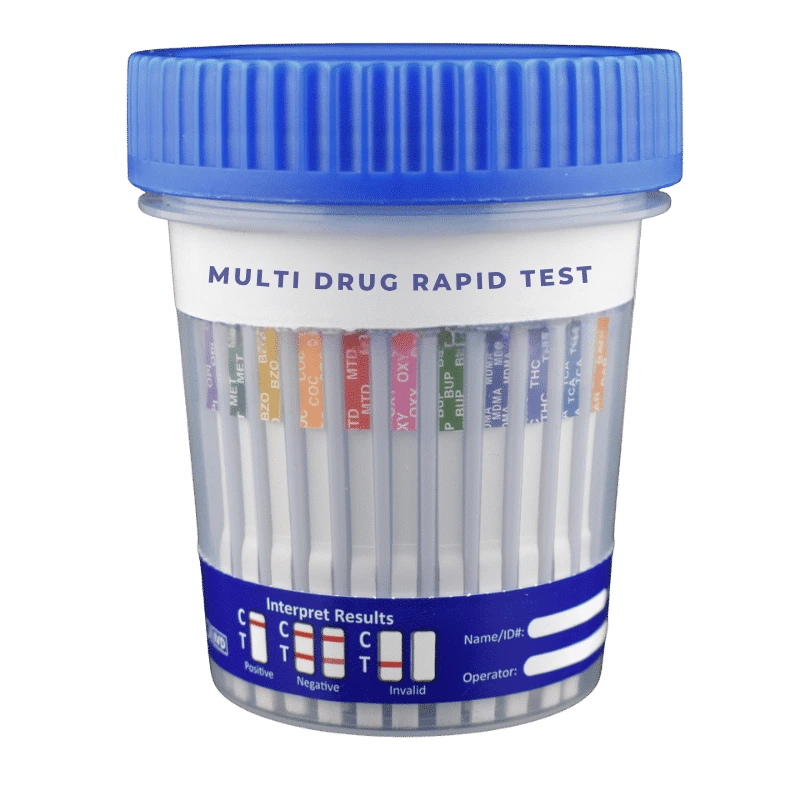
A multi-panel cup tests for several drug classes at once, so one sample covers your whole screening menu. The best choice depends on who you are, what you need to detect and whether you must use a CLIA-waived device.
We offer four configurations, and the regulatory status differs, so it is worth being exact:
| Cup | Regulatory status | Fits |
|---|---|---|
| 12-panel with PCP | CLIA-waived, FDA-cleared | Clinics and point-of-care settings |
| 12-panel with ETG and fentanyl | Forensic Use Only, not CLIA-waived | Forensic-use programs adding alcohol and fentanyl |
| 14-panel with PCP, ETG and fentanyl | Forensic Use Only, not CLIA-waived | Programs wanting a broader menu |
| 16-panel adding kratom and TCA | Forensic Use Only, not CLIA-waived | Programs with the broadest screening needs |
Every cup has an integrated temperature strip and gives a rapid read in about five minutes. Check the panel list and cutoff on the product page for the exact configuration you plan to buy, and confirm it matches the cutoff your policy specifies.
If your question is urine versus another specimen, our guide on urine versus hair drug testing compares what each one is good at. For a test that covers non-DOT panels, see what the FM-590PP non-DOT test checks. If alcohol is on your menu, our page on how long alcohol shows in a urine test covers ETG.

Who uses amphetamine urine screening
Different programs lean on the same basic tool for different reasons:
- Clinics and behavioral health programs use screens to support treatment plans and to start a conversation with patients.
- Employers use them as part of a written drug-free workplace policy. DOT-regulated roles follow the federal rules cited above.
- Drug courts and corrections use frequent, fast screens for monitoring, with confirmation when results are contested.
- Distributors supply these programs and need consistent stock and clear labeling of which devices are CLIA-waived and which are Forensic Use Only.
In each case, the screen is only the first step.
Our perspective
We supply amphetamine-capable multi-panel screening to programs that process real volume, so we see the same mistakes repeat. The most common one is treating a cup result as a conclusion. A cup is a fast, consistent way to sort a large number of samples. It is not the end of the process.
The second mistake is a mismatch between the device and the program. A clinic that needs a CLIA-waived device should buy one, and a forensic-use program should know exactly which cups are labeled Forensic Use Only. That is why we keep the catalog to four focused configurations and label each one plainly.
The third is an unclear policy on cutoffs and confirmation. Our 12-panel cup with PCP is CLIA-waived and FDA-cleared. The 14-panel and 16-panel cups are Forensic Use Only. Every cup has an integrated temperature strip and a five-minute read, and we built our ordering around bulk and recurring needs: volume pricing, free shipping on 100+ cups and same-day dispatch from US stock.
Our advice is to write the policy first, pick the cup that fits it and keep a laboratory lined up for confirmation.
Alina
Stock your program with multi-panel cups
We are a US-based wholesale supplier in St. Louis, Missouri, built for clinics, behavioral health programs, employers, drug courts, corrections and distributors. Pricing starts from $2.59 per cup, shipping is free on 100+ cups, and orders dispatch the same day from US stock. Wholesale and multi-site accounts go through a quote process.
See the multi-drug test cup page for the range, or visit Mayflower Bioscience to request wholesale pricing.

If you also screen for other stimulants, our guides on how long meth stays in your system and how long cocaine stays in your system use the same format.
FAQ
How long does amphetamine stay detectable in urine?
Usually up to about three days. Mayo Clinic Laboratories describes a window of up to 3 days, and a Mayo Clinic Proceedings table lists 48 hours as the standard figure. Dose, frequency of use, body mass and metabolism can move it either way.
Is 1,000 ng/mL a lot?
It depends on the cutoff in use. Federal workplace testing screens at 500 ng/mL, so 1,000 is above that line. Some clinical labs, such as OHSU, call amphetamine positive at 1,000 ng/mL or higher. The number alone does not show how much was taken or when.
Does Ritalin show up on a 12-panel drug test?
Methylphenidate is not an amphetamine, and a Danish study found it did not cause false positives on a common amphetamine assay in routine samples. Devices differ, so any unexpected positive should go to lab confirmation by GC/MS or LC-MS/MS.
Is a positive cup result final?
No. A cup result is a preliminary screen. Cross-reacting medications can produce a presumptive positive, so a laboratory confirmation by GC/MS or LC-MS/MS is needed to identify the actual compound.
Which of your cups are CLIA-waived?
Our 12-panel cup with PCP is CLIA-waived and FDA-cleared. Our 12-panel ETG/fentanyl cup, 14-panel cup and 16-panel cup are Forensic Use Only and are not CLIA-waived.
Sources
- Mayo Clinic Laboratories: Amphetamine-Type Stimulants
- Mayo Clinic Proceedings: Urine Drug Screening, Practical Guide for Clinicians
- Mayo Clinic Proceedings: Clinical Interpretation of Urine Drug Tests
- OHSU Lab Services: Amphetamine Screen, Urine
- 49 CFR 40.87: Federal cutoff concentrations
- Aegis Sciences: Point-of-Care Testing clinical reference guide
- Methylphenidate is Distinguished from Amphetamine in Drug-of-Abuse Testing
- ADLM guidance on laboratory testing for drugs of misuse