
How Long Do Opiates Stay in Urine? Detection Windows
How Long Do Opiates Stay in Urine? Detection Windows
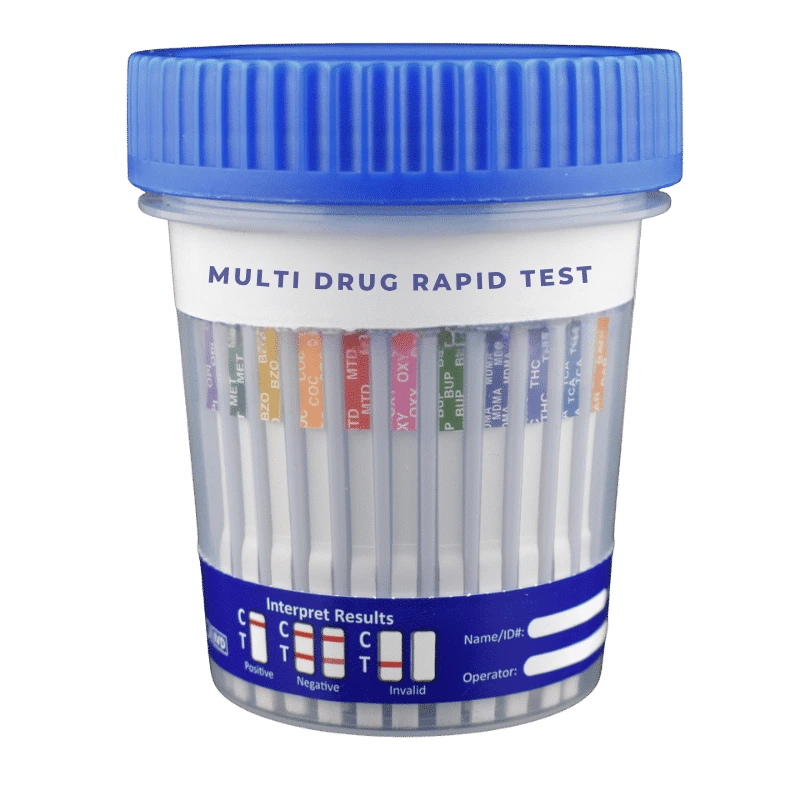
How long do opiates stay in urine? For most commonly tested opiates, the typical urine window is about 1 to 3 days after last use. Heroin’s own marker, 6-MAM, clears in hours, and a few compounds run longer. Dose, frequency of use, metabolism and the test’s cutoff all move the number. For a lab, clinic or testing program, the useful question is what a given screen can and cannot say about a given specimen. This guide covers both, and shows how we at Mayflower Bioscience supply the rapid cups that programs use for that first screening step.
TL;DR
- Most opiates (morphine, codeine, hydrocodone, hydromorphone, oxycodone) are typically detectable in urine for about 1 to 3 days after last use. Published tables differ by a day in either direction.
- Heroin is rarely found as heroin. The marker 6-monoacetylmorphine (6-MAM) is detectable for roughly 8 hours, while its metabolite morphine follows the 2 to 3 day pattern.
- A standard opiate immunoassay targets morphine and codeine. Fentanyl, methadone, buprenorphine and often oxycodone need their own test, and fentanyl can outlast other opioids in urine.
- Every rapid cup result is preliminary. A positive needs confirmation by GC/MS or LC-MS/MS.
- No universal detection rule exists, including the “7 day opioid rule” people search for.
Table of Contents
- How long opiates stay in urine, drug by drug
- Heroin, morphine and codeine: why one positive can mean three things
- What changes the window
- What a negative or positive result can and cannot establish
- The “opiate” panel misses fentanyl and many synthetics
- Is there a 7-day opioid rule?
- Setting up opiate screening so the window works for you
- Choosing the right cup: CLIA-waived or forensic use only
- Our view
- Stock cups for recurring screening
- FAQ
- Sources
How long opiates stay in urine, drug by drug
Urine detection windows are estimates, not guarantees. The published figures below come from reference laboratories and professional bodies, and they overlap more than they conflict.
Mayo Clinic Laboratories lists codeine, morphine, hydrocodone, hydromorphone, oxycodone and their listed metabolites as detectable for up to 3 days, using a 25 ng/mL limit of quantitation (LOQ) for each. The same page stresses that these are approximate and depend on dose, frequency of use and individual metabolism.
The American Academy of Family Physicians gives a three-day window for heroin and morphine and one to two days for codeine. A 2014 American Academy of Pediatrics guideline table gives 1 to 2 days for morphine, codeine, hydrocodone and hydromorphone, and 1 to 3 days for oxycodone.
ARUP Consult publishes a more granular list:
| Substance | Typical urine window |
|---|---|
| Codeine | 1 to 3 days |
| Morphine | 1 to 3 days |
| Hydrocodone | 1 to 3 days |
| Hydromorphone | 1 to 4 days |
| Oxycodone | 1 to 3 days |
| Oxymorphone | 1 to 3 days |
| 6-MAM (heroin marker) | Under 1 day |
The FDA’s page on home-use drug tests lists heroin as detectable 1 to 3 days after last use, with a positive possible as soon as 2 to 6 hours after taking the drug. It also says clearance times are only guidelines and can vary significantly with how long the person has been taking the drug, the amount used and the person’s metabolism.
If you need one range for a protocol sheet, “about 1 to 3 days, longer with heavy or chronic use” is defensible. Write it as a range with a source, never as a single number.
For drug-specific pages, we keep separate guides on how long oxycodone stays in urine, heroin, codeine, morphine, hydrocodone and hydromorphone. The broader opioid overview and our drug detection times chart put the windows side by side.
Heroin, morphine and codeine: why one positive can mean three things
The opiate class is a metabolic family, and that matters when you interpret a result.
Heroin is converted in the body to 6-monoacetylmorphine (6-MAM), then to morphine. Codeine is also partly converted to morphine. So a urine morphine result alone cannot tell you which parent drug was taken. Mayo Clinic Laboratories states that urine morphine can reflect morphine, heroin or codeine exposure in the preceding 2 to 3 days. The University of Washington’s clinician information sheet adds that opiate immunoassays respond to morphine and codeine without distinguishing them, and that GC/MS or LC-MS/MS confirmation is needed to identify the drug or drugs reliably.
6-MAM is the exception, because it comes only from heroin. Mayo Clinic Laboratories says it is detectable for about 8 hours after administration, with a listed detection time under one day at a 5 ng/mL LOQ. The federal workplace panel treats it separately, setting a 10 ng/mL cutoff for 6-acetylmorphine in both initial and confirmatory urine tests (Federal Register, March 13, 2026).
Practical consequence: if your program needs to separate heroin from prescribed morphine or codeine, collection timing is critical, because the marker is gone within hours. That is a reason to collect promptly and confirm in a laboratory, not a reason to expect the screen to answer it.

What changes the window
SAMHSA’s Clinical Drug Testing in Primary Care (TAP 32) lists the drivers: the substance’s chemistry, individual metabolism and excretion, route of administration, frequency and amount of use, test sensitivity and specificity, the cutoff concentration, and the person’s health, diet, weight, gender, fluid intake and pharmacogenomic profile. For a lab or clinic, these group into two buckets.
Donor factors. Dose, how long the person has been taking the drug, route, body composition, kidney and liver function, and genetics. Chronic or high-dose use extends detection. Mayo notes this for methadone’s metabolite EDDP in the broader literature, and the University of Washington data on fentanyl show how far a tail can run (see below).
Test factors. This is the part your program controls:
- Cutoff. A lower cutoff detects use longer after the last dose. A higher cutoff shortens the window.
- Target analyte. A test that looks for morphine will respond differently to other opiates than a test built for them.
- Cross-reactivity. Immunoassays respond unequally to different compounds.
- Method. Immunoassay screens are qualitative. Mass spectrometry measures concentration.
Cutoffs: federal workplace numbers
The federal workplace urine panel, published in the Federal Register on March 13, 2026, keeps these opiate cutoffs:
| Analyte group | Initial test | Confirmatory test |
|---|---|---|
| Codeine / morphine | 2,000 ng/mL | Codeine 2,000; morphine 4,000 ng/mL |
| Hydrocodone / hydromorphone | 300 ng/mL | 100 ng/mL each |
| Oxycodone / oxymorphone | 100 ng/mL | 100 ng/mL |
| 6-acetylmorphine | 10 ng/mL | 10 ng/mL |
These are the federal workplace program’s numbers. Clinical, treatment, court and corrections programs often set their own, so cite the cutoff on your own device and protocol rather than assuming one standard applies.
Cross-reactivity: a labeled opiate screen is not equal across opioids
The University of Michigan’s point-of-care pathology service documents a 300 ng/mL morphine cutoff for its opiate screen and a cross-reactivity table with very different concentrations by substance, including 10,000 ng/mL for oxycodone and 5,000 ng/mL for hydrocodone. In plain terms, a cup that reads positive for morphine at 300 ng/mL needs far more oxycodone or hydrocodone to read positive. Someone taking those drugs can screen negative on an opiate class test while having used them. Your reporting language should reflect that.
What a negative or positive result can and cannot establish
The FDA is direct on this point: urine drug tests are qualitative, not quantitative, and a positive home result is preliminary and should go to a laboratory for confirmation. The University of Michigan says the same of point-of-care immunoassays: results are preliminary, and quantitative or confirmatory results require a more specific method, preferably mass spectrometry.
The FDA also lists why a test can be negative when drugs are in use: the wrong drugs were tested, urine was collected too early or too late (drugs do not stay in urine indefinitely), or test chemicals were stored incorrectly or had expired. Each of these is a process issue your SOP can address with panel selection, collection timing and storage records.
Known sources of positive opiate screens
Mayo Clinic Laboratories notes that large poppy-seed food exposures can produce urine morphine concentrations up to 2,000 ng/mL for 6 to 12 hours. That is one reason a presumptive positive is reviewed, not acted on alone. Confirmation and, where required, medical review turn a screen into a finding. SAMHSA’s Medical Review Officer Manual describes that role for federal workplace programs.
Clinical context
The American Society of Addiction Medicine advises that drug test results should never be the sole determinant in assessing substance use disorder and should be combined with patient history, psychosocial assessment and physical examination. It also prefers random-interval testing over fixed schedules, because fixed schedules create known non-testing periods. For behavioral health and treatment programs, that translates into a collection schedule set by patient acuity and level of care.
The “opiate” panel misses fentanyl and many synthetics
A classic opiate immunoassay targets the morphine family. The American Family Physician review notes that typical workplace immunoassays detect only nonsynthetic opioids, morphine and codeine, and do not reliably detect methadone, buprenorphine, oxycodone or fentanyl. Mayo makes the same point for its morphine-like assay: it does not detect fentanyl, meperidine or methadone. A University of Washington presentation (2024) explains that synthetic and semi-synthetic opioids such as oxycodone, fentanyl and hydromorphone can be missed on routine opiate screens, producing significant false negatives.
So a negative “opiate” line means no morphine-family drug above the cutoff. It does not mean no opioid. The panel you ordered matters as much as the detection window.
Fentanyl runs longer than the rest
The same University of Washington presentation reports that fentanyl is detectable in urine on average up to 7 days after last use, sometimes up to 19 days. Its metabolite norfentanyl averages up to 13 days, sometimes up to 26 days, and the presentation notes up to 294 days in some pregnant patients. Other opioids, it reports, are detectable for only 1 to 4 days.
For a program, this means two things. First, a fentanyl line on the cup is not redundant with the opiate line. Second, a fentanyl positive can reflect use further back than the 1 to 3 day rule that governs the morphine family, so interpret timing accordingly. For buprenorphine, see our guide on whether buprenorphine shows up on a drug test.
Is there a 7-day opioid rule?
No. People search for it, and some summaries quote “up to seven days” for opioids in general, but that is a loose outer bound for some drugs and test types, not a rule. The ASAM guidance states that no universal standards exist in clinical drug testing, and that test frequency should be driven by patient acuity and level of care. The federal panel in the MRO Manual is a panel standard for workplace programs, not a detection-time rule.
Similarly, no table can tell you how long someone needs to be abstinent to produce a negative result. A table gives the typical range for a drug at a cutoff. The specimen, the device and the confirmation method decide the result.
How does opiate timing compare with other drugs? Using AFP figures: methadone 3 to 4 days (up to 14), long-acting benzodiazepines up to 30 days, and very heavy cannabis use 4 to 6 weeks (up to 12 weeks). The opiate family is on the short end, which is why collection timing and random scheduling carry so much weight.

Setting up opiate screening so the window works for you
For labs, treatment programs and testing institutions, a window table only helps if the workflow around it is tight. A practical routine:
- Match the panel to the question. If the question is morphine-family exposure, an opiate line fits. If it includes synthetic opioids, make sure the device has the specific lines, including fentanyl.
- Document the cutoff. Record the device’s cutoff for each analyte, because it defines what “negative” means.
- Check specimen validity. Every cup we supply has an integrated temperature strip, so you can check that the specimen is in range at the time of collection.
- Read within the labeled window. Our cups give a rapid read in about five minutes. Follow the device instructions for read time and do not interpret outside it.
- Treat positives as presumptive. Send the specimen for GC/MS or LC-MS/MS confirmation, and hold the results for medical or clinical review where your program requires it.
- Randomize collection where the program allows. This follows ASAM’s preference for random intervals over fixed schedules.
- Store and date devices correctly. Improperly stored or expired test chemicals are a listed cause of false negatives.
Choosing the right cup: CLIA-waived or forensic use only
The cup you pick determines where you can use the result, so the labeling matters. Our catalog has four configurations:
| Cup | Regulatory status | Notes |
|---|---|---|
| 12-panel with PCP | CLIA-waived, FDA-cleared | For point-of-care clinical settings |
| 12-panel with ETG and fentanyl | Forensic use only | Adds alcohol (ETG) and fentanyl |
| 14-panel with PCP, ETG and fentanyl | Forensic use only, not CLIA-waived | Multi-drug screen with alcohol and fentanyl |
| 16-panel adding kratom and TCA | Forensic use only, not CLIA-waived | The widest panel in our line |
A CLIA-waived device is categorized under the Clinical Laboratory Improvement Amendments as simple enough for waived-site testing. Forensic-use-only cups are for programs such as drug courts, corrections and employer testing, where results are presumptive and confirmation follows. Whichever cup you use, the result is a preliminary screen, and a positive goes to a laboratory.
Our view
Most of the questions we hear about opiate windows come from programs, not individuals: a clinic that wants a defensible protocol, a drug court that needs consistent collection, a lab that needs to explain a result to a counselor.
Our position is simple. The window is a range, the cutoff defines the result, and the panel defines what you can see. The published tables agree on about 1 to 3 days for the morphine family, but fentanyl behaves differently, and that is why we built our catalog around multi-panel cups with fentanyl on the line, alongside ETG for alcohol.
We also think labeling should be plain. One 12-panel cup is CLIA-waived and FDA-cleared. The 14-panel and 16-panel cups are forensic use only. The right cup is the one that fits your setting, supplied in volume, with an integrated temperature strip and a read in about five minutes. A positive is a prompt for confirmation, never a verdict.
That is the kind of screening we want to supply: consistent, labeled honestly, and available from US stock when your site runs low.
Alina
Stock cups for recurring screening
Mayflower Bioscience is a US-based wholesale supplier of urine drug test cups, based in St. Louis, Missouri. Our site is built for bulk and recurring orders, with volume pricing from $2.59 per cup, free shipping on 100+ cups and same-day dispatch from US stock. Multi-site and wholesale accounts go through a quote process, so a clinic network or a corrections program can set up recurring supply in one place.

If you are choosing between configurations, start with the 12-panel CLIA-waived cup for point-of-care clinical use, or the 14-panel and 16-panel cups for forensic-use programs. To request wholesale pricing for your volume, contact Mayflower Bioscience.
FAQ
How long can opiates be detected in urine?
Most commonly tested opiates, including morphine, codeine, hydrocodone, hydromorphone and oxycodone, are typically detectable for about 1 to 3 days after last use. Some tables list up to 4 days for hydromorphone. Heavy or chronic use, metabolism and the test cutoff can change that.
What drug stays in urine the longest?
Among opioids, fentanyl and its metabolite norfentanyl have some of the longest reported windows, averaging up to 7 and 13 days respectively. Outside opioids, very heavy cannabis use can be detected for weeks, and long-acting benzodiazepines for up to about 30 days, according to the AFP review.
What is the 7 day opioid rule?
There is no universal 7 day rule. Detection depends on the drug, dose, frequency of use, the person’s metabolism and the test’s cutoff. ASAM notes that no universal standards exist in clinical drug testing, so programs should rely on the published range for the specific drug and test.
Does a positive urine cup result prove opiate use?
It is a preliminary result. Immunoassays respond to the morphine family without telling morphine, codeine and heroin apart, and some foods can produce a positive. A confirmatory test by GC/MS or LC-MS/MS identifies the specific drug.
Does an opiate test detect fentanyl or oxycodone?
Not reliably. A standard opiate immunoassay targets morphine and codeine, and oxycodone and hydrocodone respond only at much higher concentrations. Fentanyl needs its own test line, which is why several of our cups include one.
Sources
- Opiates, Mayo Clinic Laboratories
- Opiates Confirmation, Random, Urine, Mayo Clinic Laboratories
- Drugs of Abuse Home Use Test, FDA
- Urine Drug Tests: Ordering and Interpretation, American Family Physician
- Testing for Drugs of Abuse in Children and Adolescents, Pediatrics
- Drug Half-Lives and Urine Detection Windows, ARUP Consult
- Federal Register, Volume 91 Issue 49, March 13, 2026
- Clinical Drug Testing in Primary Care, SAMHSA
- Medical Review Officer Manual, SAMHSA
- Urine Drug Screen Facts, University of Michigan Pathology
- Opioids, Semisynthetic, University of Washington
- Using Urine Drug Screens in OUD Treatment, University of Washington
- Appropriate Use of Drug Testing in Clinical Addiction Medicine, ASAM