
How Long Does Hydromorphone (Dilaudid) Stay in Your System?
How Long Does Hydromorphone (Dilaudid) Stay in Your System?
Hydromorphone (Dilaudid) is usually detectable in urine for 2 to 4 days after the last dose, in blood for about 10 to 24 hours, in saliva for 1 to 4 days, and in hair for up to 90 days. Its half-life is only 2 to 3 hours for immediate-release tablets, so the drug itself clears fast — but a urine test can stay positive for days because it detects the metabolite hydromorphone-3-glucuronide. And unlike some opioids, hydromorphone usually does trigger a standard opiate screen — the catch is that the screen cannot tell you which opioid it found.
Hydromorphone is a prescription opioid sold as Dilaudid — immediate-release tablets, liquid, and injection — and as Exalgo, the extended-release form. It is five to seven times stronger than morphine and is used for moderate to severe pain, including post-surgical and cancer pain. The National Institute on Drug Abuse notes that prescription opioids act on the same brain receptors as heroin, which is why misuse carries the same overdose risk even when the drug started as a legitimate prescription. This guide gives programs the honest detection windows, explains what the opiate screen actually catches, and shows what to order when the answer matters.
Short Answer: Hydromorphone Detection Windows by Specimen
Each specimen holds the drug and its metabolites differently:
| Specimen | Typical window | Detected from | What it is used for |
|---|---|---|---|
| Urine | 2–4 days | Within a few hours of use | Standard for workplace, treatment, and supervision testing |
| Blood | 10–24 hours | Within minutes of use | Impairment assessment and emergency toxicology |
| Saliva | 1–4 days | Within an hour | Rapid on-site screening for recent use |
| Hair | Up to 90 days | After about a week of growth | Long-term history, not recent use |
Urine is the specimen nearly every program uses, so this guide focuses on urine windows. A single therapeutic dose often clears urine in 11 to 24 hours; the 2-to-4-day range reflects larger doses, repeated use, and slower clearance. The full cross-drug picture sits on our drug detection times chart, alongside our guides on opioid, morphine, hydrocodone, and oxycodone windows.
Half-Life: Why Hydromorphone Clears Fast but Tests Stay Positive
Hydromorphone has a short half-life. The immediate-release form has an elimination half-life of about 2 to 3 hours, and the drug is mostly cleared from the blood within roughly 15 hours — about five half-lives. Extended-release hydromorphone (Exalgo) has a half-life of 8 to 15 hours, typically around 11 hours, so a single dose can take up to 3 days to clear.
Urine tests stay positive longer because they detect metabolites, not just the parent drug. The liver converts most hydromorphone into hydromorphone-3-glucuronide, an inactive metabolite that the kidneys keep excreting after plasma levels have already dropped. Only about 7 percent of a dose leaves the body unchanged in urine — so the urine window is really a metabolite window, and it stretches to 2 to 4 days. A single dose is often detectable for only 11 to 24 hours, while daily or heavy use pushes the window toward 4 days.
What Affects How Long Hydromorphone Stays Detectable
Dose and frequency. A single low dose clears at the fast end of the range; daily use builds up drug and metabolites, and chronic users can test positive a day or two longer.
Immediate-release vs extended-release. Extended-release tablets deliver the drug slowly over about 24 hours, stretching the total elimination timeline. Immediate-release Dilaudid is absorbed and processed more quickly — pain relief lasts only 3 to 4 hours, though detection lasts far longer.
Liver and kidney function. Hydromorphone is broken down mainly by the liver — through the UGT2B7 enzyme — and removed by the kidneys, so clearance slows when either is impaired. Genetic differences in liver enzymes mean some people process it much faster or slower than others. Age slows metabolism and kidney function further, so two people taking the same dose can clear it on very different schedules.
Hydration and exercise. Drinking extra water and exercising do not meaningfully speed clearance — they can dilute a urine specimen, which creates a dilute-result problem of its own. MedlinePlus advises taking hydromorphone exactly as directed rather than trying to flush the drug out.
Urine Windows Compared: Hydromorphone vs Other Opioids
The bars below show the upper end of the urine detection window for each opioid — hydromorphone sits in the middle of the family:
The practical point: a panel that covers one opioid does not cover the others, and a positive opiate result does not name the drug. Methadone and buprenorphine are invisible to a standard opiate screen, and hydromorphone — while usually visible to it — is not named as a target on the cup. Our opioid detection guide covers the whole family, and the cutoff levels guide explains what ng/mL numbers mean.
The Testing Gap: What the Opiate Screen Actually Catches
This is the section most programs get wrong, and hydromorphone is the opposite case from hydrocodone. A standard opiate (OPI) strip is built to find morphine and codeine at a 300 ng/mL cutoff. Hydrocodone cross-reacts only partly with that strip and can be missed at low doses — our hydrocodone guide documents that gap. Hydromorphone is different: a close chemical relative of morphine, it cross-reacts well with opiate immunoassays. A person taking Dilaudid will usually test positive on an OPI strip, and even a standard 5-panel test can pick hydromorphone up.
But “positive for opiates” is not the same as “positive for hydromorphone.” The strip cannot tell morphine from codeine from hydromorphone — it only reports the class. And there is a second twist: hydromorphone is also a metabolite of hydrocodone, made in the liver by the CYP2D6 enzyme. A laboratory result showing hydromorphone does not prove the person took Dilaudid — it could come from hydrocodone (Vicodin, Norco) instead. Only LC-MS/MS confirmation identifies the specific substance, and even then a clinician or medical review officer must interpret it against the person’s prescriptions.
We checked all four MayFlower cups against their own published panel lists:
| MayFlower cup | Hydromorphone named as target | OPI / MOP strip | OXY strip |
|---|---|---|---|
| 12 Panel Drug Test Cup with PCP | No — OPI lists Morphine, Codeine | 300 ng/mL | 100 ng/mL |
| 12 Panel Drug Test Cup with ETG & Fentanyl | No | 300 ng/mL | 100 ng/mL |
| 14 Panel Drug Test Cup with PCP, ETG & Fentanyl | No — OPI screens MOR-based opiates incl. 6-AM, MOR, codeine | 300 ng/mL | 100 ng/mL |
| 16 Panel Drug Test Cup with Kratom, ETG, TCA & Fentanyl | No | 300 ng/mL | 100 ng/mL |
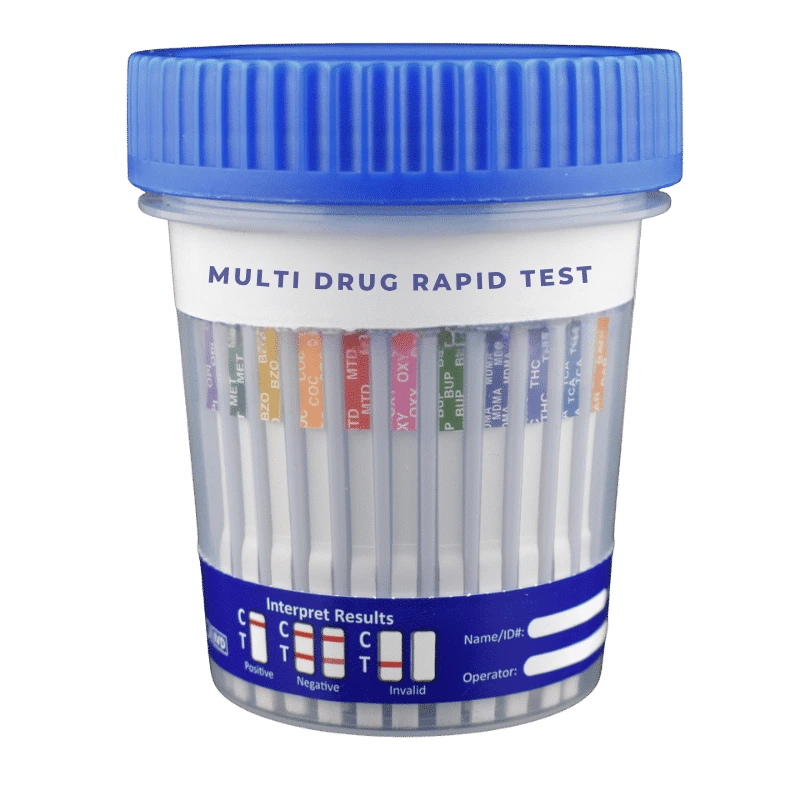
None of the four cups names hydromorphone as a target — the word does not appear on any of their published panel lists — and none has a dedicated hydromorphone strip. The OXY strip on all four is for oxycodone, a different drug. In practice the OPI strip will usually catch hydromorphone use, but the cup does not promise it, and a negative OPI result does not rule it out — especially at a low or single dose. If hydromorphone is a drug of concern in your population, check the panel list before you buy, and send any consequential specimen for laboratory confirmation by LC-MS/MS, which identifies hydromorphone specifically. Our 12-panel, 14-panel, and 16-panel collections show the full analyte list for each configuration, and our MOP guide explains exactly what the opiate strip does — and does not — detect.
One more caution: a positive OPI result from a rapid cup is presumptive, not final. Every consequential decision should rest on laboratory confirmation, which identifies the specific substance. Our guide on how to read a drug test cup covers the reading rules for rapid cups.
Dilaudid, Exalgo, and Hydromorphone: Same Drug, Different Windows
Dilaudid and hydromorphone are the same drug — Dilaudid is simply the best-known brand name. The windows are identical either way: urine 2 to 4 days, blood 10 to 24 hours, saliva 1 to 4 days, hair up to 90 days. The formulation changes the window, not the brand.
Extended-release hydromorphone (Exalgo) is the exception. Exalgo releases the drug gradually over about 24 hours, so clearance starts later and runs longer. Treat extended-release hydromorphone as the long end of every window above — urine toward 4 days, blood toward 2 days, total clearance up to about 3 days. The NCBI StatPearls review notes the extended-release half-life of 8 to 15 hours and the higher risk that comes with each tablet holding a large total dose. Codeine and heroin follow the same pattern — both funnel through morphine, which is why a standard opiate screen catches them — while tramadol and methadone need their own strips.
What a Positive Hydromorphone Result Means for a Program
A positive result is information, not a verdict. In a pain-management clinic, a patient prescribed Dilaudid should test positive for opiates; a negative result can be just as informative, suggesting the medication is not being taken as directed. In a treatment program, a positive result in a patient who should not be taking it signals a need to review the treatment plan — not automatic discharge.
Three practices keep hydromorphone testing defensible. First, confirm every positive with laboratory testing before acting on it — a positive opiate screen does not prove Dilaudid use, since the same result can come from morphine, codeine, or hydrocodone. Second, have a medical review officer review confirmed results against prescribed medications — a valid prescription explains a positive result. Third, write the rules down and apply them the same way every time; random, unannounced testing catches more than a predictable schedule. If you or someone you know needs help with opioid use, the SAMHSA National Helpline at samhsa.gov/find-help/national-helpline (1-800-662-4357) is free, confidential, and available 24 hours a day. More on our mission and catalog is on the MayFlower Bioscience homepage.
Frequently Asked Questions
How long does hydromorphone stay in your urine?
Usually 2 to 4 days after the last dose. A single therapeutic dose often clears in 11 to 24 hours, while daily or heavy use pushes the window toward 4 days. The metabolite hydromorphone-3-glucuronide keeps urine positive after the parent drug has cleared the blood.
How long does hydromorphone stay in your blood?
About 10 to 24 hours for immediate-release hydromorphone. Extended-release hydromorphone (Exalgo) can be detected in blood for up to about 2 days because the drug is released slowly over 24 hours.
Does hydromorphone show up on a standard drug test?
Usually yes — hydromorphone cross-reacts well with the standard opiate (OPI) strip, so even a standard drug test can pick it up. But the screen only reports the opiate class; it cannot tell morphine from codeine from hydromorphone, and only lab confirmation identifies the specific drug.
What is the half-life of hydromorphone?
About 2 to 3 hours for immediate-release hydromorphone, and 8 to 15 hours — typically around 11 hours — for extended-release formulations. It takes about five half-lives to mostly clear a drug, so an immediate-release dose leaves the blood within roughly 15 hours, while an extended-release dose can take up to 3 days.
How long does Dilaudid stay in your system?
The same as hydromorphone itself, because Dilaudid is the brand name for hydromorphone: urine 2 to 4 days, blood 10 to 24 hours, saliva 1 to 4 days, and hair up to 90 days. The formulation matters, not the brand — extended-release Exalgo sits at the long end of every window.
Can hydromorphone be detected after 5 days?
In urine, usually not after 5 days, except with heavy or chronic use or with liver or kidney impairment. In hair, yes — a standard 1.5-inch hair sample can detect hydromorphone use for up to 90 days.
Does a positive opiate result prove someone took Dilaudid?
No. A positive opiate screen only shows the opiate class — it could come from morphine, codeine, hydromorphone, or hydrocodone, since hydromorphone is also a metabolite of hydrocodone. Only laboratory confirmation by LC-MS/MS identifies the specific substance, and a medical review officer must weigh it against the person’s prescriptions.
What affects how long hydromorphone stays detectable?
Dose and frequency of use, immediate-release versus extended-release formulation, liver and kidney function, age, and body composition. Genetic differences in liver enzymes, chronic use, larger doses, and impaired liver or kidney function all extend the window.
Can you speed up clearing hydromorphone from your system?
No reliable way exists. Drinking extra water or exercising does not meaningfully speed clearance, and it can dilute a urine specimen, which creates a separate problem. Time is the only thing that clears hydromorphone.
Does a 12-panel drug test detect hydromorphone?
Usually, through its opiate (OPI) strip at 300 ng/mL — hydromorphone cross-reacts well with it. But no MayFlower cup names hydromorphone as a target on its panel list, so the cup does not promise it, and a negative OPI result does not rule out hydromorphone use. Programs that need certain hydromorphone detection should confirm with lab testing.