
How Long Does Methadone Stay in Your System?
How Long Does Methadone Stay in Your System?
Methadone is typically detectable in urine for 3 to 7 days after occasional use and up to 14 days with chronic or maintenance use — the longest urine window of any common opioid — because its half-life runs 8 to 59 hours, averaging about 24 to 36 hours. Blood clears faster, usually within 24 to 72 hours, saliva within about 1 to 2 days, and hair for up to 90 days. The wide range is real: methadone’s elimination varies sevenfold between people, driven by liver enzymes, dose, duration of use, and other medications. For treatment programs, employers, and supervision agencies, the question is which test, cutoff, and panel actually catches it.
Methadone is a long-acting synthetic opioid used for daily maintenance therapy for opioid use disorder in federally supervised programs, and for severe chronic pain. Taken every day, it accumulates — stretching its detection window far beyond shorter-acting opioids like heroin or oxycodone. A single dose clears in days; a patient on a stable daily dose can test positive for two weeks after the last dose.
Short Answer: Methadone Detection Windows by Specimen
Detection windows vary by specimen:
| Specimen | Typical window | What it is used for |
|---|---|---|
| Urine | 3–7 days (occasional use); up to 14 days (chronic / maintenance use) | Treatment, workplace, supervision testing |
| Blood | 24–72 hours | Recent-dose confirmation, impairment assessment |
| Saliva | About 1–2 days (some sources report up to 10 days) | Rapid on-site screening |
| Hair | Up to 90 days | Long-term history, not recent use |
Urine is the specimen nearly every program uses, so the rest of this guide focuses on urine windows — see the full picture on our drug detection times chart, and the sibling guides on opioids and benzodiazepines.
Why Methadone’s Half-Life Makes It the Outlier
Half-life — the time for half the drug to leave the body — sets the detection window, and methadone’s is the most variable of any common opioid: 8 to 59 hours in adults, averaging roughly 24 to 36 hours. It takes about five half-lives to clear a drug almost completely, so at the short end methadone is gone in about 40 hours, while at the long end clearance takes nearly 12 days. That sevenfold spread is why honest sources give ranges, not single numbers. Opioid tolerance also matters: tolerant patients average about 24 hours, while people who are not opioid-tolerant average about 55 hours.
The same pharmacology creates methadone’s best-known safety trap: pain relief lasts only 4 to 8 hours, but the drug persists for 24 to 59 hours or more. Over the first 2 to 4 days of daily dosing, plasma levels climb as each new dose stacks on the previous one, and respiratory depression can appear days after dosing began. In maintenance treatment the daily dose is calibrated to last 24 to 48 hours — which is why methadone works, and why it needs supervised programs.
Methadone vs EDDP: What Tests Actually Detect
Urine tests for methadone rarely target the parent drug alone. The liver converts methadone, mainly through CYP3A4, into EDDP (2-ethylidene-1,5-dimethyl-3,3-diphenylpyrrolidine) — a pharmacologically inactive metabolite and the principal analyte on confirmation testing. EDDP is excreted consistently regardless of urine pH, while parent methadone excretion rises and falls with urine acidity — so a test targeting only parent methadone can miss a genuine user with alkaline urine.
EDDP also proves the drug was actually metabolized: a specimen spiked with parent methadone after collection contains methadone but no EDDP, because no liver was involved. Finding EDDP is therefore the strongest evidence of real use rather than tampering — which is why treatment and pain-management programs include EDDP on the screening device or at confirmation, where it may remain detectable for up to about seven days. Our cutoff levels guide explains how screening and confirmation cutoffs work together.
For programs, the practical consequence is simple: a screen that reports methadone is presumptive, and confirmation by GC-MS or LC-MS/MS identifies the actual molecules before any decision.
What Extends (or Shortens) the Window
Several factors move an individual result well outside the half-life baseline:
Dose and duration of use. Higher doses and daily use extend the window most. Methadone is fat-soluble, so it distributes into adipose tissue and leaches back slowly — one reason maintenance patients test positive long after stopping, while a single low dose may clear within about three days.
Liver enzymes and interacting medicines. Methadone is metabolized mainly by CYP3A4, with smaller roles for CYP2D6 and CYP2C19. Drugs that inhibit these enzymes — including some antifungals, antidepressants, and antibiotics — slow clearance, while drugs that induce them speed it. A medication list taken at collection is essential context for any result.
Liver and kidney function, and age. Liver disease slows clearance substantially, and older age and reduced kidney function lengthen the window.
Urine pH. Acidic urine speeds parent methadone excretion; alkaline urine slows it — another reason EDDP-based testing is steadier across patients.
Cutoff level. The industry-standard urine screening cutoff for methadone (MTD) is 300 ng/mL. A lower laboratory cutoff extends every window; a higher one shortens them — so two programs testing the same patient on the same day can get different results.
The Panel Trap: Standard Opiate Tests Do Not Detect Methadone
This is the single most consequential fact in this guide: methadone is a fully synthetic opioid whose molecular shape does not cross-react with the antibodies in a standard opiate immunoassay. The American Society of Addiction Medicine notes that methadone has negligible to no cross-reactivity with a standard opiate test, and the SAMHSA-5 opiate screen — calibrated against morphine and codeine — simply is not built to recognize it. A patient taking methadone daily can pass a standard five-panel drug test with a negative opiate result. The test did not fail; it was never looking for methadone.
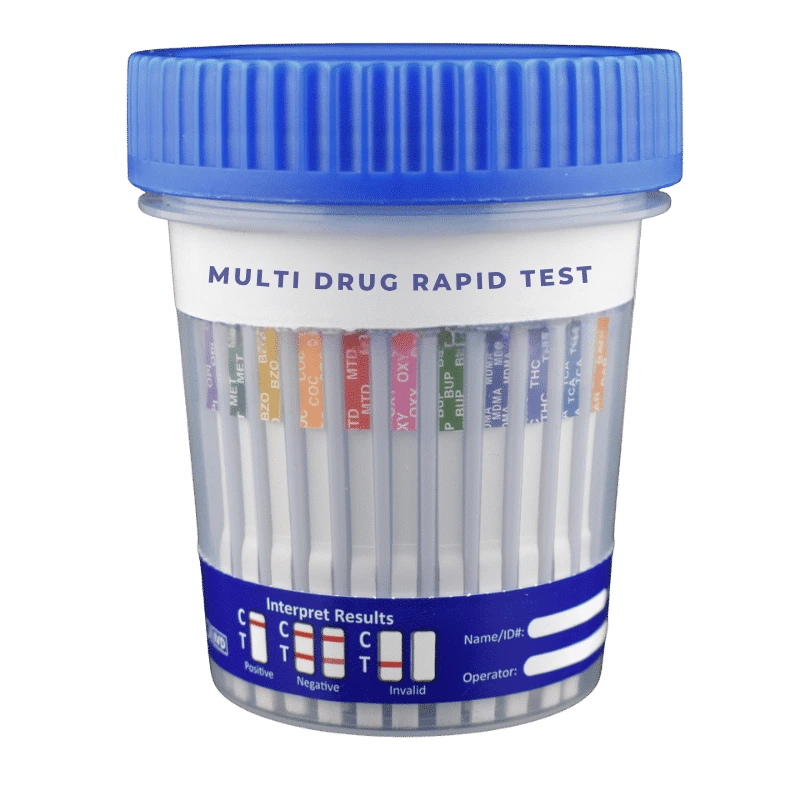
Detecting methadone requires a dedicated assay, labeled MTD on cups, strips, and result sheets. Most modern multi-panel devices include MTD as a standard analyte, and MayFlower’s 12-panel, 14-panel, and 16-panel cups all carry an MTD strip at the 300 ng/mL cutoff — verified on the live 14-panel cup, whose drug table lists MTD/300. Any program where methadone use is realistic — treatment, pain management, probation, and safety-sensitive workplaces — must confirm the panel explicitly includes MTD. Volume programs standardize through wholesale drug test cups so the same panel is used every time.
False Positives: What Else Triggers a Methadone Screen
Methadone screens are far less cross-reactive than benzodiazepine screens, but they are not immune: diphenhydramine, the over-the-counter antihistamine sold as Benadryl, has been reported to trigger presumptive positives on certain methadone immunoassays. The short cross-reactant list is one reason a methadone positive is taken seriously.
Even so, a presumptive positive should never be acted on without confirmation. A medication disclosure taken at collection — including over-the-counter antihistamines — is the cheapest protection, and laboratory confirmation by GC-MS or LC-MS/MS separates a true positive from a cross-reactant, because confirmation identifies the actual molecule. This is the same discipline our MAT programs guide applies to fentanyl, EtG, and kratom: screen, disclose, confirm, then decide.
The Program Angle: Methadone Testing in MAT, Pain Management, and Workplaces
For medication-assisted treatment programs, methadone testing has a different purpose than in a workplace: in an opioid treatment program, methadone is the prescribed therapy, not the substance being policed — federal rules require supervised dosing through certified programs. A positive MTD result in a maintenance patient is expected, not a failure. The real questions in MAT are whether the patient is taking the prescribed dose and no other opioids, and whether the dose holds them for the full 24 hours. Our MAT programs guide covers the full monitoring picture, including fentanyl, EtG, and kratom alongside methadone.
First, test with the right panel and the right cadence. Weekly urine testing catches ongoing use easily — but a patient who stops for a few days and restarts can still test positive from the earlier course, so a single positive says little about timing. Random scheduling and EDDP confirmation give a truer picture.
Second, interpret a positive in context. A positive MTD result in a person with a valid prescription is therapeutic use, and the correct response is a medical review officer comparing the confirmed result against the disclosed prescription — not a sanction. Without a prescription, the same result means something else entirely. The screen cannot tell the two apart; only the process can.
Third, remember the pain-management overlap. Methadone is also prescribed for severe chronic pain, where the detection window can run longer than in maintenance therapy. Pain-management programs monitoring compliance need an MTD-inclusive panel.
Choosing the Right Cup for Methadone Testing
Match the panel to the population: any program where methadone is realistic needs a dedicated MTD strip, and programs screening for fentanyl, EtG, or kratom should not lose methadone coverage when they upgrade. MayFlower’s 12, 14, and 16-panel cups all carry methadone screening at the 300 ng/mL cutoff, so upgrading never means dropping MTD coverage. Browse the range at MayFlower Bioscience.
External references: the MedlinePlus drug testing overview explains screening versus confirmation, SAMHSA’s methadone page covers medication-assisted treatment, MedlinePlus on methadone covers its uses and precautions, and NIDA summarizes drug testing in treatment and justice programs.
Frequently Asked Questions
How long does methadone stay in your system?
Methadone is typically detectable in urine for 3 to 7 days after occasional use and up to 14 days with chronic or maintenance use. Blood clears faster, usually within 24 to 72 hours, saliva within about 1 to 2 days, and hair for up to 90 days. The wide range comes from methadone’s half-life of 8 to 59 hours, which varies greatly between people.
How long does methadone stay in urine?
Methadone is usually detectable in urine for 3 to 7 days after occasional use and up to 14 days with chronic or daily maintenance use, at the standard 300 ng/mL screening cutoff. A single low dose may clear within roughly three days, while a maintenance patient can test positive for two weeks after the last dose.
How long does methadone stay in blood?
Methadone is typically detectable in blood for 24 to 72 hours after the last dose. Blood testing is best for confirming a recent dose and for impairment assessment, but its window is much shorter than urine, so a negative blood result does not rule out use from several days earlier.
How long does methadone stay in saliva and hair?
Methadone is detectable in saliva for about 1 to 2 days in most published ranges, though some sources report up to 10 days. In hair it can be detected for up to 90 days. Hair testing reflects long-term history rather than recent use, while saliva testing suits rapid on-site screening.
Does methadone show up on a standard drug test?
No, not on a standard opiate test. Methadone is a fully synthetic opioid that does not cross-react with standard opiate immunoassays, so the SAMHSA-5 opiate screen misses it entirely. Detecting methadone requires a dedicated methadone-specific assay, labeled MTD on cups, strips, and result sheets.
What is EDDP and why do tests look for it?
EDDP is the main metabolite of methadone, produced when the liver breaks methadone down through the CYP3A4 enzyme. It is pharmacologically inactive, but it is excreted in urine regardless of urine pH, and its presence proves the drug was actually metabolized rather than added to the specimen afterward. Programs include EDDP on the screening device or at confirmation because it is the strongest evidence of real methadone use.
Does a prescribed methadone dose make you fail a drug test?
Yes, if the test includes a methadone (MTD) strip, a prescribed dose taken as directed will produce a positive screen, because the test cannot distinguish therapeutic use from misuse. The correct process is to disclose the prescription at collection, confirm the presumptive positive by laboratory testing, and have a medical review officer compare the confirmed result against the prescription before any decision is made. In a maintenance program, a positive MTD result is expected, not a failure.
What can cause a false positive for methadone?
The best-documented false positive comes from diphenhydramine, the over-the-counter antihistamine sold as Benadryl, which has been reported to trigger presumptive positives on certain methadone immunoassays. A presumptive positive should always be confirmed by GC-MS or LC-MS/MS before any action is taken, because confirmation identifies the actual molecule and separates a true positive from a cross-reactant.
What is the half-life of methadone?
Methadone’s half-life ranges from 8 to 59 hours in adults, averaging about 24 to 36 hours. It takes roughly five half-lives to clear a drug almost completely, so clearance takes about 40 hours at the short end and nearly 12 days at the long end. Opioid-tolerant patients average about 24 hours, while people who are not opioid-tolerant average about 55 hours.
Does methadone show up on a 12-panel drug test?
Yes. MayFlower’s 12-panel, 14-panel, and 16-panel cups all include a dedicated methadone (MTD) strip at the 300 ng/mL screening cutoff. A standard 5-panel test typically does not include methadone, so programs that need methadone coverage should confirm the panel explicitly includes MTD rather than assuming any multi-panel test covers it.