Drug Testing in MAT Programs: Fentanyl, ETG and Kratom Monitoring
Drug Testing in MAT Programs: Fentanyl, ETG and Kratom Monitoring
Drug testing in MAT programs exists to monitor medication adherence first and illicit substance use second: a negative result on the strip for the patient’s prescribed medication — buprenorphine or methadone — triggers a clinical review for possible diversion or non-adherence. Federal opioid treatment program rules (42 CFR Part 8) require at least eight random drug-abuse tests per year for each patient in maintenance treatment, and MAT panels need dedicated FEN (fentanyl), ETG (alcohol), and kratom strips because standard opiate and alcohol screens miss them entirely.
This guide covers the administrator’s view of medication-monitoring testing: why MAT strips read “in reverse,” which panels clinics need, how often to test, when a cup result must go to a laboratory for confirmation, and how results should drive treatment-plan changes rather than punishment. (For general treatment-center testing workflows, see our companion overview at MayFlower Bioscience.)
Why MAT Programs Test: Adherence First, Use Second
MAT uses FDA-approved medications — buprenorphine, methadone, and extended-release naltrexone — for opioid use disorder; NIDA describes them as effective in suppressing withdrawal, reducing cravings, and improving retention in treatment. The federal guidance published on NCBI as “Drug Testing as a Tool” states the purposes plainly: testing is an objective measure of treatment efficacy and a tool to monitor patient progress, feeding program quality assurance.
For a MAT program, the testing question is inverted:
- The expected positive. A patient prescribed buprenorphine or methadone should test positive on that medication’s strip. Buprenorphine needs its own BUP strip — a generic opioid panel cannot do this job.
- The meaningful negative. A negative strip for the prescribed medication is the clinical signal: possible non-adherence, diversion, or a compromised specimen.
- The concurrent-use positive. Fentanyl, cocaine, benzodiazepine, or alcohol positives during early recovery are data about whether the treatment plan is working — a signal to intensify care, not a verdict on the patient.
Reading the Strips in Reverse: BUP and MTD Logic
Everyone who reads cups in a MAT program must understand the inverted logic:
- BUP (buprenorphine): expected positive for patients on Suboxone or Subutex. A negative BUP is the red flag — possible non-adherence or diversion — and calls for a clinical conversation plus laboratory confirmation before any consequential decision. Without a dedicated BUP strip the program is blind to adherence, since the OPI strip never sees buprenorphine.
- MTD (methadone): expected positive for methadone maintenance patients. Known edge case: low-dose patients can test methadone-negative while adherent — lab-confirm before the program acts.
- Naltrexone (Vivitrol/ReVia): an opioid antagonist with no opioid activity; it does not produce opioid-screen positives. Adherence monitoring here leans on injection records and visit attendance rather than a strip.
Diversion control is a standing responsibility: clinical guidance recommends urine testing — including testing for buprenorphine and its metabolites — alongside frequent early-treatment visits and prescription drug monitoring program checks. The mechanical reading step is covered in our guide to reading a drug test cup; the clinical reading starts with knowing the expected result for each patient.
Which Panels MAT Programs Actually Need
The drug supply MAT patients live in has changed faster than many panel configurations have. Three blind spots are now near-mandatory strips:
- FEN (fentanyl) — non-negotiable. The standard OPI opiate strip does not detect fentanyl; it needs its own dedicated FEN strip. A MAT program screening for “opioids” without a fentanyl strip is monitoring the wrong threat. Fentanyl cutoffs are manufacturer-set, approximately 1 ng/mL on CLIA-waived devices. See fentanyl drug test cups and which panels include fentanyl.
- ETG (alcohol) — the extended window. Standard alcohol strips detect only very recent use; ethyl glucuronide extends the window to approximately 80 hours — the window MAT programs need, because alcohol use in early recovery is a relapse indicator. See EtG alcohol test cups and the drug detection times chart.
- KRA (kratom/mitragynine) — invisible on standard panels. Kratom’s active alkaloid mitragynine and its metabolite 7-hydroxymitragynine register on no standard strip, so a patient using kratom as an unmonitored opioid alternative tests “clean” on a generic cup. Only a dedicated kratom strip corrects this false picture of recovery. See the kratom drug test cup collection.
Benzodiazepine (BZO) strips earn their place because combined sedative and opioid use sharply raises overdose risk. Cocaine, THC, and oxycodone strips round out the concurrent-use picture.
| Strip | MAT monitoring role | Minimum cup for this strip |
|---|---|---|
| BUP | Adherence — expected positive; negative = clinical review | 12-panel cup |
| MTD | Adherence — expected positive; confirm low-dose negatives by lab | 12-panel cup |
| FEN | Illicit fentanyl — the dominant supply threat; OPI strip misses it | 14-panel cup (dedicated FEN strip) |
| ETG | Alcohol over ~80 hours — relapse indicator in early recovery | 16-panel cup |
| KRA | Kratom/mitragynine — invisible on standard panels | 16-panel cup |
| BZO | Sedative co-use — overdose-risk signal that changes the plan | 12-panel cup |
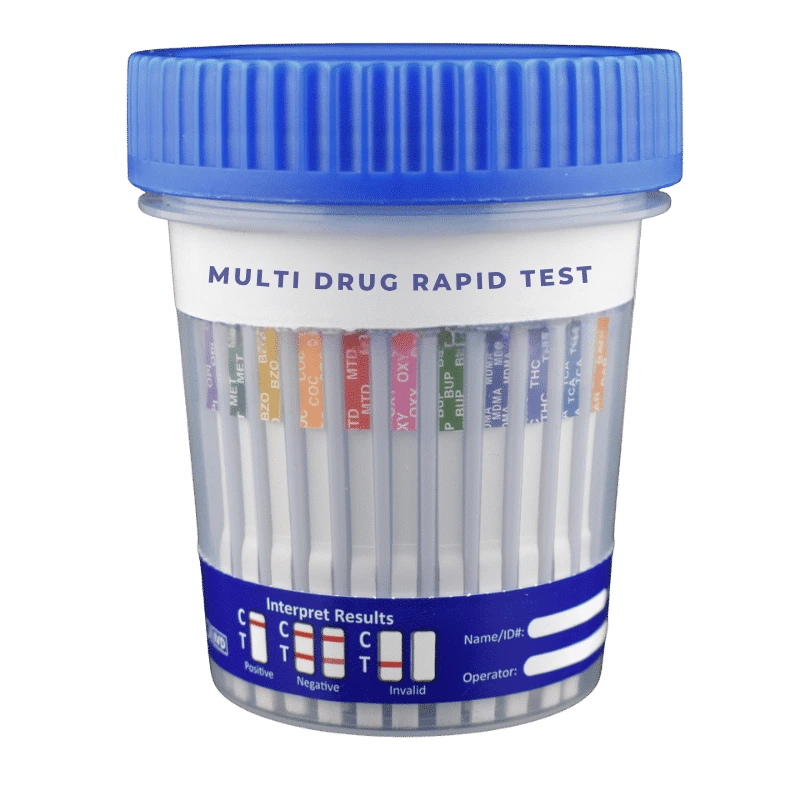
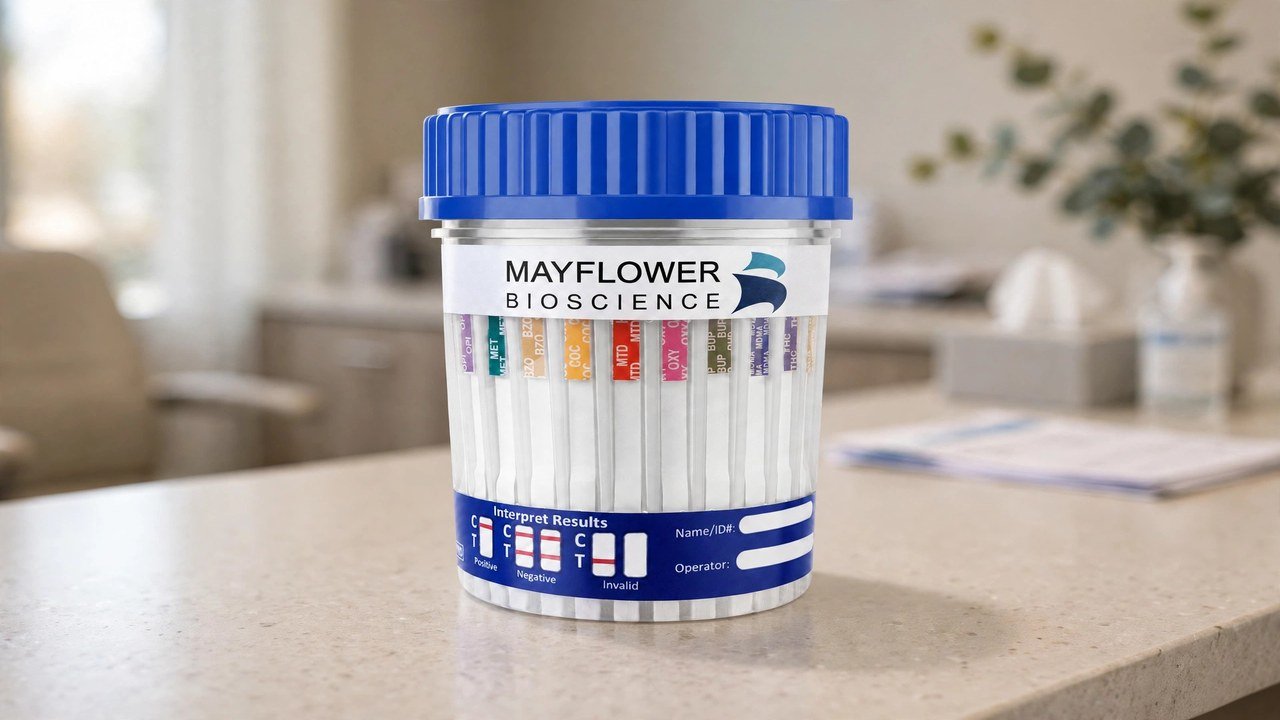
Most MAT clinics therefore standardize on the 14-panel or 16-panel drug test cup — FEN, ETG, and KRA strips alongside BUP and MTD in a single CLIA waived device.
Testing Cadence: Admission Baseline Plus Random in Early Recovery
Federal rules set the floor: at least eight random drug-abuse tests per year per patient in maintenance treatment, plus intake and monthly randoms for detox patients. Clinical guidance adds the scheduling principle: frequency follows stability — frequent in early recovery, tapering as stability is demonstrated.
| Phase | Cadence | Purpose |
|---|---|---|
| Admission | Baseline screen at intake | Starting picture: substances present, medication prescribed, baseline before induction |
| Induction / stabilization | Random, frequent (weekly or more) | Confirms adherence in the highest-risk period; catches concurrent use while the plan is calibrated |
| Maintenance, early | Random, roughly monthly | Ongoing adherence and use monitoring as stability increases |
| Maintenance, stable | Random, at least 8/year (federal minimum) | Verifies that stability holds |
Randomness matters as much as frequency: predictable schedules are the biggest hole in a program’s testing integrity, so tests should arrive at irregular intervals the patient cannot anticipate. Apply the same cutoff levels for the same strip across every site, so results are comparable program-wide.
Specimen Integrity: Validity Checks Are Program Protection
An adherence-monitoring program lives or dies on specimen integrity — a substituted or diluted specimen that reads “clean” feeds false clinical confidence. The program-side response is procedural:
- Temperature strips on every collection. A specimen that is not body-temperature at collection is compromised. Built-in temperature strips make this check part of the collection itself.
- Validity indicators. Creatinine, pH, and adulterant checks distinguish dilution from substitution. A dilute result is ambiguous — innocent or intentional — so programs need a written dilute-specimen policy before the first one arrives; see our guide to dilute drug test results.
- Collection conditions in writing. Federal guidance expects programs to develop written drug-testing procedures covering collection. Whatever the policy on observed versus unobserved collection, it must be written, consistent, and applied equally.
- Chain of custody. Specimen labeled with the patient ID at collection, read within the insert’s time window, recorded with the operator’s initials.
Confirmatory Logic: When a Cup Result Is Not Enough
A drug test cup is a presumptive screen, not a diagnosis. For routine monitoring, the presumptive result is usually enough to guide care — that is what CLIA-waived point-of-care screening is for. But any result driving a consequential decision must be confirmed by a laboratory with GC-MS or LC-MS/MS:
- Negative BUP/MTD for a patient prescribed that medication — before acting on suspected non-adherence or diversion, especially given the low-dose methadone false-negative edge case.
- Positive fentanyl or other illicit substances that will change dose, take-home eligibility, or level of care.
- Any result the patient disputes — a documented confirmation pathway, with specimen retention and a reference laboratory, keeps testing fair and defensible.
Clinical laboratories offer specialized MAT monitoring — metabolite ratios (norbuprenorphine-to-buprenorphine) that distinguish ingestion from specimen spiking, and naloxone detection. A cup cannot make those distinctions; the program’s job is to know which questions require the laboratory and route them there.
Clinical Response to Results: Treatment-Plan Revision, Not Punishment
The point of testing in a MAT program is to change care, not to punish patients. Federal treatment guidance frames substance-use findings as a signal for a medical review of medication dosage and an intensification of counseling. Results become data flowing into the care plan:
- Ongoing illicit use in early recovery: more counseling, a dose-adequacy review (under-dosed patients are likelier to use on top), and possibly a higher level of care while stability builds.
- Negative prescribed-medication strip: a direct conversation about adherence barriers — side effects, cost, logistics — before any assumption of diversion; lab-confirm before consequential action.
- Alcohol (EtG) or benzodiazepine positives: targeted counseling on interaction risk with opioid medications, plus a medication review, since combined use multiplies overdose risk.
- Repeated positives at the program level: a quality-assurance signal. Federal guidance recommends programs with persistently high positive rates develop measures to improve outcomes — the testing data is a report card on the program itself.
Programs write this response framework into policy before results arrive: what each result triggers, who reviews it, and how the patient is informed. When testing is understood as care calibration applied equally to everyone, compliance becomes part of the treatment alliance.
What MAT Programs Should Stock
The administrator’s decision reduces to one rule: every MAT cup should carry BUP and MTD for adherence monitoring, plus FEN, ETG, and KRA for the three blind spots standard panels miss — in practice, the 14-panel drug test cup with its dedicated fentanyl strip, or the 16-panel drug test cup adding EtG and kratom coverage in the same device. Standardize purchasing through wholesale drug test cups so the configuration, read procedures, training, and documentation stay identical across every site.
Frequently Asked Questions
Why do MAT programs drug test patients on buprenorphine or methadone?
To monitor medication adherence, not just illicit use. The program verifies that the patient is taking the prescribed medication — an expected positive on the BUP or MTD strip — while also screening for concurrent fentanyl, alcohol, kratom, and other substance use that would change the treatment plan. Federal treatment guidance treats testing as an objective measure of treatment efficacy and a tool to monitor patient progress.
Will buprenorphine (Suboxone) show up on a standard drug test?
No. Buprenorphine does not register on standard opiate (OPI) strips or typical multi-drug screens — it requires its own dedicated BUP strip. A MAT program that relies on a generic opioid panel is completely blind to buprenorphine adherence. Methadone likewise needs its own MTD strip.
What does a negative BUP result mean for a patient prescribed buprenorphine?
It is a clinical red flag that warrants review: possible non-adherence, diversion, or a compromised specimen. Programs should start with a clinical conversation about adherence barriers, and before taking any consequential action — dose changes, take-home adjustments, or administrative decisions — the finding should be confirmed by a laboratory, since a cup result is only presumptive.
Does the opiate (OPI) strip on a drug test cup detect fentanyl?
No. Fentanyl is not detected by the standard OPI opiate strip; it requires a dedicated FEN strip. Because fentanyl dominates the illicit opioid supply, MAT programs screening for “opioids” without a fentanyl strip are monitoring the wrong threat. Fentanyl cutoffs are manufacturer-set, approximately 1 ng/mL on CLIA-waived devices.
How far back does ETG testing detect alcohol?
Ethyl glucuronide (EtG) testing extends the alcohol detection window to approximately 80 hours, compared with the very short window of standard alcohol strips. That extended window is what makes ETG strips clinically useful for MAT programs, where alcohol use in early recovery is a relapse indicator the program needs to see.
Does a standard drug test panel detect kratom?
No. Kratom’s active alkaloid mitragynine — and its potent metabolite 7-hydroxymitragynine — does not register on any standard panel strip. A MAT patient using kratom as an unmonitored opioid alternative will test “clean” on a standard cup. Only a dedicated KRA strip closes this blind spot.
How often do MAT programs have to drug test under federal rules?
Federal opioid treatment program rules (42 CFR Part 8) require adequate testing including at least eight random drug-abuse tests per year for each patient in maintenance treatment — plus at least one initial test for short-term detoxification and initial plus monthly random tests for long-term detoxification. Clinical guidance treats that as a minimum: frequency should follow patient stability, with frequent random testing in early recovery tapering as stability is demonstrated.
Should MAT programs send drug test results to a lab for confirmation?
Yes, for any result that will drive a consequential decision. A cup is a presumptive screen — sufficient for routine monitoring, but a laboratory GC-MS or LC-MS/MS confirmation is needed before acting on a negative prescribed-medication strip, a positive that will change dose or level of care, or any result the patient disputes. Programs should have a written confirmation pathway, including specimen retention and a reference laboratory relationship.
What happens when a patient has a positive drug test in MAT?
In well-run programs, a positive triggers more care, not punishment: intensified counseling, a medical review of whether the medication dose is adequate, and possibly a higher level of care or adjusted take-home schedule. Federal treatment guidance frames substance-use findings as a signal for dosage review and counseling intensification — testing data calibrates the treatment plan.
Which drug test cup configuration is best for a MAT program?
A configuration that includes BUP and MTD strips for adherence monitoring plus FEN, ETG, and KRA strips for the three blind spots — in practice, a 14-panel cup with a dedicated fentanyl strip or a 16-panel cup that adds EtG and kratom coverage in the same CLIA-waived device. MayFlower offers both configurations for wholesale program purchasing.