
How Long Does Morphine Stay in Your System?
How Long Does Morphine Stay in Your System?
Morphine is usually detectable in urine for 1 to 3 days after the last dose, in blood for up to 12 to 24 hours, in saliva for 1 to 4 days, and in hair for up to 90 days. Its half-life is only 2 to 3 hours, so the drug itself clears fast — but its metabolites linger, and that is what a drug test actually finds. For a program running a urine screen, the practical answer is simple: a dose taken this week is very likely to show up on a standard opiate test.
Morphine matters to drug testing more than most opioids because it is the reference drug the whole opiate screen is built around. The standard opiate (MOP) immunoassay is calibrated for morphine, and heroin and codeine both break down into morphine in the body — so a positive opiate screen cannot, on its own, say which of the three drugs a person took. This guide covers each test type, how morphine is cleared, what stretches the window, and how MayFlower cups screen for it.
How Long Does Morphine Stay in Your System? Detection Times by Test
| Specimen | Typical window | Detected from | What it is used for |
|---|---|---|---|
| Urine | 1–3 days (up to 4–6 days chronic use) | Within hours | Workplace, treatment, and supervision |
| Blood | Up to 12–24 hours | Within minutes | Impairment and emergency toxicology |
| Saliva | 1–4 days | Within minutes | Rapid screening for recent use |
| Hair | Up to 90 days | After a week of growth | Long-term history |
Urine is the test that matters most for programs, because it is the specimen a multi-panel urine cup collects. The figures above are the consensus across clinical and laboratory sources: Medical News Today gives 12 to 36 hours in urine for a single dose, Recovered puts urine at 1 to 3 days (sometimes up to 4), and several guides extend that to 5 to 6 days for heavy or chronic use. The range is real — dose, frequency, kidney function, and the test’s cutoff all move the number.
Detection windows at a glance
How the Body Clears Morphine: Half-Life and Metabolites
Morphine has a short half-life of about 2 to 3 hours when given intravenously and 2 to 4 hours when taken by mouth. Pain relief usually wears off within 4 to 6 hours. But feeling the drug wear off is not the same as the drug leaving the body. The liver processes morphine through glucuronidation into two main metabolites: morphine-3-glucuronide (M3G), the largest share and mostly inactive, and morphine-6-glucuronide (M6G), which is itself active. Both leave through the kidneys, and M6G extends urine detection after the parent drug is gone.
That is why kidney function matters so much. When the kidneys work normally, most morphine and its metabolites clear in 1 to 2 days. When kidney function is impaired, M6G accumulates and the detection window stretches. Morphine is not mainly cleared by the CYP2D6 liver enzyme — that detail belongs to codeine, which the body converts into morphine through CYP2D6.
Why Morphine Is the Reference Opiate on Every Drug Test
Morphine is different from the other opioids in this cluster: the standard opiate screen does not test for “opiates” in general. It tests for morphine. The MOP (morphine/opiates) immunoassay strip on a urine cup is calibrated for morphine at a 300 ng/mL cutoff, and it cross-reacts with the drugs that turn into morphine. Heroin breaks down within minutes into 6-monoacetylmorphine (6-MAM) and then into morphine; codeine is converted by the liver into morphine. So a person who took heroin, codeine, or morphine can produce the same positive MOP result — and the screen itself cannot tell them apart, as our heroin detection guide and codeine detection guide explain from the other side.
Only laboratory confirmation can separate them. A GC-MS or LC-MS/MS confirmation test looks for the individual compounds: 6-MAM is unique to heroin, but it survives in urine for only about 2 to 8 hours, so after that window even the laboratory can only report morphine. Codeine leaves a higher codeine-to-morphine ratio, a clue a laboratory can read. And poppy seeds — which naturally contain small amounts of morphine and codeine — can produce a positive morphine screen, which is one reason federal workplace programs confirm morphine at 2,000 ng/mL while a rapid cup screens at 300 ng/mL. A program that understands this chain reads a MOP positive as the start of a question, not the end of one. Our MOP explainer covers the strip itself, and the broad opioids detection hub puts morphine in context with the rest of the class.
What Makes Morphine Detectable Longer — or Shorter
No detection window is a fixed number. The factors that move it most are the ones a program can observe and document:
Dose and frequency. A single low dose clears fastest, often within 12 to 36 hours in urine. Repeated or high doses build up metabolites, and chronic use can extend urine detection to 4 to 6 days. This is why two people with the same last-use date can test differently.
Kidney function. Because M3G and M6G leave through the kidneys, impaired kidney function slows clearance and lengthens detection — older adults and people with kidney disease are the most likely to test positive beyond the typical window.
Liver function and age. Liver disease slows glucuronidation, the first step of clearance. Age slows metabolism generally.
Formulation. Extended-release tablets release the drug over many hours, pushing the detection window toward the longer end of the range.
Hydration and body composition. Heavy fluid intake dilutes urine and can push a borderline result below the cutoff — which is why validity testing matters. Morphine is not strongly stored in fat the way THC is, so body fat plays a smaller role here. Our cutoff levels guide explains how the 300 ng/mL cutoff interacts with dilution and validity checks.
Do MayFlower Cups Detect Morphine? Yes — All Four
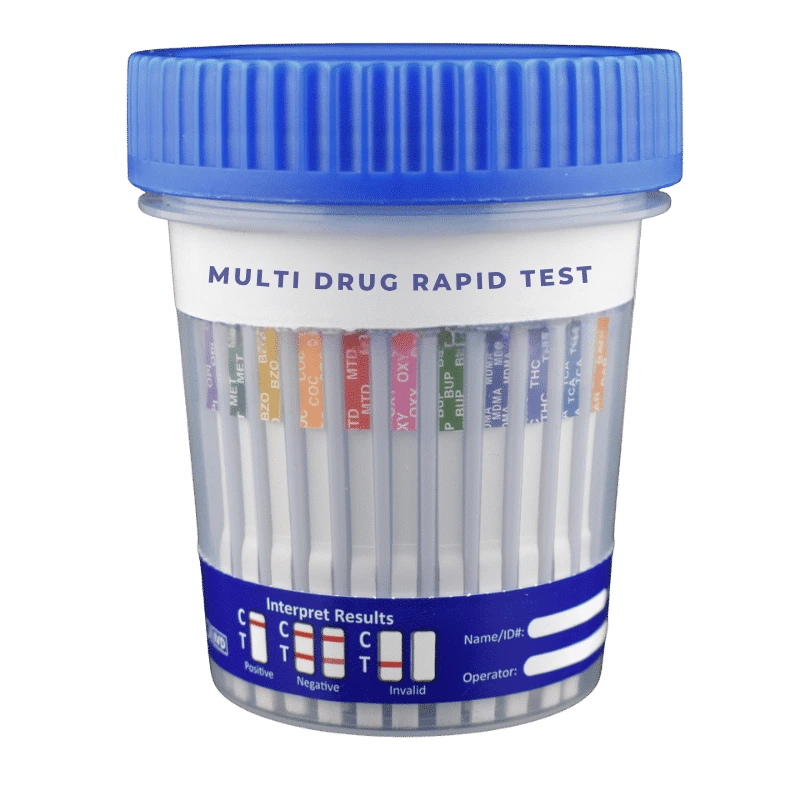
Every MayFlower 12-panel cup — and the 14- and 16-panel cups too — screens for opiates on a dedicated MOP/OPI strip at a 300 ng/mL cutoff, because morphine is the analyte that strip is calibrated for. Verified against the live product pages, not a catalogue claim:
| MayFlower cup | Opiate (MOP/OPI) strip | Cutoff |
|---|---|---|
| 12-Panel Drug Test Cup with PCP | MOP/OPI | 300 ng/mL |
| 12-Panel Drug Test Cup with Alcohol (ETG) & FEN | OPI | 300 ng/mL |
| 14-Panel Drug Test Cup with PCP, ETG & FEN | OPI | 300 ng/mL |
| 16-Panel Drug Test Cup with Kratom, ETG, TCA & FEN | OPI | 300 ng/mL |
The 12-panel PCP cup’s own page lists the opiate window as 2 to 4 days at that 300 ng/mL cutoff, squarely inside the consensus range above. Which cup a program chooses does not change the morphine answer — it changes what else is screened alongside it: the 14- and 16-panel cups add fentanyl, ETG alcohol, kratom, and other strips. The honest contrast with the rest of this cluster: tramadol is not detected by a standard opiate screen at all, and hydrocodone can be missed at low levels because the assay is calibrated for morphine and codeine. Oxycodone and methadone have their own dedicated strips on these cups, which is why they get their own detection guides.
One limit to state plainly: the cup is a screening test. A positive MOP result means morphine — or something that becomes morphine — is present above 300 ng/mL. It does not prove the person took morphine itself, it does not prove impairment, and it does not replace laboratory confirmation. Programs should treat every positive as presumptive until GC-MS or LC-MS/MS confirmation comes back, and document prescriptions: a patient on prescribed morphine will test positive, correctly, and that result needs medical review, not an automatic sanction.
For Programs: How to Use a Morphine Result
For clinics, treatment programs, and supervision officers, morphine’s short half-life and longer metabolite tail create a practical pattern. A urine screen collected 1 to 3 days after use is the most informative window; a test collected a week later will usually be negative even after heavy use, unless kidney impairment is involved. Blood is useful only for very recent use, while hair testing looks backward over months and says nothing about recent use. If the question is whether someone used morphine this week, urine is the right specimen; if it is whether they used it in the last few hours, blood or saliva is better.
When a MOP result comes back positive, the next step is confirmation, not confrontation. Ask about prescriptions, including morphine and codeine-containing cough medicines, and poppy-seed foods. Send the sample for confirmation, and let the laboratory distinguish morphine from heroin and codeine where the window allows it. A negative result is also information: a negative MOP screen 3 days after a reported single dose is consistent with the drug having cleared, not proof that nothing was taken. Morphine clears fast; the test window is short; the program’s job is to test at the right time, with the right panel, and to confirm what the screen suggests. The National Institute on Drug Abuse and the FDA’s opioid medication information are the authoritative starting points for the clinical background, the Substance Abuse and Mental Health Services Administration publishes the federal workplace testing framework, MedlinePlus covers morphine dosing and precautions, and the CDC explains how prescription opioids fit into the wider overdose picture. For the product side, the MayFlower Bioscience homepage lists the full wholesale cup range.
Frequently Asked Questions
How long does morphine stay in your urine?
Usually 1 to 3 days after the last dose. A single dose often clears within 12 to 36 hours, while heavy or chronic use can extend urine detection to 4 to 6 days, because the metabolites M3G and M6G linger after the parent drug is gone.
How long does morphine stay in your blood?
Up to 12 to 24 hours. Morphine reaches peak blood levels within about an hour, and its half-life is only 2 to 3 hours, so blood tests turn negative much faster than urine tests and are useful only for very recent use.
Does morphine show up on a standard drug test?
Yes. Morphine is the drug the standard opiate (MOP) immunoassay is calibrated for, so a standard 12-panel urine cup detects it at a 300 ng/mL cutoff. All four MayFlower cups — both 12-panel cups, the 14-panel, and the 16-panel — screen opiates at 300 ng/mL.
Can a drug test tell morphine apart from heroin or codeine?
A urine cup screen cannot. Heroin and codeine both break down into morphine, so all three produce the same positive MOP result. Only laboratory confirmation (GC-MS or LC-MS/MS) can separate them, and it can only prove heroin use while 6-MAM — unique to heroin — is still present, about 2 to 8 hours in urine.
How long does morphine stay in saliva?
About 1 to 4 days. Saliva detects morphine within minutes of use, which makes it useful for recent-use screening, but its window is similar to urine and shorter than hair testing.
How long does morphine stay in hair?
Up to 90 days or longer. Hair testing records use over months rather than days, and morphine can still be found in hair 90 days after a person stops using it. It cannot show exactly when the use happened.
What is morphine’s half-life?
About 2 to 3 hours when given intravenously and 2 to 4 hours when taken by mouth. Pain relief wears off within 4 to 6 hours, but the active metabolite M6G keeps morphine detectable in urine for 1 to 3 days after the effects fade.
Can poppy seeds cause a positive morphine test?
Yes. Poppy seeds naturally contain small amounts of morphine and codeine, and eating them can produce a positive morphine screen at a 300 ng/mL cutoff. This is one reason federal workplace programs confirm morphine at a higher cutoff of 2,000 ng/mL, and why a positive screen should always be confirmed in a laboratory.
Does kidney or liver disease make morphine detectable longer?
Yes, especially kidney disease. Morphine’s metabolites M3G and M6G leave the body through the kidneys, so impaired kidney function lets M6G accumulate and stretches the urine detection window. Liver disease slows glucuronidation, the first step of clearance, and age slows metabolism generally.
Do all MayFlower cups test for morphine?
Yes. All four MayFlower cups screen opiates (MOP/OPI) at a 300 ng/mL cutoff: both 12-panel cups, the 14-panel cup, and the 16-panel cup. The 12-panel PCP cup’s own page lists the opiate window as 2 to 4 days at that cutoff. A positive result is presumptive and needs laboratory confirmation.