CLIA-Waived Drug Test Cups: A Buyer’s Guide for US Programs
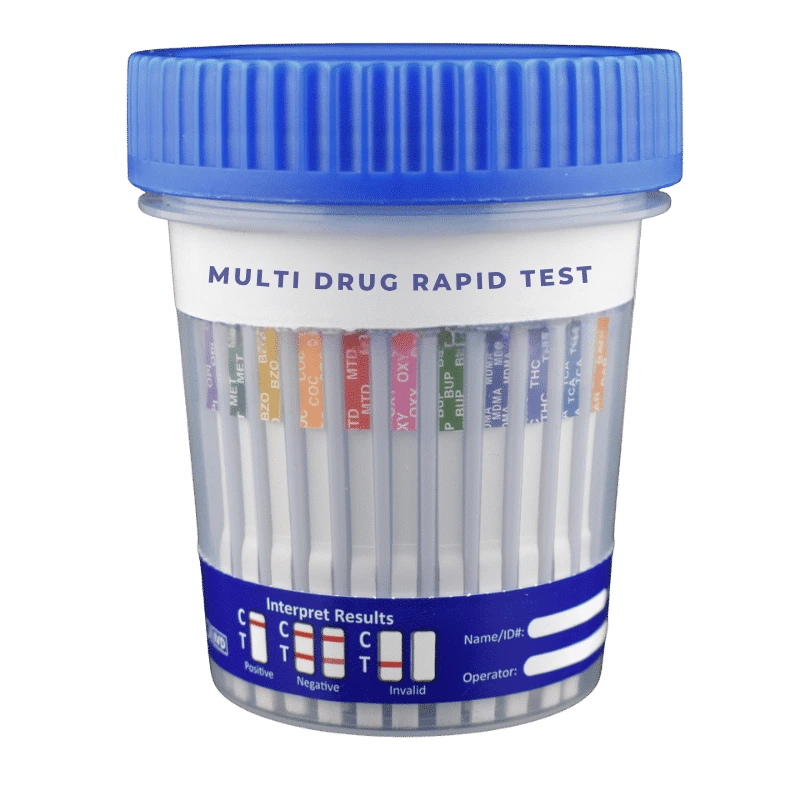
A CLIA waived drug test cup is a urine screening device that the FDA has categorized as simple enough to be used outside a high-complexity laboratory, in a clinic, treatment program or doctor’s office. It gives a rapid, preliminary result, usually in about five minutes. It does not give a final answer: a non-negative result still needs laboratory confirmation. This guide explains what “waived” means, what a cup can and cannot tell you, what your site must have in place before you use one, and how to pick the right cup for your program.
Table of Contents
- TL;DR
- What “CLIA waived” means for a drug test cup
- Which of our cups are CLIA waived
- What a CLIA-waived cup can detect
- How to use a drug test cup correctly
- Interpreting results: negative, non-negative and confirmation
- When a waived cup is not the right tool
- How to choose a cup for your program
- Perspective: what we see from the wholesale side
- Wholesale supply for clinics and programs
- FAQ
- Sources
TL;DR
- “CLIA waived” is a federal test category for simple, low-risk tests. Your site still needs a CLIA Certificate of Waiver to run one, and it must follow the manufacturer’s instructions.
- Only one of our four cups is CLIA waived and FDA cleared: the 12-panel cup with PCP. Our 12-panel ETG/fentanyl, 14-panel and 16-panel cups are Forensic Use Only and are not CLIA waived.
- Every cup result is a presumptive screen. Non-negative results go to a lab for GC/MS or LC-MS/MS confirmation.
- Panel menu, cutoffs and read time matter more than the panel count on the box. Match them to the drugs your program actually sees.
Quick answer: A CLIA waived drug test cup is a point-of-care urine screen categorized by the FDA as a waived test. It is used by certified sites in clinical settings, reads in about five minutes, and produces a qualitative, preliminary result. It is not proof of drug use and it is not a confirmation test. For clinical, point-of-care use, look at our CLIA-waived drug test cups.
What “CLIA waived” means for a drug test cup
CLIA stands for the Clinical Laboratory Improvement Amendments of 1988. In the United States, CLIA regulates facilities that test human specimens for diagnosis, prevention or treatment. Tests are sorted by complexity, and waived tests are the simplest category: considered low-risk, but, as the CDC puts it, not error-proof.
How does a cup earn the label? According to the FDA, tests cleared or approved for home use, or waived by regulation, are categorized as waived. For other tests, the FDA reviews the package insert to decide complexity, and manufacturers of moderate-complexity tests may request a waiver. So the label belongs to a specific product and its instructions, not to a brand or to a category of cups in general.
That last point catches many buyers. Two cups can look identical, with the same panel count, the same temperature strip and the same five-minute read, yet only one carries the waived categorization. Always ask for the package insert and the FDA documentation for the exact catalog number you are buying.
Waived does not mean unregulated
Waived describes the test, not your site. Under CLIA, facilities examining human specimens must be certified, and Certificate of Waiver laboratories must enroll in CLIA and follow the manufacturer’s test instructions. That means the same cup, used by the same staff, is a compliant test in a certified clinic and a problem in a site with no certificate.
If your program does not yet hold a certificate, see our walkthrough on how to get a CLIA waiver certificate, including the CMS-116 application. The CMS application form and instructions are on the CMS site, and your state agency may add its own requirements.
Which of our cups are CLIA waived
We want this to be unambiguous, because a wrong assumption here can create a compliance problem for you. Our catalog is built around four cups, and they are not all in the same regulatory category.
| Cup | Regulatory status | Notable panel content | Typical use |
|---|---|---|---|
| 12-panel with PCP | CLIA waived, FDA cleared | Multi-drug panel including PCP | Clinics, treatment programs, point-of-care screening |
| 12-panel with ETG and fentanyl | Forensic Use Only, not CLIA waived | Adds ETG (alcohol marker) and fentanyl | Forensic-use and program screening |
| 14-panel with PCP, ETG and fentanyl | Forensic Use Only, not CLIA waived | Broader panel with PCP, ETG, fentanyl | Drug courts, corrections, monitoring programs |
| 16-panel with kratom and TCA | Forensic Use Only, not CLIA waived | Adds kratom and TCA to the 14-panel menu | Programs that need the widest menu |
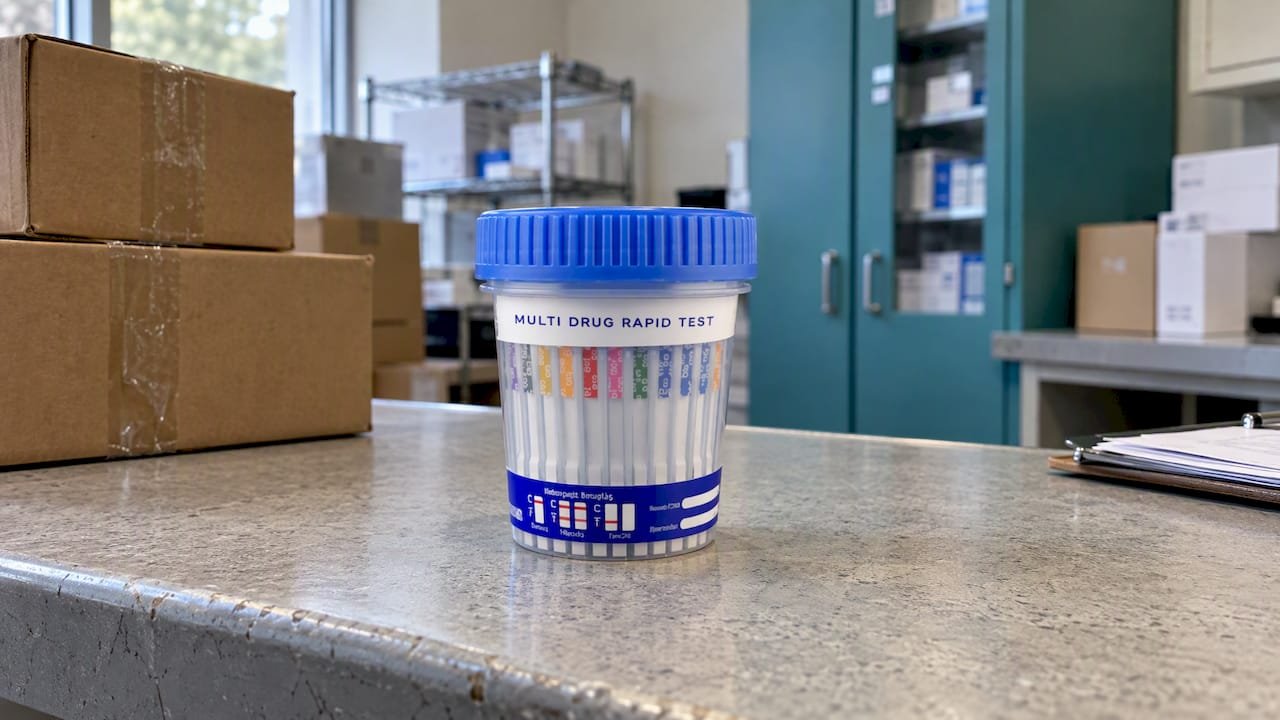
All four have an integrated temperature strip and read in about five minutes. Free shipping applies on orders of 100 or more cups, and we dispatch the same day from US stock.
The practical rule: if your site operates under a Certificate of Waiver and the result will feed a clinical decision, start with the waived 12-panel cup. If your program needs ETG, fentanyl, kratom or TCA on the same cup, those configurations are Forensic Use Only, and they should be used in programs where that designation fits the purpose.
You can see the waived cup on its 12-panel cup with PCP product page, and the expanded options on our 12-panel cup page with ETG, fentanyl and PCP.
What a CLIA-waived cup can detect
A multi-panel cup uses immunoassay test strips, one for each drug or drug class. Each strip has a cutoff, the concentration of the drug or metabolite above which the strip reads non-negative. A cup does not report a number. As the FDA explains for drugs-of-abuse tests, these tests are qualitative: they show whether a drug may be in urine, not how much.
Common panel contents
The 12-panel cups on the market typically combine drugs such as amphetamine, barbiturates, buprenorphine, benzodiazepines, cocaine, MDMA, methamphetamine, methadone, opiates, oxycodone, THC and, on some configurations, PCP. Exact menus differ by manufacturer and lot, so read the insert. One ranking product page, for example, lists a 12-panel menu with abbreviations and cutoffs per drug, which is the level of detail you should expect from any supplier.
Our panel additions work like this:
- PCP: included on our waived 12-panel cup and on the 14-panel. See the PCP drug test cups page for the 25 ng/mL panel.
- ETG: ethyl glucuronide, a metabolite of alcohol, which lets a program screen for recent alcohol use rather than only for drugs.
- Fentanyl: added because standard opiate strips do not detect it.
- Kratom and TCA: on the 16-panel cup, for programs that see these substances.
Cutoffs: why the same drug can read differently
Cutoffs are set by the manufacturer and cleared in the FDA review, so they vary between products. For context, federal workplace programs use defined initial and confirmatory cutoffs: for example 50 ng/mL initial for marijuana metabolite and 150 ng/mL for cocaine metabolite, with confirmation by GC/MS or LC-MS/MS at lower thresholds. A cup that is not built for federal programs may use different values, and that is fine for clinical screening, but you should know which ones you are using.
When you compare cups, put the cutoffs side by side. A cup with a lower cutoff will flag more non-negative results, and a higher one will miss lower concentrations. Neither is better in general. The right choice depends on whether your program prefers to catch more and confirm, or to reduce follow-up testing.
Detection windows
How long a drug stays detectable in urine depends on the drug, the dose, how often it is used, hydration, metabolism and the cutoff. Widely cited ranges are broad. Cocaine metabolite is commonly reported for roughly two to four days, and opiates for about one to four days, while THC metabolite can persist much longer in regular users, from days to several weeks. Treat these as general ranges, never as a promise about a specific person. A result tells you about the specimen at the moment it was collected, not about when use occurred.
How to use a drug test cup correctly
Most errors with waived tests are procedural. The CDC notes that errors can occur when manufacturer instructions are not followed or staff are unfamiliar with the test system. A short, written routine fixes most of them.
- Read the package insert first. Every lot can carry updated instructions. The FDA’s guidance for these tests is the same: read and understand the instructions before you start.
- Prepare the collection area. Use a restroom or collection point where the donor’s belongings are secured and the water source is controlled, following your program’s policy.
- Check the temperature strip. Our cups have an integrated strip. Read it within the time stated in the insert, since a specimen out of the expected range is a specimen-integrity concern that should be handled under your protocol.
- Seal the cup and start a timer. Results must be read within the specified number of minutes after the test starts. Lines that appear after the window are not valid.
- Read each strip in good light. A control line must appear on every strip. A strip without a control line is invalid and should be repeated with a new cup. Our guide on how to read a drug test cup covers faint lines and invalid results.
- Document and act. Record the lot number, the time, the reader and the result. Send any specimen you need confirmed to a laboratory.
Two staff members reading the same cup independently is a simple habit that reduces disagreement about faint lines. It also gives you a record if a result is ever questioned.
Interpreting results: negative, non-negative and confirmation
The most important sentence in this guide: a cup result is presumptive. Here is what each outcome means.
Negative. No drug was found at or above the cutoff. It does not prove the person has not used drugs. The FDA is direct on this: a negative result does not prove that a person did not abuse drugs. Use below the cutoff, use outside the detection window or a substance not on the panel will all read negative.
Non-negative (presumptive positive). A drug or metabolite is present at or above the cutoff. A positive result does not by itself mean a person is abusing a drug, because immunoassays can react with related compounds, including some prescription and over-the-counter medicines. When a test suggests drugs may be present, the FDA advises sending the sample to a laboratory for additional testing.
Confirmation. The standard confirmation methods are GC/MS and LC-MS/MS. They identify the specific compound and measure its concentration. Programs that make consequential decisions, such as treatment changes, court reporting or employment actions, should not rely on a cup result alone. Federal workplace programs go further: SAMHSA’s Medical Review Officer Guidance Manual stresses validated procedures for both initial and confirmatory testing.
If a patient disputes a result, talk about the medications they take and ask your supervising clinician or medical review officer to review it before taking any action. Do not make a clinical or legal decision on a single cup.

Specimen integrity
The temperature strip is the first check, not the only one. Programs commonly add visual inspection, documented chain of handling and, where policy allows, observed or monitored collection. We do not give advice on how to defeat a test, and the purpose of these controls is to protect the person being tested as much as the program: a clean, documented process makes the result defensible either way.
When a waived cup is not the right tool
CLIA waived does not mean suitable for every purpose. Check the intended use in the insert and in your own policy before you buy.
- Forensic, court and legal testing. Some devices are labeled for medical use only. One academic medical center notes that its point-of-care cup is for medical purposes only, not pre-employment or legal testing. Forensic-use cups exist for programs that need that designation, which is why we offer them separately.
- Federal workplace programs. Regulated testing follows its own rules about collection, laboratories and reporting. A point-of-care cup is not a substitute.
- Programs that need ETG, fentanyl, kratom or TCA on one cup. Those are on our Forensic Use Only cups, and those cups are not CLIA waived. Do not use them as if they were.
- Quantitative needs. If you need to know how much of a drug is present, you need laboratory testing.
There is no shame in using two tools. Many programs screen with a waived cup at intake or at visits, then send selected specimens to a lab. Others use a Forensic Use Only cup for monitoring and keep a waived cup for clinical encounters.
How to choose a cup for your program
Use these criteria in order.
- Regulatory status vs. purpose. Is the result a clinical, point-of-care decision? Then the waived cup fits. Is it forensic-use monitoring? Look at the Forensic Use Only options.
- Drug menu. List the substances you actually see. Add alcohol (ETG) if your program monitors alcohol. Add fentanyl if opioid risk is part of your population. Add kratom and TCA only if your program needs them.
- Cutoffs. Compare per-drug cutoffs in the insert, not just the panel count.
- Read time and readability. About five minutes is typical. Clear, dark lines reduce reading disputes.
- Integrity features. An integrated temperature strip saves a step and a separate device.
- Documentation. Ask for the insert, lot information and FDA documentation for the exact catalog number.
- Supply reliability. Programs that test daily need steady stock, predictable shipping and consistent lots.
- Total cost. Compare per-cup price at your real monthly volume, including shipping.
A larger panel is not automatically better. More strips mean more drugs that can trigger a non-negative result, and more follow-up confirmation. A 12-panel waived cup is often the right fit for general clinical screening, while a 14- or 16-panel configuration suits programs with a defined reason to screen for the added substances.
Perspective: what we see from the wholesale side
Most of the questions we get from clinics and programs are not about chemistry. They are about paperwork and fit. A buyer orders a broad panel because it looks more thorough, then learns that the cup is Forensic Use Only and their clinic’s certificate and policy call for a waived device. Or the reverse: a drug court program buys a waived cup and then finds it does not include the fentanyl and alcohol markers its monitoring plan needs.
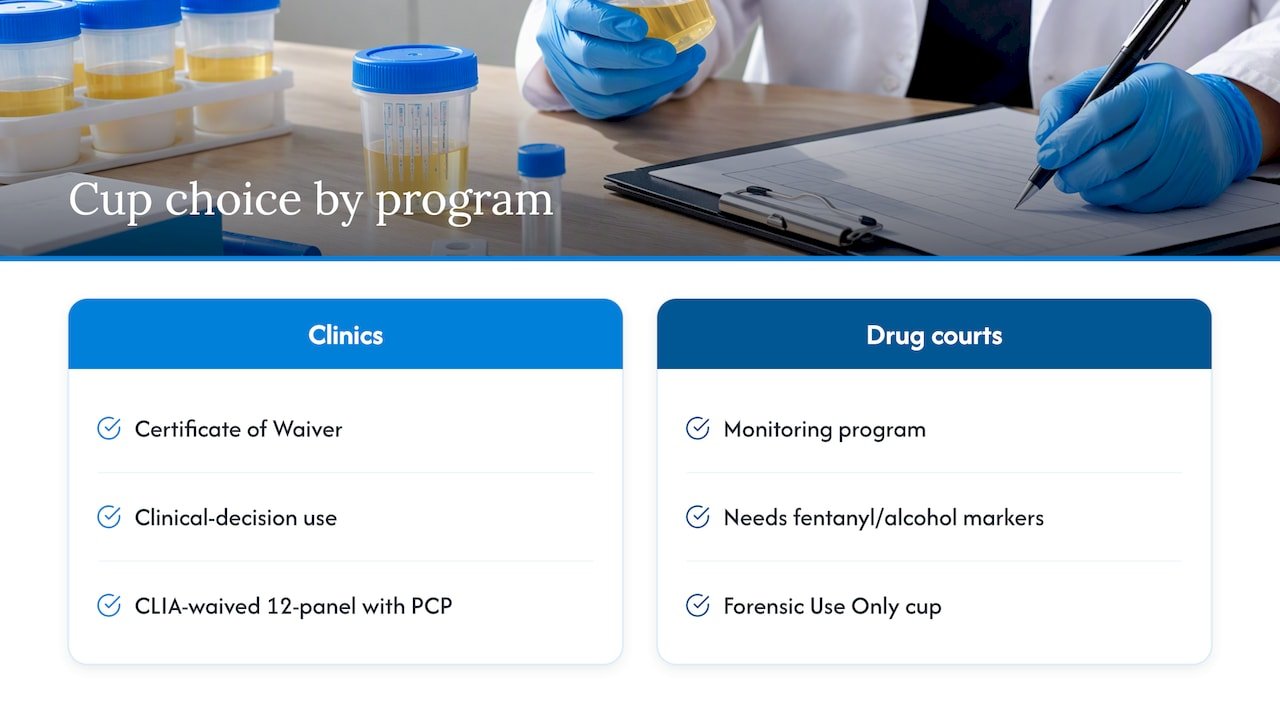
That is why we keep the catalog small. Four configurations, each with a clear designation, an integrated temperature strip and a five-minute read. We say plainly which cup is CLIA waived and FDA cleared (the 12-panel with PCP) and which cups are Forensic Use Only (the ETG/fentanyl 12-panel, the 14-panel and the 16-panel). We would rather you buy the right cup once than the wrong cup in volume.
Our advice is simple. Decide the purpose first, then the panel. Train every person who reads a cup on the same written steps. Treat every non-negative as a reason to confirm, not a conclusion. And keep the package insert where the staff can find it.
— Alina
Wholesale supply for clinics and programs
We supply urine drug test cups at wholesale to clinics, behavioral health programs, employers, drug courts, corrections and distributors. Pricing is volume based: our 12-panel cup with PCP is listed from $3.70, and the 16-panel cup is listed as low as $2.59. Orders of 100 or more cups ship free, and stock ships the same day from the US.
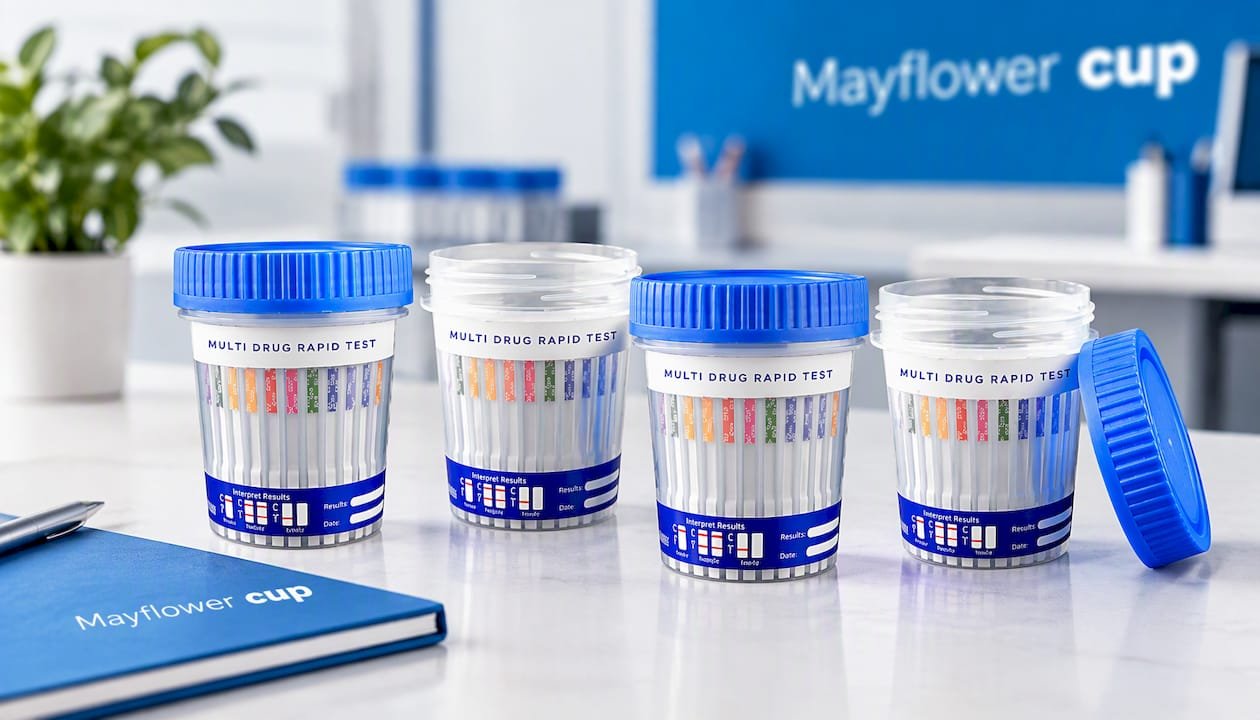
Multi-site and recurring accounts can request a quote so that pricing and delivery match how you actually order. Start on our drug test cups for clinics and programs page or browse the full drug test cup range.
FAQ
What is a CLIA waived drug test?
It is a drug test that the FDA has categorized as waived under CLIA, meaning it is simple and low-risk enough to be used at a site holding a Certificate of Waiver. The site must follow the manufacturer’s instructions. The result is still a preliminary screen.
Do I need a CLIA certificate to use a waived cup?
Yes, if you are a facility testing human specimens for diagnosis, prevention or treatment, CLIA requires certification, and a Certificate of Waiver is the type used for waived tests. Requirements can also vary by state, so check with your state agency. Our CLIA waiver certificate guide outlines the application steps.
Is a CLIA waived cup accurate enough to act on?
It is accurate enough to screen, not to decide. A cup is qualitative and can react with related compounds, so non-negative results should be confirmed by GC/MS or LC-MS/MS before any consequential action. Accuracy also depends on following the instructions and reading the result within the stated time.
Are all of your drug test cups CLIA waived?
No. Our 12-panel cup with PCP is CLIA waived and FDA cleared. Our 12-panel ETG/fentanyl, 14-panel and 16-panel cups are Forensic Use Only and are not CLIA waived. Choose by the purpose of your program.
Can a cup detect fake or substituted urine?
A cup with a temperature strip can flag a specimen outside the expected temperature range, which is a specimen-integrity signal. It is not a complete adulteration check. Programs add visual inspection and documented collection procedures under their own policy.
Sources
- CLIA Categorizations, FDA
- Waived Tests, CDC Laboratory Quality
- Drugs of Abuse Home Use Test, FDA
- Questions and Answers on the CLIA, CMS
- Form CMS-116, CLIA application
- Medical Review Officer Guidance Manual, SAMHSA
- Point of Care Urine Drug Screen, Michigan Medicine Laboratories
- Drug Test Cutoff Levels by Drug, BlueHive
- 4-Panel Drug Test Detection Windows, Recovered