How Long Do Opioids Stay in Your System?
How Long Do Opioids Stay in Your System?
Most opioids stay detectable in urine for 1 to 4 days after use — heroin, morphine, and codeine for about 1 to 3 days, oxycodone and hydrocodone for 2 to 4 days, and fentanyl for 1 to 3 days after a single use. Methadone is the big exception, remaining detectable for 3 to 14 days because of its long half-life, while buprenorphine can be found for up to about 7 to 11 days. These are standard-screening urine windows, not guarantees: dose, frequency, metabolism, and cutoff all shift the answer, and a negative only means the drug was below the cutoff that day — not proof of abstinence.
There is a second catch: no single strip catches all opioids. A standard opiate strip can miss oxycodone, fentanyl, methadone, and tramadol entirely, so this guide covers both the windows and which strip detects each drug.
Opioid Detection Windows at a Glance
The table below gives usual urine windows at standard screening cutoffs, with the strip that detects each drug. Windows are ranges: a single low dose clears near the short end, heavy or repeated use toward the long end.
| Opioid | Urine window | Strip that detects it | Key note |
|---|---|---|---|
| Heroin | 1–3 days | OPI (opiate) | 6-MAM lasts under a day, so heroin itself is rarely caught directly |
| Morphine | 1–3 days | OPI (opiate) | Reference molecule for most opiate strips |
| Codeine | 1–3 days | OPI (opiate) | Prescribed medicine — positives need a prescription check |
| Oxycodone | 2–4 days | OXY (oxycodone) | Opiate strips detect it poorly; needs its own strip |
| Hydrocodone | 2–4 days | OXY (oxycodone) | Semi-synthetic, grouped with oxycodone |
| Hydromorphone / oxymorphone | 1–3 days | OPI / OXY | Confirmation identifies the exact drug |
| Fentanyl | 1–3 days acute; up to ~5 days or longer with chronic use | FEN (fentanyl) | Opiate strips do NOT detect it — dedicated FEN strip required |
| Tramadol | Up to 4 days | TRA (tramadol) | Synthetic opioid that opiate strips miss |
| Methadone | 3–14 days | MTD (methadone) | Long half-life outlier; treatment prescription gives context |
| Buprenorphine | Up to ~7–11 days | BUP (buprenorphine) | MAT medicine; needs its own strip |
See also our drug detection times chart.
Why Opioid Windows Differ So Much
The liver converts each opioid into metabolites the kidneys excrete, but speed varies enormously. Half-life is the main driver: heroin converts to morphine within minutes, so its window is short, while methadone’s half-life of roughly 15 to 60 hours is why it lingers for days to weeks. Fentanyl is highly fat-soluble, so after repeated use it stores in fatty tissue and releases slowly, extending detection beyond a single dose’s 1-to-3-day window.
Heroin, Morphine, and Codeine: The Classic Opiates
Heroin is trickiest to catch directly: the body converts it to 6-monoacetylmorphine (6-MAM) and then morphine within minutes, and 6-MAM is detectable for less than a day. A urine test usually finds morphine, not heroin, and morphine is also prescribed, so a morphine-positive result alone cannot prove heroin use. Only a lab test finding 6-MAM confirms heroin, and only within hours of use.
Morphine and codeine are detectable for about 1 to 3 days. The liver converts some codeine into morphine, so codeine use can produce a morphine-positive result — and a legitimate codeine prescription can look identical to illicit morphine use on a screening cup, so prescribed medicines must be recorded before testing.
Oxycodone, Hydrocodone, and the Semi-Synthetic Gap
Oxycodone and hydrocodone are semi-synthetic opioids, related to morphine but different enough that standard opiate antibodies bind them weakly. A cup with only a standard opiate strip can return a negative result for recent oxycodone use that a dedicated oxycodone strip would catch. Their windows run 2 to 4 days; hydromorphone and oxymorphone, their breakdown products, last roughly 1 to 3 days.
Fentanyl: Short Window, Separate Strip, Serious Stakes
Fentanyl breaks the usual assumptions: a fully synthetic opioid dozens of times more potent than morphine, with a shape different enough that standard opiate strips do not detect it. A person can test negative on an opiate strip while fentanyl is present; only a dedicated fentanyl (FEN) strip catches it.
After a single use, fentanyl is typically detectable for 1 to 3 days; with chronic use, around 5 days or longer as it accumulates in fatty tissue. Because its window is short and its risk high, testing frequency matters more for fentanyl than for almost any other drug — a weekly test can easily miss use from days earlier. See our fentanyl drug testing guide and which drug test panels include fentanyl; this post deliberately does not repeat that detail.
Methadone and Buprenorphine: Treatment Drugs With Long Windows
Methadone and buprenorphine are medication-assisted treatment (MAT) medicines, which changes how results should be read. Methadone’s long half-life gives it the longest window of any common opioid, 3 to 14 days, and it needs its own MTD strip. In a treatment patient, a methadone-positive result is usually expected and compliant; in a person with no prescription, it indicates non-prescribed use. The result is identical either way — the prescription record gives it meaning.
Buprenorphine is detectable for up to about 7 to 11 days and likewise needs its own BUP strip; it does not register on a standard opiate strip. Programs monitoring MAT patients need MTD and BUP strips, or they will miss exactly the medicines they are monitoring — and may wrongly read a missing result as non-adherence when the strip simply was not there.
Urine Is Not the Only Specimen: Blood, Saliva, and Hair
Urine is the standard program specimen because its window is long enough to be useful and collection is non-invasive. Blood has the shortest window — hours to about a day — and is used mainly in hospitals and impairment investigations. Saliva typically detects opioids for 1 to 4 days and is harder to adulterate because collection is observed.
| Specimen | Typical opioid window | Best use |
|---|---|---|
| Urine | 1–4 days (methadone up to 14 days) | Routine program and treatment screening |
| Blood | Hours to ~1 day | Impairment and hospital testing |
| Saliva | 1–4 days | Observed collection; harder to adulterate |
| Hair | Up to ~90 days | Long-term history only |
What Lengthens or Shortens a Detection Window
Dose and frequency matter most: higher doses and daily use extend detection, while a single low dose clears near the short end. Liver and kidney function set the clearance rate, so impaired function lengthens windows. Body composition matters for fat-soluble fentanyl, which lingers in fatty tissue. Urine dilution and pH also play a role: very dilute urine can push a level below the cutoff. Our dilute drug test results guide explains how collectors handle dilute specimens.
Cutoffs: 300 vs 2,000 ng/mL and Why the Number Changes the Window
A window only means something at a stated cutoff. The traditional opiate cutoff was 300 ng/mL; many workplace programs now use 2,000 ng/mL, adopted largely to cut poppy-seed false positives. A level triggering a 300 ng/mL test may already be below 2,000 ng/mL, so the same person can test positive on one device and negative on another the same day. Fentanyl cutoffs are manufacturer-set, not federally standardized. Our drug test cutoff levels guide explains near-cutoff results.
False Positives and Why Confirmation Is Non-Negotiable
Screening cups work by antibody shape recognition, so similar-shaped substances can trigger a presumptive positive: poppy seeds (small amounts of morphine and codeine) and medicines including fluoroquinolone antibiotics, dextromethorphan, and diphenhydramine. A poppy-seed positive is far less likely at 2,000 ng/mL than at 300 ng/mL, but not impossible, and prescription opioids legitimately produce positives only a prescription record can explain.
That is why every presumptive positive driving a consequential decision — employment, a sanction, a treatment change — must be confirmed by GC-MS or LC-MS/MS. Confirmation identifies the exact molecule and concentration, separating heroin’s 6-MAM from codeine and genuine positives from cross-reactivity. The MedlinePlus drug testing overview describes the two-stage screen-and-confirm process, and SAMHSA’s drug-free workplace guidance sets the federal framework many programs follow.
The Program Angle: Testing Cadence for Short Windows
The most important practical implication is scheduling, not chemistry. Because most opioids clear urine within 1 to 4 days, infrequent testing misses most use: a monthly program catches only use from the few days before each test, while random, unannounced testing two or three times a week has a far better chance of catching ongoing use.
Equally important is what a negative does not mean: only that the drug was below the cutoff in that specimen on that day — not that the person has never used, is not using another substance, or will test negative tomorrow.
Choosing a Panel That Actually Covers Opioids
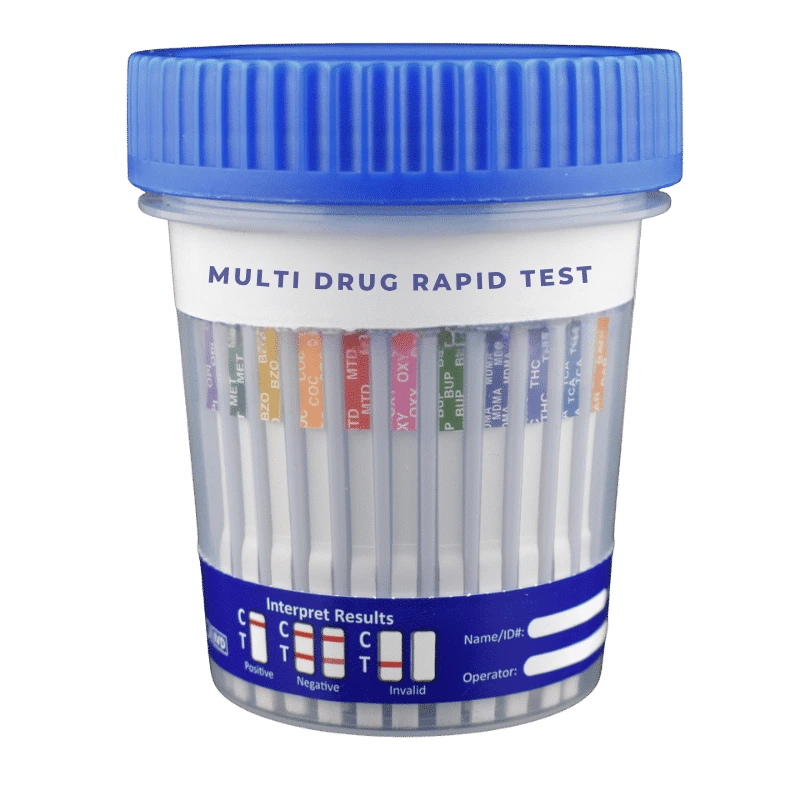
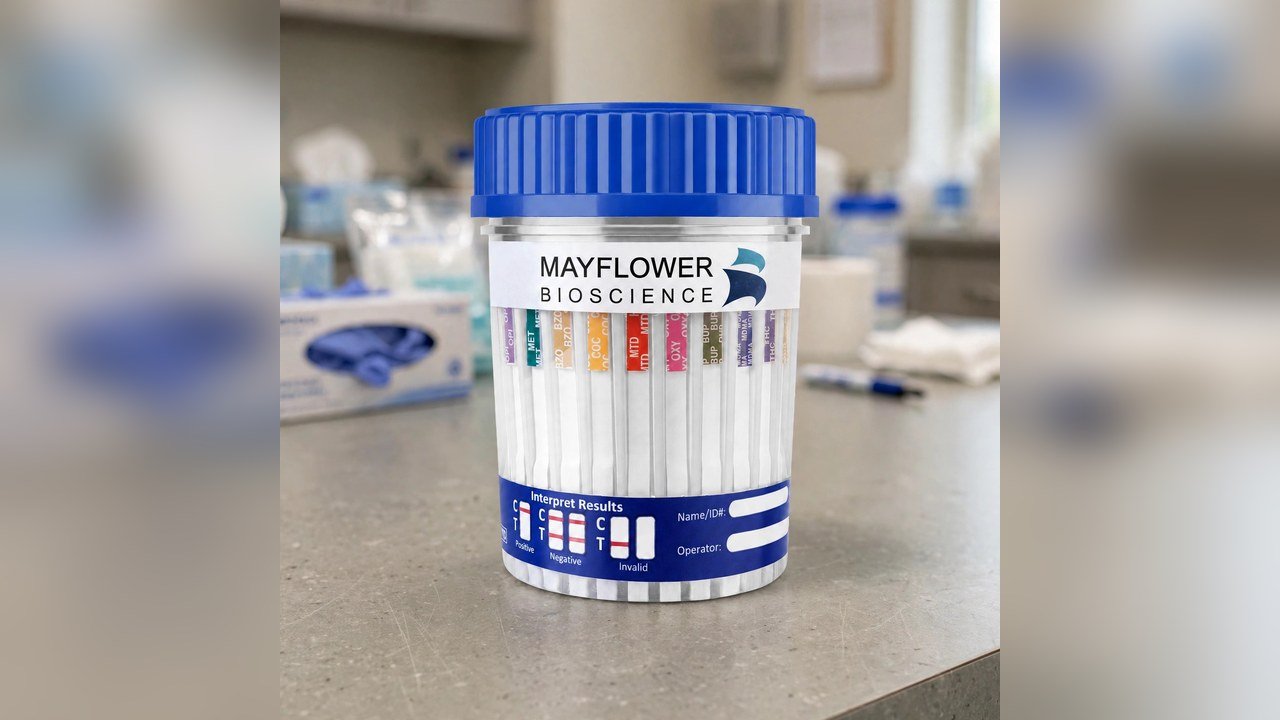
Panel choice should follow the population’s opioid risk, not panel count alone. A basic panel with only a standard opiate strip misses oxycodone, fentanyl, tramadol, methadone, and buprenorphine — most of the modern opioid picture. MayFlower sells only 12, 14, and 16-panel cups: the 12-panel cup covers the core drugs with expanded opiates, the 14-panel cup adds fentanyl and tramadol strips, and the 16-panel cup adds EtG alcohol and kratom. Volume programs standardize through wholesale drug test cups so every site reads the same strip layout.
Frequently Asked Questions
How long do opioids stay in your system?
Most opioids are detectable in urine for 1 to 4 days after use. Heroin, morphine, and codeine last about 1 to 3 days, oxycodone and hydrocodone 2 to 4 days, and fentanyl 1 to 3 days after a single use. Methadone is the exception at 3 to 14 days, and buprenorphine can last up to about 7 to 11 days. Blood windows are shorter (hours to a day), while hair testing can show use for up to about 90 days.
How long does heroin stay in your system?
Heroin is detectable in urine for about 1 to 3 days, usually as morphine, because the body converts heroin to morphine within minutes. Its unique metabolite, 6-MAM, lasts less than a day, so confirming heroin specifically requires laboratory testing within hours of use. After that window, a test can show morphine but cannot prove it came from heroin.
Does a standard opiate drug test detect oxycodone and fentanyl?
No, not reliably. Standard opiate strips are tuned to morphine-like molecules and bind oxycodone weakly, and they do not detect fentanyl at all. Oxycodone needs a dedicated OXY strip and fentanyl needs a dedicated FEN strip. A panel without those strips can return a negative result even when oxycodone or fentanyl was recently used.
How long does fentanyl stay in your system?
After a single use, fentanyl is typically detectable in urine for 1 to 3 days. With chronic or repeated use, detection can extend to around 5 days or longer because fentanyl stores in fatty tissue and releases slowly. Fentanyl requires a dedicated FEN strip; standard opiate strips will not detect it. See our fentanyl drug testing guide for the full detail.
How long does methadone stay in your system?
Methadone is detectable in urine for 3 to 14 days, the longest window of any common opioid, because its half-life ranges from roughly 15 to 60 hours. It needs its own MTD strip, as opiate strips do not detect it. In a treatment patient, a methadone-positive result is usually an expected, compliant result, so the prescription record matters as much as the test result.
How long does tramadol stay in your system?
Tramadol is detectable in urine for up to about 4 days after use. It is a synthetic opioid that standard opiate strips miss, so it needs a dedicated tramadol (TRA) strip. Its window is similar to oxycodone’s, but because tramadol is often prescribed, a positive result should always be checked against the person’s prescription record.
Can poppy seeds cause a false positive for opioids?
Yes, poppy seeds contain small amounts of morphine and codeine and can trigger a presumptive positive on an opiate screen, especially at the older 300 ng/mL cutoff. The risk is much lower at the 2,000 ng/mL cutoff used by many workplace programs. Certain medicines, including fluoroquinolone antibiotics, dextromethorphan, and diphenhydramine, can also cross-react. Any presumptive positive should be confirmed by GC-MS or LC-MS/MS before action is taken.
How long are opioids detectable in hair?
Hair testing can detect opioid use for up to about 90 days, depending on hair length. It shows a long-term history rather than recent use, because newly grown hair takes a week or more to emerge, so it cannot detect use from the last few days. Hair testing is a laboratory test, not a cup test, and is best used for history rather than day-to-day program monitoring.
Does a negative opioid drug test prove someone has not used drugs?
No. A negative result means only that the drug was below the test’s cutoff in that specimen on that day. Most opioids clear urine within 1 to 4 days, so use from a week earlier will not show up, and a panel without the right strips can miss oxycodone, fentanyl, tramadol, methadone, or buprenorphine entirely. A negative is a point-in-time result, not proof of abstinence.
Do drug test cups detect buprenorphine?
Only if the cup includes a dedicated buprenorphine (BUP) strip. Standard opiate strips do not detect buprenorphine, which is detectable in urine for up to about 7 to 11 days. Programs monitoring medication-assisted treatment should confirm their panel includes BUP and MTD strips, or they may wrongly read a missing result as non-adherence when the strip simply was not present.