How Far Back Does a 14-Panel Drug Test Go? Urine Windows
How Far Back Does a 14-Panel Drug Test Go? Urine Windows
A 14-panel urine drug test usually looks back about 2 to 7 days for most substances. Marijuana in regular users, long-acting benzodiazepines and some barbiturates can stay detectable for weeks. The window is not one number for the whole panel. It is a separate range for each drug, and it moves with dose, frequency of use, metabolism and the cutoff the test uses.
This guide gives you the ranges published by clinical and government sources, explains why they overlap and disagree, and shows what that means if you buy, run or interpret multi-panel urine cups in a clinic, treatment program, workplace or court-supervised program.
TL;DR
- For most drugs on a 14-panel urine test, expect a detection window of roughly 1 to 7 days after last use.
- Marijuana is the main exception: a single use may show for a few days, but heavy, long-term use can show for 30 days or more.
- Long-acting benzodiazepines and long-acting barbiturates can be detected for weeks, because the body clears them slowly.
- A cup is a preliminary screen. A non-negative result needs confirmation by GC/MS or LC-MS/MS before anyone acts on it.
- Our 14-panel cup is Forensic Use Only and is not CLIA-waived. Our 12-panel cup with PCP is the CLIA-waived, FDA-cleared option.
Table of Contents
- How far back a 14-panel drug test goes
- Detection windows by drug in urine
- Why the same drug has different windows
- Parent drug versus metabolite
- Urine compared with hair, saliva and blood
- What a result can and cannot tell you
- Choosing the right cup for your program
- Our perspective
- Stock the 14-panel cup for your program
- FAQ
- Sources
How far back a 14-panel drug test goes
The short answer is “days, not months.” Urine reflects recent exposure. The SAMHSA guide to clinical drug testing in primary care says most substances of abuse are detectable in urine for roughly 2 to 4 days, and that the window can be longer when large, frequent doses are taken over a long period. The same publication notes that chronic marijuana use may be detectable for up to 30 days after use stops.
A 14-panel test is a screen for 14 analytes or drug classes in one cup. Each analyte has its own metabolism, so each has its own window. That is why one clinician may say “about a week” and another may say “up to a month.” They are both talking about the same panel, but about different drugs and different patterns of use.
If you want the exact list of analytes in our cup, see our 14-panel analyte guide. The ranges below cover the substance classes that multi-panel urine tests commonly screen for.
Detection windows by drug in urine
Published windows differ by source because each source uses different cutoffs, populations and definitions of “use.” The table gives the range that clinical references report, so you can see both the typical figure and the upper end.
| Substance | Typical urine window | Longer in heavy or chronic use | Where it comes from |
|---|---|---|---|
| Amphetamine, methamphetamine | 1 to 3 days | Longer with repeated dosing | UCSF Health, AAFP |
| Cocaine (metabolites) | 2 to 4 days | 10 to 22 days with heavy use | UCSF Health |
| Marijuana (THC) | About 2 to 3 days after a single use | 2 to 6 weeks for daily or very heavy use, in some cases longer | AAFP, Mayo Clinic Proceedings |
| Codeine, morphine, heroin | 1 to 3 days | Codeine and morphine can run longer with chronic use | UCSF Health, Mayo Clinic Proceedings |
| Oxycodone | 2 to 4 days | Varies with dose | Mayo Clinic Proceedings |
| Methadone | 2 to 4 days | Up to 14 days | AAFP |
| Fentanyl | 2 to 3 days | Varies with dose and duration | AAFP |
| Benzodiazepines | 3 to 5 days for short-acting | Up to 30 days for long-acting | AAFP, Mayo Clinic Proceedings |
| Barbiturates | About 1 day for short-acting | About 3 weeks for long-acting | Mayo Clinic Proceedings |
| Phencyclidine (PCP) | 1 to 10 days | Varies by source | UCSF Health, AAFP |
| Buprenorphine | Up to 11 days | n/a | AAFP |
Treat these as ranges, not promises. They describe what clinical references report, not what any one person’s result will be.
Stimulants: amphetamine, methamphetamine, cocaine
Stimulants clear quickly. Reported windows for amphetamines run from about 24 hours to 3 days. Cocaine itself leaves the body within hours, but the test looks for a metabolite. SAMHSA explains that, when urine is tested for cocaine, the target is usually the metabolite benzoylecgonine, which is why the window is days rather than hours. For a deeper look at one stimulant, see how long meth stays in your urine.
Marijuana: the widest range on the panel
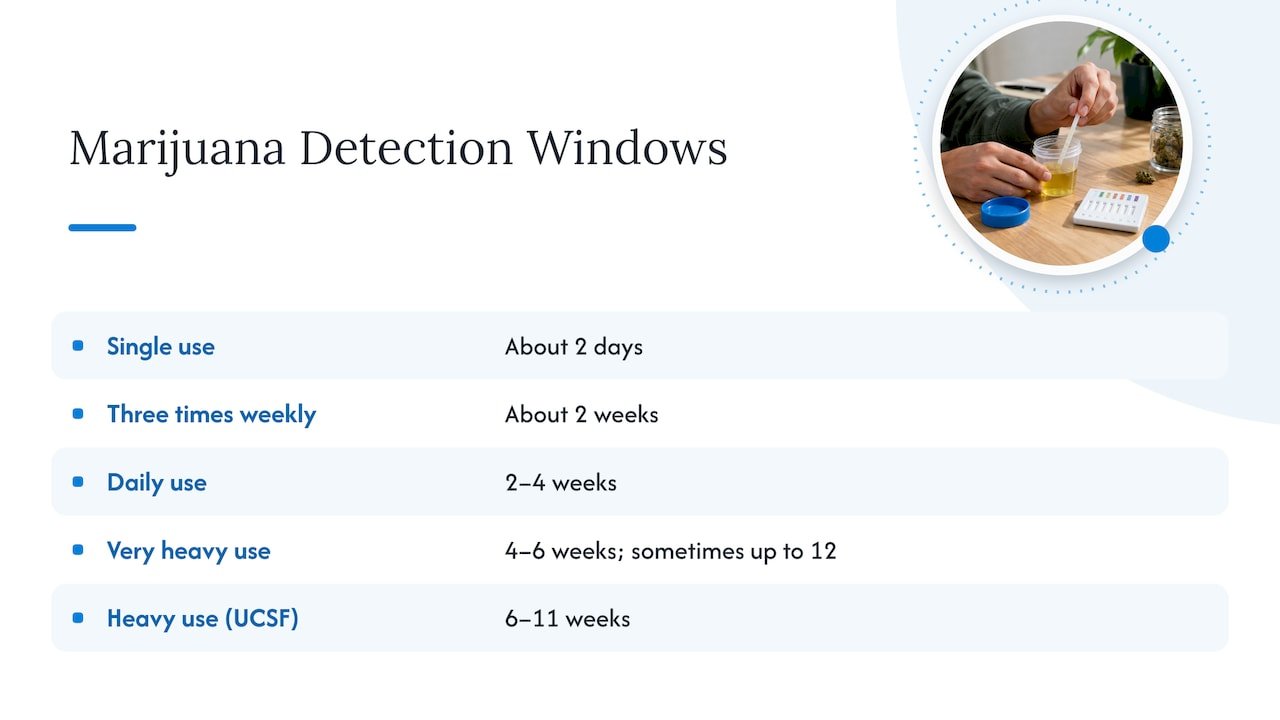
Marijuana produces the biggest spread. According to the AAFP, a single use may be detectable for about 2 days, use three times a week for about 2 weeks, daily use for 2 to 4 weeks, and very heavy use for 4 to 6 weeks, and in some cases up to 12 weeks. UCSF Health lists up to 6 to 11 weeks with heavy use. THC is stored in body fat and released slowly, which is why frequent users stay positive longer than occasional ones.
Opioids and fentanyl
Short-acting opioids such as morphine and heroin metabolites generally clear in 1 to 3 days. Methadone, oxycodone and fentanyl run about 2 to 4 days in the references above. Our 14-panel cup includes fentanyl screening, and the 2 to 3 day figure is why fentanyl screening is most useful for recent use. For the full opioid picture, see our guide on how long opioids stay in your system.
Benzodiazepines and barbiturates
These classes depend heavily on the specific drug. A short-acting benzodiazepine may be gone in 3 to 5 days, while a long-acting one can remain for up to 30 days, according to the Mayo Clinic Proceedings review of urine drug screening. The same review gives about 24 hours for short-acting barbiturates and about 3 weeks for long-acting ones. Our benzodiazepine detection guide goes through the individual drugs.
PCP
PCP windows are reported from 1 to 10 days depending on the source and how often the drug was used. UCSF Health lists 1 to 8 days, Mayo Clinic Proceedings gives about 8 days, and the AAFP lists 1.5 to 10 days.
Alcohol and ETG
Alcohol itself leaves urine fast. UCSF Health lists a toxicology urine screen detecting alcohol for about 3 to 10 hours. ETG is a metabolite of alcohol rather than alcohol itself. Following the general SAMHSA principle that metabolites remain in the body longer than the parent drug, an ETG test looks back further than a test for ethanol itself. Our chart pulls the commonly cited ranges together in one place: drug detection times chart.
Why the same drug has different windows
If you have seen two sources give different numbers for the same drug, nothing is wrong. The window is set by many variables. SAMHSA lists these as the chemical properties of the substance, individual metabolism and excretion, route of administration, frequency of use, amount taken, the sensitivity and specificity of the test, the cutoff concentration, the person’s health, diet, weight, gender and fluid intake, and the specimen tested. All of them shape the window of detection.
In practice, six factors do most of the work.
- Dose and frequency. One use of a drug and months of daily use produce very different windows. Chronic use fills body tissue, and the drug is released over a longer time.
- Metabolism and half-life. Drugs with long half-lives, such as long-acting benzodiazepines, linger. Fast-clearing drugs such as cocaine do not.
- Route of use. SAMHSA notes that smoked or injected drugs show in urine almost immediately, while orally taken drugs peak at about 6 hours.
- Cutoff concentration. A lower cutoff catches smaller amounts and lengthens the window. A higher cutoff shortens it.
- Urine concentration. Very dilute urine can lower the concentration of a drug below the cutoff. Early-morning urine is the most concentrated, according to a toxicology addendum from the University of Arizona.
- Individual biology. Body mass, age, overall health and urine pH all change how fast the body clears a drug.
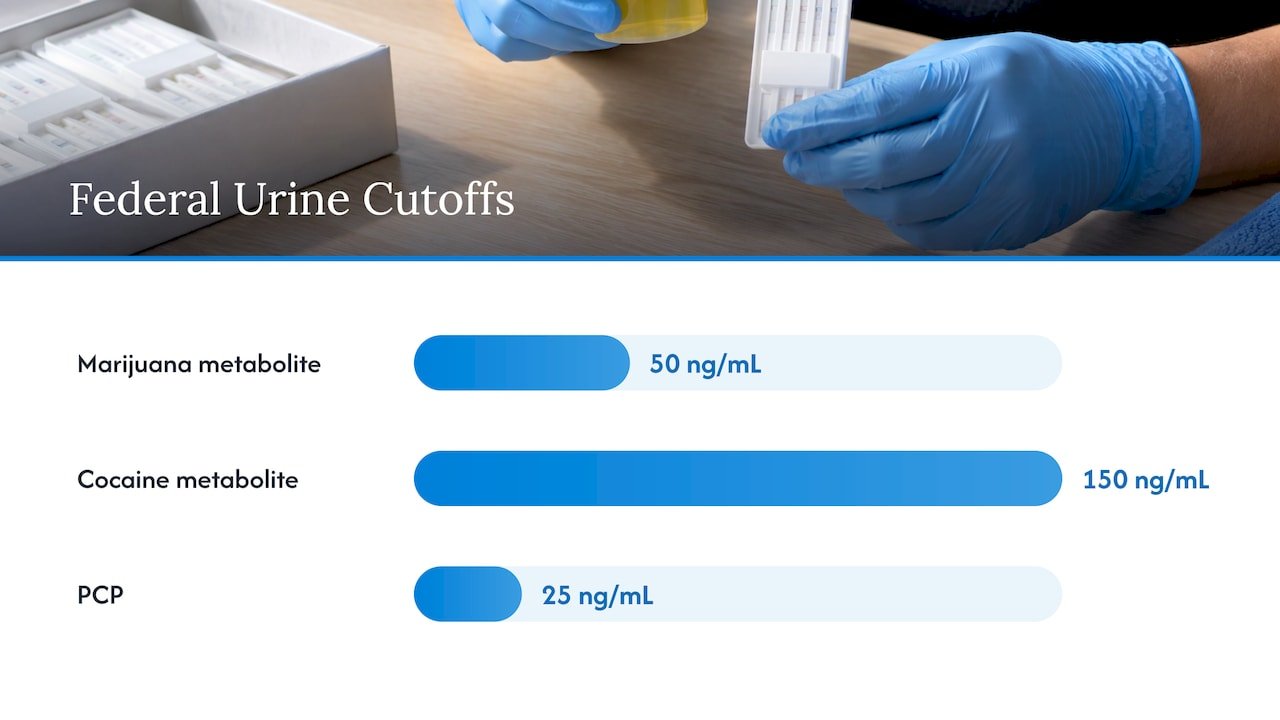
Cutoffs deserve a closer look because they are the factor buyers control. The federal workplace program, for example, sets initial urine test cutoffs of 50 ng/mL for the marijuana metabolite, 150 ng/mL for the cocaine metabolite, and 25 ng/mL for PCP under guidelines effective February 1, 2024. Those are the federal program’s own figures. Rapid cups used outside that program can carry different cutoffs, so always read the cutoff table in the package insert for the specific cup you use before comparing it with a published window.
Parent drug versus metabolite
Most urine tests do not look for the drug you swallowed or smoked. They look for what the body turned it into. SAMHSA explains that metabolites generally stay in the body longer than the parent drug, which extends the detection period. Blood and oral fluid are better suited to finding the parent drug, while urine mostly holds metabolites.
This matters for interpretation. A urine result tells you that exposure happened at some point within the window. It does not tell you when, how much, or whether someone was impaired. A 2021 consensus report on drug-impaired driving makes the point directly: drug presence in urine shows historical use or exposure, not impairment at the time of collection. That is a reason programs use urine for monitoring and compliance, where a longer look-back is the goal.
Urine compared with hair, saliva and blood
Urine sits in the middle of the look-back range, and that is why multi-panel urine cups are the standard for monitoring programs.
| Specimen | Typical look-back | Best suited to |
|---|---|---|
| Oral fluid (saliva) | Hours to about 2 days | Recent use |
| Blood | A few days at most | Current exposure and impairment questions |
| Urine | About 1 to 7 days, longer in chronic users | Ongoing monitoring and compliance |
| Hair | Up to about 90 days | Long-term pattern of use |
The ranges for hair and oral fluid are the typical figures reported in public guidance. Consumer sources commonly describe a urine test as covering up to a week, saliva about 3 to 4 days, and hair up to 90 days. If you are weighing a saliva format against a urine cup, our comparison of urine and saliva drug testing covers the detection windows side by side.
Hair tests reach back furthest because drugs are incorporated into the hair shaft as it grows. The standard head-hair sample is about 1.5 inches, which corresponds to roughly three months, as described in the overview of drug testing on Wikipedia. Hair is slow to show recent use, though, so it complements urine rather than replacing it.
What a result can and cannot tell you
A rapid cup is an immunoassay screen. It is fast and practical, and it is designed to flag samples that need a closer look. It is not a final answer.
- Non-negative results are preliminary. They need confirmation by GC/MS or LC-MS/MS before any decision is made about a person’s employment, treatment, custody or legal status.
- Cross-reactivity exists. The AAFP notes that commonly used medications can cross-react with the assay and cause false positives, a particular concern with immunoassays. A prescription list should be part of any review.
- Negatives need care too. The same article notes that negative results are hard to interpret in patients on long-term opioid therapy, and that confirmatory testing separates a true negative from a false negative.
- Sample validity matters. A valid specimen has a temperature of 90 to 100°F within 4 minutes of voiding, a pH of 4.5 to 8.0 and creatinine above 20 mg/dL, per the University of Arizona toxicology addendum. Our cups include an integrated temperature strip so the collector can check the sample at the time of the test. If a result comes back negative but dilute, our explainer on negative dilute results covers what happens next.
The question of how a person might beat a test is not one we answer. Our focus is accurate collection, correct reading and proper confirmation.
If you are an individual looking for a screen rather than buying cups, free drug testing options from a treatment provider can be a practical first step toward an assessment and support.
Choosing the right cup for your program
The look-back window is one input. The other is the regulatory status of the cup, and it differs across our catalog.
- 12-panel cup with PCP: CLIA-waived and FDA-cleared. This is the one for point-of-care settings that need a waived test.
- 12-panel cup with ETG and fentanyl: Forensic Use Only.
- 14-panel cup with PCP, ETG and fentanyl: Forensic Use Only. It is not CLIA-waived.
- 16-panel cup adding kratom and TCA: Forensic Use Only. It is not CLIA-waived.
Every cup has an integrated temperature strip and gives a rapid read in about five minutes. If you are deciding between the larger panels, our guide to 14 vs 16 panel tests lists the analyte differences, and the 16-panel drug list shows what the extra panels add.
A practical rule: match the panel to the drugs your population is actually likely to use, then match the look-back to your testing schedule. If you test weekly, a window of 2 to 4 days will miss some use between tests for drugs that clear fast. If you test randomly, longer-window drugs like marijuana and benzodiazepines will show more often than short-window ones. Knowing this helps you read results realistically.
Our perspective
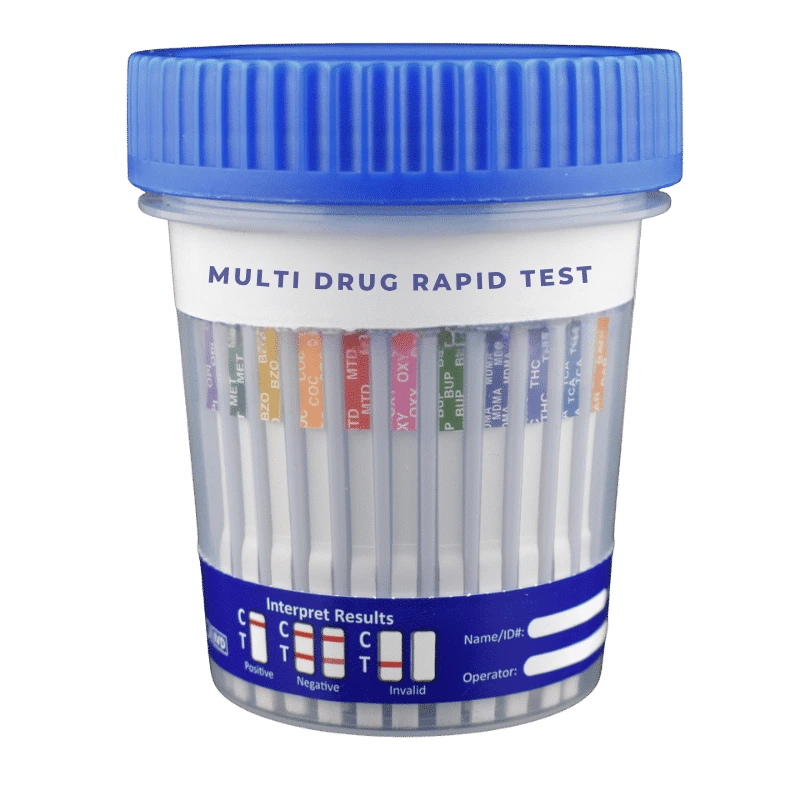
Programs ask us for one number: how far back does the cup go. We understand why, but we think the better question is what the cup is for. A 14-panel urine cup is built to give a fast, preliminary read across a broad set of drugs, including PCP, ETG and fentanyl, so a counselor, collector or officer can decide quickly whether a sample needs confirmation.
That is where a multi-panel cup earns its place. You get several drug classes from one sample in about five minutes, with a temperature strip to check the specimen at collection, and you send the non-negative results on to a lab for GC/MS or LC-MS/MS confirmation. Treating the cup as a screen, and the lab as the final word, is what keeps a program fair and defensible.
We also believe in being direct about status. Our 14-panel cup is Forensic Use Only and is not CLIA-waived, and our 12-panel cup with PCP is the CLIA-waived, FDA-cleared one. Choosing the right cup for the setting is the first step to getting reliable results, and the published detection windows are the guide for how often to test.
Alina
Stock the 14-panel cup for your program
We supply multi-panel urine drug test cups wholesale to clinics, behavioral health programs, employers, drug courts, corrections and distributors. Orders over 100 cups ship free, and we dispatch the same day from US stock. The 14 panel drug test cup with PCP screens for PCP, ETG and fentanyl alongside the other panel analytes, and carries an integrated temperature strip.
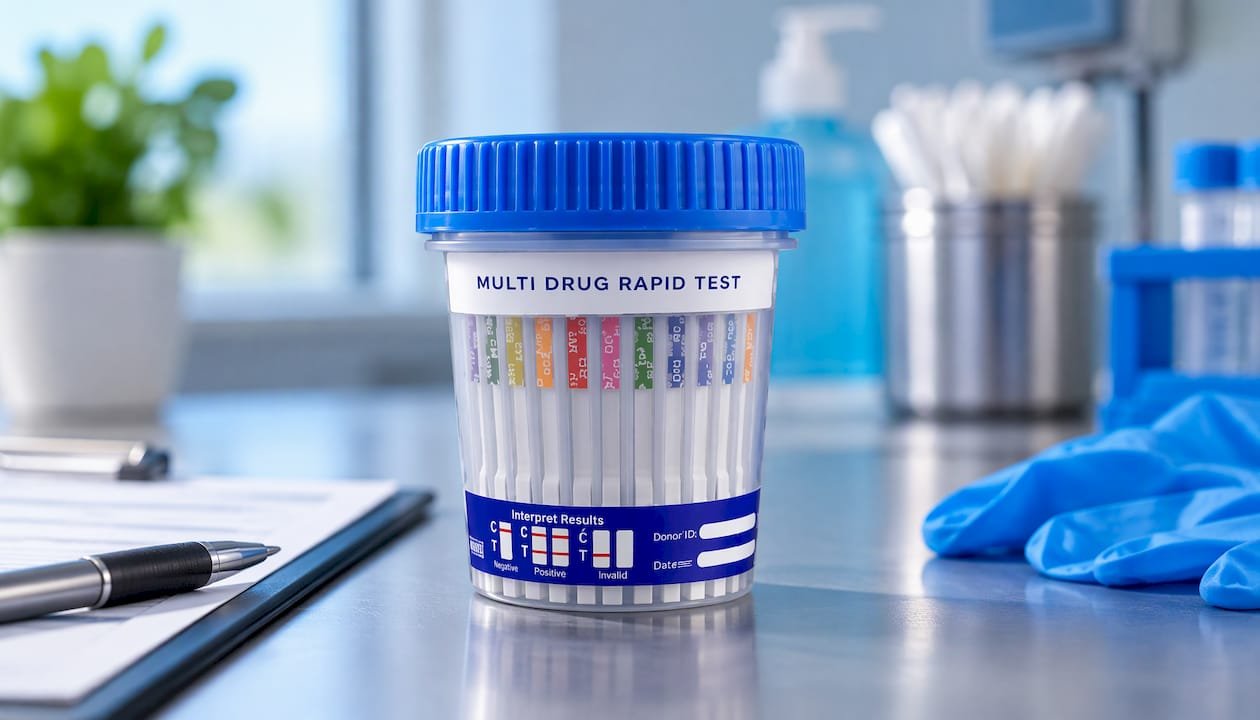
If you run several sites or reorder on a schedule, we build volume pricing and recurring orders around your testing volume. Request wholesale pricing from Mayflower Bioscience and tell us your panel, your monthly volume and your sites.
FAQ
What does a 14-panel drug test consist of?
It screens a single urine sample for 14 analytes or drug classes. The exact list depends on the cup. Our 14-panel cup includes PCP, ETG and fentanyl, and the full list is in our 14-panel analyte guide. Results are preliminary and non-negative results need lab confirmation.
How far does a drug test go back?
It depends on the specimen. Clinical and public references describe urine at roughly 1 to 7 days, saliva at hours to a few days, and hair at up to about 90 days. For a urine cup, most drugs fall in the 1 to 7 day range, with marijuana and long-acting benzodiazepines running longer.
Can a 14-panel urine test detect marijuana from weeks ago?
It can, for heavy or long-term users. The AAFP reports daily use may be detectable for 2 to 4 weeks, and very heavy use for 4 to 6 weeks or more. A single use is usually detectable for only a few days. The result depends on how much and how often someone used and on the cutoff.
Does a positive result on the cup prove drug use?
No. A rapid cup is a screen, and cross-reactivity with some medications can cause false positives. A non-negative result should be confirmed by GC/MS or LC-MS/MS before anyone makes a decision based on it.
Sources
- Clinical Drug Testing in Primary Care (SAMHSA)
- Toxicology screen (UCSF Health)
- Urine Drug Screening: Practical Guide for Clinicians (Mayo Clinic Proceedings)
- Urine Drug Tests: Ordering and Interpretation (American Family Physician)
- Mandatory Guidelines for Federal Workplace Drug Testing Programs using Urine (Federal Register)
- Recommendations for Toxicological Investigation of Drug-Impaired Driving (PMC)
- Urine drug screen interpretation addendum (University of Arizona toxicology)
- Drug test (Wikipedia)