What Does a 14 Panel Drug Test Test For? The Complete Analyte Guide
What Does a 14 Panel Drug Test Test For?
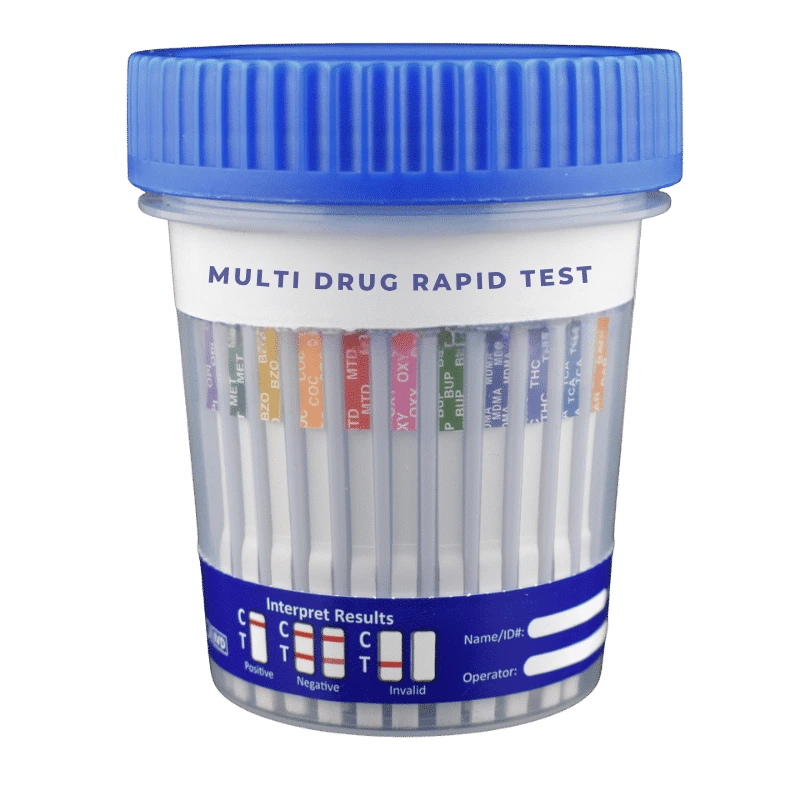
A 14 panel drug test screens one urine specimen for 14 drug classes and metabolites at the same time — amphetamine, methamphetamine, MDMA (ecstasy), cocaine, THC (marijuana), opiates, oxycodone, buprenorphine, methadone, benzodiazepines, barbiturates, PCP, fentanyl, and ETG (alcohol metabolite). Each panel has its own screening cutoff in ng/mL, and a rapid urine cup delivers preliminary results in about 5 minutes. The exact 14-analyte mix varies by manufacturer — unlike the federally defined 5-panel, there is no single universal 14-panel standard — so programs should always confirm which abbreviations appear on the cup they buy.
The 14-panel format exists because the classic 5-panel no longer matches what testing programs actually need to find. The SAMHSA model behind federal workplace testing covers five drug classes, but courts, probation offices, treatment programs, and employers increasingly need to detect synthetic opioids like fentanyl, recent alcohol use via ETG, and widely misused prescription medications such as oxycodone, buprenorphine, and benzodiazepines — all in one collection. A 14-panel cup bundles that broader coverage into a single device. SAMHSA’s workplace program guidance describes how federal testing programs are structured, while expanded panels like this one are built for state courts, treatment, and private programs that set their own panels.
The 14 Analytes: Full Panel Table
The table below lists the 14 panels in a standard expanded configuration, what each one detects, its typical immunoassay screening cutoff, and the usual urine detection window. Cutoffs vary slightly between manufacturers; confirm the values printed on your cup’s labeling.
| Panel | What it detects | Typical cutoff (ng/mL) | Typical urine window |
|---|---|---|---|
| AMP | Amphetamine (Adderall, illicit amphetamine) | 1,000 | 2–4 days |
| MET | Methamphetamine (crystal meth) | 1,000 | 2–4 days |
| MDMA | Ecstasy / Molly (MDMA) | 500 | 2–4 days |
| COC | Cocaine (benzoylecgonine metabolite) | 300 | 2–4 days |
| THC | Marijuana / cannabis (THC-COOH metabolite) | 50 | 3–30 days |
| OPI | Opiates (morphine, codeine, heroin metabolite) | 300 | 2–3 days |
| OXY | Oxycodone (OxyContin, Percocet) | 100 | 2–4 days |
| BUP | Buprenorphine (Suboxone) | 10 | 2–7 days |
| MTD | Methadone | 300 | 3–7 days |
| BZO | Benzodiazepines (Xanax, Valium, Ativan, Klonopin) | 300 | 3–7 days |
| BAR | Barbiturates (phenobarbital, secobarbital) | 300 | 2–7 days |
| PCP | Phencyclidine (angel dust) | 25 | 7–14 days |
| FEN | Fentanyl (synthetic opioid) | 20 | 1–3 days |
| ETG | Ethyl glucuronide (alcohol metabolite) | 300 | Up to 80 hours |
Fentanyl cutoff — read this before comparing cups: Fentanyl screening cutoffs are manufacturer-set; there is no single federal fentanyl cutoff for rapid cups. CLIA-waived fentanyl cups commonly use 1 ng/mL, while forensic-use cups commonly use 20 ng/mL. The 20 ng/mL value in the table above is the forensic-use configuration described in this guide — it is not the only “typical” value. A program comparing a 1 ng/mL CLIA-waived cup against a 20 ng/mL forensic-use cup is comparing two different sensitivity levels, so always check the FEN cutoff printed on the specific cup.
The stimulant group (AMP, MET, MDMA, COC) and the depressant/sedative group (BZO, BAR) cover the most common illicit and misused prescription drugs. The opioid group is deliberately deep — OPI, OXY, BUP, MTD, and FEN — because standard opiate panels miss synthetic and semi-synthetic opioids: a basic opiate strip detects morphine and codeine but will not reliably catch oxycodone, fentanyl, or buprenorphine. That gap is exactly why programs moved from 5- and 10-panel formats to 12- and 14-panel cups. Our drug test abbreviations guide decodes every panel code you will see on a cup.
Other 14-Panel Configurations: EDDP, TCA, Tramadol & Meperidine
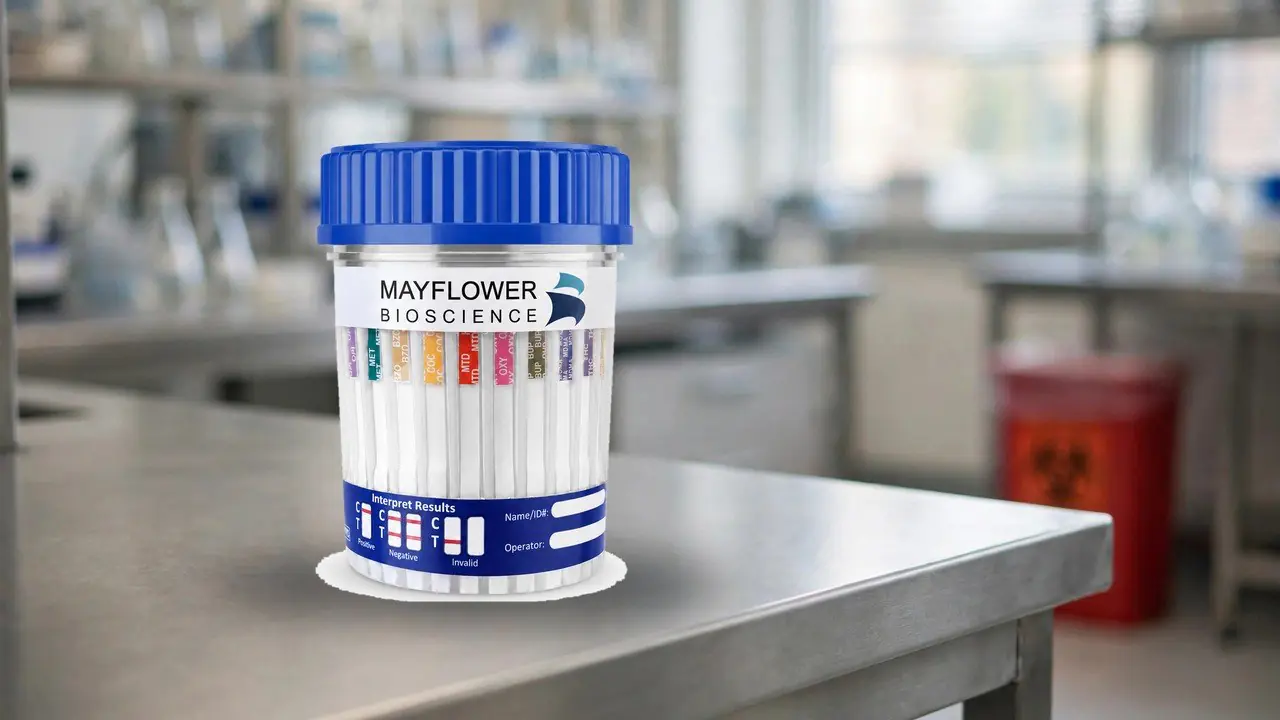
The configuration in the table above — fentanyl and ETG in the last two slots — is the one this guide (and the MayFlower cup) uses, but it is not the only 14-panel sold. Because there is no universal 14-panel standard, other manufacturers and laboratory panels fill the same 14 slots differently. Naming those variants matters: a buyer comparing two “14 panel” products may be comparing two different drug lists.
EDDP configurations. Some 14-panel cups replace parent methadone (MTD) with EDDP (2-ethylidene-1,5-dimethyl-3,3-diphenylpyrrolidine), methadone’s primary metabolite, commonly at a 300 ng/mL cutoff. EDDP only appears in urine when methadone has actually been ingested and metabolised, so an EDDP panel defeats the oldest MAT compliance trick — spiking a specimen with a few drops of methadone, which produces MTD without EDDP. It also catches extensive metabolisers, who clear parent methadone too quickly to screen positive on an MTD strip. Methadone-maintenance and MAT programs are the main buyers of EDDP configurations.
TCA configurations. Other cups use a slot for TCA — tricyclic antidepressants such as amitriptyline and nortriptyline — commonly at a 1,000 ng/mL cutoff. TCA matters in pain management and behavioural health, where tricyclics are prescribed, misused, and dangerous in overdose. On the MayFlower range, TCA sits on the expanded 16 panel drug test cup alongside kratom, rather than on the 14-panel.
Lab-panel variants: tramadol and meperidine. Laboratory 14-panels are built differently again: one common lab definition is the 12-panel plus tramadol and meperidine (Demerol). Tramadol is a synthetic opioid the standard opiate strip does not reliably detect; meperidine is an older synthetic opioid that has largely fallen out of clinical use but persists on lab menus. Some expanded lab panels also add sufentanil, a high-potency fentanyl analogue. None of these lab variants maps neatly onto a rapid cup.
The rule when comparing any two “14 panel” products: compare the printed abbreviations, not the number. If a configuration lists EDDP, TCA, tramadol or meperidine, it has traded away one of the analytes in the table above — usually ETG, PCP or fentanyl — to make room.
How Long Each Panel Stays Detectable
Detection windows differ sharply across the 14 analytes. The chart below shows typical maximum urine detection times — see the full drug detection times chart for windows by specimen type.
Two windows deserve attention when you schedule testing. THC is the long outlier — chronic daily users can test positive for up to 30 days (see how long THC stays in your system). Fentanyl is the short one: most use clears urine in 1–3 days, so programs that need to catch fentanyl test frequently rather than relying on a single wide net (details in our fentanyl drug testing guide). ETG extends alcohol detection to about 80 hours after heavy drinking — far beyond the 6–12 hours a breath test covers (see what an ETG test is).
14 Panel Drug Test Cutoff Levels
A cutoff is the concentration threshold, measured in nanograms per milliliter (ng/mL), at or above which a specimen screens positive. Below the cutoff, the result is negative — even if a trace of the drug is present. Cutoffs exist to separate meaningful use from incidental exposure and to keep immunoassay screening consistent across devices.
Each panel’s cutoff reflects the drug’s pharmacology. Buprenorphine screens at just 10 ng/mL and PCP at 25 ng/mL because these substances are active — and detectable — at low concentrations. Amphetamine and methamphetamine screen at 1,000 ng/mL, a higher bar that reduces false positives from structurally similar compounds. NIDA’s drug testing research topic covers how these screening thresholds are developed and validated, and the FDA’s drugs-of-abuse test guidance describes how manufacturers validate their devices.
One critical distinction: a 14-panel cup is a screening test, not a confirmation. A presumptive positive should be confirmed by laboratory methods such as GC-MS or LC-MS/MS before any employment, legal, or clinical decision is made. Confirmation testing also identifies the specific drug behind a class-level positive — for example, which benzodiazepine triggered the BZO panel.
14 Panel vs 12 Panel vs 16 Panel
The difference between panel counts is simply which analytes are included, and the naming is not standardized — one brand’s “12 panel” may include fentanyl while another’s does not. In the most common progression: a 12-panel cup typically covers the stimulants, THC, opiates, oxycodone, benzodiazepines, barbiturates, methadone, buprenorphine, and PCP; the 14-panel adds fentanyl and ETG alcohol; the 16-panel adds still more analytes such as kratom (mitragynine) and TCA (tricyclic antidepressants). Our 14 vs 16 panel comparison breaks down the full drug lists side by side, and the 12 panel drug test guide covers the smaller format for programs that do not need fentanyl or alcohol panels.
The practical question is not “which number is best” but “which substances does this program need to detect.” A pain-management clinic monitoring opioid compliance needs the deep opioid stack (OPI, OXY, BUP, MTD, FEN). A drug court supervising alcohol abstinence needs ETG. A workplace doing pre-employment screens may need neither. Buying panels you do not need wastes money; missing panels you do need wastes the whole test.
MayFlower’s wholesale drug test supplies cover exactly the 12, 14 and 16 panel configurations compared above, so the panel list in this guide can be matched strip-for-strip against a stocked cup.
Who Uses a 14 Panel Drug Test Cup?
Fourteen-panel cups are the workhorse of programs with broad detection mandates. Drug courts and probation departments use them because participants may use anything from methamphetamine to fentanyl to alcohol — and the ETG and FEN panels close the two biggest gaps in older formats. Medication-assisted treatment (MAT) programs use them to monitor buprenorphine and methadone compliance while checking for relapse to other substances. Employers in safety-sensitive industries use them for reasonable-suspicion and post-accident testing where the substance is unknown. Clinical and behavioral health programs use them at intake to get a complete substance-use picture in five minutes.
The same configuration serves four settings for four different reasons:
| Setting | Why this 14-panel configuration fits | Go deeper |
|---|---|---|
| Probation | Participants can relapse to almost anything; the FEN strip catches the shortest-window drug and ETG verifies alcohol abstinence for up to 80 hours. | Drug testing in correctional facilities |
| Drug court | Court-ordered testing needs documented chain of custody and defensible, confirmable results — forensic-use configurations pair this panel list with court-ready collection paperwork. | Forensic-use drug test cups |
| MAT / treatment | The BUP and MTD strips verify medication compliance at the same visit where OPI, OXY and FEN check for relapse to other opioids. | Drug testing programs for rehab & treatment centers |
| Workplace | Broad coverage for reasonable-suspicion and post-accident testing in safety-sensitive roles, where the substance involved is unknown. | Drug testing for construction companies |
Because these programs test at volume, most buy wholesale drug test cups with free shipping on 100+ units. Programs with forensic or court-admissibility requirements should choose forensic-use cups with documented chain-of-custody features, while clinics performing waived testing use CLIA-waived cups. The 14 panel drug test cup collection — including the 14 Panel Drug Test Cup with PCP, ETG & Fentanyl — matches the exact configuration described in this guide.
How to Read a 14 Panel Drug Test Cup Result
Each of the 14 strips works the same way: two lines (C for control, T for test) mean negative, one control line only means presumptive positive, and no control line means the test is invalid and must be repeated. Read results at the time specified in the labeling — usually 5 minutes — because reading too late can produce evaporation lines that look like faint test lines. MedlinePlus’s drug testing overview explains how these rapid immunoassay results fit into the broader testing process. Validity checks matter as much as the strips: confirm the specimen temperature is within 90–100°F within 4 minutes of collection and check the adulteration indicators before trusting any line.
Frequently Asked Questions
What does a 14 panel drug test test for?
A 14 panel drug test screens urine for 14 drug classes and metabolites: amphetamine (AMP), methamphetamine (MET), ecstasy/MDMA, cocaine (COC), marijuana/THC, opiates (OPI), oxycodone (OXY), buprenorphine (BUP), methadone (MTD), benzodiazepines (BZO), barbiturates (BAR), PCP, fentanyl (FEN), and ETG alcohol metabolite. Exact configurations vary by manufacturer, so check the panel abbreviations on the cup.
Does a 14 panel drug test detect fentanyl?
Most modern 14-panel configurations include a dedicated fentanyl (FEN) panel. The cutoff depends on the cup type: CLIA-waived fentanyl cups commonly screen at 1 ng/mL, while forensic-use cups commonly screen at 20 ng/mL — fentanyl cutoffs are manufacturer-set, so neither value is the single universal “typical” one. Older or budget 14-panel formats may substitute a different analyte, so confirm FEN is listed before buying. Our fentanyl drug testing guide covers detection windows and result interpretation.
Does a 14 panel drug test detect alcohol?
Yes, when the configuration includes ETG (ethyl glucuronide), the direct metabolite of ethanol. ETG extends alcohol detection to about 80 hours after heavy drinking, compared with 6–12 hours for a breath test. Learn more in what an ETG test is.
What are the cutoff levels on a 14 panel drug test?
Typical screening cutoffs: AMP 1,000 ng/mL, MET 1,000, MDMA 500, COC 300, THC 50, OPI 300, OXY 100, BUP 10, MTD 300, BZO 300, BAR 300, PCP 25, FEN 20, and ETG 300 ng/mL. At or above the cutoff screens positive; below it screens negative. Values vary slightly between manufacturers. Fentanyl needs one qualification: the 20 ng/mL listed here is the forensic-use value — CLIA-waived fentanyl cups commonly use 1 ng/mL instead (see the note under the panel table).
How long does a 14 panel drug test detect drugs in urine?
Most panels detect use for 2–4 days. The long exceptions are THC (up to 30 days in chronic users), PCP (7–14 days), and methadone, buprenorphine, benzodiazepines, and barbiturates (up to 7 days). Fentanyl clears fastest at 1–3 days. See our drug detection times chart for the full breakdown.
Is there a standard 14 panel drug test, or do configurations vary?
There is no single universal standard — unlike the SAMHSA 5-panel used in federal workplace testing, 14-panel configurations are set by each manufacturer. One brand’s 14-panel may include fentanyl and ETG while another includes tramadol or TCA instead. Always compare the printed panel list, not just the panel count.
Does a 14 panel drug test detect kratom?
Standard 14-panel cups do not include a kratom (mitragynine) panel — kratom requires a dedicated KRA strip, found on expanded 16-panel formats. Programs monitoring kratom use should check our kratom drug testing guide and 14-panel cup options.
What is the difference between a 12, 14, and 16 panel drug test?
The 14-panel typically adds fentanyl and ETG alcohol to the 12-panel base; the 16-panel adds further analytes such as kratom and TCA. More panels mean broader coverage and higher cost — choose based on which substances your program must detect. Compare the full lists in our 14 vs 16 panel comparison.
Can a 14 panel drug test be wrong?
Rapid cups are screening devices with known cross-reactivity — for example, certain cold medicines or poppy seeds can trigger presumptive positives. That is why every non-negative screen should be confirmed by laboratory GC-MS or LC-MS/MS before employment, legal, or clinical decisions. A confirmation identifies the exact drug behind a class-level positive.
What is EDDP on a 14 panel drug test?
EDDP (2-ethylidene-1,5-dimethyl-3,3-diphenylpyrrolidine) is the primary metabolite of methadone. Some 14-panel configurations test EDDP — commonly at a 300 ng/mL cutoff — instead of, or alongside, parent methadone (MTD). MAT and methadone-maintenance programs prefer it because EDDP only appears in urine when methadone has actually been ingested and metabolised: spiking a specimen with methadone produces MTD without EDDP, and extensive metabolisers who clear parent methadone quickly still show EDDP. The MayFlower 14-panel configuration tests parent methadone (MTD) — see “Other 14-Panel Configurations” above for how the variants compare.