Drug Testing Programs for Rehab and Treatment Centers
Drug Testing in Rehab Centers: Panels, Cadence & Program Guide
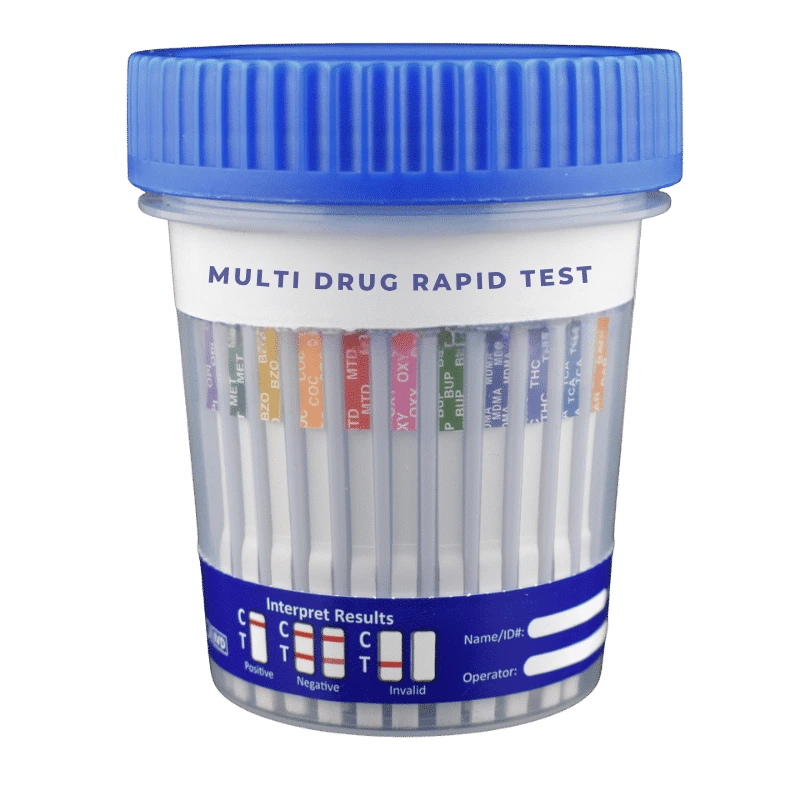
Drug testing in rehab centers follows a structured program: a comprehensive urine screen at admission to establish a baseline, scheduled plus random testing throughout treatment to monitor abstinence and catch relapse early, and panels chosen for the substances a treatment population actually uses — fentanyl, opioids, benzodiazepines, and alcohol via the ETG metabolite. A point-of-care multi-panel cup runs the screen on site in about five minutes; any presumptive positive that will affect the treatment plan is confirmed by a laboratory before the clinical team acts on it.
Unlike workplace testing, testing in addiction treatment is a clinical tool, not a disciplinary one. The result is data — it tells the treatment team what a patient has been exposed to, whether the current plan is working, and when the level of care needs to change.
Why Treatment Programs Test: Three Clinical Jobs
A drug testing program in a treatment center does three distinct jobs, and each one shapes how the program should be built:
- Admission baseline. The intake screen documents what is in a patient’s system on day one. Self-report at admission is notoriously incomplete — patients minimize, forget, or genuinely do not know what a street drug contained. A baseline result protects the medical team during detox (an undisclosed benzodiazepine dependence, for example, changes withdrawal management entirely).
- Relapse monitoring. Addiction is a chronic, relapsing condition, and resumed use during treatment is common. Routine testing detects use days or weeks before it surfaces in behavior, while intervention is still simple. A run of documented negatives is also objective evidence of progress, supporting step-down decisions and court reports.
- Milieu safety. Residential and inpatient settings house dozens of people in early, fragile recovery together. A visible, consistently applied testing program is a structural deterrent that keeps the therapeutic environment safe.
SAMHSA’s substance use treatment resources frame testing as one component of a monitored treatment plan: objective monitoring improves retention and outcomes because clinicians respond to use as a clinical event rather than discovering it at discharge.
Which Panels Treatment Centers Use — and Why
Treatment panels are wider than workplace panels because the clinical questions are wider: a treatment screen asks exactly which substances a patient is exposed to, including the ones that create medical risk. The analytes that drive panel selection:
- Fentanyl (FEN). The standard opiate (OPI) strip does not detect fentanyl — it is a synthetic opioid that needs its own strip. Given fentanyl’s dominance in the illicit opioid supply, a treatment panel without a dedicated fentanyl strip has a dangerous blind spot. The fentanyl drug test cups page details the panel configurations that include it.
- ETG alcohol. Alcohol is the most commonly used substance in most treatment populations, but breath and urine ethanol tests detect it for only a few hours. The EtG (ethyl glucuronide) metabolite extends the urine detection window to roughly 80 hours, which is what makes abstinence monitoring between sessions realistic. See the ETG alcohol drug test cups collection for how ETG panels are configured.
- Kratom (mitragynine). Kratom is legal in many states, sold openly, and widely used by people self-managing opioid withdrawal — which means it shows up constantly in treatment populations while remaining invisible to standard panels. The kratom drug test cups page covers mitragynine testing in detail.
- Buprenorphine and methadone (BUP / MTD). For patients in medication-assisted treatment, these strips work in reverse: the program expects them to be present. A negative buprenorphine strip on a patient prescribed Suboxone is itself a finding — it can signal diversion or non-adherence — while a positive confirms adherence.
- The classic core. THC, cocaine, amphetamines/methamphetamine, benzodiazepines, barbiturates, opioids, oxycodone, and PCP round out the panel — polysubstance use is the norm in treatment populations.
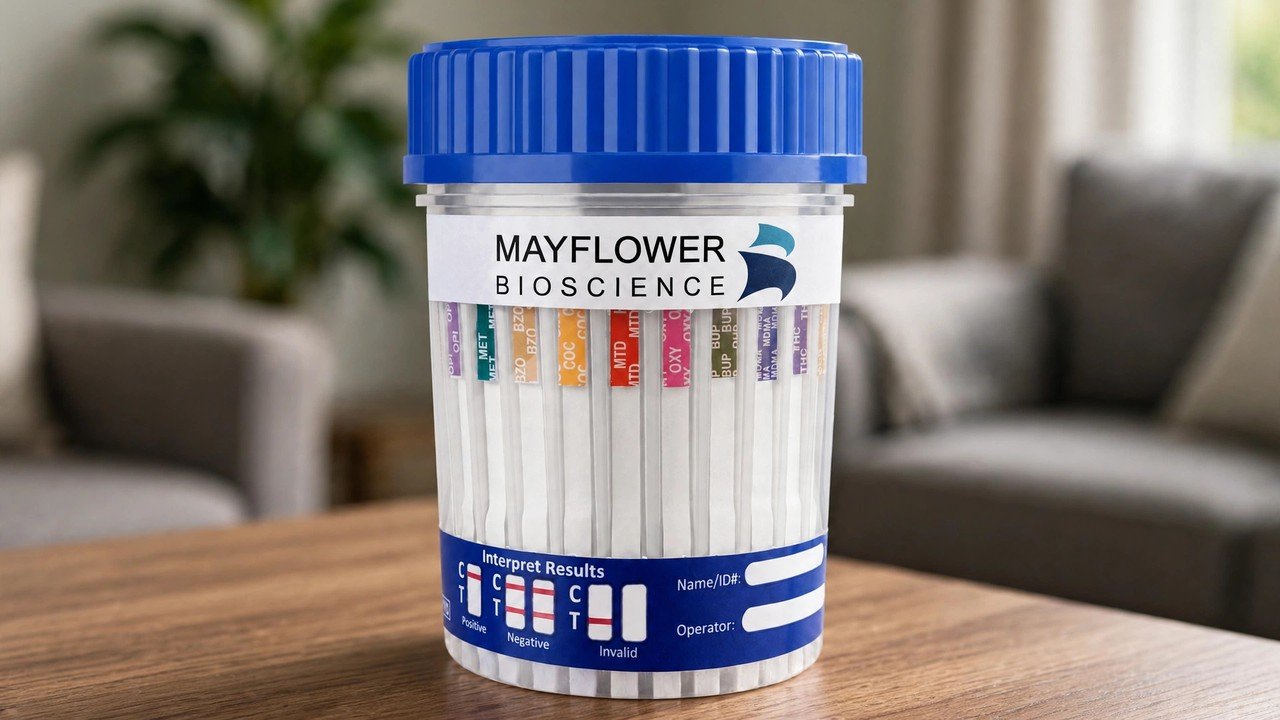
This is why treatment centers gravitate to the widest panels available: MayFlower’s 16 panel drug test cups combine the classic core with fentanyl, ETG, and kratom in a single collection, so one specimen answers the full clinical picture.
Urine vs. Blood, Saliva and Hair Testing in Rehab
Urine is the working specimen in treatment, and the other three methods answer narrower questions. Urine’s window — days, not hours — is long enough to catch use between sessions, a cup returns a result in about five minutes on site, and built-in temperature and validity checks make substitution hard. Blood, saliva, and hair each trade that practicality for one specific advantage, which is why programs use them as supplements rather than replacements:
| Method | Detection window | Collection complexity | Typical use in rehab |
|---|---|---|---|
| Urine | Most drugs 1–4 days; ETG alcohol up to about 80 hours; THC longer — weeks in chronic users. Substance-by-substance windows are in the drug detection times chart. | Low — point-of-care cup at the facility, result in about 5 minutes, validity checked on the cup | The routine program specimen: admission baseline, scheduled and random monitoring, and for-cause testing at every level of care |
| Blood | Hours to about 1–2 days for most drugs | High — venipuncture by trained medical staff; laboratory analysis only; no point-of-care option | Medical questions, not monitoring: suspected very recent use during a detox assessment, or when a patient cannot provide a urine specimen |
| Saliva (oral fluid) | About 1–48 hours for most drugs | Low to moderate — observed swab collection that is hard to substitute, read on a device or at a laboratory | Very recent use, and settings where observed urine collection is impractical or clinically inappropriate |
| Hair | Up to about 90 days; cannot detect use in roughly the last week | Moderate — a small sample cut at the scalp; laboratory analysis only; results take days | Retrospective history at admission: verifying — or challenging — a claimed period of abstinence before treatment began |
Windows vary with the substance, dose, frequency of use, and cutoff, so the matrix above is a planning guide rather than a promise for any single result. For routine monitoring, no alternative matches urine’s combination of window, cost, and on-site speed — which is why the rest of this guide is built around urine cups.
Testing Cadence by Level of Care
Frequency follows structure: the more intensive the level of care, the more often the program tests — and the less predictable the schedule should be. Common practice across the ASAM continuum of care:
| Level of care | Typical testing cadence | Primary purpose |
|---|---|---|
| Detox / withdrawal management | At admission, then as clinically indicated | Baseline for safe withdrawal management; confirm what is on board before medications are set |
| Residential / inpatient | 2–3× per week, random, plus for-cause | Milieu safety, relapse detection, pass/leave verification on return to the facility |
| PHP (partial hospitalization) | 2× per week, random | Monitor abstinence during the high-risk transition out of 24-hour care |
| IOP (intensive outpatient) | 1–2× per week, random | Ongoing monitoring while the patient lives at home and attends sessions |
| Outpatient / aftercare | Weekly to monthly, random | Long-term accountability, documentation for courts/employers, early relapse warning |
Two design rules matter more than the exact numbers. First, random beats scheduled: a patient who knows testing happens every Monday can time use around it, because most analytes clear urine in 2–4 days (the drug detection times chart lists every window). Second, for-cause testing — on behavioral signs, after passes, or after an incident — belongs in the written policy alongside the routine schedule.
Observed vs. Unobserved Collection in Treatment Settings
Collection method is a clinical and ethical decision in treatment, not just a security one. Unobserved collection respects patient dignity and the therapeutic alliance, and it is the default in most outpatient settings. Directly observed collection — a trained same-gender staff member witnessing the specimen being provided — is more common at admission, in residential settings, and whenever a prior specimen was invalid, dilute, or inconsistent.
Most programs land on a tiered policy: unobserved collection with strong specimen-validity checks as the baseline (temperature strip read within 4 minutes, validity pads checked on every cup — the full procedure is in our guide on how to read a drug test cup), escalating to observed collection when validity fails or clinical suspicion is documented. The validity checks do much of the work: a specimen in the 90–100°F window with normal creatinine and specific gravity is very difficult to fake.
Specimen Validity in Treatment Settings
Validity problems take a specific shape in treatment. Outright substitution and chemical adulteration happen, but the most common finding by far is the dilute specimen — creatinine and specific gravity below the normal range, usually from heavy water loading before a scheduled test. A dilute negative is not proof of use, and it is not a clean negative either; it is an inconclusive result that policy must answer in advance. Our full breakdown of dilute drug test results covers the creatinine/specific-gravity criteria and the recollection policies programs use, including observed recollection after a low-creatinine negative.
The practical workflow: check the temperature strip on every collection, read the validity pads at the time the package insert specifies, document abnormal findings in the chart, and apply the written dilute/invalid policy uniformly. Inconsistency — recollecting for one patient and accepting the same result from another — is what turns a validity finding into a grievance.
What Happens When a Test Is Positive: A Clinical Response, Not a Punishment
The defining difference between treatment testing and workplace testing is what a positive triggers. In a treatment program, a confirmed positive is clinical information, and the response runs through the treatment plan:
- Clinical conversation first. The counselor reviews the result with the patient. Denial, admission of use, and disclosure of a full relapse pattern each lead somewhere different therapeutically.
- Treatment plan revision. A positive usually means the current plan is under-powered: session frequency increases, a higher level of care is assessed, medication-assisted treatment is started or adjusted, or relapse triggers are built into the safety plan.
- Level-of-care review. Repeated positives at an outpatient level are the standard clinical justification for stepping up to IOP, PHP, or residential care — the results become the documentation supporting the referral and insurance authorization.
- Consequences with a clinical frame. Programs do set boundaries — loss of pass privileges in residential care, notification to a referring court where the court has ordered it — but discharge for a single positive is poor practice and increasingly rare. Relapse is a symptom of the condition being treated; the program’s job is to respond to it, not to expel it.
None of this works on an unconfirmed screen. A cup result is presumptive: immunoassay strips cross-react, and a result that will change a treatment plan, a court report, or a custody recommendation must be confirmed by GC-MS or LC-MS/MS at a laboratory first, with chain of custody intact. NIDA’s drug testing research resources and MedlinePlus’s drug testing overview both cover why screening requires laboratory confirmation before consequential decisions.
Consent, Confidentiality and the Written Testing Policy
Testing in treatment runs on consent in a way workplace testing does not. Before the first collection — normally at admission — the program explains the testing program to the patient in writing and documents their consent: which panel is used, when testing happens (admission, random, and for-cause), whether collection is observed, how results will be used clinically, who outside the program may receive them, and what a positive result triggers. Where treatment is court-ordered or employer-referred, the reporting obligation is stated explicitly in that consent, so no patient learns about a disclosure after it has happened.
Confidentiality law then controls what the program may do with the result. Test results are health records: HIPAA governs protected health information generally, and substance use disorder records from federally assisted treatment programs carry an additional, stricter layer under 42 CFR Part 2, SAMHSA’s confidentiality regulation. Part 2 generally requires the patient’s written consent before a program discloses records that identify them as receiving SUD treatment, attaches a prohibition on redisclosure, and restricts the use of Part 2 records in legal proceedings against the patient without consent or a court order. The 2024 Part 2 final rule aligned parts of the regulation with HIPAA — including a single consent for treatment, payment, and health care operations — while keeping those SUD-specific protections. The operational rule for a testing program is simple: the signed consent, not habit, defines who receives a result.
Both duties — consent and confidentiality — belong in the written testing policy, alongside the operational rules covered earlier in this guide. A complete policy contains:
- The panel and cutoffs — which substances are tested, on which device, at which thresholds.
- Testing occasions — admission, the random cadence for each level of care, and the for-cause triggers.
- Collection procedure — the observation tiers, temperature and validity checks, and chain of custody for specimens sent out.
- Validity responses — exactly what happens after a dilute, invalid, or substituted specimen, including recollection rules.
- Confirmation — laboratory GC-MS or LC-MS/MS confirmation before any result changes a treatment plan or leaves the program.
- Confidentiality and consent — who receives results, under which signed consent, and how Part 2 redisclosure limits are honoured.
- Clinical response — the non-punitive pathway a confirmed positive triggers, from plan revision to level-of-care review.
- Documentation and retention — what is recorded for every test, where it is filed, and how long it is kept.
- Uniform application — the same rules for every patient, regardless of payer, referral source, or how well staff know them; selective enforcement is what converts a clinical tool into a grievance.
Building the Program: Devices, Documentation, and Supply
A treatment testing program runs on consistency: the same panel at every site, the same collection procedure on every shift, and a result form that captures the donor ID, temperature reading, validity findings, per-strip results, and operator initials. Programs testing at volume standardize on one cup configuration — typically a 14 or 16 panel drug test cup covering fentanyl, ETG, and kratom alongside the classic analytes — so a result means the same thing in detox, in residential, and in the IOP office across town.
Two planning points belong in the same document. A facility that runs waived cups in-house needs a CLIA Certificate of Waiver covering each testing site — how to get a CLIA waiver certificate walks through the CMS-116 application, the current fee, and the compliance duties that follow. And a program standardizing supply across sites can compare the full range of wholesale drug test supplies MayFlower offers treatment facilities before fixing one configuration in policy.
MayFlower’s 12, 14, and 16 panel cups are CLIA-waived point-of-care devices with built-in temperature strips and validity pads, read at 5 minutes and confirmed at the lab when it matters — with wholesale pricing structured for facilities that test every day. Choose the panel against your population’s substance profile, write the cadence and validity policies before the first admission, and the testing program becomes a quiet piece of clinical infrastructure the treatment team can trust.
Frequently Asked Questions
Do rehab centers drug test on admission?
Yes — an admission (intake) urine screen is standard practice in detox, residential, and most structured outpatient programs. It establishes an objective baseline of what is in the patient’s system, which the medical team needs for safe withdrawal management (an undisclosed benzodiazepine or alcohol dependence changes detox protocol) and the clinical team needs as the starting point for the treatment plan. Self-report alone is not considered sufficient, because patients commonly under-report or do not know what a street drug contained.
How often do rehab centers drug test?
It depends on the level of care. Detox tests at admission and as clinically indicated; residential programs typically test 2–3 times per week on a random basis, plus for-cause and on return from passes; PHP usually tests twice weekly; IOP once or twice weekly; and outpatient or aftercare weekly to monthly. Random scheduling matters more than the exact frequency, because most drugs clear urine in 2–4 days and a predictable test day can be timed around.
What drugs do rehab centers test for?
Treatment panels are wider than standard workplace panels. The typical treatment panel covers THC, cocaine, amphetamines and methamphetamine, opiates, oxycodone, benzodiazepines, barbiturates, methadone, buprenorphine, and PCP — plus three analytes that matter specifically in treatment: fentanyl (which the standard opiate strip cannot detect), ETG alcohol, and kratom (mitragynine). Wide 14 and 16 panel cups combine all of these in a single collection.
Does rehab test for alcohol?
Yes, and usually with an ETG test rather than a breathalyzer. Breath and urine ethanol only detect alcohol for a few hours after drinking, which is nearly useless for monitoring abstinence between sessions. ETG (ethyl glucuronide) is a metabolite that remains detectable in urine for up to about 80 hours, so an ETG panel can identify drinking that happened days earlier — the window ongoing monitoring actually needs.
What happens if you test positive in rehab?
A positive result in treatment is handled as clinical information, not an automatic expulsion. After laboratory confirmation, the counselor reviews the result with the patient, and the treatment team typically revises the plan — more frequent sessions or testing, a medication adjustment, or a level-of-care review that may recommend stepping up from outpatient to IOP, PHP, or residential care. Programs may apply policy consequences such as loss of pass privileges in residential settings or notification to a referring court, but discharge for a single positive is uncommon because relapse is a symptom of the condition being treated.
Are drug tests in rehab observed?
Sometimes. Unobserved collection is the default in most outpatient settings, backed by temperature and specimen-validity checks on every cup. Directly observed collection — by a trained staff member of the same gender — is more common at admission, in residential programs, and after a specimen comes back dilute, invalid, or inconsistent. Most programs write a tiered policy: unobserved with validity checks first, observed collection when validity fails or clinical suspicion is documented.
Can a rehab drug test detect fentanyl?
Only if the panel includes a dedicated fentanyl strip. Fentanyl is a synthetic opioid that the standard opiate (OPI) strip does not detect, so a basic panel will miss it entirely. Because fentanyl dominates the illicit opioid supply and drives overdose risk, treatment programs should specifically choose panels with a FEN strip — it is included in MayFlower’s fentanyl-configured 12 panel and its 14 and 16 panel cups.
Do treatment centers test for kratom?
Increasingly, yes. Kratom (tested via its mitragynine metabolite) is widely available and frequently used by people self-managing opioid withdrawal, so it appears often in treatment populations — but it is invisible to standard drug panels. A program that wants to see kratom use needs a panel with a dedicated kratom strip, such as a 16 panel cup; without one, kratom use during treatment goes undetected.
What should be included in a drug testing policy for a rehabilitation center?
A complete written policy names: the panel and cutoffs used; when testing happens — admission, the random cadence for each level of care, and for-cause triggers; the collection procedure, including when collection is observed; specimen-validity criteria and what happens after a dilute or invalid result; laboratory confirmation by GC-MS or LC-MS/MS before any result changes a treatment plan or is reported outside the program; confidentiality and consent rules under HIPAA and 42 CFR Part 2, including exactly who receives results; the clinical, non-punitive response to a confirmed positive; and documentation and record-retention requirements. The policy should apply uniformly to every patient.
What panel drug test do treatment centers use?
Most treatment centers use wide multi-panel cups — typically 12, 14, or 16 panels — because polysubstance use is the norm in treatment populations and narrow panels leave clinically important gaps. A 16 panel cup is the common choice for full monitoring programs because it adds fentanyl, ETG alcohol, and kratom to the classic drug classes in one collection. The right panel is the one that matches the population’s substance profile, applied consistently at every level of care the program operates.