Drug Testing for Construction Companies: Building a Compliant Program
Construction Drug Testing
Construction drug testing is a written workplace program that screens construction workers for drugs at defined events — hiring, random selection, after incidents, and on reasonable suspicion — most commonly with urine tests run on site or at a clinic. No single federal law requires it for most construction workers; the drivers are safety, project-owner and general-contractor requirements, insurance, and, for CDL drivers inside the same company, federal DOT rules. A compliant program is built before the first test: a written policy, defined testing events, a panel matched to the industry’s actual risks, trained supervisors, and laboratory confirmation of every positive screen.
Construction is not a generic workplace. The work happens at height, around heavy equipment, energized systems, and trenches, often with multiple employers sharing one site and crews that change by the week. That combination — high-hazard tasks, a transient workforce, and layered contractor responsibility — is exactly what a drug testing program has to be designed for, and why copying an office policy does not work on a job site.
Why Construction Companies Test
The Numbers: Substance Use in Construction
- Substance use disorder: 14.3% of construction workers — about 1 in 7 — had a substance use disorder in the past year, compared with 9.5% of full-time workers across all industries (SAMHSA analysis of NSDUH data, 2008–2012).
- Heavy alcohol use: 16.5% of construction workers reported heavy alcohol use in the past month — the second-highest rate of any industry, behind only mining (17.5%).
- Overdose deaths: construction recorded the highest drug overdose death rate of any industry in 2020 — 130.9 deaths per 100,000 workers, about three times the rate for workers overall (42.1 per 100,000) (CDC reporting on opioids in construction).
Four forces drive construction drug testing, and a defensible program can name all four:
- The hazard profile. Construction consistently records one of the highest workplace fatality and injury rates of any U.S. industry. Impairment around cranes, scaffolds, excavators, and energized panels turns an ordinary error into a multi-casualty event, which is why safety-sensitive trades treat screening as an engineering-adjacent control, not an HR formality. OSHA’s construction safety resources frame impairment as one element of a broader safety and health program.
- Owner and general-contractor flow-downs. On large commercial, industrial, and public projects, the project owner or GC sets substance-testing requirements in the contract, and every subcontractor on site must comply to keep its crews badged. For many mid-size contractors, the program exists because the work they bid on requires it.
- Insurance and bonding. Workers’ compensation carriers and sureties routinely ask whether a documented testing program is in place, and experience-modifier calculations reward employers who can show one.
- Regulated roles inside the company. A construction firm is often also a motor carrier: its CDL drivers fall under federal DOT testing even though its carpenters and laborers do not. Running both regimes under one policy document is where most compliance mistakes start.
One boundary is essential. OSHA does not mandate blanket drug testing in construction, and its recordkeeping rule (29 CFR 1904.35) prohibits using post-incident testing to retaliate against or discourage injury reporting. Post-incident testing is permitted when there is a reasonable possibility that drug use contributed to the incident — not automatically for every reported injury. Programs that test every injury regardless of circumstances are the ones OSHA has warned about; programs that test on documented, incident-specific grounds are defensible.
Who Requires Construction Drug Testing?
Requirements come from several directions at once, and a worker on a large site may be covered by more than one:
- Federal DOT rules — mandatory for CDL drivers operating commercial motor vehicles, including those employed by construction firms: the fixed 5-panel, HHS-certified laboratory testing, and MRO review described in our DOT drug testing guide.
- Drug-Free Workplace Act of 1988 — any organization holding a federal contract of $100,000 or more, and any organization receiving a federal grant of any size, must maintain a drug-free workplace as a condition of the award: a published policy statement prohibiting controlled substances in the workplace, a drug-free awareness program, and defined consequences for violations, as set out in SAMHSA’s guidance for federal contractors and grantees. The Act requires the policy, not testing itself — but on federal and federally funded projects it is the legal floor the testing program is built on.
- Project contracts — owner/GC flow-down clauses specifying events, panels, and consequences for every tier of subcontractor.
- State law — a patchwork: some states regulate how testing may be done (notice, licensed labs, confirmation rights), some restrict marijuana discipline, and a few public-works statutes require testing on state projects.
- Company policy and collective bargaining agreements — for union workforces, testing terms are frequently negotiated into the CBA, including random pool percentages and return-to-duty terms.
Everything outside the DOT lane is non-DOT testing — governed by the written policy, the contract, and state law rather than a federal rulebook. That freedom is useful (panels can match site risks), but it means the policy document itself is the compliance program: if an event, cutoff, or consequence is not written down, it is hard to defend.
The Five Testing Events in a Construction Program
Construction programs are organized around events, not calendars. The standard set:
| Event | When it happens | Construction notes |
|---|---|---|
| Pre-employment / pre-access | After a conditional offer, before site access or badging | The gateway test on most large projects; new-hire and re-hire crews are screened before mobilization |
| Random | Unannounced, spread across the project, from a defined pool | Pool definition matters on multi-employer sites — each employer runs its own pool; selection method must be genuinely random and documented |
| Post-incident | After an accident or near-miss where impairment may have contributed | Must rest on a reasonable possibility of contribution (OSHA 1904.35); testing every injury report indiscriminately risks a retaliation finding |
| Reasonable suspicion | When a trained supervisor documents specific observations | Behavior, speech, appearance, odor — documented contemporaneously; the most legally sensitive event and the one training exists for |
| Return-to-duty / follow-up | After a policy violation and any required evaluation/treatment | Unannounced follow-up testing for a defined period; terms often set by policy or CBA |
The pre-employment drug testing guide covers the hiring-stage workflow in full. The point for program design: each event needs its own trigger definition, its own notification path (foreman, safety director, DER-equivalent), and its own consequence — the same cup, five different procedures.
Choosing the Panel: What Construction Actually Needs to Catch
Panel choice in construction is driven by two industry-specific facts. First, the sector’s dominant substance risks are opioids and stimulants. Construction workers perform physically destructive work, injury rates are high, and prescription opioid exposure after injuries is common — the pathway from a treated back injury to opioid misuse is a recognized industry problem in NIDA’s drug testing research. A panel that screens opiates but misses fentanyl — which standard opiate strips do not detect — has a hole exactly where the industry’s risk is worst. Expanded panels with a dedicated fentanyl strip, plus oxycodone and other semi-synthetics, are the practical baseline for safety-sensitive trades.
Second, marijuana policy is the industry’s live tension. THC is legal for adults in many states where construction is booming, yet it remains impairing, remains on every federal panel, and remains prohibited on most large project sites. Employers outside DOT coverage must decide — in writing — whether THC stays on their panel, knowing that state law may limit discipline for off-duty use in some jurisdictions while project contracts may demand THC screening regardless. There is no national answer; there is only a documented one. Whatever the decision, cutoff levels should follow the SAMHSA reference values so results stay comparable with laboratory reports.
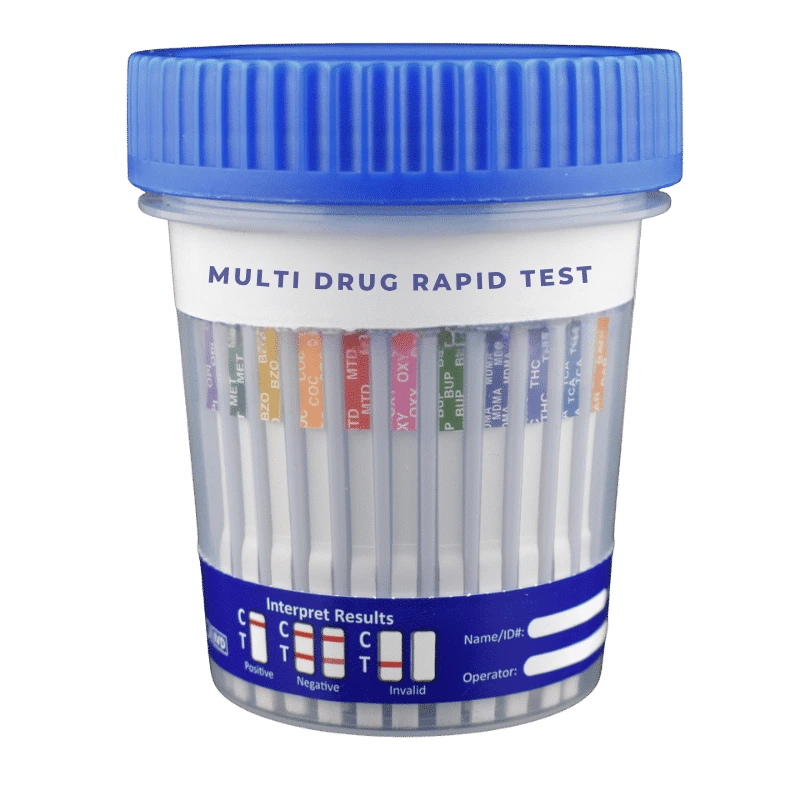
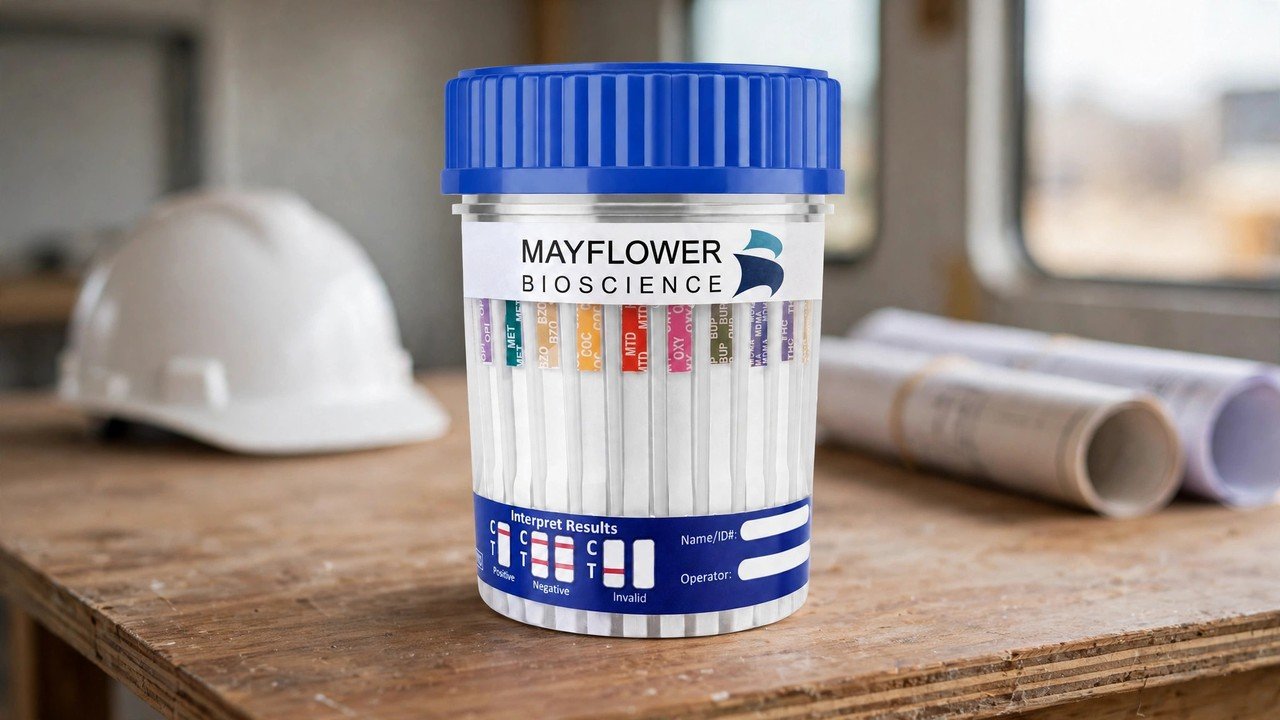
In practice, most multi-trade programs standardize on an expanded panel — MayFlower’s 12 panel drug test cups and its 14 and 16 panel configurations add fentanyl, ETG alcohol, and other analytes the federal five leaves out — one device, one procedure, one cutoff set across every crew and every event. The configuration most multi-trade programs standardize on is the 12 panel drug test cup, and contractors running several sites at once source it with the rest of their wholesale drug test supplies so every crew, on every site, tests to the same standard.
Running On-Site Testing With Rapid Cups
Jobsite reality: the nearest clinic may be 40 minutes away, the crew starts at 6 a.m., and a post-incident test loses value with every hour of delay. That is why construction programs lean on point-of-care urine cups collected on site:
- Set up a collection point. The site trailer or a designated restroom, secured for the collection: no running water access during collection where feasible, supplies sealed until use, and a private space that still allows the collector to control the process.
- Collect and check temperature. Donor initials the label, specimen is checked against the 90–100°F strip within 4 minutes — on a site with stored-sample risks, the temperature check is the first integrity control.
- Read at 5 minutes, never after 10. Control line, test line, validity pads — the full procedure in how to read a drug test cup. A result read late is a result a grievance can unwind.
- Act on screens correctly. A negative clears the worker per policy. A presumptive positive means removal from safety-sensitive duties pending confirmation — the sealed specimen goes to a laboratory for GC-MS or LC-MS/MS, because no cup result, construction or otherwise, is final on its own. MedlinePlus’s drug testing overview explains the screen-then-confirm structure workers will ask about.
- Document everything. Donor ID, event type, collector, result, lot number, and chain of custody for anything sent to a lab. On multi-employer sites, records stay with the employing company, not the GC, unless the contract says otherwise.
SAMHSA’s drug-free workplace framework is written for federal programs, but its structure — policy, trained collectors, confirmation, review — is the template non-DOT construction programs adapt. Programs testing across many simultaneous sites standardize the device and the paperwork through wholesale drug test cups so a foreman in one state runs the identical procedure as a superintendent in another.
Where oral fluid fits. Some sites add saliva (oral fluid) testing alongside urine cups. Collection is directly observed and needs no restroom, which makes substitution and adulteration much harder, and suits post-incident and reasonable-suspicion events on remote sites. The trade-off is the window: oral fluid detects the parent drug over roughly the past 24–48 hours for most analytes, so it answers “is this worker impaired now?” far better than “did this worker use last week?” Programs therefore use it as a recent-use complement to the urine cup, not a replacement — and a presumptive oral-fluid positive still goes to a laboratory for confirmation, exactly like a cup result.
Supervisor Training: The Reasonable-Suspicion Backbone
Every event in the table is mechanical except one. Reasonable-suspicion testing stands or falls on a foreman’s ability to observe, document, and escalate: slurred speech, unsteady gait, the smell of alcohol or marijuana, erratic behavior, a marked change from the worker’s normal presentation. DOT rules require 60 minutes of drug-symptom and 60 minutes of alcohol-symptom training for supervisors of covered drivers; strong non-DOT programs adopt the same standard for all site supervisors, because the observation memo written in the first hour is what the eventual grievance, claim, or lawsuit will be argued over. Train supervisors to document facts, not conclusions — “speech slurred, stumbled twice, eyes bloodshot at 09:40” defends a program; “seemed high” does not.
Frequently Asked Questions
Are construction companies required to drug test their workers?
Usually not by a single law. Most construction testing is non-DOT testing driven by project-owner and general-contractor contract requirements, insurance expectations, and company policy. The hard federal requirement applies only to specific roles — above all CDL drivers, who must be tested under DOT rules (49 CFR Part 40) even when their employer is a construction firm.
Does OSHA require drug testing in construction?
No. OSHA does not mandate blanket drug testing for construction workers. Its recordkeeping rule (29 CFR 1904.35) actually limits how testing can be used: post-incident testing must not discourage or retaliate against injury reporting, so it should be based on a reasonable possibility that drug use contributed to the incident rather than applied automatically to every injury.
What drugs do construction drug tests look for?
Programs typically screen for marijuana (THC), cocaine, amphetamines, opioids, and PCP at minimum. Because opioid and fentanyl exposure is a major construction risk, most safety-sensitive programs use expanded panels that add a dedicated fentanyl strip, oxycodone and other semi-synthetic opioids, benzodiazepines, and often ETG alcohol — analytes the standard opiate strip and the federal 5-panel do not fully cover.
When are construction workers drug tested?
At five standard events: pre-employment or pre-access before site badging, randomly during the project, after an incident where impairment may have contributed, on reasonable suspicion based on a trained supervisor’s documented observations, and during return-to-duty and follow-up after a violation. The exact events and triggers must be written in the company policy or project contract.
How often do construction workers get drug tested?
There is no single schedule — how often a construction worker is tested is set by the employer’s written policy and the project contract. Most workers are tested at least once, at pre-employment or pre-access before site badging. After that, testing is event-driven: workers in a random pool can be selected at any time (many programs draw names monthly or quarterly), and post-incident and reasonable-suspicion tests happen whenever the triggering event occurs, so a worker on a large safety-sensitive project may be tested several times over its life. The one fixed federal frequency in construction applies to CDL drivers, who sit in a DOT random pool tested at an annual rate of 50% of the pool.
Can a construction company drug test on the job site?
Yes. Point-of-care urine cups are designed for on-site collection: a designated collection area, a temperature check within 4 minutes (90–100°F), and results read at 5 minutes. Negative screens are documented and the worker returns per policy; presumptive positives are sealed and sent to a laboratory for GC-MS or LC-MS/MS confirmation before any final action.
What happens if a construction worker fails a drug test?
A positive cup result is presumptive, so the worker is typically removed from safety-sensitive duties while the specimen is confirmed at a laboratory. Consequences after a confirmed positive follow the written policy or collective bargaining agreement — commonly removal from the project, referral to an employee assistance program or evaluation, and a defined return-to-duty process with follow-up testing.
Can construction companies test for marijuana if it is legal in the state?
Often yes, but it depends on the state and the project. Marijuana remains on the federal DOT panel, and most large project contracts require THC screening regardless of state legalization. Some states limit discipline based on off-duty use or a positive THC result alone, so employers should state their marijuana position explicitly in the written policy and check it against state law and contract terms.
Do CDL drivers who work for construction companies follow DOT drug testing rules?
Yes. DOT testing follows the function, not the employer’s industry. A driver who holds a CDL and operates a commercial motor vehicle for a construction company is in the DOT program — federal 5-panel, HHS-certified laboratory, split specimen, and MRO verification — while the same company’s non-driving crews are tested under the company’s non-DOT policy.
Which drug test panel is best for construction?
An expanded panel matched to site risk. The federal 5-panel misses fentanyl and several prescription drugs central to construction’s injury-and-opioid problem, so most programs standardize on 12, 14, or 16 panel cups that add fentanyl, oxycodone, benzodiazepines, and ETG alcohol to the classic panel — one device and one cutoff standard for every crew and testing event.