
How Long Does Hydrocodone Stay in Your System?
How Long Does Hydrocodone Stay in Your System?
Hydrocodone is usually detectable in urine for 2 to 4 days after the last dose, in blood for up to 24 hours, in saliva for 12 to 36 hours, and in hair for up to 90 days. Its half-life is only about 4 hours for immediate-release tablets, so the drug itself clears fast — but the window that matters depends on the specimen, the dose, and whether the panel even looks for hydrocodone at all. A standard opiate screen is calibrated for morphine and codeine, not hydrocodone, and it can miss hydrocodone entirely at low levels.
Hydrocodone is a prescription opioid sold as Vicodin, Norco, and Lortab — all combinations of hydrocodone with acetaminophen — and as extended-release tablets Hysingla ER and Zohydro ER. The National Institute on Drug Abuse notes that prescription opioids act on the same brain receptors as heroin, which is why misuse carries the same overdose risk even when the drug started as a legitimate prescription. This guide gives programs the honest detection windows, explains why a standard panel can miss this drug, and shows what to order instead.
Short Answer: Hydrocodone Detection Windows by Specimen
Each specimen holds the drug and its metabolites differently:
| Specimen | Typical window | Detected from | What it is used for |
|---|---|---|---|
| Urine | 2–4 days | 2–4 hours after use | Standard for workplace, treatment, and supervision testing |
| Blood | Up to 24 hours | Within about an hour | Impairment assessment and emergency toxicology |
| Saliva | 12–36 hours | Within an hour | Rapid on-site screening for recent use |
| Hair | Up to 90 days | After about a week of growth | Long-term history, not recent use |
Urine is the specimen nearly every program uses, so the rest of this guide focuses on urine windows. The full cross-drug picture sits on our drug detection times chart, alongside our guides on opioid, oxycodone, methadone, and tramadol windows.
Half-Life: Why Hydrocodone Clears Fast but Tests Stay Positive
Hydrocodone has a short half-life. The immediate-release form has an elimination half-life of about 3.8 to 4.5 hours, according to NCBI StatPearls, and some sources give a range of 3.8 to 6 hours. A drug is mostly cleared after about five half-lives, so most of a single immediate-release dose leaves the blood within roughly 19 to 27 hours — which is why blood tests go negative within about a day.
Urine tests stay positive longer because they detect metabolites, not just the parent drug. The liver breaks hydrocodone down mainly through two enzymes: CYP3A4, which produces norhydrocodone — the major metabolite, detectable in urine for up to 3 days — and CYP2D6, which produces hydromorphone, a smaller but more potent metabolite. Because the kidneys keep excreting these metabolites after plasma levels have already dropped, urine detection stretches to 2 to 4 days. Inside that range, a single dose screened at the standard 300 ng/mL opiate cutoff is often detectable for only 24 to 48 hours, while daily or heavy use pushes the window toward 4 days. Extended-release hydrocodone — Hysingla ER and Zohydro ER — has a half-life of 7 to 9 hours under FDA labeling, so a single extended-release dose can take up to 45 hours to clear the bloodstream.
What Affects How Long Hydrocodone Stays Detectable
Dose and frequency. A single low dose clears at the fast end of the range. Daily use builds up drug and metabolites, and chronic users can test positive a day or two longer.
Immediate-release vs extended-release. Extended-release tablets deliver the drug slowly over about 24 hours, which stretches the total elimination timeline. Immediate-release tablets such as Vicodin and Norco are absorbed and processed more quickly.
Liver and kidney function. Hydrocodone is broken down mainly by the liver and removed by the kidneys, so clearance slows when either is impaired — one reason older adults and people with liver or kidney disease test positive longer.
Age and body composition. Slower metabolism and reduced kidney function with age extend the window, so two people taking the same dose can clear it on very different schedules.
Hydration and exercise. Drinking extra water and exercising do not meaningfully speed clearance. They can dilute a urine specimen, which creates a dilute-result problem of its own, but they do not remove the drug faster. MedlinePlus advises taking hydrocodone exactly as directed rather than trying to flush the drug out.
Urine Windows Compared: Hydrocodone vs Other Opioids
The bars below show the upper end of the urine detection window for each opioid. Hydrocodone sits in the middle of the family — longer than morphine, similar to methadone, far shorter than buprenorphine:
The practical point: a panel that covers one opioid does not cover the others. Methadone and buprenorphine are invisible to a standard opiate screen, and hydrocodone is only partly visible to it. Our opioid detection guide covers the whole family, and the cutoff levels guide explains what ng/mL numbers like these actually mean.
The Testing Gap: Why a Standard Opiate Screen Can Miss Hydrocodone
This is the section most programs get wrong. A standard opiate (OPI) strip is built to find morphine and codeine at a 300 ng/mL cutoff. Hydrocodone is a semi-synthetic opioid with a different chemical shape that cross-reacts only partly with that strip, so at a low or therapeutic dose, a person taking hydrocodone can test negative on an OPI-only screen — a false negative that looks exactly like a clean result. A standard 5-panel test, which relies on that same OPI strip, does NOT reliably detect hydrocodone either. Our tramadol and oxycodone guides document the same gap — the opiate strip is not a catch-all for every opioid.
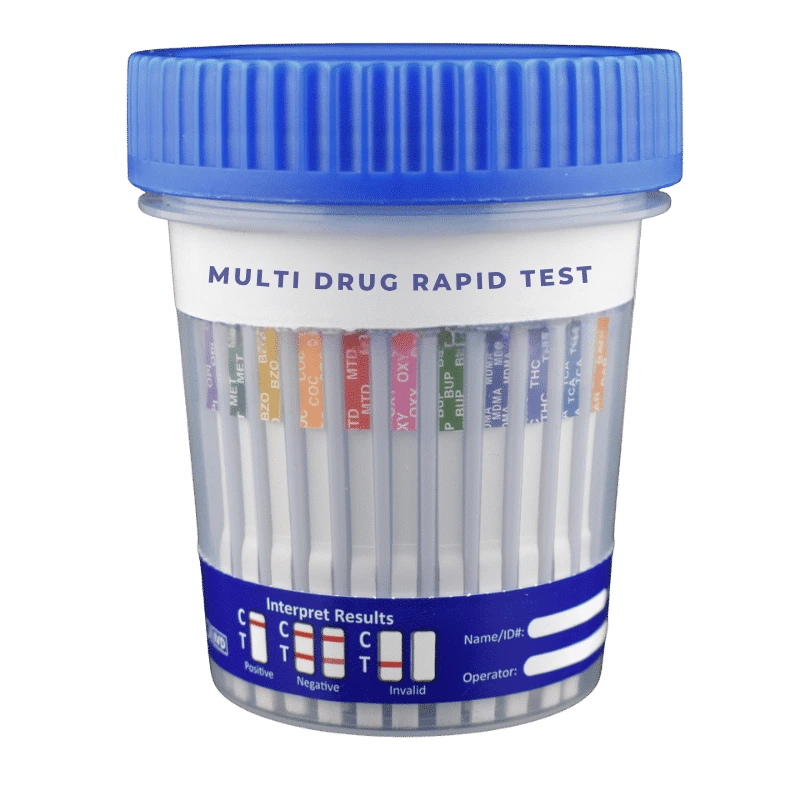
Hydrocodone needs a dedicated HYD strip or an expanded opioid panel, and neither is on a standard multi-panel cup. We checked all four MayFlower cups against their own published panel lists:
| MayFlower cup | HYD strip | OPI / MOP strip | OXY strip |
|---|---|---|---|
| 12 Panel Drug Test Cup with PCP | No | 300 ng/mL | 100 ng/mL |
| 12 Panel Drug Test Cup with ETG & Fentanyl | No | 300 ng/mL | 100 ng/mL |
| 14 Panel Drug Test Cup with PCP, ETG & Fentanyl | No | 300 ng/mL | 100 ng/mL |
| 16 Panel Drug Test Cup with Kratom, ETG, TCA & Fentanyl | No | 300 ng/mL | 100 ng/mL |
None of the four cups has a dedicated hydrocodone strip, and the OXY strip on all four is for oxycodone — a different drug — not hydrocodone. A negative OPI result on one of these cups does not rule out hydrocodone use. For a program, the buying decision is straightforward: if hydrocodone is a drug of concern in your population, order a panel that lists hydrocodone as its own target, or send the specimen for laboratory confirmation by LC-MS/MS, which identifies hydrocodone and norhydrocodone specifically. Check the panel list before you buy, not after a missed positive. Our 12-panel, 14-panel, and 16-panel collections show the full analyte list for each configuration, and our MOP guide explains exactly what the opiate strip does — and does not — detect.
One more caution: a positive OPI result from a rapid cup is presumptive, not final. Every consequential decision should rest on laboratory confirmation, which identifies the specific substance. Our guide on how to read a drug test cup covers the reading rules for rapid cups.
Vicodin, Norco, and Extended-Release Hydrocodone: Same Drug, Different Windows
Vicodin and Norco are both hydrocodone combined with acetaminophen, so their detection windows are the same as hydrocodone itself — urine 2 to 4 days, blood up to 24 hours, saliva 12 to 36 hours, and hair up to 90 days. The acetaminophen changes nothing about detection.
Extended-release hydrocodone is the exception. Hysingla ER and Zohydro ER release the drug gradually over about 24 hours, so clearance starts later and runs longer than with an immediate-release tablet. Treat extended-release hydrocodone as the long end of every window above — urine toward 4 days, blood toward 2 days. The U.S. Food and Drug Administration lists hydrocodone among the opioid medications that carry boxed warnings for addiction, abuse, and misuse, and extended-release forms carry the highest risk because each tablet holds a large total dose.
What a Positive Hydrocodone Result Means for a Program
A positive result is information, not a verdict — and the right response depends on context. In a pain-management clinic, a patient prescribed hydrocodone should test positive for it; a negative result can be just as informative, suggesting the medication is not being taken as directed. In a treatment program, a positive result in a patient who should not be taking it signals a need to review the treatment plan — not automatic discharge.
Three practices keep hydrocodone testing defensible. First, confirm every positive with laboratory testing before acting on it — and remember that a negative rapid-cup result does not rule out hydrocodone, so order an expanded panel or lab confirmation when it is a concern. Second, have a medical review officer review confirmed results against prescribed medications — a valid prescription explains a positive result. Third, write the rules down and apply them the same way every time. Random, unannounced testing catches more than a predictable schedule. If you or someone you know needs help with opioid use, the SAMHSA National Helpline at samhsa.gov/find-help/national-helpline (1-800-662-4357) is free, confidential, and available 24 hours a day. More on our mission and catalog is on the MayFlower Bioscience homepage.
Frequently Asked Questions
How long does hydrocodone stay in your urine?
Usually 2 to 4 days after the last dose. A single dose screened at the standard 300 ng/mL opiate cutoff is often detectable for only 24 to 48 hours, while daily or heavy use pushes the window toward 4 days. The metabolite norhydrocodone can be detected for up to 3 days.
How long does hydrocodone stay in your blood?
Up to 24 hours for immediate-release tablets. Extended-release hydrocodone, such as Hysingla ER and Zohydro ER, can be detected in blood for up to about 2 days because the drug is released slowly over 24 hours.
Does hydrocodone show up on a standard drug test?
Not reliably. A standard opiate screen is calibrated for morphine and codeine at 300 ng/mL, and hydrocodone cross-reacts only partly with it — at low or therapeutic doses it can be missed entirely. Reliable detection needs a dedicated hydrocodone strip, an expanded opioid panel, or laboratory confirmation by LC-MS/MS.
What is the half-life of hydrocodone?
About 3.8 to 4.5 hours for immediate-release hydrocodone, and 7 to 9 hours for extended-release formulations. It takes about five half-lives to mostly clear a drug, so an immediate-release dose leaves the blood within roughly 19 to 27 hours, while an extended-release dose can take up to 45 hours.
How long does Norco or Vicodin stay in your system?
The same as hydrocodone itself, because both are hydrocodone combined with acetaminophen: urine 2 to 4 days, blood up to 24 hours, saliva 12 to 36 hours, and hair up to 90 days. The acetaminophen changes nothing about detection.
Can hydrocodone be detected after 5 days?
In urine, usually not after 5 days, except with heavy or chronic use or with liver or kidney impairment. In hair, yes — a standard 1.5-inch hair sample can detect hydrocodone use for up to 90 days.
Does hydrocodone show up the same as oxycodone on a drug test?
No. They are different drugs with different strips. The OXY strip on a multi-panel cup detects oxycodone at 100 ng/mL, not hydrocodone. Hydrocodone needs its own HYD strip or an expanded opioid panel, and a standard opiate strip may miss both at low doses.
What affects how long hydrocodone stays detectable?
Dose and frequency of use, immediate-release versus extended-release formulation, liver and kidney function, age, and body composition. Chronic use, larger doses, and impaired liver or kidney function all extend the window.
Can you speed up clearing hydrocodone from your system?
No reliable way exists. Drinking extra water or exercising does not meaningfully speed clearance, and it can dilute a urine specimen, which creates a separate problem. Time is the only thing that clears hydrocodone.
Does a 12-panel drug test detect hydrocodone?
Not reliably. No MayFlower 12-panel cup has a dedicated hydrocodone (HYD) strip — the opiate (MOP/OPI) strip at 300 ng/mL is calibrated for morphine and codeine and may miss hydrocodone at low levels. Programs that need hydrocodone detection should order a panel that lists it as its own target or send the specimen for lab confirmation.