
How Long Does Codeine Stay in Your System?
How Long Does Codeine Stay in Your System?
Codeine is detectable in urine for 1–3 days after a single dose, in blood for up to 24 hours, in saliva for 1–4 days, and in hair for up to 90 days. A single dose is often gone from urine within 24–48 hours, while repeated or heavy use can extend the urine window to 7 days. Codeine itself clears fast — its half-life is only about 2.5–4 hours — but the test is not only looking for codeine: your liver converts part of every dose into morphine, and those metabolites keep a standard opiate screen positive after the parent drug is gone.
Codeine is a prescription opioid for mild to moderate pain and, in combination products, for cough. It is also the opioid in “lean” (codeine mixed with promethazine syrup), which is why the question comes up in treatment programs, probation screening, and workplace testing. This guide gives the detection windows by test type, explains the CYP2D6 pathway that turns codeine into morphine, and shows exactly how a multi-panel urine drug test cup screens for it. For the full series, see the drug detection times chart hub and the broad opioid detection windows guide.
Codeine Detection Windows by Test Type
The table below is the consensus across the ranking guides and clinical sources; chronic or heavy use pushes every window toward its long end.
| Test type | Typical window | What it detects |
|---|---|---|
| Urine | 1–3 days (single dose often 24–48 hours; chronic use up to 7 days) | Codeine, morphine, codeine-6-glucuronide |
| Blood | Up to 24 hours | Codeine and morphine in plasma |
| Saliva (oral fluid) | 1–4 days (commonly 24–48 hours after a single dose) | Codeine and morphine |
| Hair | Up to 90 days (7–10 day lag before new use appears) | Codeine incorporated into the hair shaft |
The urine number is the one programs use most, and it is also the one most often misunderstood. A single 30 mg dose in a healthy adult is frequently undetectable at the standard 300 ng/mL opiate cutoff within 24–48 hours — controlled studies put the mean at roughly 33–54 hours. But that is a mean, not a guarantee: a higher dose, several days of use, slow kidney function, or ultra-rapid CYP2D6 metabolism can each add a day or more. Treat “1–3 days” as the working window for a single dose and “up to 7 days” as the planning window for heavy use.
How Your Body Processes Codeine: CYP2D6 Turns It Into Morphine
Codeine is a prodrug — most of its pain-relieving effect comes from what your liver makes out of it. The enzyme CYP2D6 converts about 10–15% of a dose into morphine; a much larger share, roughly 50–70%, becomes codeine-6-glucuronide, which is inactive. Codeine’s own plasma half-life is short, about 2.6 hours on average, so the parent drug is largely gone from blood within about 12 hours. The metabolites last longer, and the morphine they produce is exactly what an opiate screen is calibrated to find.
CYP2D6 is where the individual variation lives. Ultra-rapid metabolizers convert codeine to morphine faster and in larger amounts, so they can show higher morphine levels and a longer positive window from the same dose. Poor metabolizers convert very little, so they feel less pain relief yet still test positive for codeine itself. The FDA has restricted codeine use in children and adolescents precisely because ultra-rapid metabolism can produce dangerously high morphine levels; see the FDA’s opioid medication guidance. For a program, the point is simple: two people can take the same dose on the same day and test positive for different lengths of time.
Does Codeine Show Up on a Standard Drug Test? Yes — on the Opiate (MOP) Strip
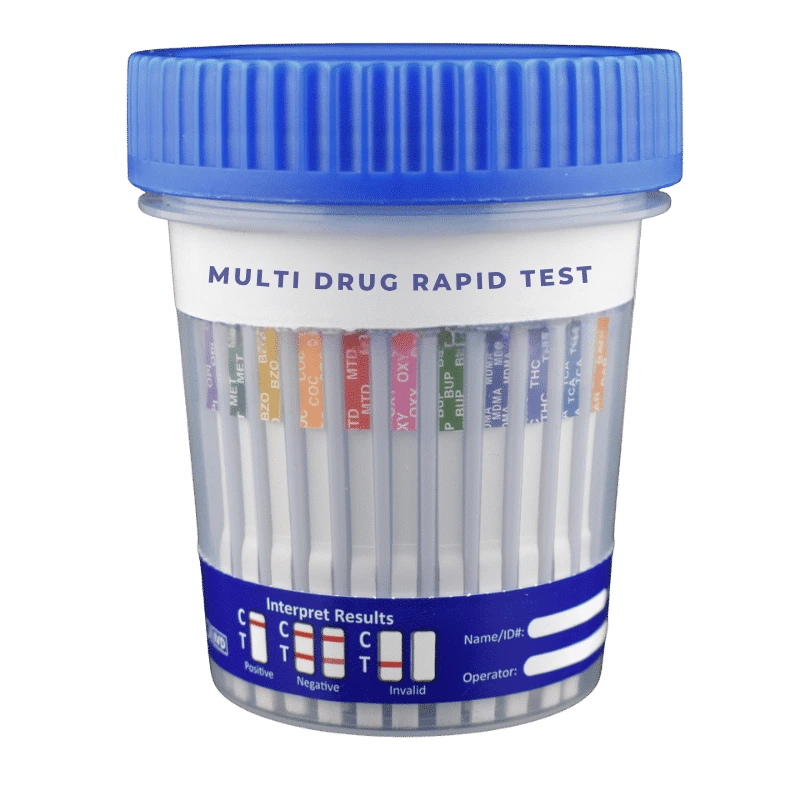
Yes. The screen used on multi-panel urine cups — labeled MOP or OPI — is calibrated for morphine at a 300 ng/mL cutoff, and because codeine becomes morphine in the body, codeine use triggers that same strip. What MOP means on a drug test explains the strip in full; the short version is that MOP stands for morphine, the reference analyte, and the strip reacts to the morphine that codeine, heroin, and poppy seeds all produce.
Every MayFlower cup screens that opiate strip at 300 ng/mL: the 12-Panel Drug Test Cup with PCP (CLIA-waived; its panel list names “Opiates — Morphine, Codeine” and its table gives opiates 2–4 days), the 12-Panel Drug Test Cup with Alcohol (ETG) & Fentanyl (forensic use; OPI/300, “OPI MOR 2–3 days”), the 14-Panel Drug Test Cup with PCP, ETG & Fentanyl (OPI/MOR 300; “screens for MOR-based OPI including 6-AM, MOR, and codeine”), and the 16-Panel Drug Test Cup with Kratom, ETG, TCA & Fentanyl (OPI/300, same “OPI MOR 2–3 days” table).
The honest limit is the same for all four cups: a positive MOP strip proves an opiate was present, but it cannot say which one. Codeine, morphine, and heroin all end up as morphine in urine, so only a laboratory confirmation (GC-MS or LC-MS/MS) can distinguish them. If your program needs to know whether a positive came from prescribed codeine, morphine, or heroin, order confirmation on every MOP positive and record the prescription first. The 12-panel, 14-panel, and 16-panel drug test cup collections explain each configuration, and wholesale drug test cups covers bulk pricing for programs that screen regularly.
What Makes Codeine Detectable Longer (or Shorter)
Five factors move the window most, and programs should weigh them before calling a result late or early:
- Dose and frequency. A single 15–30 mg dose clears fastest; repeated dosing builds up morphine and glucuronide metabolites, which is why chronic use stretches urine detection to 7 days.
- CYP2D6 phenotype. Ultra-rapid metabolizers make more morphine faster and can stay positive longer; poor metabolizers make less morphine but still test positive for codeine itself.
- Kidney function. Codeine and its metabolites leave through urine, so impaired kidney function slows clearance markedly — the half-life rises from about 4 hours in healthy adults to roughly 19 hours in end-stage kidney disease.
- Liver function and other medications. Liver disease slows conversion and clearance, while drugs that inhibit CYP2D6 (for example, some antidepressants and antihistamines) change how much morphine is produced — keep a medication list in the file before interpreting any result.
- Hydration and urine concentration. Very dilute urine can push a borderline sample below the 300 ng/mL cutoff, which is why specimen validity checks — creatinine, specific gravity, temperature — matter as much as the strip itself.
Codeine vs Morphine vs Heroin on a Drug Test
These three are the classic funnel: heroin becomes 6-MAM and then morphine within minutes; codeine becomes morphine through CYP2D6; morphine is morphine. A urine screen sees the same endpoint for all three. The only marker that proves heroin specifically is 6-MAM, and it is gone from urine within about 2–8 hours — after that, a heroin result and a morphine result look identical on a screen. The sibling guides cover the same funnel from the other directions — heroin detection windows and morphine detection windows — while methadone, oxycodone, and tramadol behave differently: tramadol is not detected by the standard opiate strip at all, and oxycodone needs its own dedicated strip. For programs, the rule is: a MOP positive tells you an opiate was used; only confirmation and a prescription history tell you which one.
Poppy Seeds, Confirmation Testing, and Cutoffs
Poppy seeds contain trace morphine and codeine, and a large serving can push a urine sample over the 300 ng/mL opiate cutoff — usually for less than 60 hours. Modern confirmation testing has made this much less of a problem: laboratories confirm positives at defined cutoffs (the federal workplace program confirms morphine and codeine at 2,000 ng/mL by GC-MS). If a donor reports poppy-seed food before a test, note it, confirm the positive in the lab, and let the medical review officer decide. The National Institute on Drug Abuse’s opioid research overview is a solid reference for programs, and MedlinePlus on codeine covers the drug’s uses, risks, and metabolism in plain language.
What About Lean (Codeine and Promethazine)?
Lean — codeine cough syrup mixed with promethazine and usually a soft drink — is detected the same way as codeine alone: the same CYP2D6 pathway, the same urine window of 1–3 days, up to 7 days with heavy repeated use. Promethazine itself is not on a standard multi-panel cup, so a lean result appears as an ordinary MOP positive. Programs that see lean use should screen on the same schedule as any codeine use and confirm positives the same way. If someone in your program needs help rather than a sanction, the Substance Abuse and Mental Health Services Administration’s alcohol, tobacco, and other drugs help page lists treatment resources.
What Programs Should Order
For codeine, the right panel is any cup carrying the MOP/OPI strip at 300 ng/mL — all four MayFlower cups — so the choice comes down to what else the program needs to screen. A clinic watching pain-management compliance pairs the opiate strip with oxycodone (OXY/100); a drug court or probation program adds ETG alcohol and fentanyl on the forensic-use 12-panel or the 14-panel; a treatment program that needs the widest net takes the 16-panel with kratom and TCA. Whatever the panel, run the screen at the standard cutoff, check specimen validity on every sample, and confirm every MOP positive in the lab before acting on it.
Frequently Asked Questions
How long does codeine stay in your system?
Codeine is detectable in urine for 1–3 days after a single dose, in blood for up to 24 hours, in saliva for 1–4 days, and in hair for up to 90 days. Repeated or heavy use can extend the urine window to 7 days.
How long does codeine show up in a urine drug test?
Usually 1–3 days. A single dose is often undetectable at the standard 300 ng/mL opiate cutoff within 24–48 hours — controlled studies put the mean detection time at roughly 33–54 hours — while chronic or heavy use can extend detection to 7 days.
Does codeine show up on a standard drug test?
Yes. A standard opiate (MOP/OPI) immunoassay is calibrated for morphine at 300 ng/mL, and because your liver converts codeine into morphine, codeine use triggers that strip. All four MayFlower multi-panel cups carry the OPI strip at 300 ng/mL.
Can a drug test tell codeine apart from morphine or heroin?
No — not on a screen. Codeine, morphine, and heroin all end up as morphine in urine, so a positive MOP strip cannot say which one was taken. Only laboratory confirmation (GC-MS or LC-MS/MS) can distinguish them, and only the marker 6-MAM proves heroin specifically, within about 2–8 hours of use.
What is the half-life of codeine?
Codeine’s plasma half-life is about 2.5–4 hours in healthy adults, so the parent drug is largely gone from blood within about 12 hours. Its metabolites — morphine and codeine-6-glucuronide — persist longer, which is why urine detection runs 1–3 days.
Does lean stay in your system longer than codeine alone?
No. Lean is codeine mixed with promethazine, and it follows the same detection window as codeine alone: 1–3 days in urine, up to 7 days with heavy repeated use. Promethazine itself is not screened on a standard multi-panel cup.
Can poppy seeds cause a positive drug test for codeine?
Yes, briefly. Poppy seeds contain trace morphine and codeine and can push a urine sample over the 300 ng/mL opiate cutoff, usually for less than 60 hours. Laboratory confirmation at higher cutoffs separates ordinary dietary exposure from drug use, and a medical review officer makes the final call.
How long does codeine stay in blood, saliva, and hair?
Blood: up to 24 hours. Saliva: 1–4 days, commonly 24–48 hours after a single dose. Hair: up to 90 days, with a 7–10 day lag before new use appears in the hair shaft.
Does kidney or liver function affect how long codeine is detectable?
Yes. Codeine and its metabolites leave the body through urine, so impaired kidney function slows clearance — the half-life rises from about 4 hours in healthy adults to roughly 19 hours in end-stage kidney disease. Liver function and CYP2D6 genetics also change how much morphine is produced and how long it lasts.
Which MayFlower drug test cup detects codeine?
All four: the 12-panel PCP cup, the 12-panel ETG and fentanyl forensic cup, the 14-panel cup, and the 16-panel cup all carry the opiate (MOP/OPI) strip at 300 ng/mL. The 12-panel PCP cup and the 14-panel cup name codeine explicitly in their panel descriptions. Confirm every positive in the lab before acting on it.