
Forensic Use Only Drug Tests: What the Label Means
Forensic Use Only Drug Tests: What the Label Means
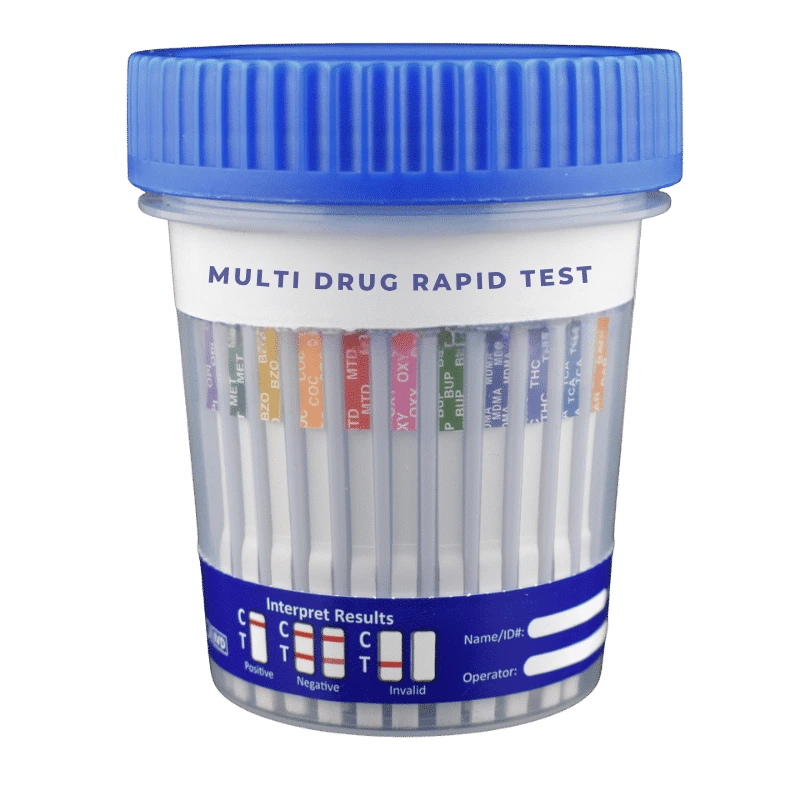
A forensic use only drug test is a rapid screening device whose manufacturer labels it for non-clinical programs such as drug courts, probation, corrections and law enforcement, not for diagnosis or treatment decisions. The label describes the intended use and the regulatory path, not the quality of the chemistry. If your program is forensic, a forensic-use cup with the right panel is the correct tool. If your decisions are medical, you need a CLIA-waived, FDA-cleared cup instead. We supply both kinds, and this guide shows how to tell which one your program needs.
TL;DR
- “Forensic Use Only” (FUO) means the device is labeled for law enforcement and similar non-medical purposes. The FDA applies enforcement discretion to these devices rather than actively regulating them.
- Most other drugs-of-abuse tests are Class II devices that need 510(k) clearance before sale. CLIA-waived cups carry that clearance and suit point-of-care clinical use.
- Every rapid cup result is a preliminary screen. A positive needs confirmation by GC/MS or LC-MS/MS in a laboratory.
- Our 12-panel cup with PCP is CLIA waived and FDA cleared. Our 12-panel ETG/fentanyl, 14-panel and 16-panel cups are Forensic Use Only and not CLIA waived.
Table of Contents
- Quick answer
- What “Forensic Use Only” means on a drug test
- Forensic use only vs. CLIA waived vs. FDA cleared
- Where a forensic use only test fits
- What a forensic drug test screens for
- How far back does a forensic drug test go?
- From screen to confirmation
- Specimen validity: what laboratories check
- Choosing the right cup for your program
- Our perspective
- Stocking your program: wholesale supply from Mayflower
- FAQ
- Sources
Quick answer
What is a forensic use only drug test? A rapid immunoassay screen, usually a urine cup, that the manufacturer has not submitted for FDA 510(k) clearance and labels for forensic programs only.
Who uses it? Drug courts, probation and parole, corrections, and other programs where the result supports a non-medical decision.
What happens to a positive? It is a presumptive result. A laboratory confirms it with a second, more specific method before it is treated as a positive finding.
When is it the wrong choice? When a clinician will use the result for diagnosis, treatment or patient care. That calls for a CLIA-waived, FDA-cleared device.
What “Forensic Use Only” means on a drug test
The label has a precise regulatory meaning. In an FDA presentation to the SAMHSA Drug Testing Advisory Board, forensic-use-only devices are described as labeled for use only by law enforcement, with the FDA not actively regulating them through enforcement discretion. The same document explains that most other drugs-of-abuse tests are Class II devices and need 510(k) clearance before they can be marketed.
Two practical points follow.
First, the label sets the scope of use. A forensic-use cup supports decisions in a justice, supervision or monitoring setting. It is not labeled for the clinical decisions a hospital, clinic or physician office makes about a patient.
Second, the label tells you which paperwork exists. A cleared device has gone through premarket review, where the FDA evaluates test design, performance, sample collection systems, instructions and package inserts. A forensic-use device is positioned outside that review, so the program, not the clearance, carries responsibility for how results are used and documented.
Why the law treats forensic testing differently
The federal clinical laboratory rules recognize the split too. Under 42 CFR 493.3, CLIA requirements do not apply to components or functions of a facility that only performs testing for forensic purposes. CLIA, the Clinical Laboratory Improvement Amendments, is the federal program that governs laboratory testing on human specimens used for health assessment. Purely forensic testing sits outside it. The key word is “only”: a site that also reports results for patient care does not get that carve-out for those results.
Forensic use only vs. CLIA waived vs. FDA cleared
These three terms get mixed up in purchasing conversations. Here is how they relate.
- FDA cleared means the device went through 510(k) premarket review for in-vitro diagnostic use.
- CLIA waived means the FDA has categorized the test as simple enough, with low enough risk of error, that it can be run at a point-of-care site holding a CLIA Certificate of Waiver. The FDA keeps a public database of these categorizations. As an example of how it records them, the entry for one drug test card lists its waived analytes and effective date.
- Forensic use only means the device is labeled for non-clinical, law enforcement-type programs and is not claimed as cleared for clinical use.
| CLIA-waived, FDA-cleared cup | Forensic Use Only cup | |
|---|---|---|
| Intended setting | Clinics, behavioral health, point-of-care | Drug courts, probation, corrections, other forensic programs |
| Regulatory status | 510(k) cleared, CLIA waived | Labeled forensic use only, enforcement discretion |
| Basis for clinical decisions | Appropriate as a screen, with confirmation where needed | Not labeled for clinical decisions |
| Positive result | Presumptive, confirm by lab method | Presumptive, confirm by lab method |
| Mayflower cups | 12-panel with PCP | 12-panel ETG/fentanyl, 14-panel, 16-panel |
The last row matters when you build a standing order. We label each cup clearly so a lab manager or program director can match the cup to the program in one look: the 12-panel cup with PCP is CLIA waived and FDA cleared, while the 12-panel ETG/fentanyl, 14-panel and 16-panel cups are Forensic Use Only and are not CLIA waived.
Where a forensic use only test fits
Forensic-use cups are built for programs where the result supports supervision, compliance or a legal process rather than patient treatment. Typical settings include:
- Drug courts and treatment courts that test participants on a schedule.
- Probation and parole offices.
- Jails, prisons and other corrections programs.
- Employers and programs whose testing is non-clinical and policy-driven.
- Distributors supplying those programs.
These programs often need panels that go beyond the traditional basics. Fentanyl and alcohol (through the ETG marker) are the clearest examples, and they are the reason our forensic-use configurations exist. A court that wants to know whether a participant has used alcohol or fentanyl between hearings needs those analytes on the same cup as the usual drug classes, with a result in about five minutes at the point of collection.
If your program sits closer to a clinic or behavioral health practice and the result will inform care, the CLIA-waived 12-panel cup is the match. Many multi-site buyers run both: a cleared cup in clinical locations and a forensic-use cup in court-facing or corrections locations.
What a forensic drug test screens for
A panel is the list of drug classes one cup tests at once. A 12-panel, 14-panel or 16-panel cup tests for that many analytes in a single urine sample. The classes covered by drugs-of-abuse tests in the FDA’s overview include amphetamines, methamphetamines, opiates, cocaine, cannabinoids, PCP, barbiturates, benzodiazepines, methadone, tricyclic antidepressants and alcohol. Our configurations extend this with the analytes forensic programs ask for most:
- 12-panel, CLIA waived, with PCP: the standard multi-drug panel including PCP.
- 12-panel, forensic use, with ETG and fentanyl: adds alcohol exposure and fentanyl.
- 14-panel, forensic use, with PCP, ETG and fentanyl: the broader panel for programs that want all three.
- 16-panel, forensic use, adds kratom and TCA: for programs screening for kratom and tricyclic antidepressants as well. See the 16-panel cup with ETG, fentanyl and kratom.
Every cup has an integrated temperature strip, which gives the collector an immediate check on the specimen at the moment of collection. Results read in about five minutes.
Cutoffs decide what counts as a result
A cutoff is the concentration at which a test calls a sample positive. NIDA explains that drug tests target specific drugs or drug classes above a predetermined cutoff level. Its example is the federal workplace urine cannabis cutoff of 50 ng/mL: results below that level are reported negative even if some drug is present, a design that helps limit false positives.
The practical consequence for a program: a negative on a cup means “below the cutoff,” not “zero.” Cutoffs differ by analyte and by device, so confirm the cutoff on the product insert for the cup you buy. Our cutoff levels guide explains how to read them.
What a standard screen will not find
No cup covers every substance. The Merck Manual notes that LSD, GHB and mescaline are not detected on readily available drug tests. Program policies should say which analytes the chosen panel covers and what a negative result does and does not establish.
How far back does a forensic drug test go?
Detection windows depend on the specimen, the substance, the amount and pattern of use, and the individual. Treat all ranges as general guides, not guarantees.
On specimen type, a forensic toxicology lecture summarizes the typical differences: oral fluid about 1 to 2 days, urine about 2 to 5 days, and hair about 3 months, with hair requiring careful removal of environmental contamination. Arup Laboratories notes that urine is usually the preferred specimen for screening and adherence testing because collection is noninvasive and inexpensive, volumes are large, drugs and metabolites concentrate there, and windows are usually longer than in blood.
That is why urine cups are the standard tool for scheduled monitoring: they cover a longer look-back than oral fluid, cost less than hair testing, and give a result on site. If your program is weighing urine against hair for longer look-back, our comparison of urine vs. hair drug testing lays out which fits which program.
For individual substances, windows vary widely, and a cutoff-based screen only reports whether the concentration was above the cutoff at collection. Build your testing schedule around that: frequent, random collection catches more than a single scheduled test.
From screen to confirmation
A rapid cup is an immunoassay, a test that uses antibodies to flag a drug or drug class. It is fast and practical at the point of collection, and it is preliminary by design. NIDA describes the two-step logic: initial screens identify possible use, while confirmatory tests use gas chromatography/mass spectrometry or liquid chromatography/mass spectrometry in a laboratory, which are more specific and sensitive and can identify the specific drug and give more exact quantities.
The SAMHSA/DTAB document makes the same point about FUO devices: positive screening results should be tested by a more specific confirmation method.

A state court system’s lab reference guide shows what this looks like in practice. Urine is screened by enzyme immunoassay; responses below the cutoff are reported as not detected, and responses at or above it are presumptive positive, which may then be confirmed by a second method before a positive is reported. Federal rules define this concept too: under 42 CFR Part 493, confirmatory testing is a second analytical procedure that could substantiate or bring into question the result of an initial test.
A workable confirmation routine
- Collect under a written protocol. Use the temperature strip right away and record the time and the collector.
- Read the cup at the time stated in the instructions. Do not read it late, and record the result.
- Treat a non-negative result as presumptive. Do not describe it as a positive finding to the participant or the court yet.
- Send a retained portion to a laboratory for GC/MS or LC-MS/MS confirmation, following your chain-of-custody procedure.
- Act on the confirmed result, and keep the screen, the confirmation and the dates together in the file.
A lecture on forensic toxicology adds a useful rule: “positive” should only be used with confirmatory testing because of the risk of false positives on screening tests. Medications, foods and cross-reacting compounds can trigger a screen, which is why confirmation protects both the participant and the program. Our guide to urine drug test false positives covers common causes and the next steps.
Specimen validity: what laboratories check
Program staff often ask how a laboratory knows a urine specimen is real and unaltered. Laboratories run specimen validity testing, a set of measurements that show whether a sample is normal human urine. The National Laboratory Certification Program documentation lists the required checks: creatinine, specific gravity, pH and one or more oxidants. It gives normal urine creatinine as 20 mg/dL or higher and specific gravity of 1.0030 to 1.0200, and it reports a pH below 4.0 or 11.0 and above as adulterated. Nitrite at 200 mcg/mL up to but not including 500 mcg/mL is invalid, and 500 mcg/mL or more is adulterated under the Urine Mandatory Guidelines.
Clinical guidance describes the same layers: attempts to dilute, adulterate or substitute urine may be detected by visual inspection and laboratory validity testing, covering temperature, specific gravity, pH, creatinine and adulterants.
For your program, the takeaway is about collection quality, not suspicion. A well-run collection has three safeguards:
- Immediate temperature check. Our cups include an integrated temperature strip, so the collector verifies the specimen temperature as soon as it is produced.
- Observation consistent with your policy. Follow the written collection procedure your program or court has adopted.
- Laboratory validity testing on specimens sent for confirmation.
These steps keep results defensible, which is the whole purpose of a forensic program.
Choosing the right cup for your program
Start with the decision the result will support, then pick the configuration.
| If your program needs… | Choose |
|---|---|
| A clinical or behavioral health point-of-care screen, CLIA waived and FDA cleared | 12-panel cup with PCP |
| Forensic screening with alcohol (ETG) and fentanyl on a 12-panel | 12-panel ETG/fentanyl forensic-use cup |
| Forensic screening with PCP, ETG and fentanyl | 14-panel cup with PCP |
| Forensic screening that also covers kratom and TCA | 16-panel forensic-use cup |
A few questions settle most orders:
- Is the result used for patient care? Choose the CLIA-waived cup.
- Is it a court, probation or corrections program? Choose a forensic-use cup.
- Do participants face alcohol or fentanyl concerns? Choose a configuration with ETG and fentanyl.
- Are you supplying several sites? Standardize on one or two cups so staff learn one read procedure.
You can browse all configurations on our drug test cups page and see the multi-drug test cup listing.
Our perspective
We built the catalog around four cups because programs told us the same thing: they want to know which cup is for which job, without a long explanation. One CLIA-waived, FDA-cleared 12-panel cup with PCP for clinical settings. Three forensic-use cups, with ETG and fentanyl, with PCP added, and with kratom and TCA added, for programs where the result supports supervision rather than treatment.
Forensic use only is not a lesser tier. It is the right label for courts, probation and corrections, where the questions are about compliance and the stakes are about documentation. What makes a forensic program defensible is the routine around the cup: a written collection procedure, a temperature check at collection, a clear read, and lab confirmation by GC/MS or LC-MS/MS before anyone treats a result as final.
That is why every cup we sell has an integrated temperature strip and a rapid read in about five minutes, and why we state the CLIA status of each cup plainly. We stock in the US, dispatch the same day from stock, and price by volume, because programs reorder on a schedule and need the same cup, on time, every time.
Alina
Stocking your program: wholesale supply from Mayflower
Mayflower Bioscience is a US-based wholesale supplier of rapid multi-panel urine drug test cups for clinics, behavioral health programs, employers, drug courts, corrections and distributors, based in St. Louis, Missouri. Buyers get volume pricing, free shipping on 100+ cups and same-day dispatch from US stock. The site is built for bulk and recurring orders, with a quote process for wholesale and multi-site accounts.

To match a cup to your program and request wholesale pricing, start with our drug test cups and send us the quantity and the sites you supply. For the broader catalog of laboratory products and services, see the full product range.
FAQ
What does a forensic drug test test for?
It depends on the panel. Common classes include amphetamines, methamphetamines, opiates, cocaine, cannabinoids, PCP, barbiturates, benzodiazepines and methadone, and newer panels add fentanyl, ETG for alcohol exposure, kratom and TCA. Check the product insert for the exact analytes and cutoffs of the cup you use.
What does “Forensic Use Only” mean?
It means the manufacturer labels the device for law enforcement and other non-clinical programs and has not claimed FDA clearance for clinical use. The FDA applies enforcement discretion to such devices. Results are preliminary screens, and positives go to a laboratory for confirmation.
How far back does a forensic drug test go?
It varies by specimen and substance. Typical general ranges are about 1 to 2 days for oral fluid, 2 to 5 days for urine and about 3 months for hair. Individual factors and the cutoff change the result, so treat these as guides.
Can a laboratory detect synthetic urine or other specimen tampering?
Laboratories run specimen validity testing on creatinine, specific gravity, pH and oxidants, and they report out-of-range specimens as dilute, substituted, adulterated or invalid. Visual inspection and the temperature check at collection add further layers. This is why a documented collection procedure matters in any forensic program.
Is a forensic use only cup accurate enough for a court program?
A rapid cup is a screening tool. Programs use it for immediate, on-site information and send non-negative results for confirmation by GC/MS or LC-MS/MS before acting on them as positive findings. That two-step process is what makes the result defensible.
Sources
- FDA Regulation of Drugs of Abuse Tests (SAMHSA DTAB)
- Drugs of Abuse Tests (FDA)
- 42 CFR 493.3 Applicability (eCFR)
- 42 CFR Part 493 Laboratory Requirements (eCFR)
- CLIA database entry K131811 (FDA)
- Drug Testing (NIDA)
- Drug Testing, Merck Manual Professional Edition
- Testing Reference Guide (Nebraska Judicial Branch)
- Forensic Toxicology lecture (Michael P. Smith, PhD)
- Drug Testing: Choose the Right Test (Arup Consult)
- Validating Specimen Validity Testing (NLCP, 2023)
- A Practical Guide to Urine Drug Monitoring (MDedge)