14 Panel Drug Test Results: How to Read Them Correctly
14 Panel Drug Test Results: How to Read Them Correctly
A 14 panel drug test result is a preliminary screen. A negative means no tested drug was found at or above the cutoff. A presumptive positive means a drug or metabolite may be present and needs confirmation by GC/MS or LC-MS/MS. An invalid result means the test did not work or the sample was not usable, so you repeat it. This guide shows program staff and lab teams how to read each outcome and document it. It also covers what can cause a false reading.
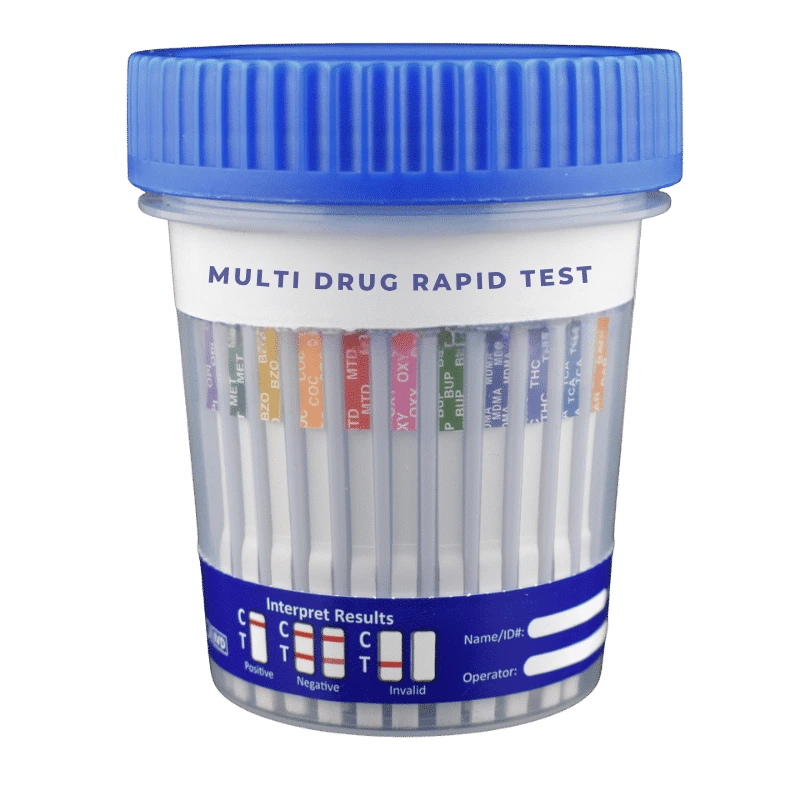
One point first, because it changes how you use the result. Our 14 panel cup is Forensic Use Only and is not CLIA waived. Our 12 panel cup with PCP is the CLIA-waived, FDA-cleared option. Both give a rapid read in about five minutes, and both are screens, not final answers.
TL;DR
- Negative: no tested drug at or above its cutoff. It does not mean the person has used no drug at all, and it does not cover drugs outside the panel.
- Presumptive positive: a possible drug or metabolite above the cutoff. It does not measure impairment or intoxication, and it is not a final finding until confirmed.
- Invalid: a missing control line, an out-of-range temperature or a suspect specimen. Recollect and retest rather than guess.
- Confirmation: GC/MS or LC-MS/MS on the specimen is the standard way to confirm a screening positive, especially if the result is unexpected or disputed.
- Panel and cutoffs vary: always read the result against the cutoff list printed on your specific cup’s insert.
Table of Contents
- What a 14 panel result actually tells you
- The three outcomes: negative, presumptive positive, invalid
- Step by step: reading a cup result
- Cutoff levels: why the same sample can read differently
- What can cause a false positive or a false negative
- Confirmation: when and how
- CLIA-waived or Forensic Use Only: why it affects your results
- Documenting results so they hold up
- Perspective
- Stocking the 14 panel cup for your program
- Common mistakes when reading results
- FAQ
- Sources
What a 14 panel result actually tells you
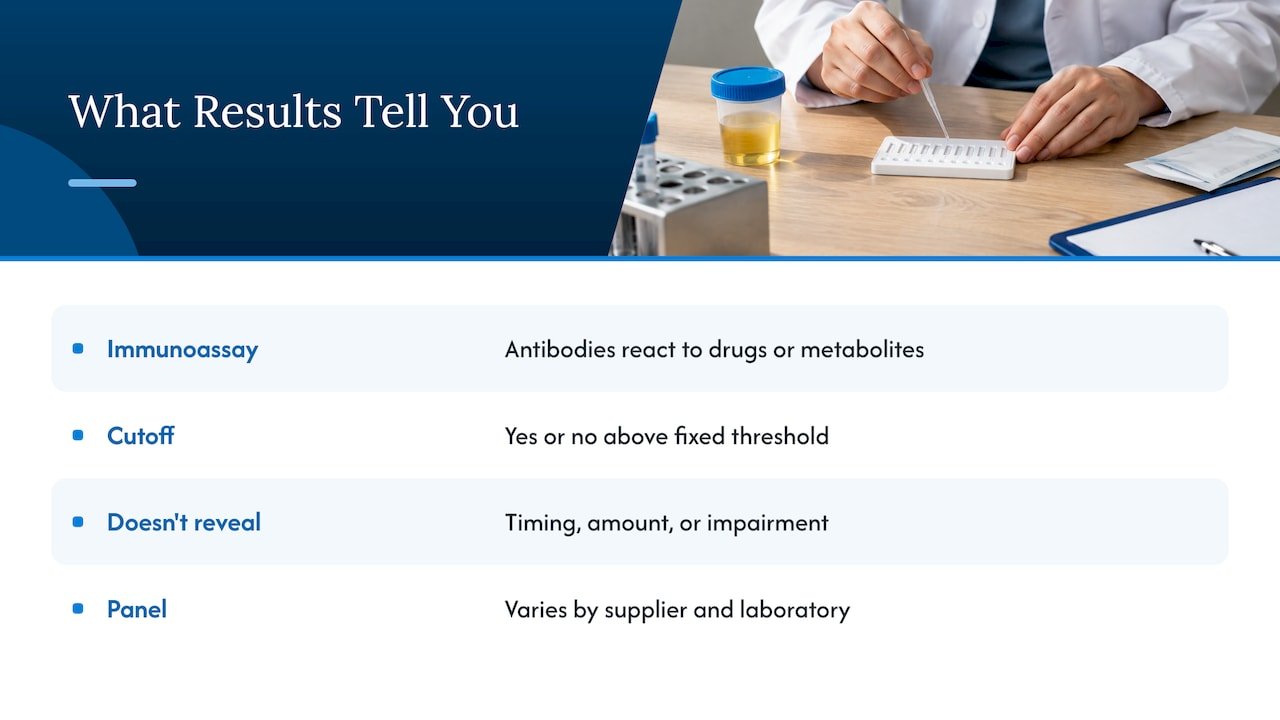
A multi-panel urine cup is an immunoassay. Antibodies in the device react to a drug or its metabolite. If the concentration is high enough, the result lines show it. The cup does not report a number. It reports a yes or no against a fixed threshold.
That threshold is the cutoff. NIDA explains that drug tests target specific drugs or drug classes above a predetermined cutoff level. So a result tells you whether a drug was detected above that line. It does not tell you when the drug was taken, how much, or whether the person was impaired.
The panel itself is not standardized either. Federal clinical guidance notes that clinical drug testing has no set panel and that the drugs tested vary by laboratory and even within one laboratory. A “14 panel” from one supplier may not match another. Our own breakdown of every analyte and abbreviation is in the 14 panel drug test list, and the analyte guide explains what each target means.
The Labcorp pediatric screen that ranks for this query, for example, lists ETG, amphetamines, barbiturates, benzodiazepines, cocaine, PCP, THC, 6-AM, opiates, oxycodone, MDMA, fentanyl, buprenorphine and tramadol. That is a useful illustration that two 14-drug panels can differ in a few slots.
The three outcomes: negative, presumptive positive, invalid
Negative
A test that detects nothing, or detects a concentration below the cutoff, is considered negative. MedlinePlus adds that a negative means either that no drug was present or that the amount was too low to detect.
A negative has limits you should record:
- It covers only the drugs on that panel.
- It covers only concentrations at or above each cutoff.
- It reflects the specimen collected at that moment.
NIDA gives a clear federal example. The workplace urine cannabis cutoff is 50 ng/mL, so a result below 50 ng/mL is reported negative even when the concentration is above zero. A negative on a cup is therefore a statement about a threshold, not about zero.
Presumptive positive
We call a screening positive “presumptive” for a reason. The University of Iowa’s laboratory handbook describes it as indicating the possible presence of a drug or its metabolites in urine, and says it does not measure the level of intoxication.
In practice, treat a presumptive positive this way:
- Record which analyte lines show a positive, the lot number and the read time.
- Do not label the person’s conduct or status from the cup alone.
- Send the specimen for confirmation, or follow your program’s written policy on when confirmation is required.
- Talk to the person about prescriptions and recent medications before any conclusion is drawn.
MedlinePlus puts it plainly: after a positive, you will usually have a follow-up urine test because the first-stage test can produce false positives.
Invalid
An invalid result is not a negative and not a positive. It means you cannot interpret the test. On a typical cup that happens when:
- the control line does not appear, which can mean too little sample, a faulty device or a procedural error;
- the temperature strip reads outside the expected range, which raises a question about the specimen;
- the reading was taken outside the time window in the insert.
What happens next depends on your setting. In a clinic or program, you usually repeat the test with a fresh sample and a new cup, and note why. For federally regulated testing the rules are stricter. DOT’s 49 CFR 40.87 requires laboratories to measure creatinine on every primary specimen, measure specific gravity when creatinine is below 20 mg/dL, measure pH and test for oxidizing adulterants. The same rule says further validity testing is needed when physical characteristics are abnormal or an unidentified substance may interfere, and an invalid specimen can require consultation with the laboratory and a medical review officer. A rapid cup is not a substitute for that process. It is a point-of-collection screen.
Step by step: reading a cup result
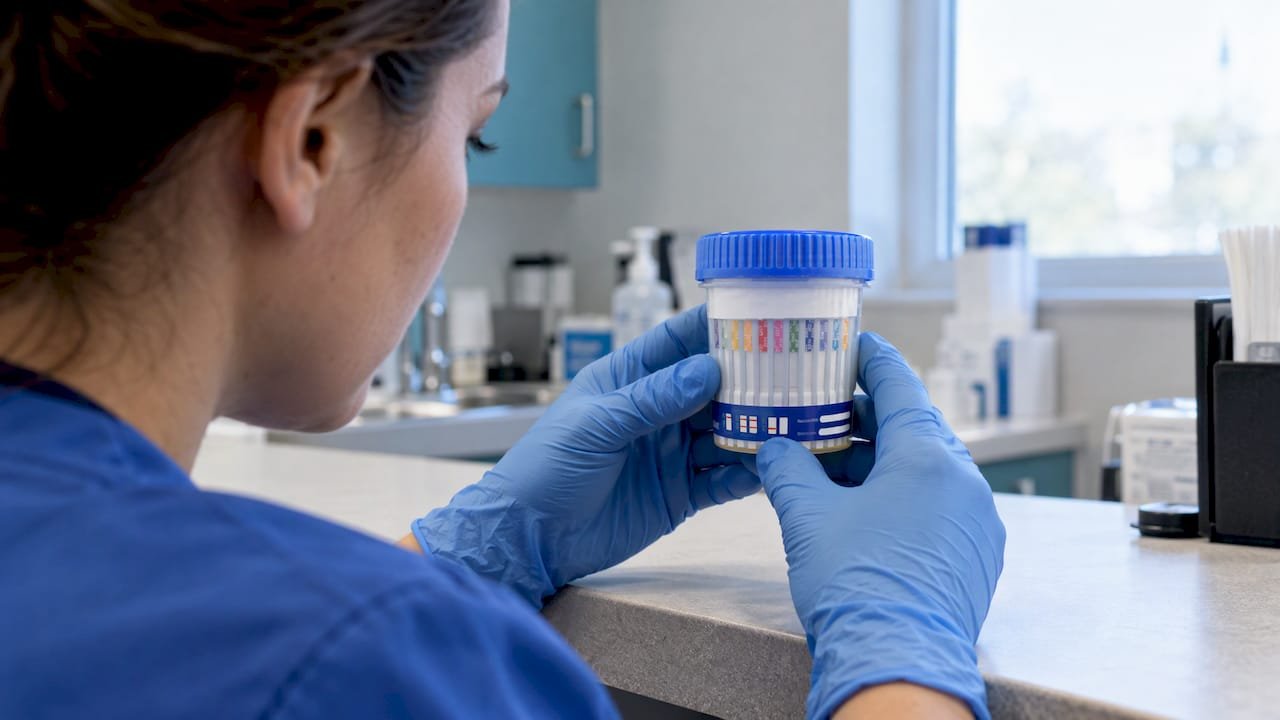
- Check the temperature strip right after collection. Read it within the time stated in the cup’s instructions. Note the reading in your log.
- Seal the cup and start the timer. Our cups give a rapid read in about five minutes. Do not read results long after the window closes.
- Confirm the control line first. If it is missing, the test is invalid, whatever the other lines show.
- Read each drug strip against the insert. On most multi-panel cups a line in the test region means negative for that drug, and no line means a presumptive positive. Faint lines still count as lines on most devices, but follow your cup’s own insert.
- Record every analyte. Write down each result, not just the positives.
- Decide on confirmation. Apply your written policy before the person leaves.
Because line conventions can differ by manufacturer, the insert for your exact lot is the final authority on how to read it.
Cutoff levels: why the same sample can read differently
A cutoff is the point at or above which a result is positive and below which it is negative. SAMHSA defines the administrative cutoff as the concentration at or above which a result is positive, chosen with regard to assay reliability, accuracy and a reasonable post-use detection period.
Two practical consequences:
- Different cups, different cutoffs. One device may flag a drug at a lower concentration than another. Clinicians should know the cutoff and analyte the test uses. The same federal guidance says federal workplace cutoffs are not necessarily appropriate for clinical use.
- Drug classes are not single drugs. An opiate strip, an oxycodone strip and a fentanyl strip target different compounds. A negative on one says nothing about another.
For a deeper look at specific numbers, see our cutoff levels chart. We do not quote detection windows as fixed numbers here. How long a drug stays detectable depends on the drug, dose, frequency of use, metabolism and the cutoff, so any single figure is a rough range at best. Use the manufacturer’s literature and your lab’s guidance.
What can cause a false positive or a false negative
NIDA explains that false positives can occur when immunoassay antibodies cross-react with similar chemicals, including some medicines and foods such as poppy seeds. False negatives can occur when the cutoff is too high for the amount present, or when contaminants interfere. Laboratory errors can cause either.
For program staff, the practical list looks like this:
| Situation | What it can do | What to do |
|---|---|---|
| Prescription or over-the-counter medication that resembles a target compound | Possible false positive | Ask about medications, then confirm by GC/MS or LC-MS/MS |
| Certain foods, such as poppy seeds | Possible opiate cross-reactivity | Record it and confirm before acting |
| Concentration just under the cutoff | Negative result even with some drug present | Report as negative against that cutoff, and use a lower-cutoff method if clinically needed |
| Contaminated or unusual specimen | Interference or invalid read | Recollect under observation per your policy |
| Wrong timing or misread line | Misinterpretation | Retrain on the read window and control line |
This is why a confirmed result, not the cup alone, should drive any consequential decision.
Confirmation: when and how
Confirmation uses a more specific method on the same specimen. NIDA describes confirmatory testing as more specific and sensitive than the initial screen, typically using gas chromatography/mass spectrometry or liquid chromatography/mass spectrometry, and able to identify specific drugs and more exact concentrations.
The rules depend on setting:
- Federally regulated workplace testing: an initial positive screen is followed by a second, more precise confirmatory test, and final review is commonly done by a medical review officer, according to NIDA.
- Clinical testing: SAMHSA says confirmation is situation-dependent and at the practitioner’s discretion, but an unexpected or disputed result should generally be investigated with definitive testing. The federal clinical guide on this is Clinical Drug Testing in Primary Care.
- Specimen handling: Nebraska’s judicial laboratory reference guide lists GC, GC/MS and LC/MS/MS and describes confirmation on an independent portion of the original urine.
If your program may need confirmation, set aside enough specimen and keep the chain of custody your policy requires. Drug courts and corrections programs often have their own written protocols, so follow those.
CLIA-waived or Forensic Use Only: why it affects your results
This distinction matters when you document and act on a result.
| Cup | Panel highlights | Regulatory status |
|---|---|---|
| 12 panel with PCP | Multi-drug screen including PCP | CLIA waived, FDA cleared |
| 12 panel with ETG and fentanyl | Alcohol (ETG) and fentanyl added | Forensic Use Only |
| 14 panel with PCP, ETG, fentanyl | Broader drug set | Forensic Use Only, not CLIA waived |
| 16 panel adding kratom and TCA | Widest panel we offer | Forensic Use Only, not CLIA waived |
If you need a point-of-care test for clinical decision-making under a CLIA Certificate of Waiver, the CLIA-waived 12 panel is the matching product. Our 14 and 16 panel cups suit forensic-use programs that treat every result as preliminary. Our guide to 12 vs 14 panel tests and the 14 vs 16 panel comparison walk through which analytes each adds, and choosing the right panel for clinics covers the decision from a program perspective.
Documenting results so they hold up
Good records protect the person tested and your program. For each test, log:
- the date, time and collector’s initials;
- the temperature strip reading;
- the cup lot number and expiry date;
- each analyte result, positive or negative;
- any invalid reading and the reason for retesting;
- whether the sample was sent for confirmation, and where.
Store cups as the insert directs and never use an expired lot. Consistent paperwork also makes it easier to spot patterns, such as repeated invalid reads that point to a training or storage problem rather than a donor problem.
Perspective
We supply cups to clinics, behavioral health programs, employers, drug courts and corrections, and the same question comes up in every setting: what do we do with the result?
Our answer is to be exact about what the cup is. It is a fast, consistent screen that tells you in about five minutes whether a drug may be present above a cutoff. That speed is the point. It lets a counselor or supervisor make a next step, such as a conversation, a recollection or a send-out for confirmation, while the person is still in the room.
That is why we keep the catalog focused on four cups and state the status of each one plainly. The 12 panel with PCP is CLIA waived and FDA cleared. The 14 and 16 panel cups are Forensic Use Only. Each has an integrated temperature strip, so specimen checks start at collection. Our 14 panel adds PCP, ETG and fentanyl, which are the analytes programs ask us about most.
A cup works best inside a clear policy: read the control line, log every analyte, confirm by GC/MS or LC-MS/MS where it matters. We build ordering around that workflow, with volume pricing, free shipping on 100+ cups and same-day dispatch from US stock, so you can keep cups on the shelf instead of rationing them.
Alina
Stocking the 14 panel cup for your program
If your team has settled on a broad screen, our 14 panel drug test cup with PCP covers the panel described above, with an integrated temperature strip and a rapid read in about five minutes. Pricing starts from $2.59 per cup, with volume pricing for larger orders, free shipping on 100+ cups and same-day dispatch from US stock. It is labeled for Forensic Use Only and is not CLIA waived.
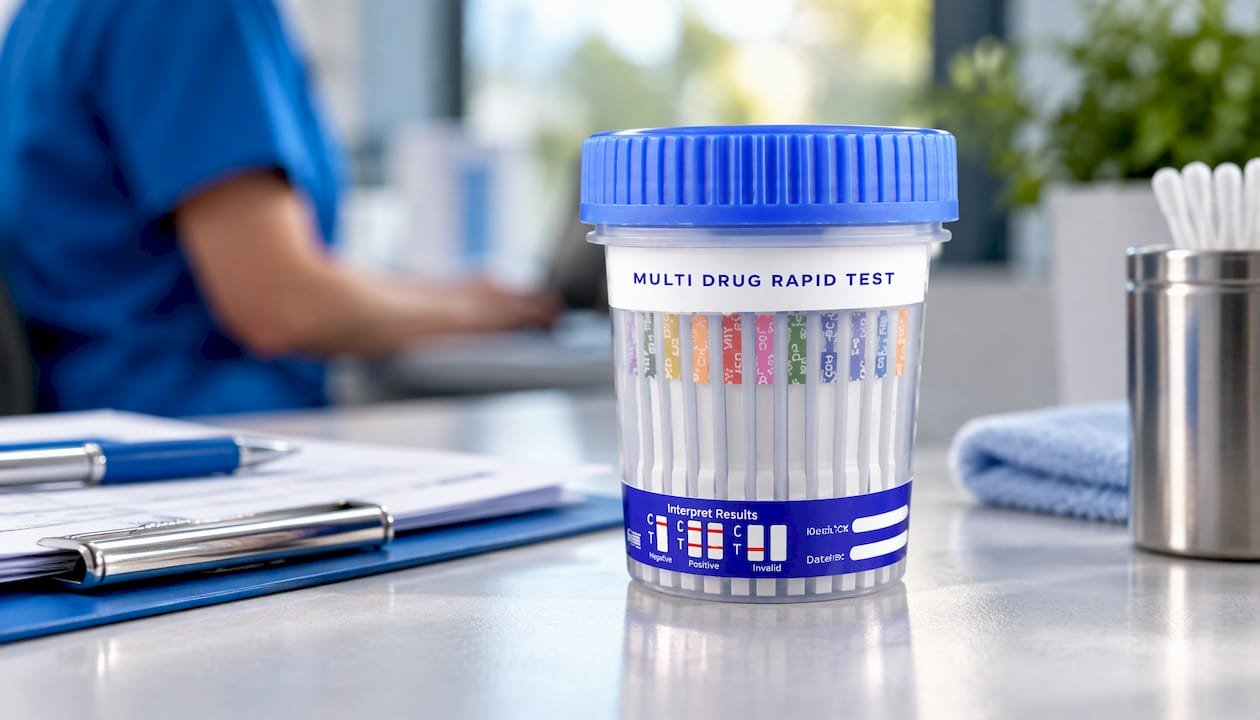
Multi-site and recurring accounts can request a wholesale quote through mayflowerbio.com. For a side-by-side of cups, kits and lab options, see our 14 panel drug test overview and the 14 panel cup page.
Common mistakes when reading results
- Treating a presumptive positive as proof. The cup flags a possibility. Confirmation identifies the drug.
- Reading a negative as “clean” across the board. The result covers only the panel’s drugs at their cutoffs.
- Skipping the control line. No control line, no valid result.
- Ignoring medications. Prescriptions and some foods can cross-react, which is why a conversation and confirmation come before any conclusion.
- Using a federal cutoff as a clinical rule. Know the actual cutoff for the analyte on your device.
- Reading late. Results outside the window in the insert are not reliable.
- Mixing up regulatory status. A Forensic Use Only cup is not a CLIA-waived device. Use the right one for the right purpose.
FAQ
What does a 14 panel drug test include?
There is no single standard. Panels vary by supplier and laboratory. Ours includes PCP, ETG and fentanyl alongside common drug classes, and the full list is in our 14 panel drug test list. Always check the insert for the exact analytes and cutoffs of your lot.
What do the results of a drug test mean?
A negative means nothing was found at or above the cutoff. A positive means one or more drugs were found in amounts that suggest use or misuse, according to MedlinePlus. On a rapid cup, that positive is presumptive until confirmed.
Does a positive result need a lab test?
In federally regulated workplace testing, yes: an initial positive is followed by a confirmatory test and medical review. In clinical settings it is at the practitioner’s discretion, though an unexpected or disputed result should generally be confirmed. GC/MS and LC-MS/MS are the usual methods.
Can medicines or food cause a false positive?
Yes. NIDA notes that some medicines and foods, such as poppy seeds, can cross-react with immunoassay antibodies. Ask about medications and confirm any positive before drawing conclusions.
Is the 14 panel cup CLIA waived?
No. Our 14 and 16 panel cups are Forensic Use Only and not CLIA waived. Our 12 panel cup with PCP is CLIA waived and FDA cleared, so choose by the way your program will use results.
Sources
- Clinical Drug Testing in Primary Care (SAMHSA, via GovInfo)
- Drug Testing, National Institute on Drug Abuse
- Drugs of Abuse Urine Screen with Reflex Confirmation, University of Iowa
- DOT 49 CFR Part 40 Section 40.87
- Testing Reference Guide, Nebraska Judicial Branch
- Drug Testing, MedlinePlus
This article is general information for program staff and does not replace the guidance of your medical review officer, laboratory director or legal counsel. Request wholesale pricing for your program at mayflowerbio.com.