
Difference Between 12 and 14 Panel Drug Test: Lab Guide
Difference Between 12 and 14 Panel Drug Test: Lab Guide
The difference between a 12 and 14 panel drug test is two additional analytes, and which two depends on the manufacturer. One maker’s 14-panel adds prescription opioids to its 12-panel. Ours adds PCP, ETG (an alcohol metabolite) and fentanyl to a drug menu built for forensic-use programs. So the panel count alone never tells you what a cup detects. The analyte list, the cutoffs and the regulatory status do. This guide shows how to read those three things so your lab, clinic or testing program buys the cup that matches its purpose.
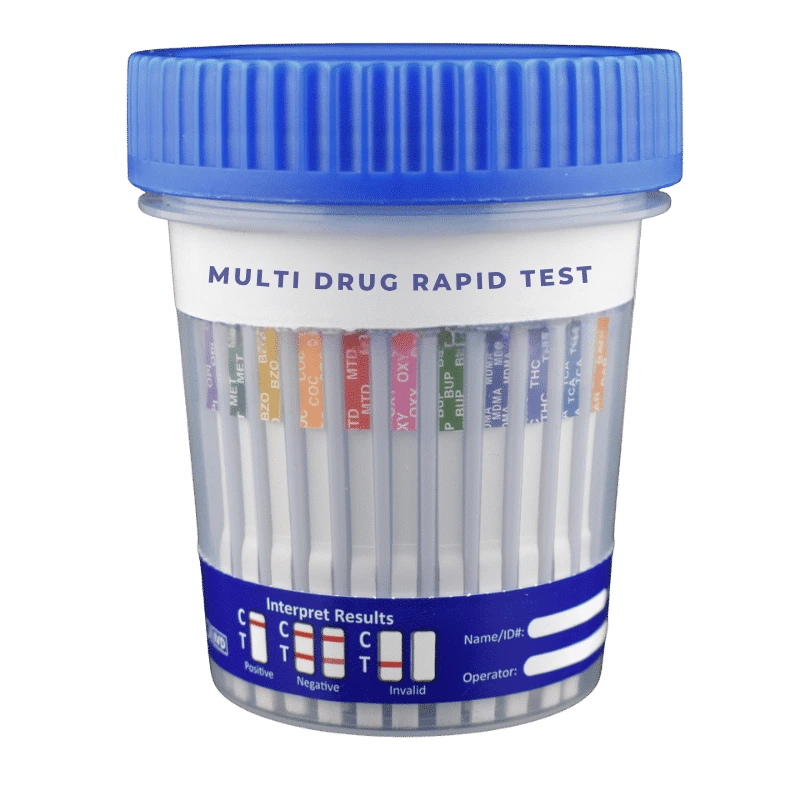
At Mayflower Bioscience, a St. Louis, Missouri wholesale supplier, we sell four cups: a 12-panel CLIA-waived, FDA-cleared cup with PCP, a 12-panel forensic-use cup with ETG and fentanyl, a 14-panel cup with PCP, ETG and fentanyl, and a 16-panel cup that adds kratom and TCA.
TL;DR
- A 12-panel and a 14-panel cup differ by two analytes. Those two are not standardized, so compare drug lists, not panel numbers.
- Our 12-panel cup with PCP is CLIA-waived and FDA-cleared. Our 12-panel ETG/fentanyl, 14-panel and 16-panel cups are Forensic Use Only and are not CLIA-waived.
- Every result from an immunoassay cup is preliminary. A positive needs confirmation by GC/MS or LC-MS/MS.
- Choose by purpose: point-of-care clinical screening, or forensic-use programs such as courts, corrections and employers that want alcohol and fentanyl on the same cup.
- Each of our cups has an integrated temperature strip and reads in about five minutes. Pricing starts at $2.59 per cup, with free shipping on 100+ cups.
Table of Contents
- The difference between a 12 and 14 panel drug test, drug by drug
- 12-panel vs 14-panel at a glance
- CLIA-waived versus Forensic Use Only
- Why the extra two panels matter
- Cutoffs: the number behind every strip
- Detection windows: what a result can and cannot tell you
- Every cup result is preliminary
- How to choose between a 12-panel and a 14-panel cup
- Our view on panel selection
- Order cups for your program
- FAQ
- Sources
The difference between a 12 and 14 panel drug test, drug by drug
A “panel” is one test strip on the cup, each aimed at a drug or a drug class. A 12-panel cup carries twelve of them, a 14-panel cup carries fourteen. No single standard fixes which twelve or fourteen. SAMHSA’s primary care guidance says that no single drug panel suits every clinical use and that panels vary greatly between and within laboratories. It advises contacting the laboratory to learn what a urine drug screen will and will not detect.
That is why two products with the same number can behave differently. One manufacturer’s 14-panel urine test adds tramadol and meperidine to its 12-panel and leaves alcohol out, so an EtG test must be added separately. Another maker may spend the extra slots elsewhere.
Our own configurations show the point. The 14-panel cup includes PCP, ETG and fentanyl. Our 12-panel CLIA-waived cup includes PCP. Our 12-panel forensic-use cup carries ETG and fentanyl. For the full analyte list of the 14-panel cup, see our 14-panel drug test page, and for the 12-panel, what a 12-panel drug test covers.

What the common core usually looks like
Most multi-panel cups build on the same core of widely screened classes. Typical 12-panel menus include amphetamines, barbiturates, benzodiazepines, cocaine, marijuana (THC), methadone, opiates and others. The remaining slots, and the two extra on a 14-panel, are where makers differ: PCP, propoxyphene, oxycodone, buprenorphine, tramadol, fentanyl, MDMA and ETG all appear on some menus and not others.
Before you buy, ask the supplier for the printed analyte list and the cutoff for each strip. Match it to your protocol line by line.
12-panel vs 14-panel at a glance
The table compares the cups we supply. It speaks only to features we state for these products.
| Feature | 12-panel CLIA-waived | 12-panel ETG/fentanyl | 14-panel | 16-panel |
|---|---|---|---|---|
| Notable analytes | PCP | ETG alcohol, fentanyl | PCP, ETG, fentanyl | Adds kratom and TCA |
| Regulatory status | CLIA-waived, FDA-cleared | Forensic Use Only, not CLIA-waived | Forensic Use Only, not CLIA-waived | Forensic Use Only, not CLIA-waived |
| Temperature strip | Integrated | Integrated | Integrated | Integrated |
| Read time | About 5 minutes | About 5 minutes | About 5 minutes | About 5 minutes |
| Typical setting | Point-of-care clinical screening | Programs that need alcohol and fentanyl | Programs that need PCP, alcohol and fentanyl | Broadest forensic-use menu |
For a side-by-side with the next tier up, see our 14 vs 16 panel comparison. A longer treatment of this exact comparison is in our guide to 12 vs 14 panel drug tests.
CLIA-waived versus Forensic Use Only
This is the line labs most often need drawn clearly, so here it is plainly.
- CLIA-waived: the test falls into the category of simple tests that the Clinical Laboratory Improvement Amendments allow a site to run under a certificate of waiver. Our 12-panel cup with PCP is CLIA-waived and FDA-cleared. It is the one for point-of-care clinical use.
- Forensic Use Only: our 12-panel ETG/fentanyl, 14-panel and 16-panel cups are not CLIA-waived. They are intended for forensic-use programs such as drug courts, corrections, employer programs and similar settings.
Do not mix these up in a protocol. If your clinic’s procedure requires a CLIA-waived device for patient care decisions, the 12-panel CLIA-waived cup is the match. If your program is forensic in nature and needs ETG or fentanyl on the same device, the forensic-use cups are built for it.
Why the extra two panels matter
Two extra strips can close a real gap, and the reasons come from how immunoassays work.
An immunoassay needs a specific antibody for each drug, metabolite or class. The AMA’s Council on Science and Public Health notes that many commercial tests cover only the SAMHSA-5 drugs, and that opiate immunoassays may not react to semisynthetic opioids such as hydrocodone or oxycodone. In drug testing language, “opiates” means the natural compounds, codeine, morphine and heroin metabolites. A physician who orders an “opiate” test may not realize semisynthetics are outside it. Dedicated strips fill that gap. For background on how opioid use shows up in treatment settings, see this overview of medication-assisted treatment for fentanyl addiction.
SAMHSA also warns that federally based panels may miss commonly prescribed medications such as hydrocodone and alprazolam. A wider menu helps, but only if the extra strips target what your population actually uses.
Fentanyl and alcohol on the same cup
Fentanyl and alcohol are the two additions that change program design the most. A fentanyl strip identifies exposure to a drug that a legacy opiate strip will not catch. An ETG strip looks for ethyl glucuronide, an alcohol metabolite, so a program can check for recent drinking without a separate device. Our 12-panel ETG/fentanyl cup and our 14-panel cup both carry these two. If you run an abstinence-based or court-supervised program, that is one cup, one collection and one read.
Cutoffs: the number behind every strip
A cutoff is the concentration, in nanograms per milliliter (ng/mL), at or above which a strip reads positive. Two cups with the same drug name can differ in sensitivity if their cutoffs differ.
For reference, SAMHSA’s TAP 32, citing the 2008 HHS federal workplace guidelines, lists these initial urine screening cutoffs:
| Analyte | Initial screen (ng/mL) | Confirmatory (ng/mL) |
|---|---|---|
| Marijuana metabolites | 50 | 15 (THC-COOH) |
| Cocaine metabolites | 150 | 100 (benzoylecgonine) |
| Opiate metabolites (codeine/morphine) | 2,000 | 2,000 |
| 6-acetylmorphine | 10 | 10 |
| Amphetamines | 500 | 250 |
| PCP | 25 | 25 |
| MDMA | 500 | 250 |
These are federal workplace figures, a reference point and not the cutoffs of any specific cup. The same guidance cautions that federally based panels may not be right for clinical testing, because initial cutoffs may not be low enough for clinical practice. Your cup’s package insert lists its actual cutoffs. For a broader explanation, see our cutoff levels chart.
Detection windows: what a result can and cannot tell you
Urine detection time depends on dose, route, metabolism, fat solubility, urine concentration and pH. The Family Physicians monograph on urine testing states that for most drugs the urine detection window is 1 to 3 days. Heavy or chronic use of some substances can stretch this, and a single occasional use can fall short of it. Use ranges, never promises.
A reference laboratory guide gives a feel for opioids: fentanyl has a 1 to 2 day urine detection time and tramadol 1 to 3 days. That is one reason a fentanyl strip is useful for programs with frequent testing: the window is short, so the schedule matters. Our page on how far back a 14-panel test goes covers ranges by drug.
A window also says nothing about when use occurred within it, how much was taken or whether the person was impaired.
Every cup result is preliminary
A rapid cup is a screen. The AMA report describes point-of-care urine tests as presumptive and qualitative, with limited menus, no ability to say which member of a drug class is present, and possible cross-reactions with medications and supplements. Benzodiazepine immunoassays can return false negatives depending on the antibody’s reference molecule. A patient taking alprazolam is the example given, because its major urinary metabolite may not be what the antibody targets. GC-MS or LC-MS is the standard for confirming presumptive results.
The Pennsylvania Department of Health’s training on urine drug tests lists the same cautions: false positives and false negatives are possible, and positive or unconfirmed results need additional confirmation.
In practice, build this into your protocol:
- Record the cup lot, read time and result for every test.
- Treat any non-negative result as presumptive.
- Send the specimen for GC/MS or LC-MS/MS confirmation before any adverse action or clinical decision rests on it.
- Use the temperature strip reading at collection, within the time stated in the cup’s instructions, to document that the sample is within the expected range.
The cup’s job is to sort quickly. Confirmation testing is the lab’s job. Each does its part better when the cup is reliable and consistent from lot to lot.
How to choose between a 12-panel and a 14-panel cup
Start with your purpose, not the number.
Choose the 12-panel CLIA-waived cup when
- You test at the point of care and your procedure calls for a CLIA-waived, FDA-cleared device.
- PCP belongs on your menu, and you do not need alcohol or fentanyl on the same cup.
- Volume is steady and you reorder often.
Choose the 12-panel ETG/fentanyl cup when
- Your program is forensic in nature and needs both alcohol and fentanyl without moving to a larger menu.
Choose the 14-panel cup when
- You need PCP, ETG and fentanyl together on one device.
- You run drug courts, corrections, employer or other forensic-use programs, where one collection should cover the widest practical set.
- You want fewer separate tests per collection, with less handling and a simpler workflow.
If your population also uses kratom or tricyclic antidepressants are a concern, the 16-panel cup adds both. See what a 16-panel test covers.
A worked example
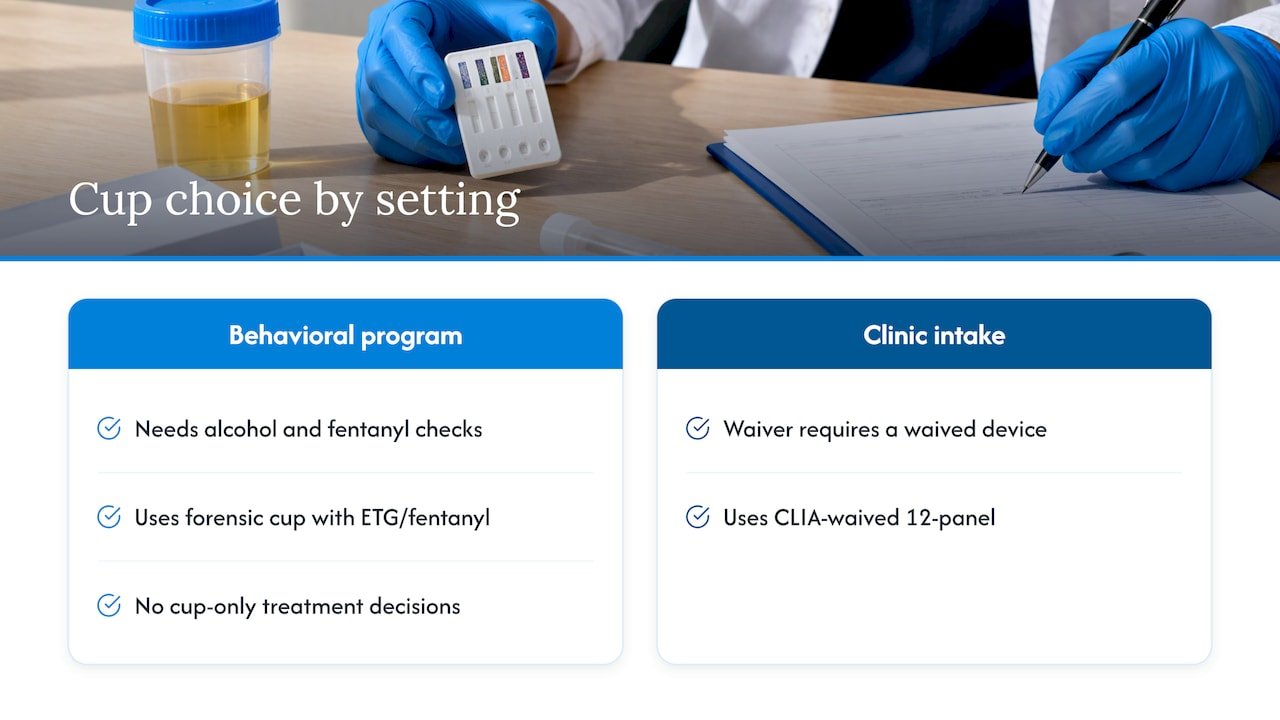
A behavioral health program tests about 400 clients a month. It needs alcohol checks and fentanyl screening under a court-supervision agreement, and it does not make clinical treatment decisions from the cup alone. A forensic-use cup with ETG and fentanyl fits that need. A clinic running intake screens at the point of care, where its certificate of waiver requires a waived device, uses the CLIA-waived 12-panel. The two sites can sit under one wholesale account, with each cup ordered for its own job.
One caution on lab-side testing: Labcorp states that general drug testing is useful for screening unexpected drug use but is not designed to monitor compliance with prescribed medications or medication-assisted treatment of opioid use disorder. Programs doing that work use dedicated monitoring profiles with mass spectrometry confirmation. A cup is the front-line screen in those workflows, with confirmation behind it. Billing and policy teams reviewing testing frequency may also want this guide to appropriate use criteria for practices.
Our view on panel selection
We hear the same question from lab managers and program directors: which panel is better? Our answer is that the better panel is the one that matches your protocol, and that is easier to decide when the choices are few and clearly labeled.
That is why our catalog is built around four cups. The 12-panel CLIA-waived cup with PCP is for point-of-care clinical use. The 12-panel ETG/fentanyl cup, the 14-panel cup and the 16-panel cup are Forensic Use Only, and we say so on every product page, because mixing up regulatory status is the mistake that costs programs the most.
Every cup has an integrated temperature strip and a read in about five minutes, so the workflow stays the same as you move up the panel ladder. A site can standardize training on one collection routine and change only the cup. Results are preliminary screening, and positives go to GC/MS or LC-MS/MS confirmation. We designed the range so confirmation stays a clean second step and not a surprise.
For multi-site and recurring accounts, we built the ordering around volume: pricing from $2.59 per cup, free shipping on 100+ cups and same-day dispatch from US stock.
Alina
Order cups for your program
If your protocol calls for PCP, ETG and fentanyl on one device, the 14-panel drug test cup with PCP is the cup to start with. Our site is built for bulk and recurring orders, with a quote process for wholesale and multi-site accounts, volume pricing from $2.59 per cup, free shipping on 100+ cups and same-day dispatch from US stock.

To see everything we carry, from drug test cups to research reagents, start at the Mayflower Bioscience home page and request wholesale pricing for your volume.
FAQ
What is a 14-panel drug test?
It is a urine screen with fourteen test strips, each aimed at a drug or class. The exact list depends on the maker. Our 14-panel cup includes PCP, ETG and fentanyl, and it is Forensic Use Only, not CLIA-waived. Results are preliminary and positives need confirmation.
How far back does a 12-panel drug test go?
For most drugs in urine the window is about 1 to 3 days, according to the Family Physicians monograph. It varies with dose, metabolism, urine concentration and pH, so treat any range as approximate. Our page on how far back a 14-panel test goes gives drug-by-drug ranges.
Is a 14-panel test always better than a 12-panel?
Not by number alone. Better means the cup whose analytes, cutoffs and regulatory status fit your protocol. For point-of-care clinical use, our CLIA-waived 12-panel is the match. For forensic-use programs needing PCP, alcohol and fentanyl, the 14-panel covers them on one cup.
Does a positive cup result need confirmation?
Yes. An immunoassay result is presumptive, and the standard confirmation methods are GC-MS or LC-MS, as the AMA council report explains. Send the specimen to a laboratory before any decision relies on the result.
Which of your cups are CLIA-waived?
Only the 12-panel cup with PCP is CLIA-waived and FDA-cleared. The 12-panel ETG/fentanyl, 14-panel and 16-panel cups are Forensic Use Only.
Sources
- SAMHSA, Clinical Drug Testing in Primary Care (TAP 32)
- AMA Council on Science and Public Health, Report 1 (I-16)
- Pennsylvania Department of Health, Module 3: Urine Drug Test Considerations
- Family Physicians, Urine Drug Testing monograph, 6th edition
- Quest Diagnostics, Clinical Drug Monitoring Reference Guide
- Labcorp, Drug testing services compendium
- Health Street, 14 Panel Urine Drug Test