How Long Do Barbiturates Stay in Your System?
How Long Do Barbiturates Stay in Your System?
Most barbiturates stay detectable in urine for 2 to 4 days, but phenobarbital — the long-acting barbiturate still prescribed for seizures — can remain detectable for 10 to 21 days, and in chronic use even longer. The honest answer depends on which barbiturate was taken, because the class spans short-acting sleep drugs to long-acting anti-seizure medicines, and their half-lives range from hours to days. Knowing which window applies matters for workplaces, drug courts, and treatment programs that must decide when to test — and what a positive result actually means.
Barbiturates are central nervous system depressants, and they are prescribed far less often today than they were fifty years ago — safer medicines have largely replaced them for sleep and anxiety. But two members of the class are still in regular use: phenobarbital for epilepsy and seizure control, and butalbital for tension headaches. That is why barbiturate positives still appear in program testing, and why a positive result often reflects a prescription rather than misuse. The full cross-drug picture sits on our drug detection times chart.
Short Answer: Barbiturate Detection Windows by Specimen
Detection windows vary by specimen type because each matrix holds the drug differently:
| Specimen | Typical window | What it is used for |
|---|---|---|
| Urine | 2–4 days (short-acting); up to 7 days (intermediate); 10–21 days (phenobarbital) | Standard for workplace, treatment, and supervision testing |
| Blood | 1–2 days (phenobarbital up to about 4 days) | Impairment assessment and emergency toxicology |
| Saliva | 1–3 days (long-acting up to about 7 days) | Rapid on-site and roadside screening |
| Hair | Up to 90 days | Long-term history, not recent use |
Urine is the specimen nearly every program uses, so the rest of this guide focuses on urine windows.
Why the Answer Depends on Which Barbiturate
Barbiturates are a class, not a single drug. They are grouped by how quickly they act and how long their effects last: ultra-short-acting drugs such as thiopental, used in anesthesia; short-acting drugs such as pentobarbital and secobarbital, formerly used for insomnia; intermediate-acting drugs such as amobarbital and butalbital; and long-acting drugs such as phenobarbital, used for seizure control.
What sets the detection window is the half-life — the time it takes for the amount of drug in the body to fall by half. A drug is not fully cleared after one half-life; most medicines need at least 4 to 5 half-lives before only trace amounts remain. That arithmetic is why the class has no single answer: a short-acting barbiturate with a 15-hour half-life clears in days, while phenobarbital, with a half-life of 53 to 118 hours, keeps being excreted for weeks. Dose and frequency multiply the effect, because repeated dosing builds up a reservoir of the drug that takes many half-lives to drain.
Urine Detection Windows by Drug: Short, Intermediate, and Long-Acting
The single most useful table for anyone interpreting a barbiturate result separates the drugs by class, because the half-life gap between them is so large:
| Barbiturate | Class | Half-life | Urine window |
|---|---|---|---|
| Pentobarbital (Nembutal) | Short-acting | 15–50 hours | About 3 days |
| Secobarbital (Seconal) | Short-acting | 15–40 hours | About 3 days |
| Amobarbital (Amytal) | Intermediate | 8–42 hours | About 3 days |
| Butalbital (Fiorinal, Fioricet) | Intermediate | About 35 hours | Up to about 7 days |
| Phenobarbital (Luminal) | Long-acting | 53–118 hours (2–6 days) | 10–21 days; longer with chronic or high-dose use |
Two cautions on this table. First, phenobarbital is the outlier that drives most surprises: it is the only barbiturate still widely prescribed, and its window is three to seven times longer than the short-acting drugs. A program that plans around a 3-day window will miss phenobarbital entirely. Second, some laboratory detection-time tables list urine barbiturates for up to 6 weeks. That longer figure reflects chronic, high-dose use tested at a low cutoff — it is not the window for a single therapeutic dose, and it should not be used to plan a testing schedule. Our cutoff levels guide explains how the cutoff level shapes every window.
What Extends (or Shortens) the Window
Half-life sets the baseline, but several factors move an individual result well outside it:
Dose and frequency. Higher doses and daily use extend the window most. Phenobarbital taken daily for epilepsy accumulates steadily, so a patient on long-term therapy carries a much longer tail than someone who took a single dose.
Age and liver function. Barbiturates are metabolized in the liver, so older age, liver disease, and medicines that slow liver enzymes lengthen detection. Younger, healthy adults with normal liver function clear faster.
Body composition. Barbiturates distribute into body fat and leach back slowly, which is one reason chronic users test positive long after stopping.
Urine pH and dilution. Barbiturates are weak acids, so alkaline urine slows their excretion and extends the window, while acidic urine speeds it. Dilute urine can push drug levels below the cutoff and produce a negative despite recent use — which is why collectors check creatinine and specific gravity.
The cutoff level. A urine barbiturate screen commonly uses a 200 ng/mL cutoff for secobarbital, and lower laboratory cutoffs extend every window in this guide. MayFlower cups use a 300 ng/mL cutoff for the barbiturate strip, so their windows run slightly shorter than a low-cutoff laboratory test. The cutoff is part of the result, not a detail — two tests on the same specimen can disagree when their cutoffs differ.
Effects Fade Long Before Detection Ends
The effects of a barbiturate begin within about 30 minutes of taking it and last 4 to 16 hours depending on the drug — but the drug keeps being detectable for days or weeks after the person feels normal. That gap is the most common misunderstanding in program testing: a person who feels fine, drives normally, and shows no impairment can still test positive, because the test measures what is still being excreted, not how impaired someone is. A positive urine result is evidence of exposure within the window, never evidence of current impairment. Programs that treat a positive as proof of intoxication at work or behind the wheel are reading the test wrong.
The Program Angle: Which Panels Actually Detect Barbiturates
For treatment programs, workplace programs, and supervision agencies, barbiturate testing has one practical trap: the standard federal 5-panel screen does not include barbiturates at all. Barbiturates sit in the additional categories beyond the five — a 7-panel test adds them, and the common 10-panel test includes a barbiturate strip. A program running only a basic 5-panel-style screen will miss barbiturate use entirely, including prescribed phenobarbital.
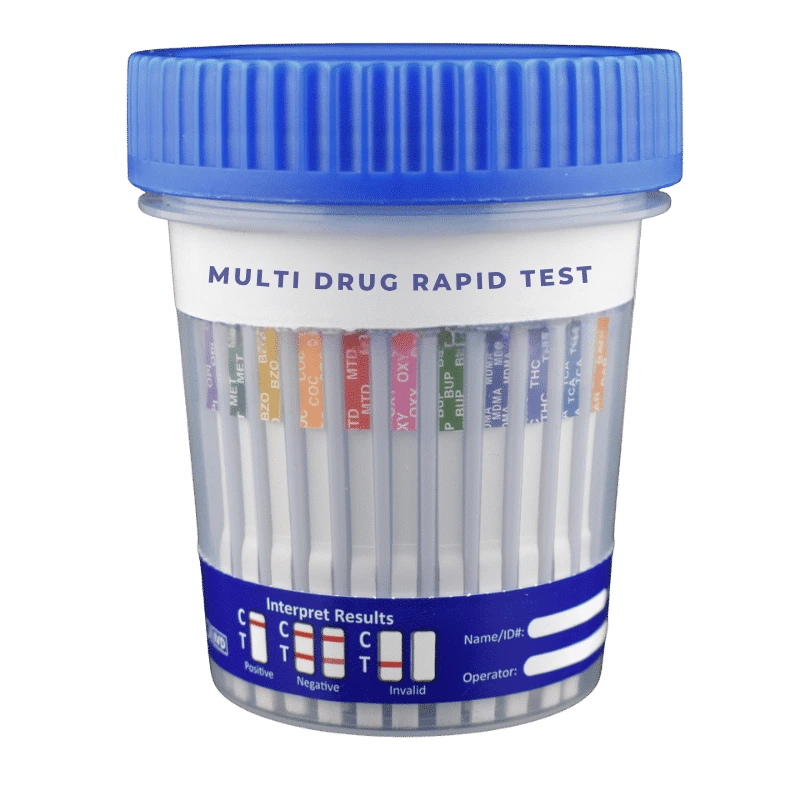
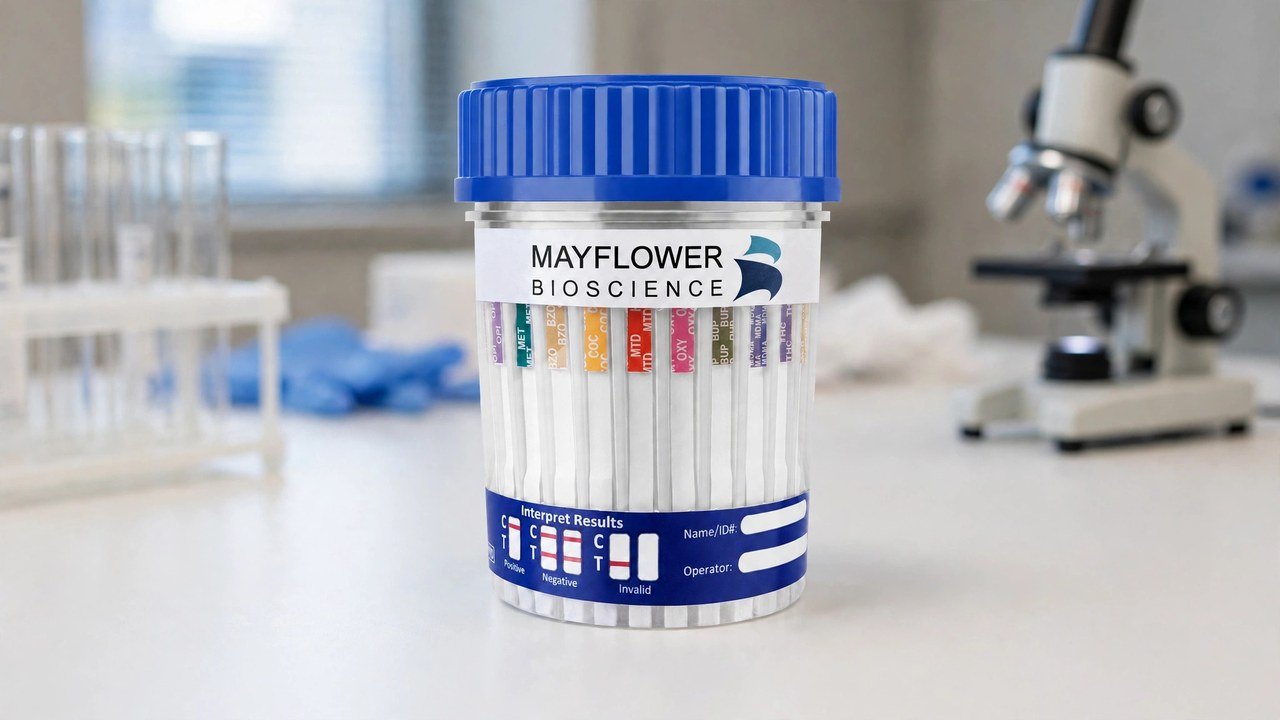
Any program where sedative use is a concern needs a panel that explicitly includes a barbiturate (BAR) strip. MayFlower’s 12-panel PCP cup, 14-panel cup, and 16-panel cup all carry a BAR strip at a 300 ng/mL cutoff, alongside the core menu — see the 12-panel, 14-panel, and 16-panel collections, and stock up through wholesale drug test cups. One exception to check before ordering: the 12-panel forensic-use cup built around EtG and fentanyl does not list a BAR strip, so programs that need barbiturate coverage should order the 12-panel PCP cup instead. And timing matters as much as the panel — testing weekly catches chronic phenobarbital use easily but can miss a single short-acting dose taken days earlier, so programs monitoring for intermittent use should test more frequently or use random scheduling.
Prescribed vs Misuse: A Positive Does Not Mean Abuse
Phenobarbital is a first-line anti-seizure medicine and butalbital is prescribed for tension headaches, so a positive barbiturate result frequently reflects legitimate therapeutic use. A patient taking phenobarbital as directed for epilepsy will test positive, exactly as a misuser would. The screen cannot distinguish the two, and neither can the cutoff level.
The correct program response is a process, not a verdict: collect a medication disclosure at testing, route every presumptive positive to laboratory confirmation by GC-MS or LC-MS/MS, and have a medical review officer (or qualified clinician) compare the confirmed drug against the disclosed prescription before any action. Confirmation also identifies the specific barbiturate — a cup screen is class-level and cannot say whether the positive came from phenobarbital, butalbital, or another member of the class. Acting on an unconfirmed screen against a prescribed patient is both unfair and legally risky. One more clinical fact programs should know: stopping barbiturates abruptly after regular use can cause dangerous withdrawal, including seizures, so any positive that leads to a treatment decision should be handled with medical supervision, not as a disciplinary event alone.
For readers comparing detection windows across drug classes, the drug detection times chart covers every major substance, and our guides on how long benzodiazepines stay in your system and how long opioids stay in your system use the same single-dose versus chronic structure.
Choosing the Right Cup for Barbiturate Testing
Match the panel to the population: any program testing for sedatives needs a barbiturate strip, and programs already screening for fentanyl, EtG, or kratom should not lose the BAR strip when they upgrade panels. MayFlower’s 12-panel PCP, 14-panel, and 16-panel cups all carry barbiturate screening alongside the core menu, so upgrading for fentanyl or EtG never means dropping barbiturate coverage. Browse the range at MayFlower Bioscience or stock up through wholesale drug test cups.
External references: the MedlinePlus drug testing overview explains screening versus confirmation, SAMHSA sets the federal framework many testing programs follow, and NIDA summarizes drug testing’s role in treatment and justice programs.
Frequently Asked Questions
How long do barbiturates stay in your system?
Most barbiturates are detectable in urine for 2 to 4 days, but phenobarbital can remain detectable for 10 to 21 days, and longer with chronic use. Blood windows are 1 to 2 days, saliva 1 to 3 days, and hair up to 90 days. The exact window depends on which barbiturate was taken, the dose, and how often it was used.
How long does phenobarbital stay in urine?
Phenobarbital is typically detectable in urine for 10 to 21 days after use, and longer with chronic or high-dose use. Its half-life is 53 to 118 hours, the longest of any barbiturate still prescribed, which is why its window is three to seven times longer than the short-acting drugs.
How long do short-acting barbiturates stay in urine?
Short-acting barbiturates such as pentobarbital and secobarbital are typically detectable in urine for about 3 days. Intermediate-acting drugs such as amobarbital clear in about the same time, while butalbital can take up to about 7 days.
Do barbiturates show up on a standard drug test?
Not on a basic 5-panel screen, which does not include barbiturates. A 7-panel test adds them, and the common 10-panel test includes a barbiturate strip. MayFlower 12-panel PCP, 14-panel, and 16-panel cups all include a barbiturate strip at a 300 ng/mL cutoff.
What is the cutoff for a barbiturate urine test?
A urine barbiturate screen commonly uses a 200 ng/mL cutoff for secobarbital, and lower laboratory cutoffs extend the detection window. MayFlower cups use a 300 ng/mL cutoff for the barbiturate strip, so their windows run slightly shorter than a low-cutoff laboratory test.
How long do barbiturates stay in blood and saliva?
Barbiturates are detectable in blood for about 1 to 2 days, with phenobarbital lasting up to about 4 days, and in saliva for about 1 to 3 days, with long-acting drugs lasting up to about 7 days. Blood and saliva windows are much shorter than urine windows because the drug clears from circulation faster than it stops being excreted.
How long do barbiturates stay in hair?
Barbiturates are detectable in hair for up to 90 days. Hair testing reflects long-term history rather than recent use, so it shows whether barbiturates were used over the past few months, not whether someone used them in the last few days.
Does a prescribed barbiturate make you fail a drug test?
A prescribed barbiturate taken as directed will produce a positive screen, because the test cannot distinguish therapeutic use from misuse. The correct process is to disclose the prescription at collection, confirm the presumptive positive by laboratory testing, and have a medical review officer compare the confirmed drug against the prescription before any decision is made.
How long do the effects of barbiturates last compared with detection?
The effects of a barbiturate begin within about 30 minutes and last 4 to 16 hours, but the drug remains detectable for days or weeks after the person feels normal. A positive urine result is evidence of exposure within the detection window, never evidence of current impairment.
Can a drug test tell which barbiturate you took?
No, a standard cup screen cannot. Barbiturate strips are class-level immunoassays, so a positive screen only shows that a barbiturate is present. Laboratory confirmation by GC-MS or LC-MS/MS is needed to identify the specific drug, for example phenobarbital versus butalbital.