
How Long Does MDMA Stay in Your System?
How Long Does MDMA Stay in Your System?
MDMA is usually detectable in urine for 1 to 3 days after a single dose and up to 4 to 5 days after heavy or repeated use. Blood and saliva windows are shorter — about 1 to 2 days — while hair can show MDMA use for up to 90 days. The drug itself clears fast, with a half-life of about 8 hours, but its metabolites keep urine tests positive well after the effects wear off. For programs, the practical question is not how long the high lasts (3 to 6 hours) but which test, on which day, can still catch it — and which panel actually screens for it at all.
MDMA — sold as ecstasy or molly — is an amphetamine derivative and a Schedule I controlled substance in the United States, with no FDA-approved medical use. It is also one of the most commonly missed drugs in routine screening: a standard 5-panel test does not include an MDMA target at all. The windows below come from controlled dosing studies and toxicology references, and the program section at the end explains how workplaces, treatment programs, and drug courts should test for it.
Short Answer: MDMA Detection Windows by Specimen
Each matrix holds the drug and its metabolites differently:
| Specimen | Typical window | What it is used for |
|---|---|---|
| Urine | 1–3 days (single dose); up to 4–5 days (heavy or repeated use) | Standard for workplace, treatment, and supervision testing |
| Blood | 1–2 days | Impairment assessment and emergency toxicology |
| Saliva | 12–48 hours | Roadside and rapid on-site screening |
| Hair | Up to 90 days | Long-term history, not recent use |
Urine is the specimen nearly every program uses, so the rest of this guide focuses on urine windows. The full cross-drug picture sits on our drug detection times chart, alongside our guides on benzodiazepine and opioid windows.
Why Urine Tests Detect Metabolites, Not the Drug Itself
MDMA is broken down by the liver before it leaves the body, so a urine test mostly detects what MDMA becomes, not MDMA itself. The liver converts it into three main compounds: MDA (itself an active stimulant), HMMA (4-hydroxy-3-methoxymethamphetamine, the main urinary metabolite), and HMA. HMMA is the workhorse of MDMA detection, and it outlasts the parent drug by a wide margin.
A controlled dosing study in the Journal of Analytical Toxicology (2009) found HMMA stayed detectable more than 33 hours longer than MDMA itself, and at sensitive laboratory thresholds MDMA-related compounds were still turning up in urine up to 168 hours — seven days — after dosing. The parent drug is mostly gone in about 40 hours, but the metabolites keep the test positive for days longer.
This also explains why the cutoff matters. MayFlower cups screen MDMA at a 500 ng/mL cutoff, the common immunoassay threshold for this analyte. A laboratory confirmation test uses a much lower threshold and targets metabolites directly, so it can detect MDMA use for longer than a cup screen. Our cutoff levels guide explains how cutoffs shape every result.
Single Dose vs Repeated Use: The Window Changes
The most important distinction for anyone interpreting an MDMA result is whether the person took one dose or used repeatedly, because MDMA does not clear the way most drugs do. MDMA inhibits CYP2D6, the very liver enzyme that breaks it down, so each dose slows the clearance of the next one. A second dose taken within 24 hours raised total drug exposure by about 77 percent in a published study, and higher doses clear disproportionately slowly. A weekend of repeated dosing therefore stretches the window well beyond what a single-dose table suggests.
| Specimen | Single dose | Heavy or repeated use |
|---|---|---|
| Urine | 1–3 days | Up to 4–5 days (up to 7 days at sensitive lab thresholds) |
| Blood | Up to 24–48 hours | Up to 2–3 days |
| Saliva | 12–48 hours | Up to 2 days |
| Hair | Up to 90 days | Up to 90 days (longer hair extends the lookback) |
Two cautions. First, hair testing cannot detect very recent use: a single dose from the past day or two usually will not appear yet, because the hair containing it has not grown out. Hair answers whether someone used over the past few months — never whether they used last night. Second, the urine numbers assume a standard 500 ng/mL screening cutoff; a laboratory test with a lower threshold extends every window, which is why a cup negative and a lab positive for the same specimen are both possible.
What Extends (or Shortens) the Window
Half-life sets the baseline — about 8 hours for MDMA, with roughly 40 hours (five half-lives) to clear about 95 percent of the parent drug — but several factors move an individual result well outside it:
Dose and frequency. This is the biggest factor for MDMA, because of the CYP2D6 autoinhibition described above. Higher doses and doses taken close together extend the window most: a single pill clears in days, while a multi-day run builds up drug and metabolites faster than the liver can process them.
Metabolism and liver function. MDMA is broken down mostly by CYP2D6, and people vary widely in how active that enzyme is — some are genetically poor metabolizers. Liver disease, older age, and drugs that inhibit CYP2D6, including some antidepressants, all slow clearance and lengthen detection.
Hydration and dilution. Heavy fluid intake before collection dilutes the sample and can push metabolite levels below the cutoff, producing a negative despite recent use — which is why collectors check creatinine and specific gravity. Our dilute results guide explains what collectors do when a specimen looks diluted.
What was actually in the pill. Street ecstasy is frequently not pure MDMA: pills sold as ecstasy or molly commonly contain methamphetamine, synthetic cathinones, caffeine, or other stimulants, and sometimes no MDMA at all. Those adulterants have their own detection windows and can trigger other strips, so a result must be read against laboratory confirmation, not assumed from the street name.
Body composition. This matters less for MDMA than for drugs like THC: MDMA is not stored in fat, so body fat is a minor factor; dose, frequency, and liver function dominate.
Does MDMA Show Up on a Standard Drug Test?
Usually not — and that is the trap. A standard 5-panel screen, the test most employers use for random screening, does not include an MDMA target. A person who used MDMA will test negative on a 5-panel cup, not because the drug cleared, but because the panel never looked for it.
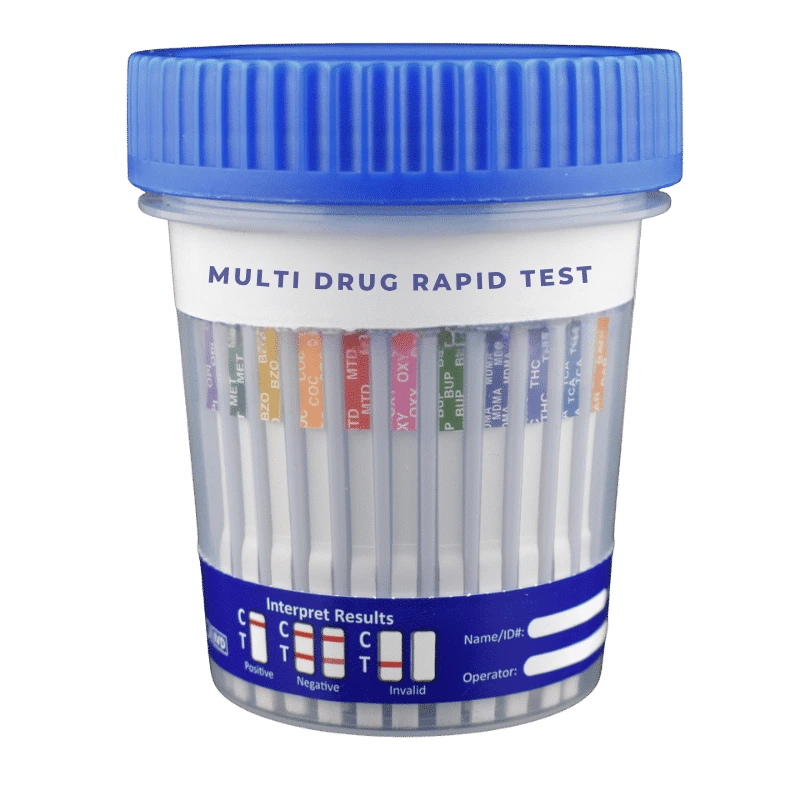
Most 12-panel urine tests do include a dedicated MDMA target, and MayFlower’s do: both the 12-panel PCP cup and the 14-panel cup screen MDMA at a 500 ng/mL cutoff. The 12-panel cup is CLIA-waived; the 14-panel adds EtG alcohol and fentanyl alongside MDMA.
One more wrinkle: MDMA is an amphetamine derivative, so it can cross-react with amphetamine (AMP) screening strips and produce a presumptive positive for amphetamines. That is a screen-level artifact, not a second drug — laboratory confirmation by GC-MS or LC-MS/MS distinguishes MDMA from amphetamine and methamphetamine. No consequential decision should ever rest on a screen alone, as our how to read a drug test cup guide explains: a screen is presumptive, never final.
The Program Angle: Testing for MDMA in Workplaces, Treatment, and Drug Courts
For workplaces, treatment programs, and supervision agencies, MDMA testing has three practical traps:
First, the panel must actually include MDMA. Any program relying on a 5-panel-style screen is blind to MDMA by design. If MDMA use is a concern in the population — and in young-adult, festival, and nightlife-adjacent populations it often is — the program needs a 12-panel cup or larger with a dedicated MDMA strip. Upgrading for fentanyl or EtG should never mean losing MDMA coverage; MayFlower’s 12-panel and 14-panel cups carry MDMA alongside the rest of the menu, and volume programs standardize through wholesale drug test cups.
Second, timing must match the drug. MDMA’s urine window is short — 1 to 3 days after a single dose — so weekly testing easily misses a single weekend dose taken days earlier. Programs monitoring for intermittent use should test more frequently or use random scheduling, and should remember that a negative result means below cutoff on this day, not never used.
Third, read the result with the pill in mind. Because street ecstasy is often adulterated, an MDMA-positive specimen may also show methamphetamine or other stimulants, and an amphetamine-positive specimen with no MDMA may still be MDMA cross-reactivity. Collect a disclosure at testing, confirm every presumptive positive by laboratory testing, and have a medical review officer compare the confirmed analytes against what the donor reports before any action.
Choosing the Right Cup for MDMA Testing
Match the panel to the population: any program testing for MDMA needs a dedicated MDMA strip, and programs screening for fentanyl, EtG, or kratom should not lose MDMA coverage when they upgrade. MayFlower’s 12-panel PCP cup (CLIA-waived, MDMA at 500 ng/mL) covers workplace and clinic screening, while the 14-panel cup adds EtG alcohol and fentanyl for programs that need the broader menu. Browse the range at MayFlower Bioscience.
External references: NIDA’s MDMA (Ecstasy/Molly) research topic, the MedlinePlus drug testing overview on screening versus confirmation, and SAMHSA Find Help for treatment and support resources.
Frequently Asked Questions
How long does MDMA stay in your system?
MDMA is usually detectable in urine for 1 to 3 days after a single dose and up to 4 to 5 days after heavy or repeated use. Blood and saliva windows are shorter, about 1 to 2 days, while hair can show MDMA use for up to 90 days. The parent drug itself is mostly cleared in about 40 hours, but its metabolites linger longer in urine.
How long does MDMA stay in urine?
A single dose is typically detectable in urine for 1 to 3 days. Heavy or repeated use extends that to 4 or 5 days, and laboratory testing that targets metabolites at sensitive thresholds has found MDMA-related compounds up to 7 days after a controlled dose. The standard screening cutoff on MayFlower cups is 500 ng/mL.
How long does molly stay in your system?
Molly is MDMA, so the windows are the same: urine 1 to 3 days after a single dose and up to 4 to 5 days after heavy use, blood and saliva 1 to 2 days, and hair up to 90 days. The name on the street does not change how the body clears the drug.
Does MDMA show up on a 5-panel drug test?
No. A standard 5-panel screen does not include an MDMA target, so MDMA use is missed entirely. Programs that need MDMA coverage must use a panel that explicitly includes an MDMA strip, such as MayFlower’s 12-panel and 14-panel cups, which both screen MDMA at a 500 ng/mL cutoff.
How long does ecstasy stay in blood and saliva?
Ecstasy, which is MDMA, is detectable in blood for about 1 to 2 days and in saliva for about 12 to 48 hours. Both matrices reflect recent use only, which is why blood and saliva testing are used for impairment assessment and roadside screening rather than for program monitoring.
How long does MDMA stay in hair?
MDMA can be detected in hair for up to 90 days with a standard 1.5-inch sample, and longer hair extends the lookback further. Hair testing reflects use over weeks to months, not recent use — a single dose from the past day or two usually will not appear yet because the hair has not grown out.
What is the half-life of MDMA?
MDMA has a half-life of about 8 hours, meaning half of the drug is cleared from the blood in that time. About five half-lives, roughly 40 hours, clears around 95 percent of the parent drug. Detection windows run longer than the half-life because tests detect metabolites that clear more slowly.
Can MDMA cause a false positive for amphetamines?
MDMA is an amphetamine derivative, so it can cross-react with amphetamine screening strips and produce a presumptive positive for amphetamines. Laboratory confirmation by GC-MS or LC-MS/MS distinguishes MDMA from amphetamine and methamphetamine, which is why no consequential decision should rest on a screen alone.
Do MDMA metabolites stay in your system longer than MDMA itself?
Yes. The liver converts MDMA into MDA, HMMA and HMA, and the main urinary metabolite HMMA stays detectable more than 33 hours longer than MDMA itself. In a controlled dosing study, MDMA-related compounds were still found in urine up to 7 days after dosing at sensitive detection thresholds.
How long after taking MDMA will a drug test be negative?
It depends on the dose, how often it was used, and the test. After a single dose, most urine screens turn negative within 3 to 5 days; heavy or repeated use can take longer. Blood and saliva tests turn negative sooner, usually within 1 to 2 days. Only an actual test can confirm a negative result, and a negative means below the cutoff on that day, not proof of no use.