What Does a Kratom Drug Test Detect? Mitragynine Explained
Does Kratom Show Up on a Drug Test?
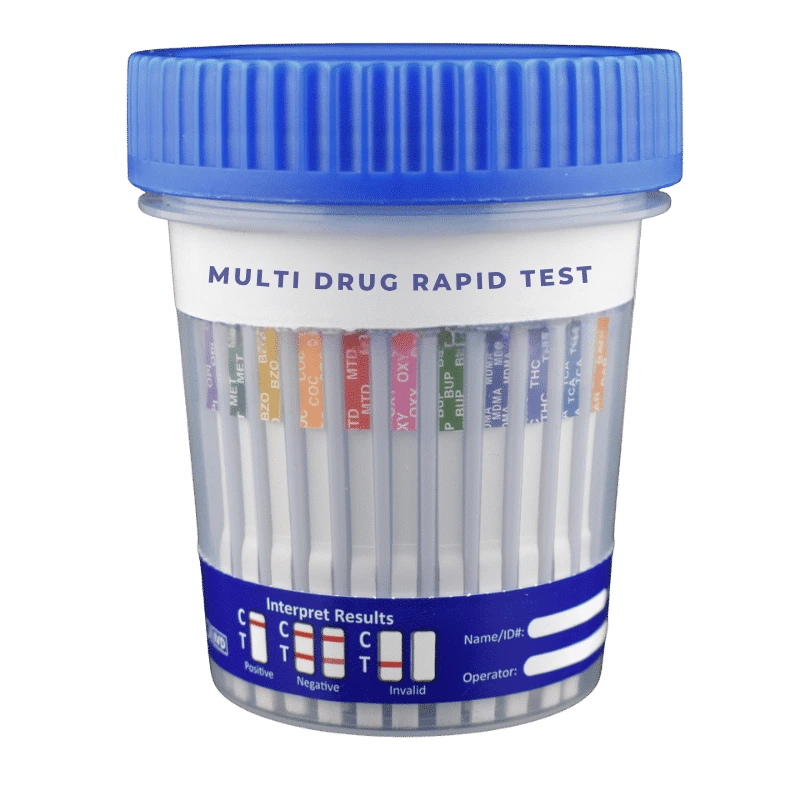
No — kratom does not show up on a standard drug test. Standard 5, 10, 12 and 14 panel tests do not screen for kratom at all. Kratom is detected only when a test carries a dedicated kratom (KRA) strip that targets mitragynine — the main active alkaloid in kratom leaf — or when a laboratory runs a specialized mitragynine assay. At MayFlower, kratom coverage is built into the 16 panel cup; everywhere else, it has to be ordered on purpose.
That one fact answers most searches for a “kratom drug test,” but it raises the follow-ups this guide covers: which panels include kratom and which do not, the mitragynine cutoff for rapid strips versus laboratory tests, how long kratom stays detectable in urine, blood, saliva and hair, whether kratom can cause a false positive, and which programs — treatment, probation, pain management, military — actually test for it. MayFlower Bioscience supplies wholesale drug test cups for those programs from its homepage range of 12, 14 and 16 panel configurations.
Does Kratom Show Up on Standard Panels?
Panel by panel, the answer is the same until the panel is deliberately expanded:
| Panel | Detects kratom? | Why |
| 5 panel (SAMHSA-5 / DOT) | No | Screens THC, cocaine, amphetamines, opiates and PCP only; kratom is not a federal panel analyte |
| 10 panel | No | Adds benzodiazepines, barbiturates, methadone and others — still no mitragynine target |
| 12 panel | No | Expanded opioid and sedative coverage, but no KRA strip |
| 14 panel | No | Adds fentanyl and ETG alcohol on common configurations — still no kratom |
| 16 panel (MayFlower) | Yes | Includes a dedicated KRA strip alongside fentanyl, ETG and TCA |
| Specialized lab test | Yes | Mitragynine immunoassay screen with LC-MS/MS confirmation, ordered separately |
Kratom also does not show up as something else on a standard panel. Mitragynine’s chemical structure differs from morphine and the other opiate targets, so the opiate strip does not cross-react with it — a kratom-only user screens negative. There is one documented exception involving a methadone-metabolite assay, covered in the false positive FAQ below.
Kratom Testing at a Glance
| Target analyte | Mitragynine (primary kratom alkaloid) |
| Also measured (lab) | 7-hydroxymitragynine (7-OH) |
| Typical rapid cutoff | 300 ng/mL |
| Typical lab screen cutoff | ~5 ng/mL (CEDIA-type immunoassay); LC-MS/MS confirms lower |
| Urine window — occasional use | 1–3 days |
| Urine window — heavy daily use | Up to ~5–7 days (occasionally reported to 9+ days) |
| On standard 5/10/12/14 panels | No — specialty strip only |
| On MayFlower 16 panel cup | Yes — KRA strip included |
Why Mitragynine Is the Target
Kratom leaf contains dozens of alkaloids, but mitragynine makes up roughly two-thirds of the alkaloid content and drives most of the plant’s effects, which is why screening assays are built around it. In the body, part of the mitragynine converts to 7-hydroxymitragynine — a much more potent opioid-receptor compound that laboratories can measure at confirmation; the focused explainer is the kratom 7-OH drug testing guide. The National Institute on Drug Abuse summarizes the pharmacology and the still-developing science around both compounds.
The cutoff gap between rapid and laboratory testing matters for program design. A rapid KRA strip screening at 300 ng/mL is a practical point-of-care tool: it catches recent, meaningful use at the time of collection. A laboratory CEDIA-type mitragynine assay screening around 5 ng/mL, with LC-MS/MS confirmation quantifying mitragynine and 7-OH at still lower concentrations, casts a much wider and longer net. Screening and confirmation answer different questions — “was kratom used recently?” versus “can we prove exactly what was used, and how much?” — and defensible programs use the strip to screen and the laboratory to confirm.
Kratom Detection Windows by Test Type
Urine is the specimen almost every kratom test uses, but it is not the only one. Windows differ sharply by specimen, and every figure below assumes a test that actually targets mitragynine — a standard panel detects kratom in no specimen, at any time.
| Test type | Typical detection window | Notes |
| Urine | 1–3 days after occasional use; up to ~7 days with heavy daily use (occasionally reported to 9+ days) | The standard specimen for rapid KRA cups and lab mitragynine tests |
| Blood | ~24–48 hours, up to about 3 days | Reflects very recent use; mainly clinical and forensic settings |
| Saliva (oral fluid) | ~24–48 hours | Emerging and rarely used for kratom; no widely standardized kratom oral-fluid test |
| Hair | Up to ~90 days | Specialized laboratory testing only; shows a pattern of repeated use, not a single occasion |
Mitragynine clears relatively quickly after a single use — most occasional users test negative in urine within 1–3 days. Heavy daily use is different: repeated dosing accumulates mitragynine, and detection can stretch to about a week. For comparison across substances, see the drug detection times chart.
What Affects How Long Kratom Stays Detectable?
Half-life first. Mitragynine’s terminal half-life is often cited at around 24 hours in chronic users (a frequently referenced 2015 pharmacokinetic study), while studies of kratom teas in occasional users report much shorter half-lives of roughly 3–9 hours. That wide, honestly uncertain range is why detection windows are ranges rather than guarantees: with a ~24-hour half-life, five half-lives of clearance takes about five days; with faster metabolism, clearance is far quicker.
Beyond half-life, five factors move the window most:
Dose and frequency. The single biggest factor. A one-time low dose may clear in a day or two; heavy daily use saturates tissue stores and extends urine detection toward a week or beyond.
Product form and potency. Raw leaf, concentrated extracts and enhanced or 7-OH-forward products differ several-fold in alkaloid content per dose. A stronger product delivers more mitragynine to clear, and labels on unregulated products do not always state potency accurately. Some adulterated products have also been found cut with other drugs — a contamination route to a true positive for a different substance, separate from any cross-reactivity.
Metabolism and CYP enzymes. Mitragynine is broken down in the liver, largely through cytochrome P450 pathways (notably CYP3A4, with CYP2D6 involvement). Genetic differences in these enzymes, liver health, and other medications that speed or slow the same pathways all change clearance speed.
Body composition. Kratom alkaloids distribute into fatty tissue, so higher body fat can mean slower release and a longer tail of detection.
Hydration and urine concentration. Hydration affects how concentrated a urine sample is. Very dilute samples can fall below a cutoff sooner — which is why programs pair screening with specimen validity checks rather than relying on a single number.
Who Needs Kratom on the Panel — and the Legal Patchwork
Kratom testing matters where kratom itself is the risk: MAT programs whose patients may substitute kratom for opioids, pain-management clinics, and probation or drug-court supervision in jurisdictions that prohibit it. Testing situations also include child-custody and family-court orders, forensic and post-accident investigations, and treatment programs whose agreements name kratom explicitly.
Two federal contexts deserve plain statements. Military: kratom is prohibited for U.S. service members under Department of Defense policy — all kratom, mitragynine and 7-OH products are on the DoD prohibited list — even though routine military urinalysis does not screen for it; specialized testing can be ordered. Workplace/DOT: kratom is not on the DOT panel under 49 CFR Part 40 and was not added to the federal authorized panel in the July 2025 SAMHSA update, so a DOT test never detects it; employers who want kratom coverage must order it as a separate non-DOT test.
Legality is a patchwork — kratom is not federally scheduled, but it is banned statewide in Alabama, Arkansas, Indiana, Louisiana, Vermont and Wisconsin, with local ordinances banning it in additional cities and counties. Rhode Island banned kratom in 2017 but replaced that ban with a regulated Kratom Consumer Protection Act framework effective April 1, 2026 — a reminder to verify current state law before writing policy around it. The FDA has issued safety communications and import alerts on kratom. Programs should test for kratom only where policy or law names it. Where it is named, the practical vehicle is the kratom drug test cups configuration — the 16 panel cup that pairs the KRA strip with fentanyl, ETG alcohol and the full expanded analyte set described in the 14 panel guide and its larger sibling, the 16 panel drug test cups collection.
Frequently Asked Questions
Does kratom show up on a 5 panel drug test?
No. A standard 5 panel drug test screens for THC, cocaine, amphetamines, opiates and PCP. Kratom’s alkaloid mitragynine is not one of its targets, so kratom use alone does not produce a positive 5 panel result. Only a test with a dedicated kratom (KRA) strip or a specialized laboratory assay detects kratom.
Does kratom show up on a probation drug test?
Only if the probation program specifically orders kratom testing. Routine probation panels do not include mitragynine, but courts and probation departments in jurisdictions that ban kratom — or where abstinence from kratom is a written condition of supervision — can add a KRA strip or a laboratory mitragynine test. If kratom is named in your conditions, assume it can be tested for.
Can kratom cause a false positive on a drug test?
Rarely, yes — on one specific assay. A published study (Pierre et al., American Journal of Clinical Pathology, 2020) documented a kratom metabolite causing false positive results on the Thermo Scientific CEDIA methadone-metabolite (EDDP) immunoassay. Kratom does not cross-react with the standard opiate strip. Any presumptive EDDP positive should be confirmed by LC-MS/MS, which distinguishes kratom metabolites from methadone and EDDP and clears the false positive.
Will kratom show up on a workplace drug test?
Not on a standard workplace panel, and not on the federal DOT panel under 49 CFR Part 40, which does not include kratom. An employer can only detect kratom if it orders a non-DOT test with a dedicated kratom strip or laboratory mitragynine assay, which some safety-sensitive employers and programs in states that restrict kratom now do.
What does a kratom drug test detect?
A kratom drug test detects mitragynine, the primary active alkaloid in kratom leaf, using a dedicated KRA immunoassay strip. Some laboratory confirmations also measure 7-hydroxymitragynine, mitragynine’s active metabolite.
What is the kratom (mitragynine) cutoff?
Rapid kratom strips commonly screen at 300 ng/mL for mitragynine in urine, though configurations vary (100–500 ng/mL exists). Laboratory immunoassays screen far lower — around 5 ng/mL — and LC-MS/MS confirmation measures lower still. Check the configuration sheet of the specific cup.
How long is kratom detectable in urine?
Mitragynine is typically detectable for 1–3 days after occasional use and up to about 5–7 days in heavy daily users — heavy users are occasionally reported out to 9 days or more — because chronic use accumulates the alkaloid. Exact windows vary with dose, product potency and metabolism.
Will kratom show up as an opiate on a drug test?
No. Although kratom alkaloids act on opioid receptors, mitragynine’s structure differs from morphine, so the opiate strip does not cross-react with it. A standard panel reports negative for a kratom-only user. The one documented exception is cross-reactivity on a specific methadone-metabolite (EDDP) immunoassay — see the false positive question above.
Which drug test cup includes kratom?
The 16 panel drug test cup — it combines a kratom (KRA) strip with fentanyl, ETG alcohol, TCA and the standard expanded analytes for treatment and monitoring programs. See also the kratom drug test cups collection.
What happens if a kratom test is positive?
A rapid positive is presumptive. Confirm by LC-MS/MS, which quantifies mitragynine (and 7-OH where ordered) and gives the program a defensible, concentration-based result.