How to Read a Drug Test Cup: Lines, Results and Validity
How to Read a Drug Test Cup
How to read a drug test cup: each strip shows a control line (C) and a test line (T). Two lines — C plus T — is a negative result for that drug, even if the T line is faint. One line — C only — is a presumptive positive. No C line means the test is invalid and must be repeated. Check the temperature strip within 4 minutes of collection (it must read 90–100°F), read every strip at 5 minutes, and never interpret a cup after 10 minutes.
Multi-panel drug test cups are lateral-flow immunoassay devices — the same competitive-binding chemistry as rapid antigen tests, adapted for drugs of abuse. One collection screens up to 16 drug classes in about five minutes. Reading them correctly is a procedural skill: the rules are simple, but the three most common mistakes — reading too late, comparing line darkness, and skipping the temperature check — all produce results a program cannot defend.
Results at a Glance
Every strip on the cup is read the same way. Find the pattern, read the meaning — the full table below is the whole interpretation system in four rows:
| Result | C line | T line | Meaning |
|---|---|---|---|
| Negative | Present | Present (any intensity) | Drug is below the cutoff — a negative result for that strip. |
| Negative (faint line) | Present | Present but faint, thin, or broken | Still negative. Line intensity does not change the result. |
| Presumptive positive | Present | Absent | Drug is at or above the cutoff — send the specimen for laboratory confirmation. |
| Invalid | Absent | Present or absent | The strip did not function — discard the cup and repeat with a new device. |
The Two Lines That Decide Every Result
Behind the peel-off label, each drug on the cup has its own strip with two zones:
- Control region (C): the procedural control. A colored line must appear here on every strip for the result to be valid. It proves the sample migrated correctly and the chemistry worked — it says nothing about drugs.
- Test region (T): the drug region. A line here means the drug is below the cutoff concentration. No line here means the drug is at or above the cutoff.
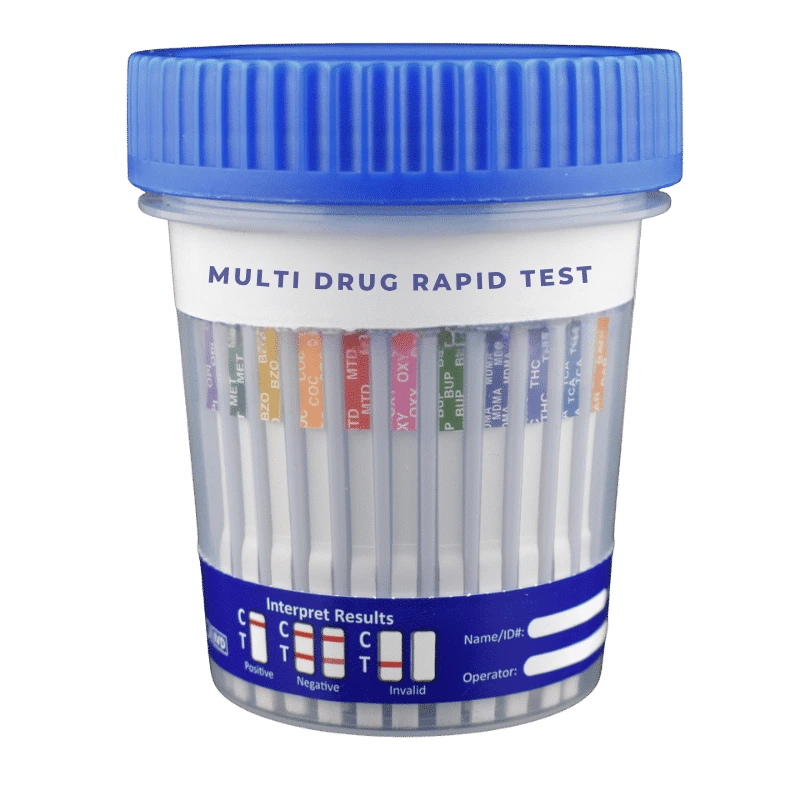
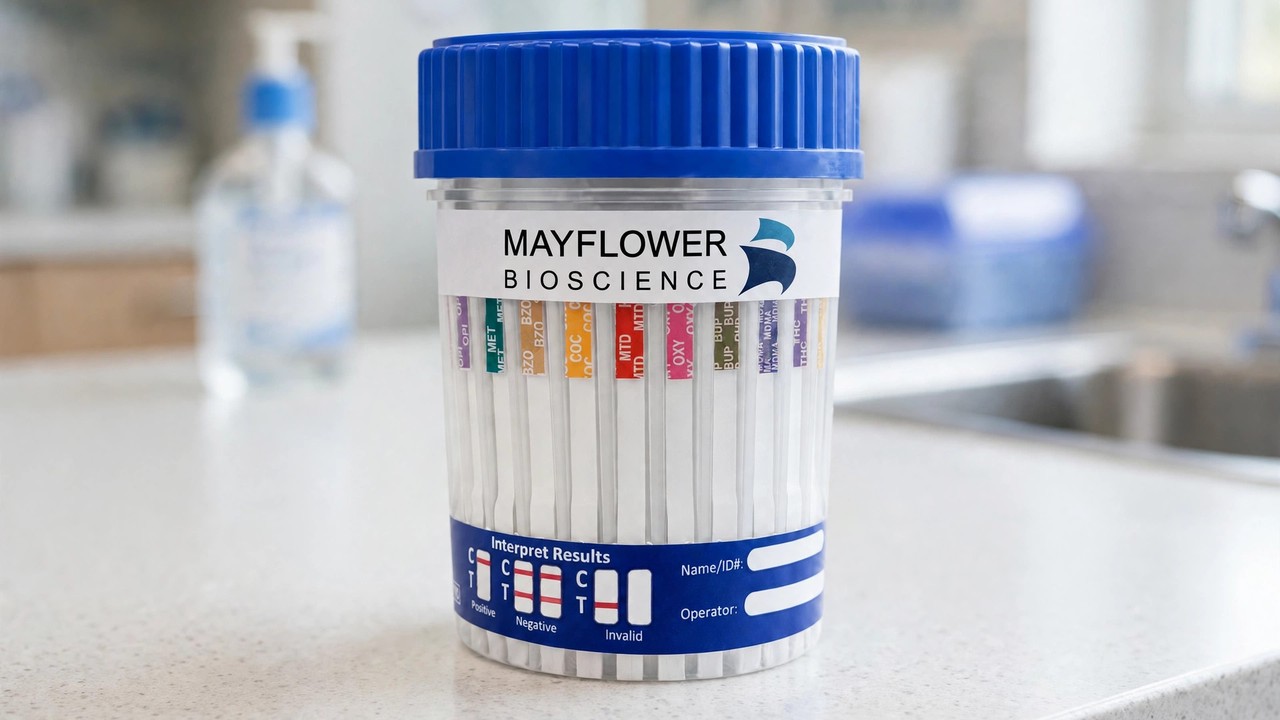
This is the opposite of what most first-time readers expect, and it is the single most important fact about reading a drug test cup: a visible T line is good news. The diagram below mirrors the “Interpret Results” legend printed on professional cup labels, so collectors can confirm the pattern at a glance.
Each strip must be judged on its own. In a multi-panel cup it is normal for some strips to show two lines and others one — a mixed cup is a donor with a mixed result, not a defective cup. Never compare strips against each other, and never compare a T line’s darkness to the control line.
Why the Lines Work Backwards: Competitive Immunoassay
Drug test strips use competitive lateral-flow immunoassay chemistry, which explains why a missing line means a positive result. When urine touches the strip, it migrates upward by capillary action, picking up particle-labeled antibodies as it goes. At the T region the strip carries immobilized drug-protein conjugate; at the C region it carries an antibody that captures the labeled particles regardless of what is in the sample. If the urine contains no drug, the labeled antibodies bind the conjugate at the T region and a line forms. If the urine contains drug above the cutoff, that drug saturates the labeled antibodies first, so nothing binds at the T region and no line forms. The control line forms either way. Near-cutoff specimens produce faint T lines because fewer antibodies reach the T region — but any visible line still counts as negative.
Cutoffs are the concentration thresholds separating negative from presumptive positive — for example THC 50 ng/mL, cocaine metabolite 300 ng/mL, opiates 300 ng/mL, amphetamine 1,000 ng/mL, PCP 25 ng/mL, fentanyl 20 ng/mL, ETG alcohol 300 ng/mL. Every value, and how cup cutoffs differ from the federal laboratory numbers, is listed in our guide to drug test cutoff levels explained. SAMHSA’s federal workplace testing framework is built on this cutoff-based model, and the same cutoffs govern point-of-care cups used by clinics and justice programs.
Step-by-Step: Reading a Drug Test Cup
- Label and collect. Have the donor initial and date the body label, collect urine to at least the minimum fill line, and screw the cap on tight. Below the fill line, strips may not wet fully and results can be invalid.
- Read the temperature strip within 4 minutes. The exterior temperature strip must read 90–100°F (32–38°C). Fresh human urine falls in this range; a reading outside it suggests the specimen is not fresh, was substituted, or was adulterated — the collection is invalid.
- Peel the result label to expose the strip windows, after the temperature check.
- Wait the full 5 minutes. Negatives may be read as soon as both lines appear, but a positive interpretation requires the full 5 minutes, because some strips (particularly THC and medication panels) take longer to develop.
- Read each strip individually in good light at eye level. Check the abbreviation beside each strip (drug test abbreviations such as THC, COC, AMP, OPI, FEN, ETG) so each result is recorded against the right drug.
- Record immediately — each strip as negative, presumptive positive, or invalid — with the donor’s name/ID, date, and the operator’s initials, the fields printed on the cup label.
Do not interpret the result after 10 minutes. Late reading is the most common procedural error in point-of-care testing. As strips dry, back-migration and evaporation lines can create or erase lines that were never part of the reaction, producing false positives or false negatives. Follow the package insert; most manufacturers specify “do not interpret after 8–10 minutes.”
Drug Test Abbreviations: What Each Strip Label Means
Each strip is labelled with a two- to three-letter abbreviation for the drug class it screens. The same abbreviations appear on laboratory reports and program policies, so collectors should be able to expand every one without checking the box:
| Abbreviation | Drug class screened |
|---|---|
| AMP | Amphetamine |
| BAR | Barbiturates |
| BUP | Buprenorphine |
| BZO | Benzodiazepines |
| COC | Cocaine (benzoylecgonine metabolite) |
| ETG | Ethyl glucuronide (alcohol metabolite) |
| FEN | Fentanyl |
| KRA | Kratom (mitragynine) |
| MDMA | Ecstasy (methylenedioxymethamphetamine) |
| MET | Methamphetamine |
| MTD | Methadone |
| OPI | Opiates (morphine / codeine) |
| OXY | Oxycodone |
| PCP | Phencyclidine |
| TCA | Tricyclic antidepressants |
| THC | Marijuana (THC-COOH metabolite) |
Worked example — one cup, mixed results: on a 14-panel cup, the THC strip shows C + a faint T (negative), the COC strip shows C only (presumptive positive for cocaine), the FEN strip shows C + T (negative), and the remaining eleven strips show C + T (negative). The recorded result is exactly that: thirteen negatives and one presumptive positive, with only the cocaine result sent for confirmation. A mixed cup is the normal output of a multi-panel device, not a malfunction.
The Faint-Line Rule: Intensity Does Not Matter
A faint or thin T line still counts as negative — this is the rule collectors get wrong most often. Line intensity varies by lot, strip, and specimen and does not correlate with the amount of drug in the sample: a bold T line and a barely visible one are both negative, as is a broken or partial line at 5 minutes. Only the complete absence of a T line at the 5-minute mark is a presumptive positive. If you are squinting and asking “is that a line?” — it is a line, and the result is negative.
| What the T line looks like | Interpretation |
|---|---|
| Bold, same darkness as the C line | Negative |
| Faint, pale, or thinner than the C line | Negative |
| Broken, partial, or uneven | Negative |
| No T line at all (C line only) | Presumptive positive — confirm by laboratory testing |
| No C line (with or without a T line) | Invalid — repeat with a new cup |
When documenting a faint-line result, record it plainly as “Negative” — never “faint negative,” “trace,” or “inconclusive.” Those improvised terms have no standing in a program record and are the first thing challenged when a result is disputed.
Temperature and Specimen Validity: Reading the Whole Cup
Reading a drug test cup is not only about the C and T lines — the specimen itself must be valid. The 90–100°F temperature window, read within 4 minutes of collection, is the first and most reliable validity check against substitution. Beyond temperature, many integrated cups include specimen-validity (adulteration) pads that screen for:
- Creatinine — abnormally low levels indicate dilution or substitution
- pH — out-of-range pH suggests chemical adulteration
- Specific gravity — abnormally low specific gravity indicates a dilute specimen
- Nitrite, glutaraldehyde, and oxidants — markers of commercial adulterant products
Read adulteration pads at the time listed in the box’s color chart, because pad colors keep changing afterward. A color outside the chart’s normal range is abnormal, and an abnormal validity result invalidates the drug results on that cup — do not interpret drug strips on a cup that fails validity. Federal and many program guidelines treat a dilute or adulterated specimen as its own reportable outcome, which is why programs document dilute drug test results as their own outcome category, and why non-DOT and pre-employment workflows should spell out validity failures explicitly.
Invalid Results: When to Repeat the Test
A result is invalid whenever the control line fails to appear — with or without a T line. Common causes include insufficient specimen volume, incorrect procedure, or an expired, damaged, or improperly stored device (room temperature; never frozen, never past the pouch expiration date). The remedy is always the same: discard the cup and repeat with a new device.
Partial invalids happen on multi-panel cups: eleven strips show proper control lines and one does not. Only that strip’s result is invalid; the remaining eleven can be read and recorded. Document the invalid strip and, depending on program policy, recollect or note the gap in the donor’s record.
A Positive Screen Is Presumptive — Confirmation Comes Next
Every positive on a drug test cup is a presumptive positive. Immunoassay screening is deliberately broad: antibodies can cross-react with legal substances that share molecular features with the target drug — classic examples include poppy-seed foods triggering opiate strips and dextromethorphan cross-reacting on some opiate or PCP panels. MedlinePlus notes that screening tests require confirmation when results will drive consequential decisions (see their drug testing overview).
Confirmation means sending the sealed specimen to a toxicology laboratory for GC-MS or LC-MS/MS analysis, which identifies the specific molecule and its concentration. SAMHSA’s framework requires laboratory confirmation of every positive screen, with a Medical Review Officer reviewing confirmed results against legitimate prescriptions. Keep the chain intact — label the cup with donor ID and date at collection, keep the cap sealed, and ship the cup itself to the lab so the confirmation specimen is unambiguously the screening specimen. NIDA’s drug testing research resources describe how screening and confirmation fit together in monitoring programs.
A Positive Screen Does Not Mean Impairment
A cup detects drug or metabolite above a cutoff — it does not measure impairment, dose, or when use occurred. Most panel drugs remain detectable for days after any effect has ended, and THC for weeks, so a presumptive positive shows exposure inside the detection window, nothing more. Never present a screening result as proof that a donor was impaired at work, on the road, or at the time of collection; that judgment belongs to the confirmation result, the Medical Review Officer review, and the program’s own process.
Common Mistakes When Reading a Drug Test Cup
Almost every disputed cup result traces back to one of these seven reading errors — all of them procedural, and all of them preventable with a written collection routine:
- Reading after 10 minutes. Drying strips develop evaporation lines and back-migration artifacts. A late read is not a result; record at 5 minutes and discard the cup.
- Calling a faint T line positive. Any visible T line is negative. Intensity varies by lot and specimen and does not grade the result.
- Skipping the temperature check. The strip must be read within 4 minutes of collection (90–100°F). An hour later it proves nothing about substitution.
- Calling a positive before 5 minutes. Negatives may be read as soon as both lines appear, but some strips develop slowly — a positive call requires the full 5 minutes.
- Comparing strips against each other. Each strip is an independent test with its own chemistry. A bold THC line says nothing about a faint BZO line.
- Interpreting drug strips on a validity-failed cup. Abnormal temperature or adulteration-pad results invalidate the whole specimen — do not report drug lines from it.
- Acting on an unconfirmed screen. A presumptive positive goes to GC-MS or LC-MS/MS confirmation (with Medical Review Officer review in workplace programs) before any consequence. Document results as Negative, Presumptive Positive, or Invalid — never improvised terms like “faint negative.”
Choosing the Right Cup for Your Program
Reading is only half the task; the cup has to test for the right drugs in the first place. A strip can only report on the drug it carries — fentanyl needs its dedicated FEN strip, which standard opiate panels miss, and alcohol abstinence monitoring needs the ETG panel that extends the alcohol window to about 80 hours (see the drug detection times chart for every analyte’s window). Match the panel to the population: treatment programs need fentanyl and ETG coverage, justice programs the full classic panel plus PCP.
MayFlower’s 12, 14, and 16 panel drug test cups are CLIA-waived point-of-care devices with built-in temperature strips, the printed C/T interpretation legend, and 5-minute results — for example, the 12 panel drug test cup with ETG alcohol and fentanyl covers the two analytes programs add most often — with wholesale pricing for programs testing at volume as part of their wider wholesale drug test supplies. One label distinction matters when buying: CLIA-waived cups are cleared for point-of-care use by trained staff in waived settings, while Forensic Use Only (FUO) devices are restricted to forensic applications such as justice and workplace testing programs and carry no CLIA waiver — match the device designation to your setting before ordering. The fentanyl and ETG alcohol collection pages detail the panels programs ask about most.
Frequently Asked Questions
How do you read a drug test cup?
Peel the result label and check each strip’s two zones: the control region (C) and the test region (T). Two lines (C + T) is negative for that drug; one line (C only) is a presumptive positive; no C line means invalid — repeat with a new cup. Read the temperature strip first (90–100°F within 4 minutes of collection), then read the drug strips at 5 minutes, never after 10 minutes.
What do C and T mean on a drug test?
C is the Control region and T is the Test region — the two zones printed on every strip. The C line is a procedural control: it must appear for the strip’s result to be valid, and it says nothing about drugs. The T line is the drug line: if it appears, the drug is below the cutoff and the result is negative; if it is absent while the C line is present, the result is a presumptive positive. No C line — with or without a T line — means the test is invalid.
What does a faint line on a drug test mean?
A faint line in the test (T) region means negative. Drug test cups use competitive immunoassay chemistry where any visible T line — however faint, thin, or broken — indicates the drug is below the cutoff. Line intensity varies by lot and specimen and does not reflect how much drug is present, so never compare the darkness of the T line to the control line or to other strips.
What does it mean if there is only one line on a drug test?
It depends on which line appears. A control (C) line alone with no test line is a presumptive positive for that drug — the specimen should go to the laboratory for GC-MS or LC-MS/MS confirmation. But if no control line appears at all (even with a test line visible), the result is invalid; the device did not function properly and the test must be repeated with a new cup.
Can different panels on the same cup have different results?
Yes — and it is the normal outcome of a multi-panel test. Each strip is an independent immunoassay with its own antibodies and cutoff, so one cup can legitimately show, for example, a negative THC strip (C + faint T), a presumptive-positive cocaine strip (C only), and negative results on every other strip. Read and record each strip on its own; never average strips together or treat a mixed cup as defective. Only the presumptive-positive strips go forward for laboratory confirmation.
How long do you wait to read a drug test cup?
Read results at 5 minutes. Negative results can be interpreted as soon as both lines appear, but wait the full 5 minutes before calling a positive, since some strips take longer to develop. Do not interpret the cup after 10 minutes — as strips dry, evaporation lines and back-migration can create or erase lines, producing false positives or false negatives. That includes a cup that has dried out: once the read window passes, the result can no longer be interpreted at all.
What is the normal urine temperature for a drug test?
90–100°F (32–38°C), read on the cup’s temperature strip within 4 minutes of collection. Fresh human urine falls in this range. A reading outside it means the specimen is not fresh or may have been substituted or adulterated, so the collection is invalid and a new specimen must be collected according to program policy.
What makes a drug test invalid?
Any strip with no control (C) line is invalid — caused by insufficient specimen volume, incorrect procedure, or an expired or damaged device — and must be repeated with a new cup. A specimen is also invalid when the temperature falls outside 90–100°F or when specimen-validity pads show abnormal creatinine, pH, specific gravity, nitrite, glutaraldehyde, or oxidant results.
Do drug test cups detect diluted or adulterated urine?
Many integrated cups include specimen-validity pads alongside the drug strips. These check creatinine, pH, specific gravity, nitrite, glutaraldehyde, and oxidants against a color chart — low creatinine or specific gravity indicates dilution or substitution, while abnormal nitrite or oxidant readings indicate chemical adulterants. Read the pads at the time listed in the chart, since their colors keep changing afterward.
Can a drug test cup give a false positive?
Yes — immunoassay screening can cross-react with legal substances that resemble the target drug, such as poppy-seed foods on opiate panels or dextromethorphan on some opiate or PCP panels. That is why every cup positive is only presumptive and must be confirmed by laboratory GC-MS or LC-MS/MS before any consequential decision, with a Medical Review Officer reviewing confirmed workplace results against legitimate prescriptions.