Drug Testing in Correctional Facilities: Standards and Panels
Drug Testing in Correctional Facilities: Standards & Panels
Drug testing in correctional facilities is the urine drug screening of incarcerated people at intake, at random, and for cause — run under facility policy and accreditation standards rather than employer rules. Most facilities test with observed-collection, forensic-use multi-panel cups at documented cutoffs, and no sanction is imposed on a screening result alone: every presumptive positive that carries a consequence goes to a laboratory for GC-MS or LC-MS/MS confirmation first. The program exists to control contraband, protect staff and incarcerated people, and identify substance use disorders that treatment inside and after custody can address.
A correctional testing program is a security system, a safety system, and a health system at once. That is what separates it from community supervision testing, where an officer monitors someone living at home (covered in our probation drug testing guide) — inside a facility, the agency controls the environment, the schedule, and the collection itself, and it is accountable for what happens to everyone in that environment.
Why Correctional Facilities Drug Test
Four operational goals drive testing in jails and prisons, and each one maps to a different testing point later in the program:
- Contraband control. Drugs smuggled into a facility fuel debt, extortion, assaults, and overdoses. A credible random testing program raises the cost of bringing drugs in and gives investigators a tool when contraband surfaces.
- Safety. Intoxication and withdrawal are medical and security events in a housing unit. Screening at intake identifies people at risk of withdrawal complications, and incident testing helps establish what happened after a fight, an overdose, or a medical emergency.
- Treatment identification. A large share of incarcerated people meet clinical criteria for a substance use disorder. NIDA’s criminal justice research is direct on this point: drug use and criminal behavior are linked in a cycle, and assessment at intake is the gateway to medication-assisted treatment, therapeutic communities, and reentry planning that reduce both relapse and recidivism.
- Program integrity. Work release, education, and treatment units depend on a drug-free environment. Testing verifies compliance so that people who are progressing are not surrounded by active use.
When Testing Happens: The Five Testing Points
Facilities do not test “in general” — they test at defined points, for defined reasons, each with its own cadence:
| Testing point | Trigger | Typical cadence | Purpose |
|---|---|---|---|
| Intake / booking | Every admission | Once, within hours of arrival | Baseline health screen, withdrawal risk, classification |
| Random | Computer-generated selection from the population | Monthly percentage of population (commonly 5–10%) | Deterrence and contraband control |
| For cause | Observed behavior, contraband find, incident, overdose | As events occur | Incident investigation and documentation |
| Program / pre-release | Work release, treatment unit, transfer, furlough | On placement, then scheduled or random | Verify a drug-free status before added freedom |
| Return / re-entry | Return from court, hospital, work detail, or escape | Every return to secure custody | Detect contraband or use acquired outside |
Intake screening deserves emphasis: it is the one universal test, and it is primarily clinical. The result guides medical monitoring during the highest-risk days of custody and creates the documented baseline every later result is compared against.
Panels Used in Secure Settings — and the Synthetics Problem
Facility panels start from the classic drugs of abuse — THC, cocaine metabolite, amphetamines and methamphetamine, opiates, PCP, benzodiazepines, methadone, oxycodone, and barbiturates — because those remain the bulk of what testing finds. Two modern additions matter more in custody than anywhere else:
- Fentanyl. Standard opiate strips do not detect fentanyl; it needs its own FEN strip, and fentanyl is now a leading contraband drug and overdose cause inside facilities. Panels without a fentanyl strip are screening blind for the highest-risk analyte — see the fentanyl drug test cups page for strip specifics.
- ETG alcohol. Alcohol is brewed inside facilities from commissary ingredients. The ETG metabolite extends the alcohol detection window to roughly 80 hours (window data in the drug detection times chart), which makes scheduled and post-incident alcohol screening practical.
One honest limitation belongs in every facility policy: synthetic cannabinoids (K2/Spice) and other designer synthetics are a specialty laboratory test, not a standard cup strip. Synthetic cannabinoids are a serious contraband problem in secure settings precisely because they evade routine panels — their chemistry changes constantly and no standard multi-panel cup covers the rotating analogues. Facilities that need synthetic coverage send specimens to a reference laboratory for dedicated synthetic panels. What point-of-care cups do cover, comprehensively, is the classic panel plus fentanyl and ETG — which is why expanded configurations such as 16 panel drug test cups are the standard facility choice: the widest defensible screen at the collection point, with laboratory referral for synthetics and confirmations.
Cutoffs follow the same discipline as federal testing — SAMHSA-aligned screening thresholds (for example THC 50 ng/mL, PCP 25 ng/mL, fentanyl 20 ng/mL) applied uniformly. The full threshold logic is covered in drug test cutoff levels explained. Whatever the panel, it must be written into policy before the test, not chosen after a result.
Observed Collection: The Secure-Setting Standard
Collection is where correctional testing differs most from workplace testing. In secure settings, direct observation by a same-gender staff member is standard practice for inmate testing, because the incentives and opportunities for substitution and adulteration are highest in custody. The protocol around the collection is what makes the result usable:
- Verify identity against the facility roster and wristband/ID before collection; the label carries the inmate number, not just a name.
- Control the environment — no bags, coats, or personal items in the collection area; water sources in the room secured or dyed per policy.
- Observe the collection directly and take the cup hand-to-hand from the donor.
- Check the temperature strip within 4 minutes — it must read 90–100°F — and read the specimen-validity (adulteration) pads for creatinine, pH, specific gravity, and oxidants.
- Read the result at 5 minutes following the standard line rules in how to read a drug test cup; never interpret after 10 minutes.
- Seal, sign, and document — tamper-evident seal, collector and donor entries on the chain-of-custody form, and secure storage for any specimen referred to the laboratory.
Staff testing is a separate track and must stay separate — officers and employees are tested under employment policy and labor agreements, not under the inmate procedure above. The full staff track is covered in Drug Testing for Correctional Officers and Staff below. Mixing staff and inmate procedures, panels, or consequences in one policy is a common and avoidable error.
Designing the Random Testing Program
Random testing only deters if it is genuinely unpredictable and genuinely random. Defensible programs share four design features: selection by a computer-generated random method applied to the full eligible population (not names picked by housing staff); a fixed monthly testing percentage set in policy, so the cadence does not drift with staffing; same-day notification — the person selected is tested that shift, before knowledge of the selection can spread; and documented substitutions when someone selected is in court, hospital, or transit, with the alternate drawn by the same random method. Facilities typically run random inmate testing alongside the universal intake screen and event-driven for-cause testing, so the three streams together cover baseline, deterrence, and investigation. Program administrators building or revising a policy can benchmark their framework against SAMHSA’s drug-free workplace resources for cutoff and confirmation conventions, adapted to their accrediting body’s standards.
The federal benchmark for this design is the Bureau of Prisons rule at 28 CFR §550.30: wardens must establish urine testing programs for the groups at highest risk — inmates in community activities, those with a history of drug use, and those specifically suspected of use — test at least 50 percent of inmates involved in community activities at a frequency the warden sets, and, in the provision state and local systems most often mirror, randomly sample each institution’s inmate population during each month. The companion procedures at §550.31 require staff of the same sex to directly supervise collection and give an inmate up to two hours to provide a sample before an incident report is filed, with staff then reviewing whether a positive has a justifiable explanation, such as prescribed medication. A facility policy that tracks Part 550’s structure — a defined population, monthly random sampling, supervised collection, and documented review of positives — starts from the framework the federal system itself uses.
Drug Testing for Correctional Officers and Staff
Officers and facility staff are tested on a completely separate, employment-based track — and it is the track most people searching this topic are actually asking about. Custody staff hold safety-sensitive posts inside a secure perimeter, so agencies test them under employment policy and labor agreements, administer the program like other safety-sensitive workplaces, and handle results as personnel records, never through the inmate testing system described above.
Staff testing happens at five points:
- Pre-employment. A drug test is a standard condition of hire for correctional officers, typically administered after a conditional offer. A confirmed positive usually ends the application.
- Random pools. Many systems place serving officers in random testing pools, selected by the same computer-generated methods used for any safety-sensitive workforce.
- Reasonable suspicion. A trained supervisor documents specific, observable behavior — odor, slurred speech, erratic conduct — and refers the officer for testing under the labor agreement’s procedure.
- Post-incident. Testing follows accidents, use-of-force incidents, and contraband events in staff areas, to establish whether impairment was a factor.
- Return-to-duty and follow-up. After a policy violation or completion of treatment, officers may be tested on an unannounced follow-up schedule as a condition of returning to a custody post.
The mechanics mirror regulated workplace testing. Urine is the standard specimen — some agencies use hair testing at the pre-employment stage for its longer look-back, or oral fluid where very recent use is the question. The specimen is split and sealed under chain of custody, screened, and confirmed at a laboratory by GC-MS or LC-MS/MS. A Medical Review Officer (MRO) then reviews every confirmed positive before it is reported: the MRO contacts the officer to check for a legitimate medical explanation, such as a valid prescription, which is disclosed to the MRO — not to facility management or the hiring panel.
Marijuana is where applicants most often misjudge the rules. Correctional agencies commonly run zero-tolerance policies for custody staff: state legalization, including a state medical marijuana authorization, does not require an agency to accommodate THC use in a safety-sensitive post, and officers are typically held to the prohibition on and off duty. A confirmed THC positive is therefore usually treated like any other positive, even in states where medical or recreational use is legal.
Consequences follow the employment frame. For applicants, a confirmed positive means disqualification, and many agencies impose a waiting period — often around a year — before the candidate may reapply. For serving officers, a verified positive can mean discipline up to termination; some systems and labor agreements offer an employee assistance program (EAP) referral or a return-to-duty path after treatment for a first violation, but no officer should count on one. Keeping this track visibly separate from inmate testing — different policy document, different records, different consequences — protects both programs.
Consequences and Due Process
A cup result is a presumptive screen, and in a disciplinary context that word carries legal weight. The defensible sequence is consistent across systems: a presumptive positive triggers referral of the sealed specimen to a laboratory; GC-MS or LC-MS/MS confirmation establishes the result; only a confirmed positive supports a disciplinary report. Sanctions then run through the facility’s disciplinary process — a hearing, a finding, and graduated consequences that typically include loss of privileges or good time, housing reclassification, and removal from work or treatment placements — alongside, not instead of, a clinical response: assessment and treatment referral, because a positive test is also diagnostic information. MedlinePlus’s drug testing overview summarizes why confirmation matters: immunoassay screens cross-react with legal substances, so an unconfirmed screen cannot fairly support a consequential decision. Programs that sanction on unconfirmed cup results expose every finding to challenge; programs that confirm first rarely lose one.
Stocking a Facility Program
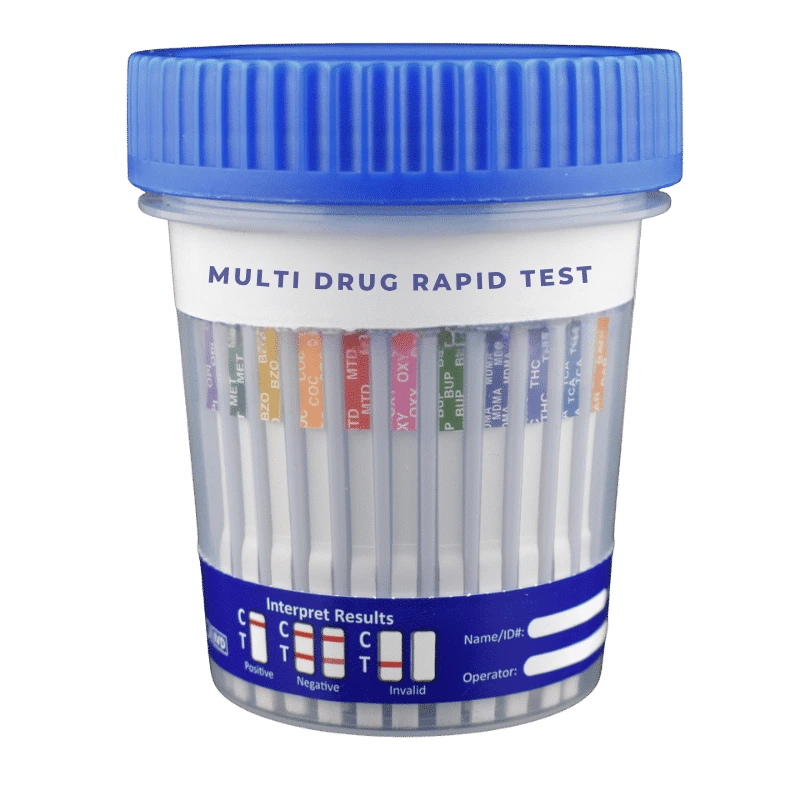
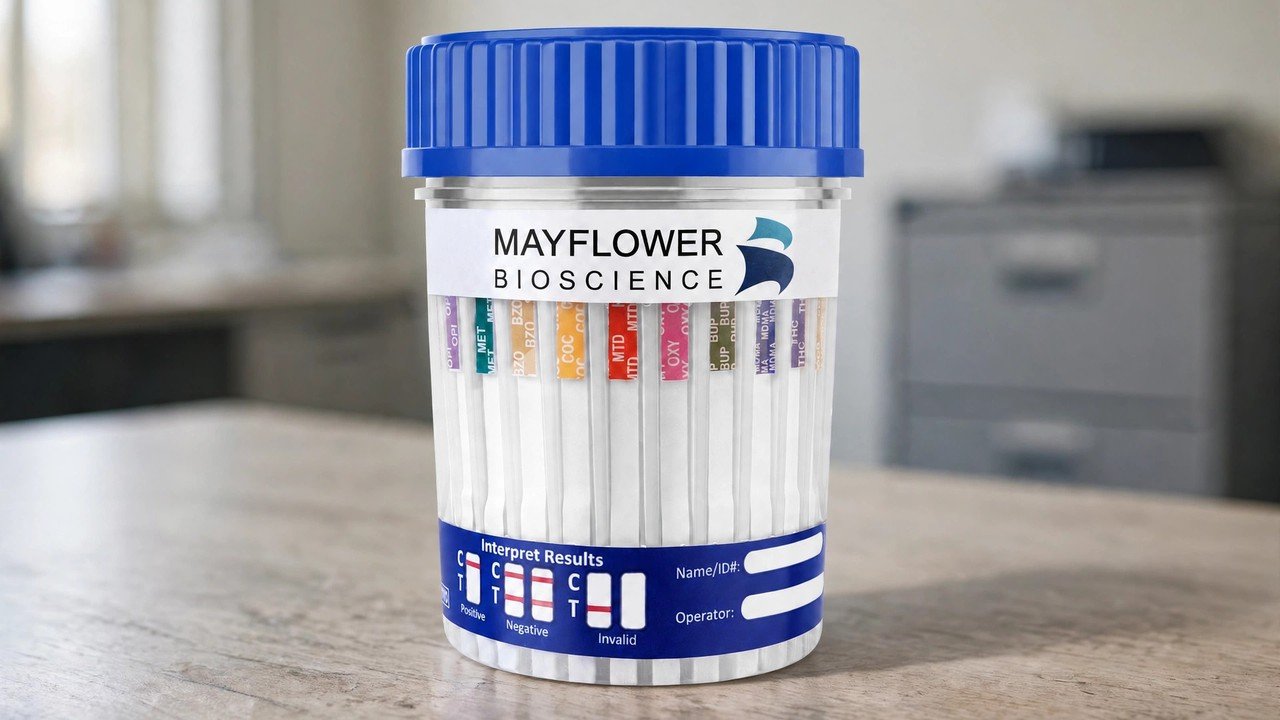
Correctional testing runs at volume and on shift schedules, which is why facilities standardize on forensic use drug test cups — the designation for devices used in justice and institutional settings — bought through wholesale drug test cups channels so every housing unit and intake desk works from the same panel, the same cutoffs, and the same lot-controlled supply. MayFlower’s 12, 14, and 16 panel cups add the fentanyl and ETG strips correctional programs ask for most, with built-in temperature strips and validity pads for observed collections. Standardize the device, write the panel and cutoffs into policy, confirm before sanctions — that is the whole architecture of a facility program that holds up.
Facilities standardizing or expanding a program can review the full range of wholesale drug test supplies MayFlower Bioscience offers for justice and institutional settings.
Frequently Asked Questions
How does drug testing work in correctional facilities?
Facilities test urine at defined points — intake, random selection, for cause after an incident, and before program placement or release steps. Collection is directly observed by same-gender staff, the specimen is checked for temperature (90–100°F) and validity, and a multi-panel cup screens it in about 5 minutes. Any presumptive positive that carries a consequence is sealed under chain of custody and sent to a laboratory for confirmation before sanctions are imposed.
What drugs do correctional facilities test for?
Panels cover the classic drugs of abuse — THC, cocaine, amphetamines, methamphetamine, opiates, PCP, benzodiazepines, methadone, oxycodone, and barbiturates — plus the two additions secure settings need most: fentanyl, which standard opiate strips cannot detect, and ETG alcohol, which detects drinking for up to about 80 hours. Synthetic cannabinoids (K2/Spice) are not on standard cups and require specialty laboratory testing.
How often are inmates drug tested?
Every admission is tested at intake. Beyond that, cadence is set by policy: random programs typically test a fixed percentage of the population each month (commonly 5–10%), and for-cause tests happen whenever an incident, contraband find, or observed behavior justifies one. People in work release, treatment units, or pre-release status are usually tested more frequently, on placement and on a scheduled or random cycle.
Are drug test collections observed in prisons and jails?
Yes — direct observation by a same-gender staff member is standard practice for inmate testing in secure settings, because substitution and adulteration risks are highest in custody. The collector takes the cup hand-to-hand, reads the temperature strip within 4 minutes, and documents the chain of custody. Staff and officer testing follows employment policy instead and is administered separately.
Can an inmate be disciplined on a cup result alone?
Best practice — and the defensible standard — is no. A cup result is a presumptive screen; immunoassay can cross-react with legal substances. Before a disciplinary report is sustained, the sealed specimen is confirmed by a laboratory using GC-MS or LC-MS/MS. Sanctions such as loss of privileges or good time, reclassification, or removal from a program placement then follow the facility’s disciplinary hearing process.
Do correctional facilities test for fentanyl?
Increasingly, yes — and they have to choose a panel that includes it. Fentanyl is a leading contraband and overdose drug in custody, but standard opiate strips do not detect it; a dedicated FEN strip is required. Expanded panels such as 14 and 16 panel cups include fentanyl alongside the classic panel, which is why they have become the standard facility configuration.
Can a drug test cup detect K2 or synthetic marijuana?
No standard multi-panel cup detects synthetic cannabinoids. K2/Spice compounds change constantly, and the rotating analogues are only covered by dedicated synthetic panels run at a reference laboratory. Facilities treat synthetics as a laboratory-testing problem and use point-of-care cups for the classic panel, fentanyl, and ETG — an honest limitation that should be written into facility policy.
What happens if an inmate refuses a drug test?
Refusal is treated as its own rule violation under facility policy — in most systems it is documented and disciplined at a level comparable to a confirmed positive, because refusing cannot be allowed to become the low-cost option. The refusal, the circumstances, and the staff involved are recorded, and the individual is typically placed on an increased-testing schedule afterward.
Do correctional officers have to pass a drug test before being hired?
Yes, in practice. A pre-employment drug test is a standard condition of hire for correctional officer posts, usually administered after a conditional offer. The specimen is collected under chain of custody and screened, and any presumptive positive is confirmed by a laboratory and reviewed by a Medical Review Officer, who checks for a legitimate medical explanation such as a valid prescription before the result is reported. A confirmed positive normally ends the application, and many agencies impose a waiting period — often around a year — before the applicant can reapply.
Are there any exceptions for correctional officers who use medical marijuana?
Generally, no. Correctional agencies commonly run zero-tolerance policies for custody staff because the role is safety-sensitive, and a state medical marijuana authorization does not require an agency to accommodate THC use in such a post. Officers are typically held to the same standard on and off duty, so a confirmed positive THC result is usually treated like any other positive — disqualification for applicants, discipline for serving staff — even where state law permits medical use. An officer or applicant with a medical authorization should raise it through the Medical Review Officer process rather than assume it will excuse a positive.