
How Long Does Heroin Stay in Your System?
How Long Does Heroin Stay in Your System?
Heroin leaves the body fast — but the traces it leaves behind do not disappear as quickly as the high does. For most people, heroin is detectable in urine for 1–3 days, in blood for 6–24 hours, in saliva for 24–48 hours, and in hair for up to 90 days. The exact window depends on dose, frequency, and which test a program runs — and, crucially, on which metabolite the test is looking for.
Heroin itself is gone from the bloodstream within minutes. What drug tests detect are its breakdown products: 6-MAM, which only heroin produces, and morphine, which lingers for days. That distinction is what makes heroin testing different from other opioids — and why a positive opiate screen alone can never prove heroin use. For programs, clinics, drug courts and probation officers, the practical question is not just “how long” but “what does the test actually see”. For the full picture across every substance, see the drug detection times chart.
Heroin detection windows by test type
| Test type | Typical window | What it detects |
|---|---|---|
| Urine | 1–3 days (heavy use up to 4 days) | 6-MAM 2–8 hours; morphine 1–3 days |
| Blood | 6–24 hours | Heroin for hours; morphine up to a day |
| Saliva | 24–48 hours (some sources up to 5 days) | 6-MAM and morphine |
| Hair | Up to 90 days | Morphine and 6-MAM in the hair shaft; not detectable until 7–10 days after use |
These are general estimates, not guarantees. Urine is the test most programs use, and it is the one this guide focuses on — urine is where the heroin question is usually decided.
Detection windows at a glance
Bar lengths are illustrative, not to scale.
How heroin breaks down in the body
Heroin (diacetylmorphine) is one of the fastest-clearing drugs there is. Its half-life is only about 2–6 minutes — within minutes, the liver has converted most of it into 6-monoacetylmorphine (6-MAM), and then into morphine. That chain is the whole story of heroin detection:
| Compound | Half-life | Urine window | Why it matters |
|---|---|---|---|
| Heroin | 2–6 minutes | Minutes only | No test looks for heroin itself — gone too fast |
| 6-MAM | ~25 minutes | 2–8 hours (some labs up to 24 hours) | Only heroin produces it |
| Morphine | 2–4 hours | 1–3 days | What opiate screens detect |
Because morphine is the dominant, longest-lived metabolite, a urine test taken a day or two after heroin use is really a morphine test. The National Institute on Drug Abuse (NIDA) notes that repeated heroin use changes brain structure and chemistry, which is part of why dependence builds — and why programs need tests that catch use across days, not hours.
6-MAM: the heroin fingerprint
6-MAM is the single most important entity in heroin testing. It is produced only when heroin is broken down, so finding 6-MAM in a sample is considered definitive evidence of heroin use. The catch is its window: about 2–8 hours in urine, according to the classic Cone et al. research, with some laboratories reporting up to 24 hours. After that, only morphine remains, and morphine alone cannot prove heroin — it could come from prescribed morphine, from codeine, or even from poppy seeds.
That has two practical consequences. First, a standard urine cup does not test for 6-MAM specifically — it screens for the opiate class through its morphine-calibrated strip; only laboratory confirmation (GC-MS or LC-MS/MS) can identify 6-MAM by name. Second, timing matters more for heroin than for almost any other drug: a test collected the morning after use can still show morphine, but the chance to prove heroin specifically is already gone. To distinguish heroin from other opioids, the sample must reach the lab fast and the confirmation order must ask for 6-MAM explicitly. Our guide to what MOP means on a drug test explains how the opiate strip works and what it can and cannot say.
Single use vs chronic use
How often someone uses heroin changes the window more than almost anything else. A single use clears on the short end of every range; regular, heavy use stretches it.
| Use pattern | Urine window | What to expect |
|---|---|---|
| Single, occasional use | 1–2 days | Morphine usually clears in 48 hours |
| Regular use | 2–3 days | The standard quoted window |
| Heavy, chronic use | Up to 4 days; a few sources say 7 | Metabolites accumulate |
Compare the other opioids in this cluster: morphine lasts 1–3 days in urine, codeine lasts 1–3 days, and hydrocodone lasts 2–4 days. The windows overlap because they all funnel through the same morphine pathway — which is also why one opiate screen cannot tell them apart. For the class-level view, see how long opioids stay in your system.
What changes the detection window
Dose and frequency. Larger doses and daily use extend every window; the body has more morphine to clear and less time between doses.
Metabolism and liver function. Heroin is processed by the liver, so liver health, age and individual metabolism shift the window by hours. Older adults and people with liver disease clear morphine more slowly.
Kidney function. Morphine and its metabolites leave through the kidneys. Impaired kidney function prolongs detection; hydration supports normal clearance but cannot “flush” a test clean — dilution is itself detectable through specimen validity checks.
Test cutoff. A lower cutoff detects use for longer. Rapid cups screen opiates at 300 ng/mL; federal workplace programs use a higher 2,000 ng/mL initial cutoff, which shortens the effective window. Two programs testing the same person on the same day can get different results. Using heroin alongside other drugs does not change the heroin window, but it changes which panels a program needs: fentanyl, increasingly found alongside heroin, needs its own strip.
Does heroin show up on a drug test?
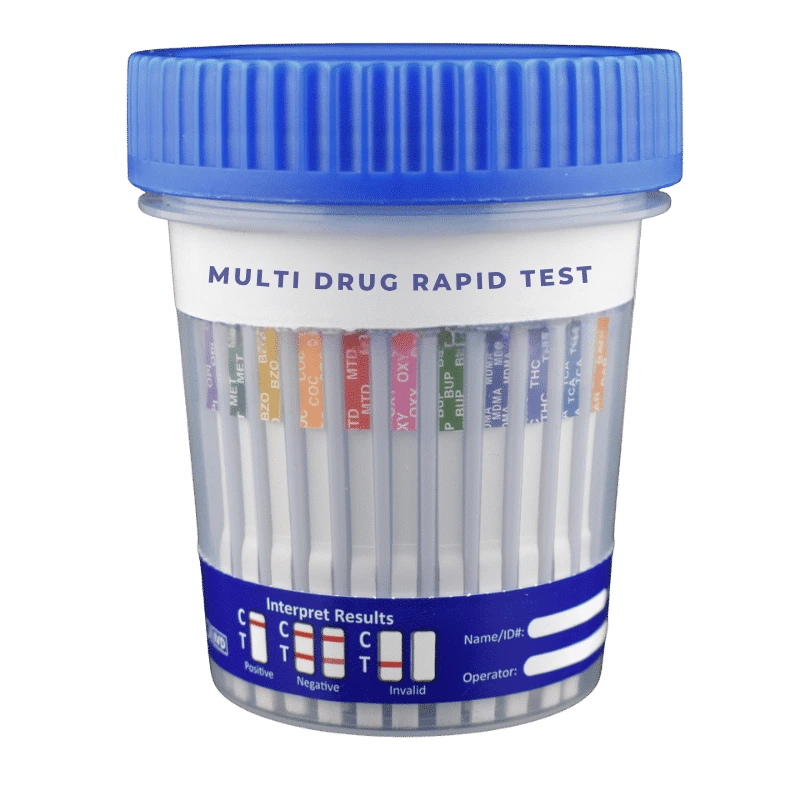
Yes — on any test that includes an opiate (OPI/MOP) strip. Heroin use is detected through its morphine metabolite, and every 12-panel drug test cup, 14-panel drug test cup and 16-panel drug test cup MayFlower sells carries an OPI strip calibrated for morphine at 300 ng/mL:
- 12 Panel Drug Test Cup with PCP (726): OPI/MOP strip at 300 ng/mL; opiate window 2–4 days.
- 12 Panel Drug Test Cup with Alcohol (ETG) & FEN (507): OPI strip at 300 ng/mL; opiate window 2–3 days.
- 14 Panel Drug Test Cup with PCP, ETG & FEN (509): OPI strip at 300 ng/mL; opiate window 2–3 days.
- 16 Panel Drug Test Cup with KRA, ETG, TCA & FEN (508): OPI strip at 300 ng/mL; opiate window 2–3 days.
The cup detects the morphine metabolite — it does not identify heroin by name, and it does not test for 6-MAM specifically. That is the honest limit of every rapid cup on the market. A positive OPI result after heroin use is expected; prescribed morphine, codeine or poppy-seed foods can produce the same positive. The cup screens; the lab confirms. MedlinePlus describes heroin’s effects and risks in plain clinical language, and the CDC’s overview of the opioid overdose epidemic explains why heroin monitoring remains a public-health priority even as fentanyl dominates overdose deaths.
What a positive opiate screen means — and what it does not
A positive OPI/MOP result means morphine (or a related opiate) was present above the 300 ng/mL cutoff. It does not by itself mean heroin was used — three other sources produce the same positive:
- Prescribed morphine — the same molecule.
- Codeine — the body converts it into morphine.
- Poppy seeds — can trigger an opiate positive for up to about 60 hours.
That is why every reputable program treats a cup result as presumptive and confirms positives in a laboratory. Confirmation by GC-MS or LC-MS/MS measures morphine, codeine and 6-MAM separately. Only a confirmed 6-MAM result proves heroin use — and because 6-MAM clears in hours, the confirmation sample must be collected quickly. The Substance Abuse and Mental Health Services Administration (SAMHSA) is the federal source for testing standards, and its guidance is the reference point most program policies follow.
What programs should order
For clinics, behavioral-health programs, drug courts, probation and corrections, heroin monitoring comes down to three choices.
1. Screen with a cup that covers opiates. All four MayFlower cups screen OPI at 300 ng/mL, so the choice between 12-panel, 14-panel and 16-panel cups is about what else the program needs — fentanyl, kratom, ETG alcohol, PCP — not heroin itself. Forensic settings should look at the forensic-use drug test cups collection, where the 507 cup is built for drug-court and probation use.
2. Confirm every positive in the lab, and ask for 6-MAM. A confirmation that only repeats the morphine result tells the program nothing new. Ask the lab for 6-MAM specifically, and collect the confirmation sample as soon as possible after the screen — the 6-MAM window is measured in hours.
3. Test on a schedule the window supports. Because urine detection lasts only 1–3 days, random testing catches use that scheduled weekly testing misses. A program testing once a week has blind days; a program testing randomly does not. Detection-window knowledge belongs in program design, not just in the lab manual.
Heroin clears fast, but the decisions around it should not be rushed: screen with a cup that covers opiates, confirm positives in the lab, and read the result for what it actually proves. For the rest of the series, see the guides on methadone, tramadol and oxycodone — and the MayFlower Bioscience homepage for the full range of wholesale multi-panel cups.
Frequently asked questions
How long does heroin stay in your urine?
For most people, heroin is detectable in urine for 1 to 3 days. Its unique metabolite 6-MAM clears much faster, in about 2 to 8 hours, while morphine, the dominant metabolite, is detectable for 1 to 3 days. Heavy, chronic use can extend the urine window to about 4 days.
How long does heroin stay in your blood?
About 6 to 24 hours. Heroin itself leaves the blood within a few hours because its half-life is only 2 to 6 minutes; its metabolite morphine may remain measurable for up to about a day.
How long does heroin stay in your saliva?
About 24 to 48 hours, with some sources reporting up to 5 days. Saliva testing is best for detecting very recent use, and 6-MAM is highly detectable in saliva for about 24 hours.
How long does heroin stay in your hair?
Up to 90 days, depending on hair length. Hair testing has the longest window, but it also has a delay: heroin use is usually not detectable in hair until 7 to 10 days after use, as the drug must grow out from the follicle.
What is 6-MAM and why does it matter?
6-MAM (6-monoacetylmorphine) is the first breakdown product of heroin, and only heroin produces it. Finding 6-MAM in a sample is considered definitive evidence of heroin use. Its urine window is short, about 2 to 8 hours, and only laboratory confirmation (GC-MS or LC-MS/MS) can identify it by name — a rapid cup cannot.
Does heroin show up on a 12-panel drug test?
Yes. Heroin use is detected through its morphine metabolite, and every MayFlower 12-panel, 14-panel and 16-panel cup carries an opiate (OPI/MOP) strip calibrated for morphine at 300 ng/mL. The cup screens for the opiate class; it does not identify heroin by name.
Can a drug test tell heroin apart from morphine or codeine?
Not on a rapid cup. A positive opiate screen only shows that morphine or a related opiate was present above the cutoff. Telling heroin apart from morphine or codeine requires laboratory confirmation that measures 6-MAM separately — and the sample must be collected quickly, because 6-MAM clears in hours.
Can poppy seeds cause a positive heroin test?
Poppy seeds can cause a positive opiate screen, because they contain small amounts of morphine and codeine. They cannot produce 6-MAM, so laboratory confirmation can distinguish poppy-seed exposure from heroin use.
How long after one use of heroin will a drug test be positive?
After a single, occasional use, a urine test is typically positive for about 1 to 2 days. A blood test would only catch it for hours, and a saliva test for about a day. The exact window depends on dose, metabolism and the test cutoff.
What should a program do after a positive opiate screen?
Treat the cup result as presumptive and confirm it in a laboratory with GC-MS or LC-MS/MS, asking for 6-MAM specifically if heroin use needs to be distinguished from morphine or codeine. Collect the confirmation sample as soon as possible, document the result, and follow the program’s policy for confirmed positives.