
How Long Does Adderall Stay in Your System?
How Long Does Adderall Stay in Your System?
Adderall is typically detectable in urine for 2 to 4 days after the last dose, in blood for 24 to 46 hours, in saliva for 1 to 2 days, and in hair for up to 90 days. The effects wear off much faster — immediate-release in about 4 to 6 hours, extended-release in about 10 to 12 — but the drug itself clears slowly. D-amphetamine’s half-life is about 10 hours, l-amphetamine’s about 13, so full clearance takes roughly two to three days. Feeling normal again is not the same as testing negative.
That gap is what trips up programs: a patient on a valid prescription can feel completely clear-headed while a urine screen still picks up amphetamine. This guide gives the window for each test type, explains why urine pH moves it more than any other factor, and covers what a positive means with a prescription. For every substance side by side, see our drug detection times chart.
Adderall Detection Times by Test Type
Windows below are general ranges for a typical adult therapeutic dose, from the FDA prescribing information and laboratory references — dose, formulation, frequency, kidney and liver function, and pH all move them.
| Test type | Typical detection window | What it detects |
|---|---|---|
| Urine | 2–4 days | Amphetamine and metabolites; 48–72 hours typical, up to ~96 hours with heavy use; ~78 hours after a single dose in a 2024 study |
| Blood | 24–46 hours | Amphetamine in plasma; shortest of the routine tests |
| Saliva | 1–2 days | Amphetamine; about 20–50 hours, reflecting more recent use |
| Hair | Up to 90 days | Amphetamine in the hair shaft; long-term patterns, not recent use |
Detection window at a glance
Hair looks back months; among fast tests, urine holds Adderall longest.
What Is in Adderall, and How Does the Body Clear It?
Adderall is four amphetamine salts delivering two active isomers — dextroamphetamine (d-amphetamine) and levoamphetamine (l-amphetamine) — in a 3:1 ratio. It is prescribed mainly for ADHD and narcolepsy, as MedlinePlus explains. The isomers clear at different speeds: in adults, d-amphetamine has a mean half-life of about 10 hours (9.77 to 11 on the FDA label) and l-amphetamine about 13 hours (11.5 to 13.8). Children clear both faster, at roughly 9 to 11 hours.
Clearing ~97% takes about five half-lives — roughly 50 hours for d-amphetamine, 65 for l-amphetamine — so two to three days for a single dose. The liver metabolizes part of the dose, mainly via CYP2D6, into norephedrine and 4-hydroxyamphetamine — but a large share leaves unchanged: at normal urine pH, roughly half a dose is recovered as alpha-hydroxy-amphetamine derivatives and 30–40% as unchanged amphetamine. That large unchanged fraction is why urine pH affects detection so strongly.
Urine pH: The Factor That Moves the Window Most
No other common panel drug has a pH effect as large as amphetamine’s. With a pKa of 9.9, its excretion is unusually sensitive to urine acidity: acidic urine (pH below 6) speeds elimination, alkaline urine (pH above 7) slows it. Studies show excretion can differ three- to four-fold on pH alone, with half-lives of 7–8 hours at acidic pH versus 16–31 at alkaline pH. The FDA label reports urinary recovery ranging from about 1% to 75% of a dose depending on pH.
Two people can take the same dose on the same day and test differently days later, purely because of urine pH — treat the 2–4 day window as a range, not a promise. And pH is not a lever to pull: deliberately acidifying urine to clear the drug faster is neither safe nor reliable, and specimen-validity checks exist precisely because samples can be manipulated. If a result does not match the person’s history, confirm it in a laboratory rather than arguing about pH.
Immediate-Release vs Extended-Release
Immediate-release (IR) peaks at about 3 hours, with effects for 4 to 6 hours. Extended-release (XR) releases in two phases across the day, peaks at about 7 hours, and lasts 10 to 12 hours. The half-life is the same either way, but because XR keeps releasing drug for hours, the detection clock effectively starts later and the window stretches. Programs testing someone on XR should expect the longer end of the range and record the formulation.
What Else Changes the Detection Window?
Dose and frequency. Higher doses and daily use push the window toward its upper end and beyond. A single dose is mostly gone in two to three days; chronic daily dosing builds a larger load that takes longer to clear. No drink or supplement clears it faster than time and metabolism — programs should say so plainly.
Kidney and liver function. Impaired kidneys or liver slow clearance, and CYP2D6 speed varies. Children clear it faster; older adults more slowly.
Hydration and dilution. A very dilute sample can fall below the cutoff and read negative even when amphetamine is present — which is why programs verify specimen temperature and validity and recollect dilute samples instead of accepting them. Our guide to reading a drug test cup covers the checks every collection needs.
Cutoffs: The Federal 500/250 Standard vs the Cup’s 1,000 ng/mL
A cutoff is the concentration, in nanograms per milliliter (ng/mL), at or above which a sample is reported positive. Under US federal workplace rules, 49 CFR 40.87 sets the amphetamines initial-test cutoff at 500 ng/mL and the confirmatory-test cutoff at 250 ng/mL — the numbers that govern DOT-regulated testing. Our amphetamine urine drug test guide explains them in full.
MayFlower’s cups use a different number: every cup screens amphetamines (AMP) at 1,000 ng/mL — higher and less sensitive than the federal 500 ng/mL screen. A sample between 500 and 1,000 ng/mL can read negative on the cup and positive at a federal laboratory, so programs matching federal thresholds should treat a cup negative as a screen result, not proof of no use, and confirm disputed or borderline samples in a laboratory. Our cutoff levels guide compares the common values across drugs.
| Setting | AMP cutoff | What it means |
|---|---|---|
| Federal workplace, initial screen | 500 ng/mL | DOT standard; most sensitive |
| Federal workplace, confirmation | 250 ng/mL | Confirmation threshold |
| MayFlower cup, AMP strip | 1,000 ng/mL | On-site screen, all four cups; less sensitive |
What an AMP Screen Can and Cannot Tell You
A urine screen can tell you that an amphetamine-class compound was present at or above the cutoff. It cannot tell you which substance caused it, when it was taken beyond the general window, how much was taken, or whether the person was impaired. That is the honest limit of every rapid screen — and why programs need a written policy on confirmation, prescription review, and documentation.
The AMP strip also does not distinguish Adderall from other amphetamines: Adderall, methamphetamine, and other amphetamine-type compounds can all produce an AMP positive. Only laboratory confirmation by GC-MS or LC-MS/MS identifies the specific drug and its metabolites and rules out immunoassay false positives. Methamphetamine is metabolized into amphetamine, so a screen alone cannot separate Adderall from methamphetamine — confirmation reads the metabolite pattern. Our methamphetamine detection guide covers the other side of that same AMP channel.
Amphetamines are also one of the five drug classes on a standard 5-panel screen, so Adderall shows up on a 5-panel too — the opposite of tramadol, which standard panels do not detect at all, and of MDMA, which routine amphetamine screens pick up only weakly. The question for a program is therefore not whether AMP is on the panel, but which cutoff the device uses.
How Programs Should Handle a Prescription Positive
A confirmed positive with a valid Adderall prescription is a medical review question, not automatically a violation. Under federal workplace rules, a Medical Review Officer (MRO) reviews confirmed positives, and a verified valid prescription is reported as negative. Non-federal programs should do the same: collect the prescription information, confirm the sample in a laboratory, and let the MRO — or the prescribing clinician — verify it before any consequence. SAMHSA’s workplace drug testing resources set out the framework programs are expected to follow.
Three rules keep programs out of trouble: never act on a cup result alone; write the prescription policy down before the first positive arrives, including who reviews it and what counts as documentation; and document everything — result, lot number, reader, confirmation result, and the MRO’s determination. A program that follows those rules can screen fairly, including for the many patients who take Adderall exactly as prescribed. The National Institute on Drug Abuse notes prescription stimulants are misused as well as prescribed — which is why the confirmation-and-review step matters in both directions.
Which MayFlower Cups Screen for Amphetamines?
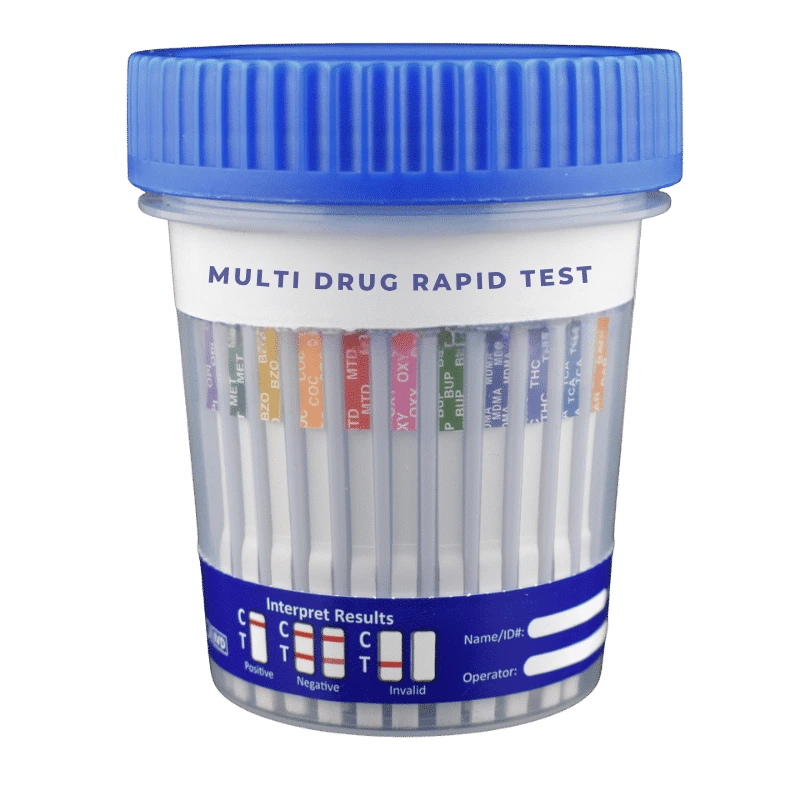
MayFlower sells only 12, 14, and 16-panel cups, and all four carry the AMP strip at 1,000 ng/mL, with five-minute results and an integrated temperature strip. They differ in regulatory status and panel breadth, not amphetamine coverage:
| Cup | Regulatory status | AMP cutoff |
|---|---|---|
| 12-panel with PCP | CLIA-waived, FDA-cleared | 1,000 ng/mL |
| 12-panel with ETG & fentanyl | Forensic Use Only | 1,000 ng/mL |
| 14-panel with PCP, ETG & fentanyl | Forensic Use Only | 1,000 ng/mL |
| 16-panel with kratom, ETG, TCA & fentanyl | Forensic Use Only | 1,000 ng/mL |
The 12-panel, 14-panel, and 16-panel collection pages list the full panel for each configuration; the 12-panel with PCP and 14-panel product pages list a 2–4 day AMP window, matching the general urine range here. For related windows, see benzodiazepines, opioids, oxycodone, and buprenorphine — and urine vs hair drug testing for the longer view.
Frequently Asked Questions
How long does Adderall stay in your urine?
Typically 2 to 4 days after the last dose. Most therapeutic doses are detectable for about 48 to 72 hours; a 2024 controlled study measured about 78 hours after a single therapeutic dose, and heavy or daily use can extend the window to about 96 hours.
How long does Adderall stay in your blood?
About 24 to 46 hours. Blood has the shortest detection window of the routine tests because amphetamine leaves plasma quickly — but urine can still detect it for days afterward.
How long does Adderall stay in your saliva?
About 1 to 2 days, or roughly 20 to 50 hours after the last dose. Saliva reflects more recent use than urine, which is why programs monitoring recent use sometimes choose it — though urine remains the standard program specimen.
How long does Adderall stay in your hair?
Up to 90 days. Hair testing detects amphetamine locked into the hair shaft as it grows, making it the right tool for long-term patterns rather than recent use — and it cannot detect use from the past few days.
Does Adderall show up on a 12-panel drug test?
Yes. Every standard 12-panel cup includes an amphetamine (AMP) strip, and all four MayFlower cups — 12, 14, and 16-panel — screen amphetamines at a 1,000 ng/mL cutoff with results in about five minutes.
Does Adderall show up on a 5-panel drug test?
Yes. Amphetamines are one of the five drug classes on a standard 5-panel screen, so Adderall shows up on a 5-panel as well as on 12, 14, and 16-panel cups. That is the opposite of tramadol, which standard panels do not detect at all.
Can urine pH change how long Adderall is detectable?
Yes — more than for almost any other drug. Acidic urine (pH below 6) speeds up amphetamine excretion, while alkaline urine (pH above 7) slows it down. Studies show excretion can differ three- to four-fold on urine pH alone, and the FDA label reports urinary recovery ranging from about 1% to 75% of a dose depending on pH.
Does Adderall XR stay in your system longer than immediate-release?
Yes. Extended-release Adderall peaks at about 7 hours instead of 3, and its effects last about 10 to 12 hours instead of 4 to 6. The half-life is the same, but because XR keeps releasing drug for hours, the detection clock starts later and the window stretches toward the longer end of the range.
Can a drug test tell Adderall apart from methamphetamine?
Not on a rapid screen. Both produce an amphetamine (AMP) positive, and methamphetamine is metabolized into amphetamine in the body. Only laboratory confirmation by GC-MS or LC-MS/MS looks at the metabolite pattern and tells which drug was taken — so confirm every non-negative AMP result when the distinction matters.
What happens if you test positive for Adderall but have a prescription?
A confirmed positive with a valid prescription is a medical review question, not automatically a violation. Under federal workplace rules, a Medical Review Officer reviews the confirmed positive, and a verified valid prescription is reported to the employer as negative. Programs should confirm the result in a laboratory and let the MRO or prescribing clinician verify it before any consequence.