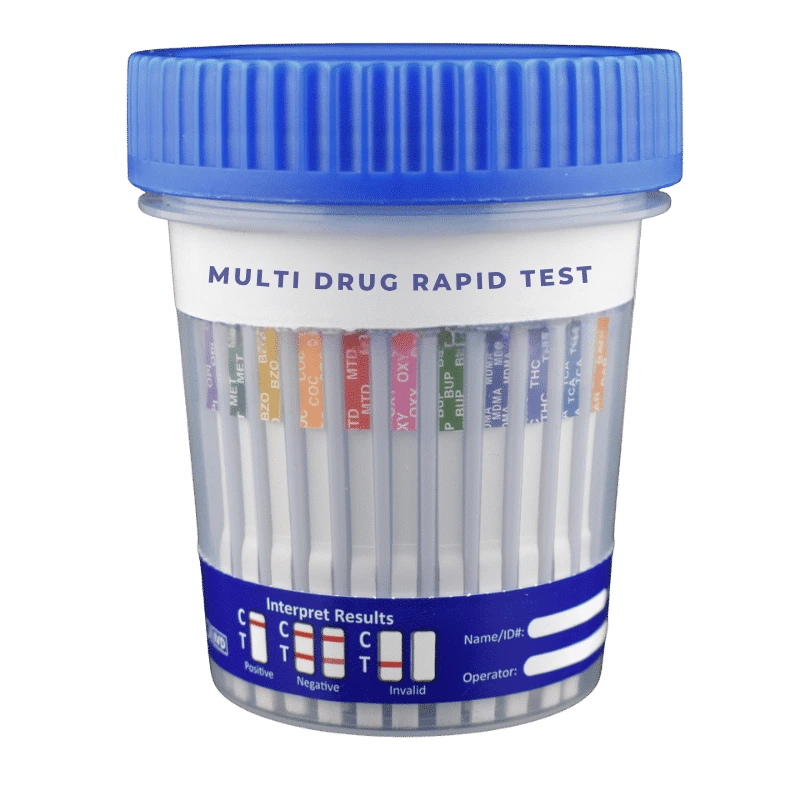

How Long Does Methadone Stay in Urine? Windows for Labs
How Long Does Methadone Stay in Urine? Windows for Labs
How long methadone stays in urine depends on the source, the dose and the person. Published guidance puts the typical window at 1 to 5 days, with some professional references allowing up to 14 days after heavy or long-term use. For a laboratory, treatment program or court-supervised testing site, the more useful question is what a given result can support: a preliminary screen, a confirmed result, or a statement about timing.
This guide gives the windows from official and clinical sources, explains why they differ, and shows how to read a methadone result from a rapid cup so that your program documents it correctly.
TL;DR
- The FDA says methadone can test positive in urine 3 to 8 hours after a dose and may keep testing positive for 1 to 3 days. The AAFP lists 3 to 4 days, up to 14 days. CAMH gives a typical 4 to 5 days.
- The main analyte in urine is the metabolite EDDP, and methadone needs its own assay. Standard opiate screens aimed at morphine and codeine do not reliably detect it.
- A positive urine result shows exposure. It does not show dose, route, timing or impairment.
- Rapid cup results are preliminary. Positives go to confirmation by GC/MS or LC-MS/MS.
- Mayflower’s 12-panel PCP cup is CLIA-waived and FDA-cleared. Our 14-panel and 16-panel cups are Forensic Use Only and not CLIA-waived.
Table of Contents
- How long methadone stays in urine: the published windows
- Why the windows differ from patient to patient
- Methadone and EDDP: what the test is actually looking for
- Why a standard opiate screen can miss methadone
- Screening versus confirmation: what each result can support
- A collection routine that protects the result
- Choosing a rapid cup for a methadone program
- Request wholesale pricing for your program
- Our perspective
- FAQ
- Sources
How long methadone stays in urine: the published windows
No single number is correct for every patient. Three reputable references give three overlapping ranges, and each one says something about the population or method behind it.
| Source | Methadone urine window | Notes |
|---|---|---|
| FDA, Drugs of Abuse Home Use Test | Positive 3 to 8 hours after taking it; can stay positive 1 to 3 days | Described as guidelines only, varying with duration of use, amount and metabolism |
| AAFP, Urine Drug Tests: Ordering and Interpretation (2019) | 3 to 4 days, up to 14 days | Principal analyte listed as EDDP |
| CAMH, Urine drug testing (2023) | Typically 4 to 5 days | Longer with heavy or larger amounts of use; Canadian clinical guidance |
The spread is not a contradiction. The FDA figure is written for consumers using a single-use test. The AAFP range is written for clinicians ordering tests and includes the long tail that follows sustained dosing. CAMH sits in the middle because it describes a typical clinic patient.
For your documentation, a sensible way to state it is as a range with its source: most single-dose exposures clear within a few days, while patients on daily maintenance dosing may stay positive longer, and a result should never be used to back-calculate when a dose was taken.

The early side of the window
The FDA’s 3 to 8 hour figure matters for collection timing. A specimen collected soon after a dose may be negative even though the person has taken methadone. The FDA also notes that a negative can occur when a sample is collected too early or too late relative to the drug’s clearance window. For intake screens and random call-ins, that means a single negative cup is a statement about that specimen at that moment, not about the preceding days.
The late side of the window
The long end, up to 14 days, reflects heavy or prolonged use and the sensitivity of the method. A laboratory method with a low cutoff will keep finding the drug longer than a rapid cup with a higher cutoff. When you compare your results with a published window, compare the cutoff first.
Why the windows differ from patient to patient
Programs often ask why two patients on similar doses have different results. Several factors move the window, and your records should capture the ones you control.
Dose and duration of use
CAMH notes that the window depends on the half-life of the parent drug and its metabolites and on lipophilicity (how readily a drug dissolves in fat and lingers in tissue). It adds that the window may be prolonged with heavy or larger amounts of use. Methadone is a drug that tends to accumulate with repeated dosing, so a patient in the second month of maintenance treatment behaves differently from a first-time exposure.
Metabolism
The FDA lists the person’s metabolism as one of the variables behind clearance rates. Liver enzyme activity, age, other medications and general health all play a part, which is why published windows are offered as ranges.
Urine pH
Urine acidity changes how much methadone is excreted. In a 2010 study of patients on 30 to 110 mg of daily methadone, methadone and EDDP concentrations in oral fluid were negatively correlated with pH, and EDDP could not be measured above pH 8.1 because of ion trapping. That study measured oral fluid, not urine, but it illustrates how pH shifts disposition. For a urine program, the practical lesson is that unusual pH is one reason a result can sit outside the typical window, and it is a reason to rely on confirmation for any result that matters.
Dilution
The same study notes that urine testing offers detection windows of several days but is subject to dilution and adulteration, so creatinine and specific gravity checks are needed. A very dilute specimen can read negative for a drug that is present. If your site sees dilute results, our guide to negative dilute drug test results covers what they mean and what to do next. Cups with an integrated temperature strip, like all four Mayflower cups, give you an immediate check that the specimen is fresh before you read the panel.
Methadone and EDDP: what the test is actually looking for
When a patient takes methadone, the body converts a large share into a metabolite called EDDP (2-ethylidene-1,5-dimethyl-3,3-diphenylpyrrolidine). The AAFP’s table names EDDP as the principal analyte for methadone in urine. In practice, this means two kinds of assay exist: one targeting methadone itself and one targeting EDDP.
Why does it matter to a laboratory?
- Interpretation. A methadone-targeted assay and an EDDP-targeted assay can both support a finding of methadone exposure, but they are not interchangeable in documentation. Record which target your cup or analyzer uses.
- Performance. A 2014 peer-reviewed evaluation of an EDDP enzyme immunoassay compared it with HPLC-MS/MS confirmation. At a 150 ng/mL cutoff it had sensitivity of 1.00, specificity of 0.986 and over 99% agreement. At 300 ng/mL, sensitivity stayed at 1.00, specificity was 0.959 and agreement was 97.5%. The authors concluded that routine EDDP detection is supported for pain-management compliance testing.
- Cutoff choice. The lower cutoff gave fewer false positives against the confirmation method in that study. Cutoffs on rapid cups are set by the device design, so confirm what your cup uses before comparing it with a lab report.
A report that names methadone, EDDP or both should be read against the cutoff stated for that assay, not against a general window from a chart.
Why a standard opiate screen can miss methadone
This is the most common error in site protocols. The ACMT position statement on urine opiate interpretation (Stolbach, Connors, Nelson and Kulig, November 2021) says there is no single universal opioid test. Most clinical opiate immunoassays target morphine and codeine. Separate assays are required to reliably detect methadone, buprenorphine, fentanyl, oxycodone, tramadol and other semisynthetic or synthetic opioids.
In plain terms: a negative result on a line labeled “opiates” or “OPI” says nothing reliable about methadone. A patient can be taking methadone and show a negative on that line, and a patient not taking methadone is not ruled in or out by it.
For a program building a testing menu, this means:
- Decide which drugs and drug classes your policy actually needs, and list them by name.
- Confirm each one has its own assay on the device you use. Do not assume the opiate line covers it.
- Write the panel into your standard operating procedure so that staff read the right line for the right question.
Our reference pages on how long opioids stay in your system and on whether buprenorphine shows up on a drug test follow the same logic for the other opioids you may be monitoring alongside methadone.
Screening versus confirmation: what each result can support
A rapid cup is a screening tool. The ACMT statement describes screening results as generally qualitative, positive above a set cutoff, and confirmatory results as generally quantitative and considered definitive. It also states that a positive urine result shows class exposure but not dose, route, source, specific timing or impairment.
That last point is the one that gets programs into trouble. A methadone-positive cup can support these statements:
- The specimen contained methadone or its metabolite above the device cutoff.
- The result is preliminary until confirmed.
It cannot support these:
- The patient took a particular dose.
- The patient took it at a particular time.
- The patient was or was not impaired.
- The methadone came from a clinic rather than another source.
What cutoffs look like
An FDA 510(k) decision summary for a lateral-flow rapid urine drug test cup lists methadone at a 300 ng/mL cutoff and EDDP at 300 ng/mL, with preliminary positives to be confirmed by methods such as GC/MS. That is one cleared device and is cited as an example of how the numbers are presented, not as a statement about any other cup. Always take the cutoff from the instructions for use of the exact product you stock.
Confirmation
Our position, and the standard in the field, is that every preliminary positive that will drive a decision gets sent for confirmation by GC/MS (gas chromatography-mass spectrometry) or LC-MS/MS (liquid chromatography with tandem mass spectrometry). These methods identify and quantify specific compounds and are the basis for a defensible result. Your documentation should say “preliminary positive, sent for confirmation” until the laboratory report comes back.
A collection routine that protects the result
The published windows are only useful if the specimen is collected and recorded consistently. A routine that suits clinics, treatment programs and supervised testing sites:
- Verify the donor and the reason for the test. Record whether it is an intake, random or scheduled test.
- Collect in a monitored or controlled setting per your policy. Check the temperature strip on the cup right away, since an out-of-range reading is a validity question to resolve before the panel is read.
- Read within the time stated in the device instructions. Our cups give a rapid read in about five minutes. Reading late can produce misleading lines.
- Record the result by analyte, with the cutoff, and mark every positive as preliminary.
- Send positives for confirmation and keep the cup or a photograph of it according to your retention policy.
- Note the time since last reported dose if the patient is in treatment, without using it to infer anything the result cannot support.
- Reevaluate dilute or unusual specimens using creatinine or specific gravity at the laboratory.
The FDA’s own caution is a good reminder for staff training: negatives can occur if the wrong drugs were tested, if the sample was collected too early or too late relative to the clearance window, or if the test chemicals were stored incorrectly or had expired. Each of those is a process point you can fix. Store cups per the instructions, rotate stock by expiration date, and keep the panel menu matched to your policy.
Reading methadone results beside other drugs
Programs that monitor methadone patients usually watch other classes too. Our reference pages on benzodiazepine windows, barbiturate windows and the drug detection times chart put the ranges side by side so your staff can use one consistent reference. Detection times are ranges, and they should be cited as ranges.
Choosing a rapid cup for a methadone program
For labs, rehab programs and drug-testing institutions, the cup choice comes down to the compliance setting, the panel and the volume.
Mayflower Bioscience is a US-based wholesale supplier of rapid multi-panel urine drug test cups, based in St. Louis, Missouri. The catalog is built around four configurations:
| Cup | Regulatory status | Panel highlights |
|---|---|---|
| 12-panel with PCP | CLIA-waived, FDA-cleared | Point-of-care use |
| 12-panel with ETG and fentanyl | Forensic Use Only | Alcohol marker and fentanyl |
| 14-panel with PCP | Forensic Use Only, not CLIA-waived | PCP, ETG and fentanyl |
| 16-panel | Forensic Use Only, not CLIA-waived | Adds kratom and TCA to ETG and fentanyl |
Every cup has an integrated temperature strip and a read in about five minutes. Because the CLIA-waived and Forensic Use Only designations decide where a cup can be used, match the cup to your setting before you order: the CLIA-waived 12-panel cup is the one for point-of-care clinical use, and the forensic-use cups are for programs that treat results as preliminary and send positives out for confirmation.
Before you standardize on a cup for methadone monitoring, confirm that the methadone line is on the panel you choose, using the product page and the instructions for use, and request a quote for your volume.
Request wholesale pricing for your program
Mayflower’s site is built for bulk and recurring orders, with volume pricing, a quote process for wholesale and multi-site accounts, free shipping on 100+ cups and same-day dispatch from US stock. Programs that test on a schedule can set up a standing order and keep cups on the shelf, rather than reordering in a rush.
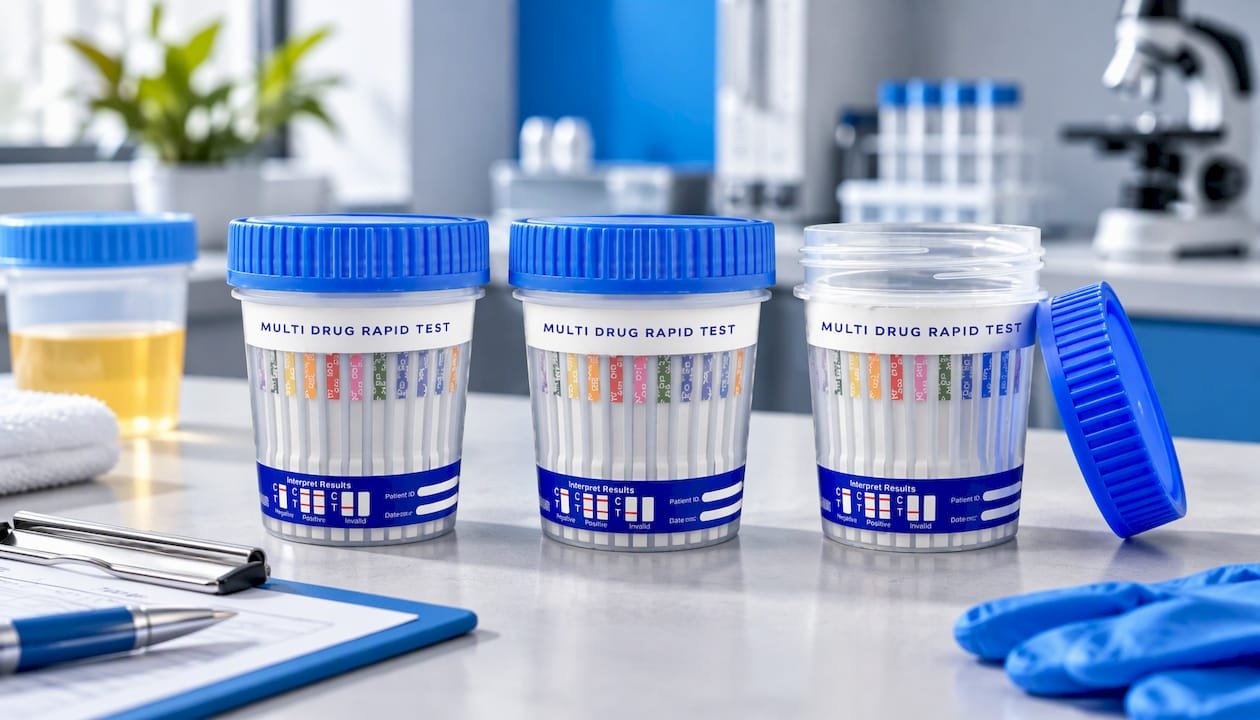
To put a quote together, have your monthly volume, the number of sites and your regulatory setting ready (CLIA-waived point of care or forensic use). You can request wholesale pricing here and we will match the cup to your program. For a deeper look at timing in your own protocols, our page on how long methadone stays in your system is a good companion for staff training.
Our perspective
Most of the methadone questions we hear from programs are not really about the number of days. They are about what a result lets a clinician or a court officer say. A window is a range, a cup is a screen, and a confirmed result is what a decision should rest on.
That is why we build our catalog around a small set of cups with clear designations. The 12-panel PCP cup is CLIA-waived and FDA-cleared for point-of-care use. The 14-panel and 16-panel cups are Forensic Use Only and are meant for programs that confirm positives by GC/MS or LC-MS/MS. Each has a temperature strip and a read in about five minutes, so staff can check validity and get a preliminary answer in one visit.
For a program running dozens or hundreds of tests a month, consistency matters more than any single feature. Ordering from one US supplier with same-day dispatch from US stock, volume pricing and free shipping on 100+ cups keeps the testing room stocked and the procedure the same from site to site. We would rather help you set up the right cup and a standing order than have staff improvising with a mixed shelf.
Alina
FAQ
How soon after a dose can methadone show up in urine?
The FDA states that methadone can produce a positive urine test 3 to 8 hours after it is taken. Collection very soon after a dose may therefore be negative. The FDA describes these timings as guidelines that vary by person.
Can a urine test show how much methadone someone took?
No. The ACMT position statement says a positive urine result indicates class exposure but not dose, route, source, specific timing or impairment. A screening result is qualitative, and even a quantitative confirmation reports a concentration in the specimen, not the amount taken.
Does a standard opiate test detect methadone?
Not reliably. The ACMT states that most opiate immunoassays target morphine and codeine, and separate assays are needed to detect methadone. Check that methadone, or its metabolite EDDP, is on the panel of the cup you use.
Does a positive rapid cup result need confirmation?
Yes, for any result that will drive a decision. Rapid cup results are preliminary screening results, and positives should go to a laboratory for confirmation by GC/MS or LC-MS/MS. FDA documentation for cleared rapid cups also describes preliminary positives as needing confirmation.
Which Mayflower cups are CLIA-waived?
The 12-panel cup with PCP is CLIA-waived and FDA-cleared. The 14-panel and 16-panel cups are Forensic Use Only and not CLIA-waived. Choose by the setting where the cup will be used and by the panel your policy requires.
Sources
- Drugs of Abuse Home Use Test, FDA
- Urine Drug Tests: Ordering and Interpretation, American Family Physician (2019)
- Urine drug testing, CAMH
- ACMT Position Statement: Interpretation of Urine Opiate and Related Drug Tests (2021)
- Methadone disposition in oral fluid during pharmacotherapy (2010)
- Evaluation of an Enzyme Immunoassay for the Detection of EDDP (2014)
- FDA 510(k) decision summary K152908