Workplace Drug Testing Program Guide for Employers
Workplace Drug Testing Program Guide for Employers
A workplace drug testing program is an employer’s complete system for drug and alcohol screening: a written policy, defined testing triggers (pre-employment, random, reasonable suspicion, post-accident, return-to-duty, follow-up), a two-step testing workflow (rapid point-of-care screen plus laboratory confirmation and MRO review), and documented compliance with state and federal rules. The program — not any single test — is what makes employer testing defensible: it applies consistently to every employee, protects confidentiality, and separates a presumptive screen from a confirmed, actionable result.
Employers build these programs for safety in high-risk roles, compliance in regulated industries, deterrence across the workforce, and — in states with drug-free workplace certification — a workers’ compensation premium credit.
Program vs Test: Why the Distinction Matters
A program proves your organization tests fairly, consistently, and legally — what matters when a termination, a workers’ comp claim, or an unemployment hearing is disputed. Five pillars:
- A written policy distributed to every employee before testing begins — everything else attaches to this document.
- Defined testing triggers with clear rules about who gets tested, when, and under what circumstances.
- A two-step testing workflow — rapid screening at the point of care, laboratory confirmation of presumptive positives, and medical review.
- Chain of custody and confidentiality — documented specimen handling and restricted access to results.
- Training and record-keeping — supervisor training on reasonable suspicion and audit-ready records.
SAMHSA’s Division of Workplace Programs publishes federal guidance many employers use as the starting point for policy design.
The Six Testing Triggers Employers Use
Which of the six triggers your program uses — and who each one covers — must be stated explicitly in your policy:
| Trigger | When it applies | Typical scope and cadence |
|---|---|---|
| Pre-employment | After a conditional offer, before the start date | Safety-sensitive or designated roles; one-time per hire. See our pre-employment drug testing guide. |
| Random | Unannounced picks from a defined employee pool | A stated percentage of the pool per period; selection truly random and uniform — the most legally sensitive trigger in several states. |
| Reasonable suspicion | Observed, specific, objective signs of possible impairment | Trained supervisors, contemporaneous written documentation; observation — not rumor. |
| Post-accident | After a qualifying workplace incident | Collect promptly; do not discourage injury reporting (OSHA guidance). |
| Return-to-duty | After a violation, treatment, or disciplinary process | Negative result required before resuming safety-sensitive duties. |
| Follow-up | After return-to-duty, per a monitoring plan | Unannounced schedule, commonly 12+ months. |
DOT-Regulated vs Non-DOT Programs
First, decide whether your program falls under federal DOT rules. DOT-regulated testing covers employees in safety-sensitive transportation roles — commercial drivers, aviation personnel, railroad workers, pipeline operators, transit workers, and merchant mariners. It is strictly prescribed: a standard five-panel urine test at federal cutoff levels, certified collectors, SAMHSA-certified laboratories, and Medical Review Officer review of every result. Employers may not substitute their own procedures, panels, or cutoffs for DOT tests.
Non-DOT programs cover everyone else, and the employer designs the policy: panel, cutoffs, rapid cups vs laboratory testing, and consequences. Our guides to DOT drug testing and non-DOT drug testing break down each model. Best practice is to mirror the DOT model’s defensibility — written policy, screen-and-confirm testing, MRO review of positives, chain of custody — while tailoring panels and cadence to the workforce. Keep DOT and non-DOT tests administratively separate: a DOT-role employee’s federal test should never be commingled with a company-policy test.
The Written Policy: What It Must Contain
The written policy is the program’s legal backbone; most state statutes and insurer certifications require these elements:
- Purpose and scope — why the program exists, whom it covers (applicants, employees, contractors), and which positions each trigger applies to.
- Prohibited conduct — the substances and behaviors covered, tied explicitly to the panel you will test for.
- The testing triggers in use — which apply, who they cover, and procedures (random selection method, reasonable-suspicion documentation standard).
- Testing procedures — specimen type, collection method, the rapid-screen-plus-lab-confirmation workflow, and the right to a split-specimen or retest of a positive.
- Consequences — what follows a confirmed positive, a refusal, or an adulterated specimen, including first vs subsequent violations.
- Confidentiality and records — who sees results (typically HR and the MRO only), how records are stored, and retention periods.
- Employee rights — how to disclose a lawful prescription, contest a result, and find assistance resources (EAP).
- Advance notice — distribution and signed acknowledgments; where required, the notice period before testing begins.
Distribute the policy in writing, collect signed acknowledgments, and include it in onboarding. A policy nobody can prove they received is nearly as weak as no policy.
Choosing Your Panel Configuration
Panel choice is strategic: the federal five-panel baseline (marijuana/THC, cocaine, opiates, amphetamines, PCP) remains the reference point, but most private employers test broader menus — fentanyl dominates overdose mortality and alcohol misuse drives workplace incidents, yet neither is in the standard five. Expanded multi-panel cups cover a modern substance list in one collection:
| Panel | Typical coverage | Program fit |
|---|---|---|
| Standard 5 | THC, cocaine, opiates, amphetamines, PCP | DOT-mirroring baseline; regulated roles |
| 12-panel | Adds benzodiazepines, barbiturates, methadone, MDMA, and expanded opiates such as oxycodone | Broad non-DOT coverage — see 12-panel drug test cups |
| 14-panel | Expanded menu plus fentanyl and/or ETG alcohol screening | Adds the two highest-risk substances — see 14-panel cups, fentanyl panels, ETG panels |
| 16-panel | The broadest menu: synthetic opioids, prescription sedatives, tramadol, and additional substances of concern | High-trust, high-risk environments — see 16-panel cups |
Disclose your panel in the policy and apply it uniformly across roles. Our fentanyl panel guide and cutoff levels guide cover the substances and thresholds in detail.
The Two-Step Workflow: Rapid Screen, Lab Confirmation, MRO Review
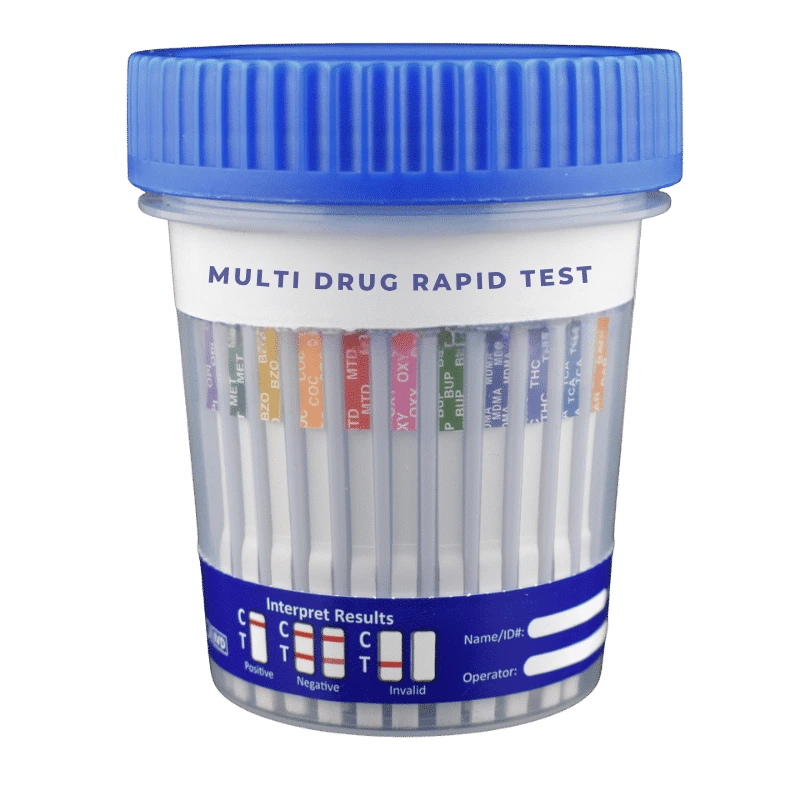
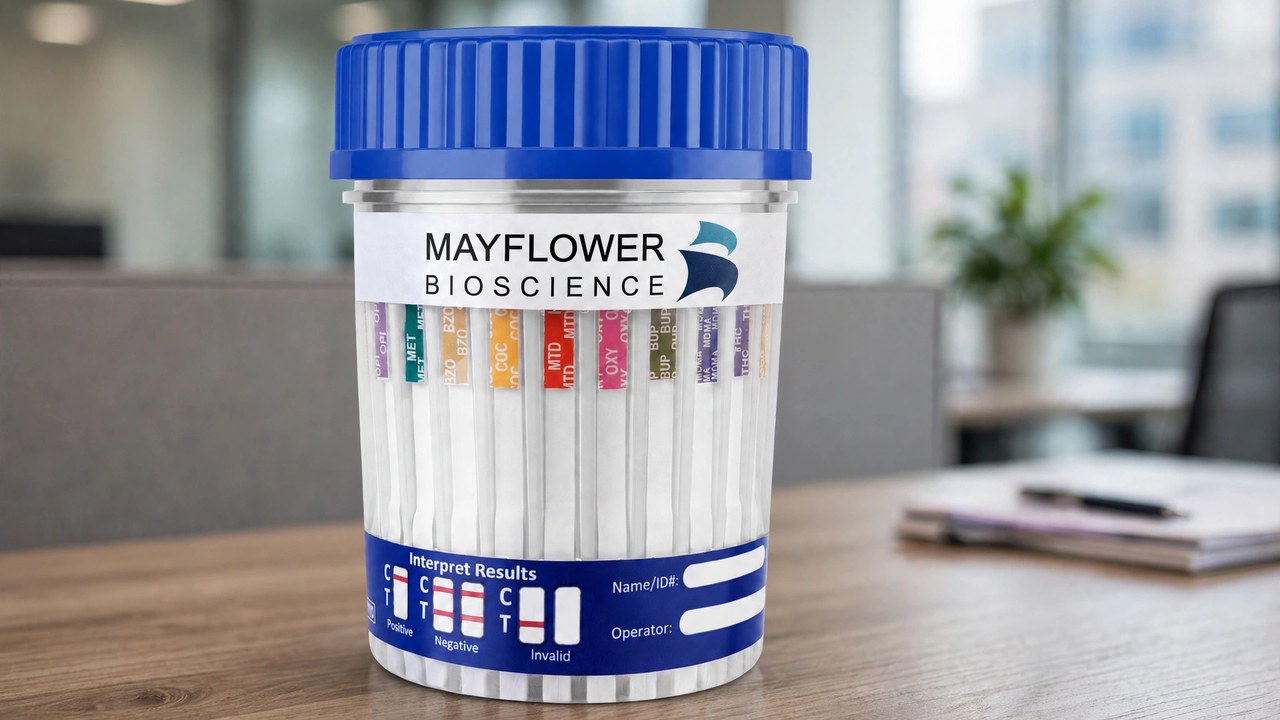
Step one is the rapid point-of-care screen: a urine drug test cup collected on site and read in about five minutes, giving a presumptive result immediately — the speed hiring decisions, post-accident timelines, and reasonable-suspicion situations demand. See our guide on how to read a drug test cup; MayFlower’s cups are CLIA waived devices with built-in temperature strips for specimen-integrity checks.
Step two applies to every presumptive positive (and every disputed negative): the specimen goes to a laboratory for confirmation by GC-MS or LC-MS/MS — far more specific methods that quantify the drug or metabolite — and the result is reviewed by a Medical Review Officer. The MRO contacts the donor, reviews lawful prescriptions or medical explanations, and only then reports a verified positive. Employment decisions should rest on verified results, never on a rapid screen alone.
Maintain chain of custody from collection to lab, honor split-specimen retests, and watch for specimen tampering — see our guide to dilute drug test results. Detection windows vary by substance; the drug detection times chart gives the standard windows for scheduling retests and follow-up programs.
State Laws and Compliance Risks
Testing is governed by a state-by-state patchwork — the most common place employer programs fail:
- Random testing restrictions. Some states limit random testing of non-safety-sensitive employees — know your states before you randomize.
- Written-policy mandates. Several states require a written policy with specific content before any testing may begin.
- Marijuana protections. More states restrict adverse action on cannabis positives for off-duty use — account for this in your policy.
- Workers’ comp incentives. States with drug-free workplace certification tie compliance to premium credits, which can offset much of the program’s cost.
- Post-accident testing and OSHA. Post-incident testing is permitted, but programs must not discourage injury reporting — keep criteria objective and consistently applied.
Multi-state employers should use state-specific addenda, especially for cannabis, applicant testing, notice, and adverse-action rules. Employers in litigation-heavy settings often standardize on forensic-use drug test cups built for legal defensibility. Have employment counsel review the policy before launch — this guide is operational, not legal advice.
Program Economics: Cup Screening vs Lab Testing
Rapid cups make the economics simple: screen everyone cheaply on site and pay laboratory prices only for specimens needing confirmation (illustrative ranges vary by vendor and volume):
On-site collection also avoids the delays and no-shows of sending every donor to a clinic. Standardize purchasing through wholesale drug test cups — one panel configuration keeps training and documentation consistent across sites. As a wholesale supplier of multi-panel urine drug test cups, MayFlower Bioscience supports employers building this screen-then-confirm architecture.
Defensibility Checklist: Common Program Mistakes
- Testing before the policy exists. No written policy, no signed acknowledgments, no defensible test.
- Inconsistent application. Testing some employees and not others in the same role invites discrimination claims.
- Acting on a presumptive screen. Never withdraw an offer or terminate on a rapid result without lab confirmation and MRO review.
- Broken chain of custody. Undocumented specimens are indefensible specimens.
- Untrained supervisors. Reasonable-suspicion testing without trained observers and contemporaneous documentation fails challenges.
- Ignoring state law. A policy legal in one state may be unlawful in another — review multi-state operations addendum by addendum.
- Disclosing results broadly. Results leave HR and the MRO only on a strict need-to-know basis.
Frequently Asked Questions
What is a workplace drug testing program?
A workplace drug testing program is an employer’s complete screening system: a written policy, defined testing triggers (pre-employment, random, reasonable suspicion, post-accident, return-to-duty, and follow-up), a two-step testing workflow of rapid screening plus laboratory confirmation and MRO review, and documented compliance with applicable state and federal rules. The program — not any single test — is what makes employer testing fair and defensible.
What types of drug tests do employers use?
Most employer programs use six testing triggers: pre-employment testing after a conditional offer, random testing of a defined employee pool, reasonable-suspicion testing based on documented observations, post-accident testing after qualifying incidents, return-to-duty testing before an employee resumes safety-sensitive work, and unannounced follow-up testing under a monitoring plan. Your written policy should state which triggers your program uses and who each one covers.
What is the difference between DOT and non-DOT drug testing?
DOT testing covers safety-sensitive transportation employees and is strictly prescribed by federal regulation: a standard five-panel urine test, certified collectors, SAMHSA-certified laboratories, and Medical Review Officer review of every result. Non-DOT testing covers all other employees and is designed by the employer — the panel, cutoffs, workflow, and consequences are set in the company policy. Best practice is for non-DOT programs to mirror the DOT model’s defensibility (written policy, screen-and-confirm, MRO review) while tailoring panels to the workforce.
Is a written drug testing policy required?
Several states require a written policy with specific content before any testing may begin, and federal drug-free workplace certification programs require one as well. Even where not legally mandated, a written policy — distributed to employees with signed acknowledgments — is essential: it defines prohibited conduct, testing triggers, procedures, consequences, confidentiality, and employee rights, and it is the document that defends your program in disputes.
Can employers do random drug testing?
It depends on the state. Many states permit random testing, especially for safety-sensitive positions, while others restrict or effectively prohibit random testing of non-safety-sensitive employees. A defensible random program requires a written policy, a truly random selection method, and uniform application across the designated pool. Multi-state employers should check each state’s rules before including random testing in their program.
What drugs are tested for in workplace drug testing programs?
The federal five-panel baseline covers marijuana/THC, cocaine, opiates, amphetamines, and PCP. Most private employers now use expanded panels: 12-panel cups add benzodiazepines, barbiturates, methadone, MDMA, and expanded opiates; 14-panel configurations add fentanyl and/or ETG alcohol screening; 16-panel cups offer the broadest menu including synthetic opioids and prescription sedatives. Disclose your panel in the policy and apply it uniformly across the tested workforce.
How long do employment drug test results take?
A rapid point-of-care urine drug test cup gives a presumptive result in about five minutes on site. Laboratory confirmation of a presumptive positive by GC-MS or LC-MS/MS typically takes 24 to 72 hours, plus Medical Review Officer review time. Employers should build this timeline into hiring and post-accident procedures — and never take adverse action on a presumptive screen alone.
What is a Medical Review Officer (MRO) and when is one needed?
A Medical Review Officer is a licensed physician trained to review drug test results. The MRO contacts the donor about a laboratory-confirmed positive, evaluates lawful medical explanations such as valid prescriptions, and only then reports a verified positive to the employer. MRO review is federally required for DOT tests and is the recommended standard for non-DOT programs — it is the key protection against acting on a result that has an innocent explanation.
How much does a workplace drug testing program cost?
Rapid point-of-care screening cups typically cost a few dollars per unit at wholesale volume, while laboratory immunoassay screens run roughly $30–$60 per specimen and GC-MS/LC-MS/MS confirmation roughly $60–$120 or more, plus MRO review fees. The economical program architecture is screen-then-confirm: rapid cups for every collection, laboratory confirmation only for presumptive positives — typically under 5% of specimens — which keeps per-test program costs in the low single digits while preserving full defensibility.
Can an employee contest a positive drug test result?
Yes. A defensible program builds in contest rights: the specimen is confirmed by laboratory GC-MS or LC-MS/MS before any action, the MRO gives the donor a confidential opportunity to explain the result (for example, a lawful prescription), and many policies provide for a split-specimen retest at a second certified laboratory at the employee’s request. Document these rights in the written policy and honor them consistently.