Drug Court Drug Testing Programs Explained
A drug court drug testing program is the accountability engine of the drug court model: frequent, random, observed urine screening — typically 2 to 3 times per week in early phases — paired with laboratory confirmation before sanctions, and structured so that each result feeds a graduated system of sanctions and incentives. This guide explains how drug court testing programs are structured for the people who run them: coordinators, judges, and treatment staff designing a testing protocol that satisfies federal best practices, holds up in court, and actually changes behavior.
More than 4,000 drug treatment courts now operate in all 50 states, per the National Association of Drug Court Professionals (now All Rise). Every one of them tests — it is not optional. Federal grant authority (34 U.S.C. § 10611) requires mandatory periodic testing, and the Adult Drug Court Best Practice Standards treat testing as one of the model’s load-bearing walls — so cadence, collection, panel, confirmation, and response logic must be decided before the first participant enrolls.
What the Drug Court Model Demands From Testing
NADCP’s 10 Key Components — the 1997 blueprint published with the U.S. Department of Justice — list alcohol and other drug (AOD) testing as Component 4: “Abstinence is monitored by frequent alcohol and other drug testing.” The other nine components form the context testing operates in: early identification and placement, a nonadversarial team, predictable treatment, ongoing judicial interaction, monitoring and evaluation, and continuous effectiveness review.
The operational detail sits in the Adult Drug Court Best Practice Standards, Volume I, developed with Bureau of Justice Assistance (BJA) support — BJA is a component of the Department of Justice’s Office of Justice Programs. Standard VII, Drug and Alcohol Testing, lays out ten provisions that effectively define a compliant program: testing must be frequent, random (unexpected, unannounced, unanticipated), directly observed, fast enough to return same-day results, broad enough to cover the substances participants actually use, and backed by adulterant checks. These are design requirements auditors and funders check against.
Designing the Testing Cadence: Frequency, Phases, and Randomization
Testing frequency is a detection-probability decision, not a budget convenience. The Illinois Criminal Justice Information Authority’s literature review summarizes the math: once per week yields roughly a 35% chance of detecting an incident of drug use; twice per week pushes that above 80%. A study of nine drug courts found three tests per week produced the best outcomes, with more than three adding no benefit. The Best Practice Standards call for urine testing at least twice per week on a genuinely random schedule — the shorter the time between notification and collection, the better.
Cadence steps down as participants progress through the program’s phases:
| Phase | Typical testing cadence | Purpose |
|---|---|---|
| Phase 1 — Stabilization | 2–3× per week, random, same-day results | Establish abstinence, build the habit of compliance; paired with weekly court appearances |
| Phases 2–3 — Active treatment | 2× per week, random | Sustain abstinence through treatment; court appearances step down to biweekly |
| Phase 4 — Maintenance | 1× per week to random | Relapse prevention and stability; appearances move toward monthly |
| Phase 5 / continuing care | Truly random, no fixed minimum | Testing can drop to a random schedule only when every other program requirement has been reduced to its lowest level |
One caution from the standards: frequency should remain constant until the participant is virtually finished with the program and fully engaged in continuing care. Reducing cadence early to save money is the classic way programs dilute their own deterrent effect — which is why cadence belongs in the written testing protocol, not a budget review.
Collection Protocol: Observed Collection, Temperature, Adulterants, Chain of Custody
Collection procedure matters as much as the device — assume your participants know more about urine drug testing than your staff do:
- Direct observation. The standards call for observed urine collection by a trained, same-sex collector. Unobserved collection invites substitution devices.
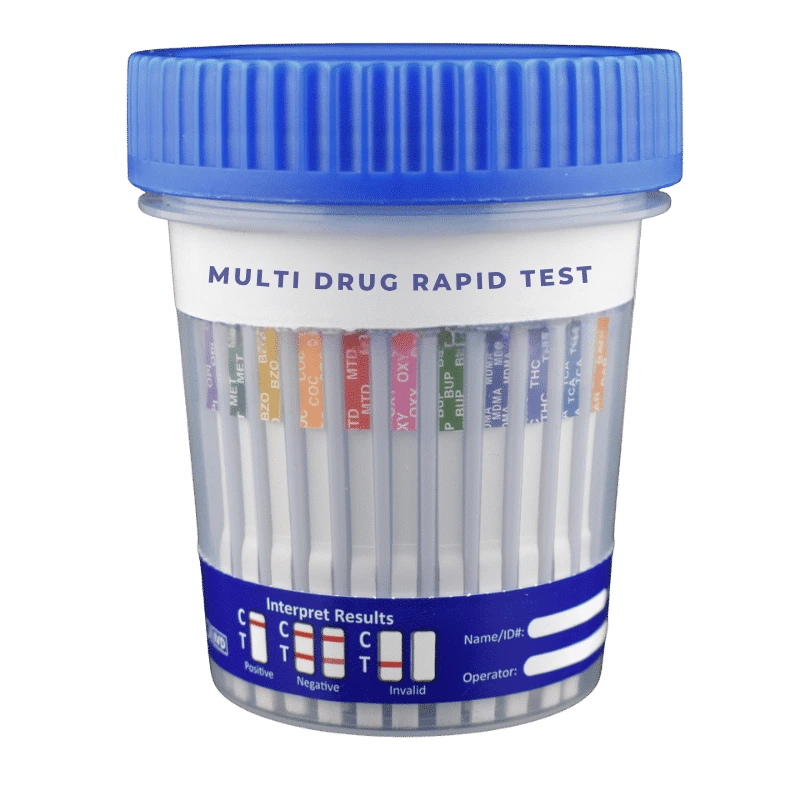
- Temperature check within minutes. Fresh urine reads 90–100°F (32–38°C) on the cup’s built-in temperature strip. A reading outside that window flags substitution or dilution — most contracts require an immediate re-collection under direct observation.
- Adulterant screening. Built-in adulterant strips check creatinine, pH, nitrite, and oxidants — the standard flags for dilution and tampering. Program policy should define exactly what happens on a flag; our dilute results guide explains the thresholds collectors see.
- Chain of custody, documented. Donor ID, date and time, collector initials, seal or tamper tape, and a custody log from collection through read and disposal. If a result ever supports a sanction, this paper trail is what makes it defensible — our how to read a drug test cup walkthrough covers the read routine.
- The participant contract. Best-practice programs spell out in the enrollment contract that a late, missed, insufficient, adulterated, or dilute specimen is treated as a positive and may draw a sanction — letting the judge act without a hearing about procedure.
Which Panels Drug Courts Order: 12, 14, and 16
Drug courts order wider panels than the federal workplace five-panel baseline (THC, cocaine, amphetamines, opioids, PCP), because their participants’ drug-of-choice profiles are wider — and in the fentanyl era, testing without fentanyl is a documented blind spot:
| Configuration | What it adds for drug courts | When programs use it |
|---|---|---|
| 12-panel cup | Baseline five plus benzodiazepines, barbiturates, methadone, MDMA, oxycodone/expanded opiates, PCP variants | General population drug courts with standard polydrug-use profiles |
| 14-panel cup | Adds fentanyl (FOA) and tramadol (TRA) to the 12-panel core | Programs in jurisdictions with active fentanyl supply |
| 16-panel cup | Adds EtG alcohol and kratom (mitragynine) screening to the 14-panel core | Programs where alcohol abstinence is a condition and kratom use is a local trend |
Alcohol deserves its own decision: EtG urine screening detects drinking for up to roughly 80 hours — far beyond breath testing — and many courts impose alcohol abstinence (see our EtG alcohol testing collection). Fentanyl is the other non-negotiable add-on — fentanyl panel selection explains why standard opioid strips miss it. Kratom (mitragynine) is newer: decide explicitly whether its use counts as a violation before testing for it. Every substance’s detection window sits on the drug detection times chart — the panel should outlast the gap between random tests.
Presumptive Screens and Laboratory Confirmation Before Sanctions
A cup result is a presumptive screen, not a confirmation — the most important legal fact in this guide. When a result will drive a consequential decision — a sanction, a phase demotion, a termination hearing — the specimen should go to a laboratory for GC-MS or LC-MS/MS confirmation. A contested positive backed by mass-spectrometry confirmation ends the argument.
Practical confirmation policy for administrators:
- Admissions don’t need confirmation. If the participant admits use after a presumptive positive, screen plus admission is sufficient.
- Denials get confirmation. Any denied positive, when a sanction will follow, should be confirmed before the judge acts.
- Set cutoff discipline. Every strip has a cutoff concentration; near-cutoff results deserve program-defined handling — see our cutoff levels guide.
- Match device classification to use. For forensic-adjacent decisions, many programs standardize on forensic-use drug test cups; where results feed treatment decisions, CLIA waived drug test cups keep on-site screening under the FDA’s waived-testing categorization framework.
Turning Results Into Behavior: Sanctions and Incentives Logic
Testing produces data; the response schedule produces behavior. Research on drug court outcomes converges on one finding: sanctions work when they are certain, swift, and proportionate — severity alone deters poorly:
- Incentives for compliance first. Clean screens earn recognition: applause in court, phase advancement, reduced appearances, vouchers, early graduation eligibility. Incentives should be as formal and predictable as sanctions — a reward schedule, not a mood.
- Graduated sanctions for violations. A first positive draws a low-level response (increased testing, essay or community service, a night or weekend in custody in some jurisdictions); repeated positives escalate toward phase demotion, brief incarceration, or termination. The schedule must be written, known to every participant at enrollment, and applied consistently.
- Speed over severity. A modest sanction at the next court appearance outperforms a severe one weeks later. Same-day cup results exist precisely to enable this.
The coordinator’s job is calibration: tie every test outcome — positive, dilute, missed, adulterated, refused — to a defined response band, leaving the judge discretion within the band. Inconsistent application is the fastest way to destroy a program’s perceived legitimacy.
Data, Documentation, and Program Metrics
Track per-participant results (date, panel, result per analyte, confirmation outcomes), testing-compliance rate, and collection-to-result time. Program-level metrics funders ask for: graduation rate, retention by phase, re-arrest rates for graduates vs. terminated participants, and cost per participant relative to incarceration. Retain randomization logs alongside chain-of-custody records — both are audit material.
Standardizing on Multi-Panel Cups for Drug Court Testing
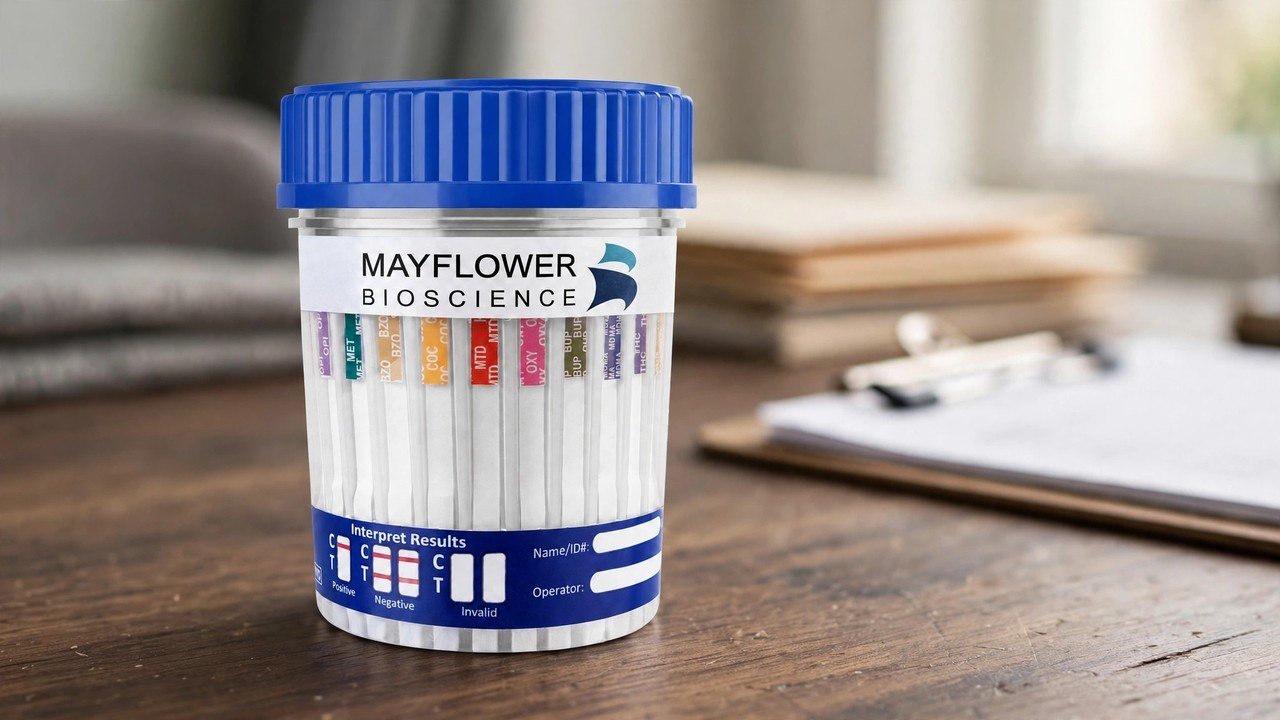
For programs running hundreds of observed collections a month, multi-panel cups consolidate collection, temperature verification, adulterant checks, and the read into a single sealed unit — fewer handoffs, a cleaner chain of custody, and the same-day results the sanctions schedule depends on. MayFlower’s 12-panel, 14-panel, and 16-panel drug test cups cover this guide’s panel ladder — fentanyl on the 14, EtG alcohol and kratom on the 16 — and programs standardizing volume procure through wholesale drug test cups to keep the test menu, training, and QC logs consistent across sites. Probation departments run a closely related protocol (see our probation drug testing guide), and the MayFlower Bioscience catalog spans the full multi-panel urine drug test cup range.
Frequently Asked Questions
How often are participants drug tested in drug court?
Most programs test 2 to 3 times per week on a random schedule during early phases, per the Adult Drug Court Best Practice Standards. Frequency steps down as participants advance through phases, but testing should stay at full cadence until the participant is virtually finished with the program and fully engaged in continuing care.
What kind of drug test do drug courts use?
Urine testing is the standard — it is the cheapest option and returns same-day results, which the sanctions schedule depends on. Collection is directly observed to prevent substitution, and the specimen is temperature-checked and screened for adulterants. Hair, saliva, and sweat-patch testing are sometimes used as supplements for longer lookback windows, not as the primary random screen.
What drugs do drug courts test for?
Beyond the five-panel baseline (THC, cocaine, amphetamines, opioids, PCP), drug courts typically order extended 12, 14, or 16-panel cups covering benzodiazepines, barbiturates, methadone, MDMA, expanded opiates such as oxycodone, fentanyl, tramadol, buprenorphine, EtG alcohol, and kratom, depending on the program’s population and local drug trends.
Does drug court test for alcohol?
Yes, when alcohol abstinence is a program condition. Programs use EtG urine screening, which detects drinking for up to roughly 80 hours — far beyond the window breath testing covers. Many 16-panel cups include an EtG strip so alcohol is screened alongside drugs in the same observed collection.
Does drug court test for fentanyl?
It should. Standard opioid immunoassay strips do not reliably detect fentanyl, so programs in jurisdictions with an active fentanyl supply add a dedicated fentanyl strip — typically by standardizing on a 14 or 16-panel cup. Testing without fentanyl in the current drug supply is a documented blind spot.
Does drug court test for kratom?
Some programs do, using immunoassay panels that screen for mitragynine, kratom’s primary alkaloid. Kratom is a newer addition — programs should decide explicitly whether kratom use counts as a violation and write that decision into the participant contract before they start testing for it.
What happens if you fail a drug test in drug court?
A positive result triggers the program’s written sanctions schedule: a first positive typically draws a low-level response such as increased testing, community service, or a short custody sanction, with repeated positives escalating toward phase demotion, brief incarceration, or termination. Research shows sanctions work best when they are certain, swift, and proportionate. Denied positives are sent for laboratory confirmation before a sanction is imposed.
Is a positive drug cup result enough to sanction a participant?
Not by itself. A cup result is a presumptive screen; when the participant denies use and a sanction will follow, the specimen should be sent to a laboratory for GC-MS or LC-MS/MS confirmation. An admitted positive — screen plus the participant’s own admission — is generally sufficient without confirmation.
Why is drug court urine collection directly observed?
Because unobserved collection is easy to defeat with substitution devices or someone else’s urine, and a substituted specimen teaches the participant the system can be beaten. The Best Practice Standards call for observed collection by a trained, same-sex collector, plus a temperature check and adulterant screening on every specimen, to keep results defensible.
What should a drug court do about a dilute or missed test?
Best-practice programs state in the enrollment contract that a dilute, adulterated, late, missed, or insufficient specimen is treated as a positive test and may draw a sanction. Writing this into the contract before testing begins is what lets the judge respond to a dilute sample without a hearing about procedure.