
How Long Does Meth Stay in Urine? Lab Detection Windows
How Long Does Meth Stay in Urine? Lab Detection Windows
Methamphetamine typically stays detectable in urine for about 1 to 4 days after use, and sometimes up to 5 days or longer in heavy or chronic use. The exact window depends on the cutoff your assay uses, the dose, the pattern of use and the urine itself. For a lab, clinic or testing program, the useful question is not only “how many days” but “at which cutoff, with which method, and what happens to a preliminary positive.” This guide gives the published ranges, explains what moves them, and shows how to choose a screening cup that fits your protocol.
TL;DR
- Published urine windows for methamphetamine cluster around 1 to 4 days at a 1,000 ng/mL screening cutoff, with sources ranging from 48 hours to 5 days depending on the study and the cutoff.
- Detection usually starts within hours of use. Lower cutoffs lengthen the window, and a controlled study found that lowering the confirmation cutoff added up to 34 hours of total detection time.
- Dose, chronic use, urine pH, hydration, kidney and liver function all shift the window, so any figure is a range, never a guarantee.
- Rapid cup results are preliminary. A positive needs confirmation by GC/MS or LC-MS/MS.
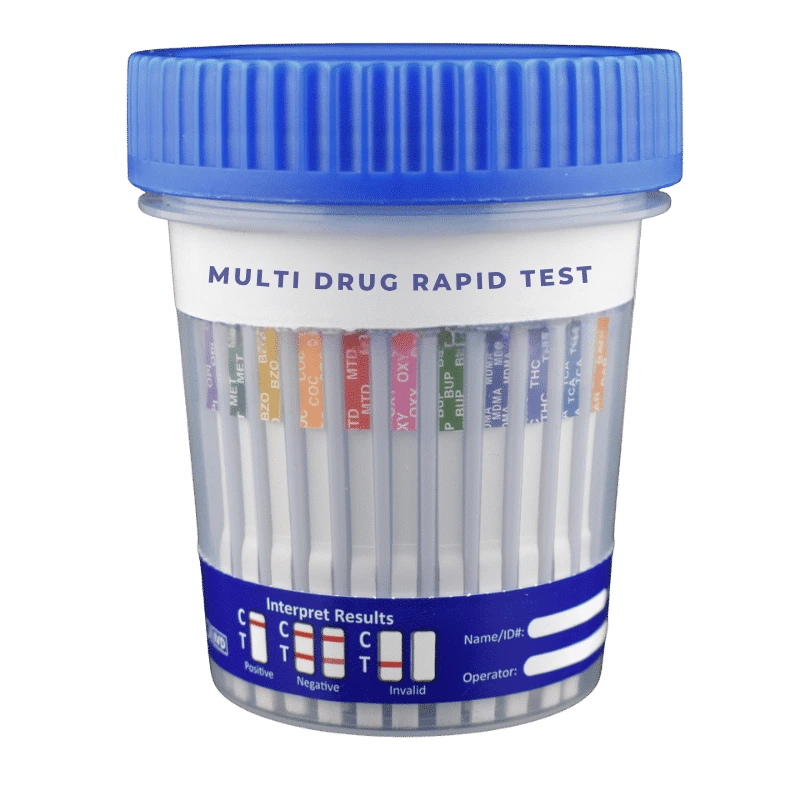
- Our 12-panel PCP cup is CLIA-waived and FDA-cleared. Our 12-panel ETG/fentanyl, 14-panel and 16-panel cups are for forensic use only and are not CLIA-waived.
Table of Contents
- How long does meth stay in urine: the published ranges
- Why cutoff levels change the answer
- What makes the window shorter or longer
- Screening versus confirmation: what a rapid cup result means
- Reading a detection window in practice
- Choosing the right cup for your program
- Perspective
- Stock the cups your protocol calls for
- FAQ
- Sources
How long does meth stay in urine: the published ranges
No single number is correct, because the sources measure different things: the first positive, the last positive, one dose or repeated dosing, and different cutoffs. Here is what the authoritative pages report.
| Source | Reported urine window for methamphetamine |
|---|---|
| University of Michigan Point of Care, 1,000 ng/mL cutoff | Minimum detection 2 to 7 hours, maximum 2 to 4 days |
| FDA, Drugs of Abuse Home Use Test | First positive 4 to 6 hours after use, can stay positive 2 to 3 days |
| Mayo-based clinical interpretation guide, 2017 | Approximately 48 hours |
| Texas DFPS detection periods table, 2010 | 1 to 5 days |
| Huestis and Cone review, 2007, 500/200 ng/mL confirmation cutoff | Mean last positive 43.6 hours (10 mg dose) and 66.9 hours (20 mg dose) |
Read together, the pattern is consistent: a positive can appear within a few hours, most single-use windows close within roughly 2 to 4 days, and the outer edge reaches 5 days in some references. The FDA itself notes that clearance varies with duration of use, amount used and individual metabolism.
Time to first detection
A drug has to be absorbed, metabolized and excreted before urine shows it. The Texas table notes that this takes roughly six to eight hours or more. In a 2002 controlled-dosing study, eight volunteers took 10 mg of methamphetamine four times daily for seven days. Methamphetamine and amphetamine generally appeared in the first or second urine void, between 0.7 and 11.3 hours after dosing. Peak concentrations came anywhere from 1.5 to 60 hours after single doses.
For a collection program, this matters in one direction: a sample collected very soon after use can be negative simply because the drug has not yet reached the bladder in measurable amounts. The FDA lists collection that is too early or too late relative to clearance as one reason a negative result can occur even when someone has used.
Single use versus repeated use
Methamphetamine is eliminated slowly. A 2011 paper on quantifying drug intake from urine reports that low concentrations can remain detectable for up to 7 days after a single 30 mg oral dose, or up to 60 hours after a single 15 mg smoked or intravenous dose. The same literature notes that chronic users are more likely to have longer windows because the drug accumulates in deep tissue compartments.
That is why a table that says “1 to 4 days” is a planning figure for occasional use at a typical screening cutoff, not a ceiling. Programs that monitor people with a history of heavy use should expect the tail to run longer.
Why cutoff levels change the answer
The same urine specimen can screen negative at one cutoff and positive at another. A cutoff is the concentration, in nanograms per milliliter (ng/mL), at or above which an assay reports a positive.
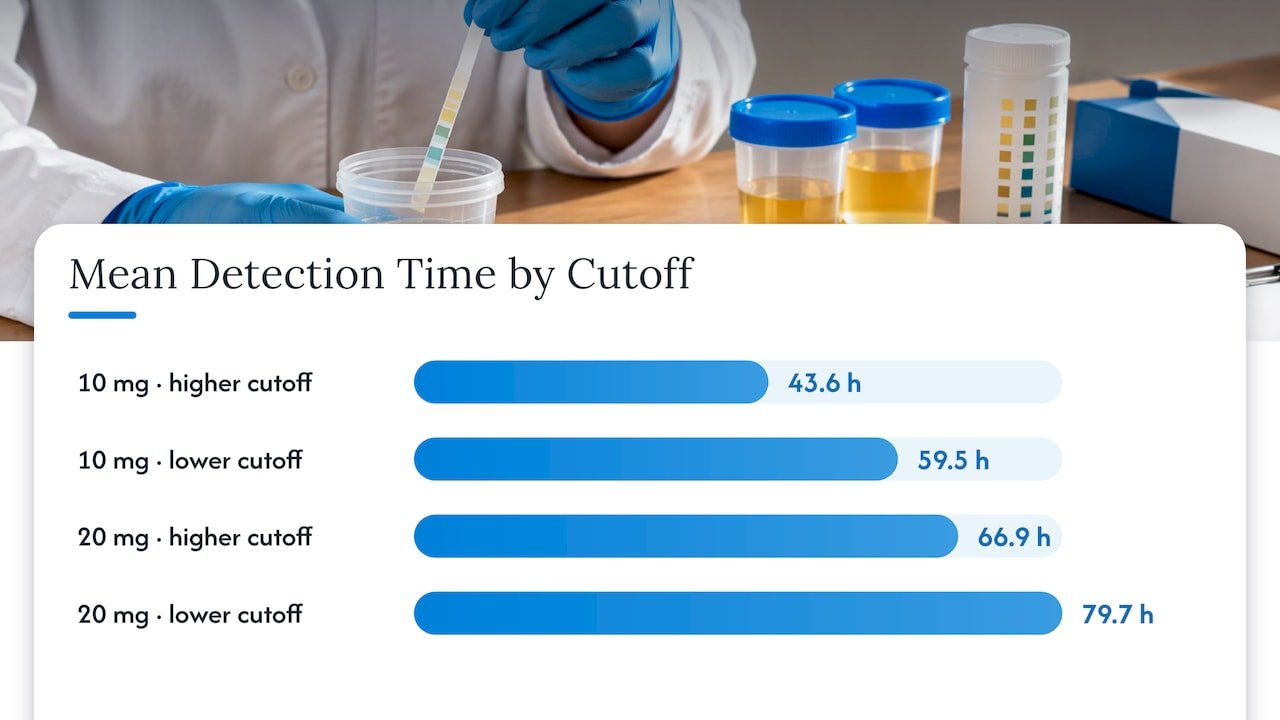
The 2002 Clinical Chemistry study quantified the effect. Lowering the confirmation cutoff from 500/200 to 250/100 µg/L extended terminal detection by up to 24 hours, increased total detection time by up to 34 hours and increased the number of positive specimens by 48%. The Huestis and Cone data show the same thing: with 10 mg doses, mean detection time rose from 43.6 to 59.5 hours when the confirmation cutoffs dropped to 250/100 ng/mL, and with 20 mg doses it rose from 66.9 to 79.7 hours.
The 2026 ADLM guidance document states that common U.S. clinical cutoffs for the amphetamine class are 300, 500 or 1,000 ng/mL. It also explains that immunoassay cutoffs are largely historical and set to minimize false positives, while mass spectrometry permits lower cutoffs and better sensitivity.
Regulated cutoffs in federal programs
If your work touches regulated testing, the cutoffs are fixed in rules and they differ by program:
- HHS-based workplace testing. SAMHSA’s Medical Review Officer Guidance Manual, effective July 7, 2025, covers federal workplace testing under the HHS Mandatory Guidelines. Confirmatory tests must use mass-spectrometric methods such as GC-MS or LC-MS/MS. The primary-care drug testing reference lists an initial amphetamine/methamphetamine cutoff of 500 ng/mL and confirmatory cutoffs of 250 ng/mL each, with a methamphetamine positive requiring amphetamine at or above 100 ng/mL.
- Nuclear power workplaces (10 CFR §26.163). The initial amphetamine cutoff is 1,000 ng/mL and the confirmatory cutoff is 500 ng/mL each, with amphetamine at or above 200 ng/mL required to report methamphetamine.
The point for a program director: if you quote a detection window to a client, a court or a patient, state the cutoff that window assumes.
What makes the window shorter or longer
The Huestis and Cone review lists dosage, pattern of use, specimen type, analytes and assay characteristics as the main determinants. The Li et al. literature adds route of administration, age, organ function and drug-metabolizing enzyme polymorphisms. In practice, these are the factors to document alongside any result:
- Dose and frequency. Larger and repeated doses push concentrations above the cutoff for longer. Compare the 43.6 and 66.9 hour means for 10 mg and 20 mg doses above.
- Chronic versus occasional use. Accumulation extends the tail in chronic use.
- Urine pH. Methamphetamine is a basic compound with a pKa of 10.1, high lipophilicity and low plasma protein binding (10 to 20%). The review explains that acidic urine enhances excretion and shortens the half-life, while basic urine slows excretion and prolongs residence time. Normal urine pH runs between 4.5 and 8, per the Mayo-based guide.
- Urine concentration. Excess fluid dilutes urine and the drug concentration; dehydration concentrates it. For this reason, labs check specimen validity on every collection.
- Kidney and liver function, body mass and age. The Texas table and the Mayo guide both list these as sources of variation.
Specimen validity checks
The Mayo-based guide gives the validity thresholds that signal suspected dilution or adulteration: pH below 3 or above 11, specific gravity below 1.002 or above 1.030, or creatinine below 20 mg/dL. Every cup in our catalog has an integrated temperature strip, which gives the collector an immediate check that the specimen is fresh and within the expected temperature range at the time of collection. A fresh-specimen check at the point of collection is the first line of specimen integrity, and the lab-based pH, specific gravity and creatinine checks follow for specimens that go to confirmation.

Screening versus confirmation: what a rapid cup result means
A rapid urine cup is an immunoassay. It uses antibodies to flag a drug class at a set cutoff. The University of Michigan point-of-care page describes its urine drug screen the same way: it gives preliminary results, and mass spectrometry is the preferred confirmatory method. The FDA says the same of at-home tests: they are qualitative, results are presumptive, and a preliminary positive should go to a laboratory for a second test.
That is the standard operating assumption for every cup we sell: a positive is a preliminary screening result, and confirmation by GC/MS or LC-MS/MS is the next step before any decision rests on it.
Cross-reactivity and why confirmation matters
Immunoassays can react to compounds other than the target. The Michigan page lists cross-reactivity for its 1,000 ng/mL methamphetamine immunoassay: d-methamphetamine at 1,000 ng/mL, MDEA at 1,000 ng/mL, MDMA at 4,000 ng/mL, l-methamphetamine at 25,000 ng/mL, ephedrine at 50,000 ng/mL and d-amphetamine at 100,000 ng/mL. In other words, some structurally related compounds can trigger the assay at concentrations that are plausible in real specimens.
A 2023 cross-sectional study of 6,558 urine samples in a clinical monitoring setting reached a similar conclusion from the other direction. The amphetamine immunoassay had 52.11% sensitivity for methamphetamine, and 54% of immunoassay-positive amphetamine samples lacked amphetamine on confirmation. The authors recommend mass-spectrometry confirmation on all samples. Their 500 ng/mL immunoassay cutoff was five times the 100 ng/mL LC-MS/MS cutoff, which explains much of the gap.
For related reading on how to handle unexpected results, see our guide to urine drug test false positives and our overview of amphetamine urine drug test cutoffs and results.
Building a result-handling workflow
A sound workflow for a rehab laboratory or testing institution is short:
- Verify the specimen at collection: temperature strip read within the manufacturer’s window, and a visual check.
- Read the cup at the time the manufacturer specifies and record the cutoff of the cup lot.
- Treat a positive as preliminary. Send the specimen for GC/MS or LC-MS/MS confirmation.
- Record collection time and any reported medications, so the confirmed result can be interpreted against the detection window.
- Interpret with the clinician or Medical Review Officer, not from the cup alone.
Programs that also screen for fentanyl often connect positive results to treatment pathways, such as medication-assisted treatment for fentanyl addiction, where the screening result is one input to a clinician’s assessment.
Reading a detection window in practice
A worked example shows why the cutoff and timing both matter. Suppose a program collects a specimen 60 hours after a participant reports a single 10 mg dose. In the controlled Huestis and Cone data, the mean last positive at the 500/200 ng/mL confirmation cutoff was 43.6 hours, so a result at that cutoff could well be negative. At the 250/100 ng/mL cutoff the mean was 59.5 hours, so the same specimen sits near the boundary. A negative at 60 hours is therefore not proof of no use, and a positive at that point is not proof of recent use. The window is a probability, not a clock.
Three habits keep interpretation honest:
- Quote the range and the cutoff together, for example “about 2 to 4 days at a 1,000 ng/mL screening cutoff.”
- Treat a negative as “below the cutoff at the time of collection,” not as absence of use.
- Keep the screening cutoff and the confirmation cutoff separate in your records, since confirmation cutoffs are often lower than screening cutoffs.
For a broader comparison across substances, our drug detection times chart and the drug test cutoff levels chart put the windows side by side. Related substance guides cover meth in your system more broadly, MDMA and Adderall, which matter because amphetamine-class compounds can overlap on a screen.
Choosing the right cup for your program
The cup you choose should match the regulatory setting. We state this plainly because it affects how results can be used:
| Cup | Panel highlights | Regulatory status |
|---|---|---|
| 12-panel with PCP | Multi-drug panel with PCP | CLIA-waived, FDA-cleared |
| 12-panel with ETG and fentanyl | Adds ETG alcohol marker and fentanyl | Forensic use only, not CLIA-waived |
| 14-panel with PCP | PCP, ETG and fentanyl | Forensic use only, not CLIA-waived |
| 16-panel with ETG, fentanyl and kratom | Adds kratom and TCA | Forensic use only, not CLIA-waived |
CLIA stands for the Clinical Laboratory Improvement Amendments, the federal framework for laboratory testing. A CLIA-waived test is one cleared for simple use at the point of care. Cups labeled forensic use only are intended for non-clinical screening programs such as drug courts, corrections, and employer or program monitoring, and their results are preliminary until confirmed.
All four cups have an integrated temperature strip and give a rapid read in about five minutes. When you pick one, match the panel to the substances in your protocol and the regulatory status to how the result will be used.
Perspective
Detection windows are easy to publish and easy to misuse. The most common mistake we see described in program protocols is treating a cup as a verdict when it is a screen. A multi-panel cup gets a collector a fast, documented first answer in about five minutes, with the temperature strip checking the specimen at the same moment. The confirmation step, GC/MS or LC-MS/MS, is what turns a presumptive result into one that can carry weight.
That is how we built our catalog. Four focused configurations, one CLIA-waived and FDA-cleared 12-panel cup with PCP, and three forensic-use cups that add ETG alcohol and fentanyl, and for the largest panel kratom and TCA. Our labeling says plainly which is which, so a clinic and a drug court each pick the cup that fits their use.
For programs that test every week across several sites, consistency matters more than any single feature: the same cup, the same read time, the same record. That is why we sell wholesale, with volume pricing from $2.59 per cup, free shipping on 100+ cups and same-day dispatch from US stock.
Alina
Stock the cups your protocol calls for
Mayflower Bioscience is a St. Louis, Missouri wholesale supplier of rapid multi-panel urine drug test cups for clinics, behavioral health programs, employers, drug courts, corrections and distributors. Pricing starts from $2.59 per cup, shipping is free on orders of 100 or more cups, and orders dispatch the same day from US stock. Multi-site and recurring accounts are handled through a quote process.

Start with the 12-panel cup with PCP if you need a CLIA-waived, FDA-cleared option, or request wholesale pricing for your program through Mayflower Bioscience.
FAQ
How long does meth stay in urine after one use?
Most references put it at about 2 to 4 days at a 1,000 ng/mL screening cutoff, with first detection 2 to 7 hours after use. Some tables run to 5 days, and low-level detection after a single oral dose has been reported up to 7 days with sensitive methods. The cutoff you use changes the answer.
Can a rapid urine cup confirm meth use?
No. A rapid cup is an immunoassay that gives a preliminary result. A positive should be confirmed by GC/MS or LC-MS/MS, which are mass-spectrometric methods that identify the specific compound and its concentration.
Does heavy or long-term use extend the window?
Yes. Chronic use can lengthen detection because methamphetamine accumulates in deep tissue compartments and is eliminated slowly. Urine pH, kidney and liver function, and dose also affect the window, which is why published figures are ranges.
Which of your cups are CLIA-waived?
The 12-panel cup with PCP is CLIA-waived and FDA-cleared. The 12-panel ETG/fentanyl cup, the 14-panel cup and the 16-panel cup are forensic use only and not CLIA-waived. Results from every cup are preliminary screening results that need laboratory confirmation when they will be acted on.
Sources
- University of Michigan Pathology, Urine Drug Screen Facts
- FDA, Drugs of Abuse Home Use Test
- Clinical Interpretation of Urine Drug Tests (Mayo, 2017)
- Texas DFPS, Appendix 1922.1: Detection Periods for Abused Substances
- Duration of Detectable Methamphetamine and Amphetamine in Urine, Clinical Chemistry 2002
- Huestis and Cone, Methamphetamine Disposition in Oral Fluid, Plasma, and Urine
- A Method to Quantify Illicit Intake of Drugs from Urine
- ADLM Guidance Document on Laboratory Testing for Drugs of Abuse
- An Evaluation of the Clinical Tools Used to Monitor Illicit Drug Use
- SAMHSA Medical Review Officer Guidance Manual, 2025